Tag Archives: prayer

A Harvest Nearby: Matthew 9:38

In our readings this 14th week of the year from Matthew’s Gospel, Jesus calls for laborers for a harvest: “The harvest is abundant but the laborers are few; so ask the master of the harvest to send out laborers for his harvest.” He gathers twelve disciples following that call. When we think of laborers in the vineyard we think of priests and religious. They are certainly needed for the harvest in our own church.

But they’re not the only laborers needed for God’s great harvest. What about laborers for places where priests or religious will never be? And what about the harvest itself, where does that happen?

I’m sure at one time or another you have overheard people at a restaurant or on a bus or at some gathering discussing religion. “What do you think of the pope?” “Do you think there’s life after death?” “Do you think Jesus is really God?” Often the questions go unanswered or wrongly answered because there’s no laborer there to speak the truth.

The harvest is waiting in a lot of places..

Jesus spoke about the laborers for the harvest as he moved from town to town in Galilee and saw  “troubled and abandoned” crowds, Matthew’s gospel says. We need to ask for laborers among crowds like those of today. Maybe we need to recognize there’s a harvest not far from where we are, “troubled and abandoned,” at a table nearby.

Looking Out The Window: Llght and Darkness

FullSizeRender

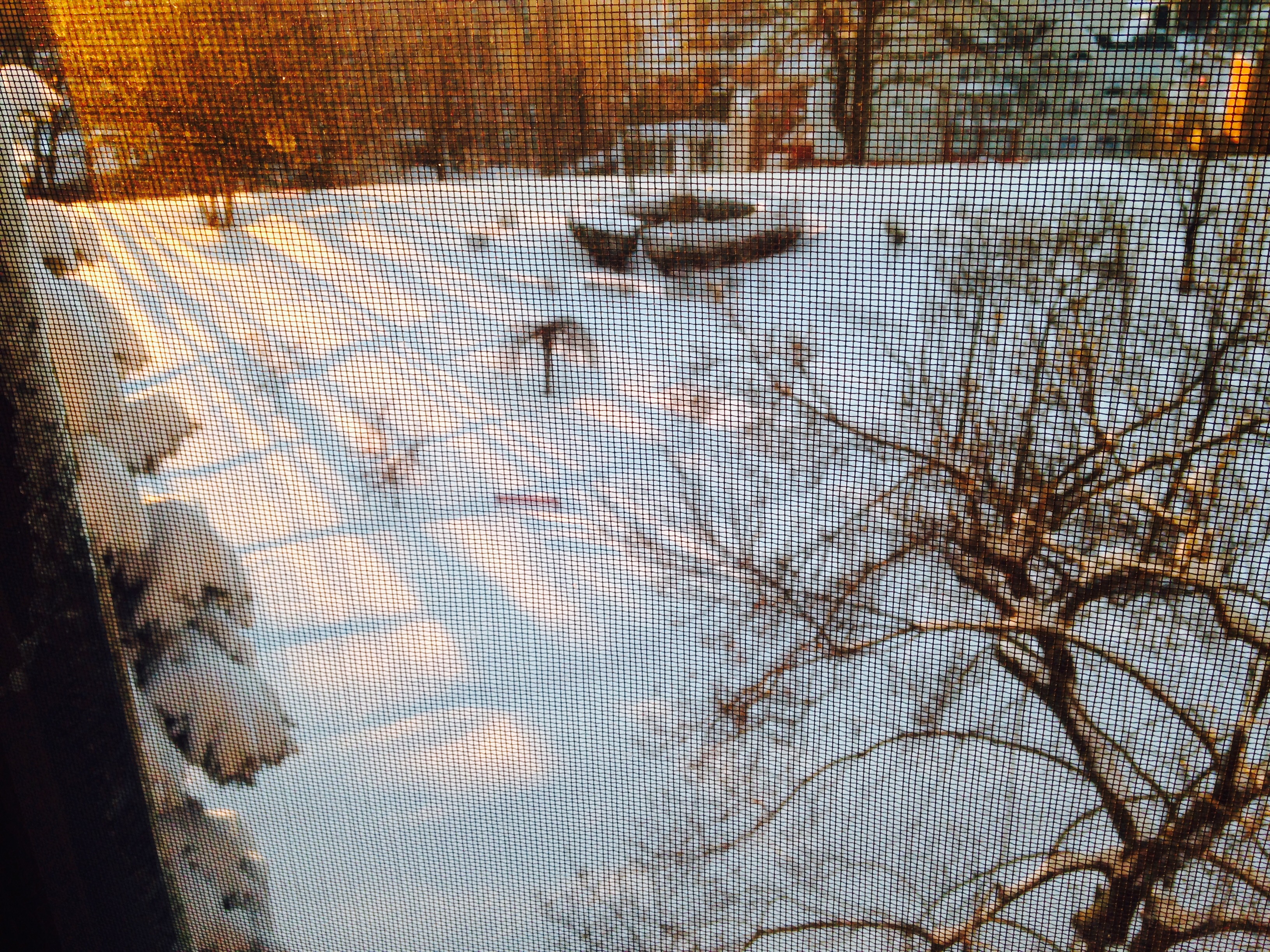
Light and darkness are important in the Genesis story; they’re also important in our morning and evening prayers. Daily prayer is deeply influenced by the Genesis story .

“God saw light and said it was good.” the Book of Genesis says. God creates light, then sunlight, first. Then, holding this bright lamp, God goes about creating the world day by day out of darkness.  Each day ends in darkness, but God goes to work the next day, light in hand, and new things come to be. Like us, God works day by day.

“Send forth your light and your truth, let these be my guide.” The morning psalms each day repeatedly ask for light to continue God’s work.

“Your word is a lamp for my steps, a light for my path.” The evening psalms prepare us for the darkness of night, when we rest. But God’s work goes on. Night for us is a time for trust and leaving the world in God’s hands. “Truly I have set my soul in silence and peace, As a child in its mother’s arms. even so my soul.” (Psalm 131, Tues.3)

Before television and radio and the complex scientific weather reports we get now, I think we looked out the window more to see the dawn, the dusk, the light and darkness. Should we stop looking out the window?

I don’t think so. Maybe we should look out the window more each morning and evening and try to see the light and darkness as the Book of Genesis suggests. We learn from them. God works day by day. So, “What am I going to do today?” Whatever we do, we should do it thankfully, by the light of God’s grace.

And don’t forget how the days of Genesis end. God rests and says it’s good. Something of God’s rest and appreciation, praise and thanksgiving, should be in us as we go through our days of creation.

In the New Testament, Jesus Christ, the Word of God, is called “the true light that enlightens everyone who comes into this world.”

The everyday sun promises the Sun that enlightens everyone.

Praying the Psalms

The psalms are prayers that never get old. Here’s Pius X, whose feast day was August 20, commenting on the psalms:

“Bless the Lord, O my soul.”

“The psalms are like a garden containing the fruits of all the other books of the Bible. Saints like Athanasius and Augustine recognized these powerful prayers. ‘The psalms seem to me to be like a mirror, in which the person using them can see himself, and the stirrings of his own heart; he can recite them against the background of his own emotions.”

Augustine says in his Confessions: “How I wept when I heard your hymns and canticles, being deeply moved by the sweet singing of your Church. Those voices flowed into my ears, truth filtered into my heart, and from my heart surged waves of devotion. Tears ran down, and I was happy in my tears. “

Pius X continues:  “Indeed, who could fail to be moved by those many passages in the psalms which set forth so profoundly the infinite majesty of God, his omnipotence, his justice and goodness and clemency, too deep for words, and all the other infinite qualities of his that deserve our praise?

Who could fail to be roused to the same emotions by the prayers of thanksgiving to God for blessings received, by the petitions, so humble and confident, for blessings still awaited, by the cries of a soul in sorrow for sin committed? Who would not be fired with love as he looks on the likeness of Christ, the redeemer, here so lovingly foretold? His was the voice Augustine heard in every psalm, the voice of praise, of suffering, of joyful expectation, of present distress.”

Daily Prayer

We celebrate the feast of St. Thomas More today, June 22. Holbein’s painting of More and his family, holding their books, portrays a family that prized learning and prayer. More made sure his daughters were well-educated.

Some of those books, I would guess, are their prayerbooks, not unusual in those days. Daily prayer is part of Catholic life and prayerbooks with psalms, prayers and personal reflections were important to those who could read and afford them.

In these uncertain days, are we being called to daily, personal prayer? Prayerbooks (and blogs) may becoming more important for us, as Sunday Mass and parish based sacraments become weaker. So thank you, More and your family, for reminding us what we might do at home.

The prayer Jesus taught his disciples, the Our Father, was a daily prayer, one of the ways we get ready for what God sends each day. We’re children of God and should act like God’s children each day.

We need to live each day with large vision, doing our part that God’s kingdom come, “on earth as it is in heaven.” We need “daily bread” of all kinds. We’re part of a messy world that’s torn apart by selfishness and smallness and pride. “Forgive us our trespasses, as we forgive those who trespass against us.” We need light to go by the right path. “Deliver us from evil” and guide us to do good.

I don’t think St. Thomas More could have lived so heroically in the world he lived in without daily prayer. It brings vision and grace to us; it’s daily bread.

Poor in Spirit

Christmas is a time of poverty. The Spirit of Bethlehem is one of smallness, of tiny new beginnings that open our minds to the infinite largeness of Incarnate Wisdom. The Christ Child heals us of our presumption. The New Born shows us that we simply don’t know what God has in store. His impoverished delivery stops us in our tracks. We stand like beasts in a stable, our knowledge, our understanding, our science, our facts, our truths stripped of eternal value. All that remains, whether we’re shepherds or kings or someone in between, is for us to nod along with the tiny beat of the drummer boy offering his seemingly meaningless gift. Let’s welcome Christ Jesus, Innocence itself, by being poor with Him. Let’s let go of preconceived notions of having control. To stand before the Lord in our nothingness is worth more to Him than any amount of gold, frankincense or myrrh. Our humility before the bright light is pure praise and prayer to the One Who offers us everything.

—Howard Hain

Mary’s Mother

by Howard Hain

durer

Albrecht Durer, “Virgin and Child with Saint Anne”, ca. 1519 (The Met)

Christmas is a time for grandmothers.

They bake and cook and decorate. Their homes become mini North Poles, diplomatic outposts of Santa’s Castle.

At its core, Christmas is of course all about Jesus. All about Jesus, Mary, and Joseph. All about the Holy Family.

The Holy Family is an extended family though. And it doesn’t stop at grandmothers and grandfathers, aunts and uncles, or even cousins and distant cousins.

Just ask Saints Joachim and Anne, Zechariah and Elizabeth, or John the Baptist—not to mention all the unknown relatives whom the child Jesus surely encountered throughout His Galilean days. Ask any one of them about the far-reaching ripple effects of family grace.

Those touched by Jesus have a tendency to appear bigger than life.

Look at Santa Claus.

Most of us are aware that he is really Saint Nick.

But do we stop to wonder who Mrs. Claus really is?

I think she’s Saint Anne.

After all, Mrs. Claus is seen as everyone’s grandmother, especially when it comes to holiday cheer. But when it comes to truly celebrating the birth of Jesus, it is through Saint Anne that we approach the gates of Christ’s Nativity.

Mary’s Mother holds a special key. She is first among grandmas, first among those who pinch chubby cheeks, who pass along one more extra sugary treat.

———

Saint Anne help us. Speak to us. Show us how to be grand parents to all those around us, especially the little ones. Stir up the spirit of Advent. Bake away the holiday blues. Cook up a dish of Christmas love that only your hearth can serve.

———

Come one, come all, to the home of Saint Anne. Come with me to Grandma’s house for a holiday visit. Taste and see. Enter her kitchen, where the hot chocolate can always fit a little more whipped cream, where you hear the constant refrain: “eat…eat…eat…”

At Grandma’s your plate is never empty.

Her table is continually set.

She always sees Jesus as having just been born.

She is always wrapping Him up tightly in swaddling clothes.

It is simply grand.

To Grandma, Jesus is always an innocent child.

And she can’t help but see Him deep within both you and me.


(Dec/21/2017)

Howard Hain is a contemplative layman, husband, and father. He blogs at http://www.howardhain.com


Web Link: Metropolitan Museum of Art. Albrecht Durer, “Virgin and Child with Saint Anne”, ca. 1519


Morning Thoughts: Little Drummer Boys and Girls

by Howard Hain

Yesterday I witnessed a “dress” rehearsal for a live nativity. The cast was made up of first and second graders, and the audience was mostly composed of residents of a retirement home for religious sisters, Franciscans. It was spectacular.

Last week I was at Radio City Music Hall to watch the Rockettes in their “Christmas Spectacular”. It was quite a production.

Sitting in the dark this morning I cannot help but contrast the two.

I also cannot help but relate to the seven-year old who played the part of The Little Drummer Boy.

As that child walked so slowly toward the foot of the altar, where the rehearsal was being staged, I saw my vocation in an entirely different light.

The children were all singing their hearts out, and many of the eighty and ninety year-old sisters were mouthing the words. The boy with the drum didn’t utter a sound. He just kept walking, slowly, extremely slowly toward the altar, every once in a while ever so slightly pretending to tap two tiny sticks upon a toy drum. He was beautifully awkward.

There was no greater spectacle on earth at that very moment. Shall I dare to say, no greater event that heaven or earth has ever known?

For a child was born. We were all being born.


Come they told me, pa rum pum pum pum
A new born King to see, pa rum pum pum pum
Our finest gifts we bring, pa rum pum pum pum
To lay before the King, pa rum pum pum pum,
rum pum pum pum, rum pum pum pum,

So to honor Him, pa rum pum pum pum,
When we come.

Little Baby, pa rum pum pum pum
I am a poor boy too, pa rum pum pum pum
I have no gift to bring, pa rum pum pum pum
That’s fit to give the King, pa rum pum pum pum,
rum pum pum pum, rum pum pum pum,

Shall I play for you, pa rum pum pum pum,
On my drum?

Mary nodded, pa rum pum pum pum
The ox and lamb kept time, pa rum pum pum pum
I played my drum for Him, pa rum pum pum pum
I played my best for Him, pa rum pum pum pum,
rum pum pum pum, rum pum pum pum,

Then He smiled at me, pa rum pum pum pum
Me and my drum.*


.

.*(Little Drummer Boy was composed by Katherine K. Davis, Henry Onorati and Harry Simeone in 1958.)


Broken Baby Jesus

by Howard Hain

(Note: This post was originally published on December 24, 2011.)
broken-baby-christ-2-1


We have not put up a tree in years.

For nearly a decade we have been moving—no longer than two years in any one house and no less than ten different not-so-humble abodes. Between and during the moves we were very much engaged with the world. A seemingly endless movable beast.

This December marks one year in our current house. I am happy to say it is our home. The Lord has blessed us with great peace. And with that peace comes a tree. A simple, well-shaped tree. Fittingly, a dear friend offered it to us as a gift.

Francesca could not be more ready to be initiated into the act of trimming. Before the tree arrived, her two-year-old fingers pointed out every tree, artificial or real, that graced the pages of a holiday flyer or the commercial floor of a Rite Aid or Dollar Store.

Up the stairs came the evergreen, into the old stand that has been in storage since my father last used it several decades ago. I cut off the mesh and out popped the branches.

We hung the lights and old glass ornaments that my mother-in-law washed a few days before.

The main attraction for Francesca was the Nativity.

Not since St. Francis of Assisi assembled the first Nativity in Greccio in 1223, has there been such admiration for each and every witness who Our Lord assembled to adore His Son that first Christmas two millennia ago. Francesca kissed and hugged every shepherd, sheep, donkey, angel, and king. Most of all she adored the Holy family, calling Mary and Joseph, Ma-ma and Da-da, respectively. And Jesus, He was simply called: “ba-be.”

She carried them around the apartment. I did not want to ruin her fun, but they are ceramic. I explained a few times to be very careful.

“Gentle, Francesca…gentle…”, I harked a host of times.

Boom. To the wood floor went the shepherd. Amazing, grace held him intact. I took that as a great sign to put an end to her carrying the animals, angels and representatives of mankind.

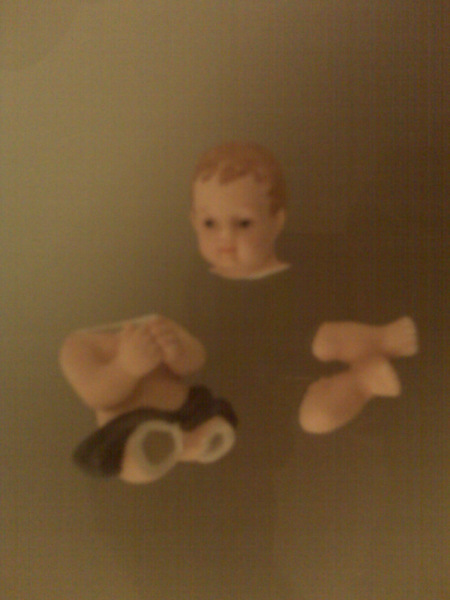
I was fixing my coffee when I turned to see Francesca with Baby Jesus in her tiny hands. But He is so small, so tiny, what harm could come from holding Him? So I let her get away with carrying the Savior.

As I stirred my spoon Christ crashed to the floor, the tile floor. Francesca immediately looked at me, as if expecting all hell to break loose. I think I sighed but that was about all. It is Christmas, right? And it is, after all, only a ceramic figure purchased at Target.

After assuring Francesca not to worry and guiding her toward a few coloring books in the living room, I bent down to retrieve the broken Christ.

———

St. Francis was told by a Crucifix in an old abandoned chapel: “Restore my Church.”

In my small one-bedroom apartment, I found Baby Christ, broken into exactly three: The Head, the Torso, and the Crossed Legs.

“Restore the Trinity,” was spoken to me.

———

For half of my forty years I can honestly say I have tried to pursue Truth, wherever it lie. In philosophy, in scripture, in literature, in art, in nature, in history…

Now, the entire Gospel of Christ lie naked on my kitchen floor.

We separate, we distinguish, we categorize, we breakdown. The Fall of Adam was a fall into denomination.

Christ’s body is One. His Church cannot be broken. Only mere men can get things so wrong.

I think of the great “Angelic Doctor” of the Church, St. Thomas Aquinas, who after spending a lifetime in unparalleled pursuit of human understanding, said after glimpsing a vision of what Our Lord has in store for those who love God:

“All that I have written seems like straw compared to what has now been revealed to me.”

Yes… “straw”…my brother Thomas…merely straw. Straw that lines the manger within which Our Savior is laid bare.

———

It is tradition to leave the crib empty until Christmas morning. Only then do we place the figurative baby Jesus into the scene, after all until that moment he was not yet brought forth from Mother Mary’s womb.

This Christmas morning I will glue together a Broken Baby Christ. The Head, the Torso, and the Crossed Legs will again be One.

Like the world after the birth of Christ, I will never be the same.

For what has now been revealed to me, no fall can break apart.


Howard Hain is a contemplative layman, husband, and father. He blogs at http://www.howardhain.com


A Voice That Passes Away

Spring Lake even

John the Baptist is a voice that passes away, according to St. Augustine:  “John is the voice, but the Lord is the Word who was in the beginning. John is the voice that lasts for a time; from the beginning Christ is the Word who lives for ever.”

John’s “voice” passes away. He no longer baptizes at the Jordan River. He cedes to the Word, and so should we. Our voice passes away; something of ourselves has to go– some of the things we hold dear, the friends who surround us,  the institutions that have upheld us.  Our way must give way to  God’s way.

We think so little of this.

Listen again to Augustine:  “What does prepare the way mean, if not be humble in your thoughts? We should take our lesson from John the Baptist. He is thought to be the Christ; he declares he is not what they think. He does not take advantage of their mistake to further his own glory.

“If he had said, “I am the Christ,” you can imagine how readily he would have been believed, since they believed he was the Christ even before he spoke. But he did not say it; he acknowledged what he was. He pointed out clearly who he was; he humbled himself.

“He saw where his salvation lay. He understood that he was a lamp, and his fear was that it might be blown out by the wind of pride.”

The Yet Empty Stable

by Howard Hain

There’s a little stable not too far from here.

It sits in a church that has seen better days.

The parish is poor and the people seem to disappear.

But a few persistent peasants won’t stay away.

I love it there.

The priest is wonderfully uncertain.

He is afraid of God.

He instinctively bows his head at the mention of the name.

He knows how little he is in front of the great star.

I imagine he was involved in setting the stable.

It is a good size, on the relative little-stable scale.

It is surrounded by ever-green branches.

Probably snipped from the few Douglas Firs placed around the altar and yet to be trimmed.

The stable itself is composed of wood.

A little wooden railing crosses half the front.

A single string of clear lights threads through the branches laid upon the miniature roof.

They are yet to be lit.

I love it there.

I kneel before the empty scene.

For as of yet, not a creature or prop is present.

Not an ox or a goat, not a piece of hay or plank of fencing.

Not even a feeding trough that is to be turned into a crib.

No visible sign of Joseph and Mary, nor a distant “hee-haw” of a very tired donkey.

I wonder if I could get involved.

Perhaps I could slip into the scene.

There’s a darkened corner on the lower left.

In the back, against the wall.

I could hide myself within the stable.

Before anyone else arrives.

I don’t think they would mind.

I’d only be there to adore.

To pay homage to the new born king.

I might even help keep the animals in line.

Yes, a stagehand, that’s what I can be!

I know there’s no curtain to pull.

That’s to be torn in a much later scene.

But to watch the Incarnation unfold from within!

That’s what I dream.

To see each player take his and her place.

To see the great light locate the babe.

To watch the kings and shepherds stumble onto the scene.

Hark! To hear the herald angels sing!

O the joy of being a simple farmhand.

Of being in the right place at always the right time.

Of course though I wouldn’t be alone.

In that darkened corner, also awaiting the entire affair, there are many others.

Most I don’t know by name.

Too many in fact to even count.

But a few I know for sure.

For certain, present are those few persistent peasants who won’t stay away.

And of course there’s that wonderful anonymous parish priest.

The one who helped set into place this yet empty but very expectant stable.

The one whose fear of God is so clearly the beginning of wisdom.


(Dec/16/2016)

Howard Hain is a contemplative layman, husband, and father. He blogs at http://www.howardhain.com