Tag Archives: prayer

Broken Baby Jesus

by Howard Hain

(Note: This post was originally published on December 24, 2011.)

broken-baby-christ-2-1


We have not put up a tree in years.

For nearly a decade we have been moving—no longer than two years in any one house and no less than ten different not-so-humble abodes. Between and during the moves we were very much engaged with the world. A seemingly endless movable beast.

This December marks one year in our current house. I am happy to say it is our home. The Lord has blessed us with great peace. And with that peace comes a tree. A simple, well-shaped tree. Fittingly, a dear friend offered it to us as a gift.

Francesca could not be more ready to be initiated into the act of trimming. Before the tree arrived, her two-year-old fingers pointed out every tree, artificial or real, that graced the pages of a holiday flyer or the commercial floor of a Rite Aid or Dollar Store.

Up the stairs came the evergreen, into the old stand that has been in storage since my father last used it several decades ago. I cut off the mesh and out popped the branches.

We hung the lights and old glass ornaments that my mother-in-law washed a few days before.

The main attraction for Francesca was the Nativity.

Not since St. Francis of Assisi assembled the first Nativity in Greccio in 1223, has there been such admiration for each and every witness who Our Lord assembled to adore His Son that first Christmas two millennia ago. Francesca kissed and hugged every shepherd, sheep, donkey, angel, and king. Most of all she adored the Holy family, calling Mary and Joseph, Ma-ma and Da-da, respectively. And Jesus, He was simply called: “ba-be.”

She carried them around the apartment. I did not want to ruin her fun, but they are ceramic. I explained a few times to be very careful.

“Gentle, Francesca…gentle…”, I harked a host of times.

Boom. To the wood floor went the shepherd. Amazing, grace held him intact. I took that as a great sign to put an end to her carrying the animals, angels and representatives of mankind.

I was fixing my coffee when I turned to see Francesca with Baby Jesus in her tiny hands. But He is so small, so tiny, what harm could come from holding Him? So I let her get away with carrying the Savior.

As I stirred my spoon Christ crashed to the floor, the tile floor. Francesca immediately looked at me, as if expecting all hell to break loose. I think I sighed but that was about all. It is Christmas, right? And it is, after all, only a ceramic figure purchased at Target.

After assuring Francesca not to worry and guiding her toward a few coloring books in the living room, I bent down to retrieve the broken Christ.

———

St. Francis was told by a Crucifix in an old abandoned chapel: “Restore my Church.”

In my small one-bedroom apartment, I found Baby Christ, broken into exactly three: The Head, the Torso, and the Crossed Legs.

“Restore the Trinity,” was spoken to me.

———

For half of my forty years I can honestly say I have tried to pursue Truth, wherever it lie. In philosophy, in scripture, in literature, in art, in nature, in history…

Now, the entire Gospel of Christ lie naked on my kitchen floor.

We separate, we distinguish, we categorize, we breakdown. The Fall of Adam was a fall into denomination.

Christ’s body is One. His Church cannot be broken. Only mere men can get things so wrong.

I think of the great “Angelic Doctor” of the Church, St. Thomas Aquinas, who after spending a lifetime in unparalleled pursuit of human understanding, said after glimpsing a vision of what Our Lord has in store for those who love God:

“All that I have written seems like straw compared to what has now been revealed to me.”

Yes… “straw”…my brother Thomas…merely straw. Straw that lines the manger within which Our Savior is laid bare.

———

It is tradition to leave the crib empty until Christmas morning. Only then do we place the figurative baby Jesus into the scene, after all until that moment he was not yet brought forth from Mother Mary’s womb.

This Christmas morning I will glue together a Broken Baby Christ. The Head, the Torso, and the Crossed Legs will again be One.

Like the world after the birth of Christ, I will never be the same.

For what has now been revealed to me, no fall can break apart.


Howard Hain is a contemplative layman, husband, and father. He blogs at http://www.howardhain.com

 

A Voice That Passes Away

Spring Lake even

John the Baptist is a voice that passes away, according to St. Augustine:  “John is the voice, but the Lord is the Word who was in the beginning. John is the voice that lasts for a time; from the beginning Christ is the Word who lives for ever.”

John’s “voice” passes away. He no longer baptizes at the Jordan River. He cedes to the Word, and so should we. Our voice passes away; something of ourselves has to go– some of the things we hold dear, the friends who surround us,  the institutions that have upheld us.  Our way must give way to  God’s way.

We think so little of this.

Listen again to Augustine:  “What does prepare the way mean, if not be humble in your thoughts? We should take our lesson from John the Baptist. He is thought to be the Christ; he declares he is not what they think. He does not take advantage of their mistake to further his own glory.

“If he had said, “I am the Christ,” you can imagine how readily he would have been believed, since they believed he was the Christ even before he spoke. But he did not say it; he acknowledged what he was. He pointed out clearly who he was; he humbled himself.

“He saw where his salvation lay. He understood that he was a lamp, and his fear was that it might be blown out by the wind of pride.”

The Yet Empty Stable

by Howard Hain

There’s a little stable not too far from here.

It sits in a church that has seen better days.

The parish is poor and the people seem to disappear.

But a few persistent peasants won’t stay away.

I love it there.

The priest is wonderfully uncertain.

He is afraid of God.

He instinctively bows his head at the mention of the name.

He knows how little he is in front of the great star.

I imagine he was involved in setting the stable.

It is a good size, on the relative little-stable scale.

It is surrounded by ever-green branches.

Probably snipped from the few Douglas Firs placed around the altar and yet to be trimmed.

The stable itself is composed of wood.

A little wooden railing crosses half the front.

A single string of clear lights threads through the branches laid upon the miniature roof.

They are yet to be lit.

I love it there.

I kneel before the empty scene.

For as of yet, not a creature or prop is present.

Not an ox or a goat, not a piece of hay or plank of fencing.

Not even a feeding trough that is to be turned into a crib.

No visible sign of Joseph and Mary, nor a distant “hee-haw” of a very tired donkey.

I wonder if I could get involved.

Perhaps I could slip into the scene.

There’s a darkened corner on the lower left.

In the back, against the wall.

I could hide myself within the stable.

Before anyone else arrives.

I don’t think they would mind.

I’d only be there to adore.

To pay homage to the new born king.

I might even help keep the animals in line.

Yes, a stagehand, that’s what I can be!

I know there’s no curtain to pull.

That’s to be torn in a much later scene.

But to watch the Incarnation unfold from within!

That’s what I dream.

To see each player take his and her place.

To see the great light locate the babe.

To watch the kings and shepherds stumble onto the scene.

Hark! To hear the herald angels sing!

O the joy of being a simple farmhand.

Of being in the right place at always the right time.

Of course though I wouldn’t be alone.

In that darkened corner, also awaiting the entire affair, there are many others.

Most I don’t know by name.

Too many in fact to even count.

But a few I know for sure.

For certain, present are those few persistent peasants who won’t stay away.

And of course there’s that wonderful anonymous parish priest.

The one who helped set into place this yet empty but very expectant stable.

The one whose fear of God is so clearly the beginning of wisdom.


(Dec/16/2016)

Howard Hain is a contemplative layman, husband, and father. He blogs at http://www.howardhain.com

Morning Thoughts: She Planted The Sun


.

There once was a little girl who loved to write “love”.

Over and over she wrote the lovely word.

Straight. Crooked. Curved. Upside down.

“Love”, “Love”, “Love”…

She drew hearts and placed all around.

And in a corner she planted the sun.

Day after day she pecked away.

A little hen marking the ground where she play.

All kinds of chicks came to stay.

She lined her dolls in pretty little rows.

A beauty pageant, all kinds of hair.

Straight. Curly. Blond. Brown.

She loved them all.

Did she favor?

She rotated each day.

She knew who needed extra care.

Though all to be happy.

That the only rule.

No room in her garden for overcast days.

And how her family grew.

She had, my God, so many to attend!

Amazing she could even keep track.

Yet each tiny doll held a special place.

She simply made room.

A little girl who loved to write “love”.

Over and over she wrote the lovely word.

Straight. Crooked. Curved. Upside down.

“Love”, “Love”, “Love”…

She drew hearts and placed all around.

And in a corner she planted the sun.

———

Miriam…Marie…Maria…

Mary…

I guess it depends on the day.

Accent. Pronunciation. Spelling.

Even eye color may change.

But it’s always the same little girl.

Age to age.

Place to place.

The same little girl

Helping save the human race.

The same little girl

In the fullness of time

Forever known:

Full of Grace


.

—Howard Hain

.

Friday Thoughts: Being qua Being


.

Learn from the way the wild flowers grow.

—Matthew 6:28


.

Does a flower make pronouncements? Does it define itself? Does it box itself in with titles, names, and distinctions?

And yet, “not even Solomon in all his splendor was clothed like one of these.” (Matthew 6:29)

———

A flower simply exists.

And its existence glorifies God.

There is no need for it to do more.

By its very existence it magnifies what cannot be further magnified: God’s Presence, God’s Glory, God’s Beauty…

———

“I’m a flower.”

“I’m a rose.”

“Look at me!”

Statements such as these we shall never hear.

Flowers are divinely indifferent to the world’s definitions and distinctions, to its approval and applause.

After all, it’s a person who receives the medal at an orchid show, and not the flower herself. No, her finely-placed petals would only be weighed down by such metallic-based ribbons.

What a gift it is to simply exist.

———

Flowers don’t cling to seasonal life.

When it’s time to go, they gracefully drop their heads and lose their pedals.

Never has there existed a man as poor as a flower.

Never has mankind so possessed the richness of fleeting, transitory, and momentary life.

It’s their genius to instinctively believe that death leads to new abundant life.

———

Flowers graciously receive:

Ladybugs, drops of dew. Beams of light, the relief of shade.

Flowers give and receive as if not a single thing has ever been made by man.

They welcome sun as well as rain.

They never cry over fallen fruit or a stolen piece of pollen.

They quietly applaud instead, rejoicing that their little ones have the opportunity to travel abroad—perhaps even the chance to help nurture a neighbor.

———

A flower, perhaps most of all, knows it place.

It never wishes to be bigger or thinner…greener or higher…it never dreams of being more like a tree.

A flower’s blessing is simplicity beyond you and me.

———

Christ is a flower.

He is the one true perfect eternal flower, through whom all other flowers partake, toward whom all other flowers reach.

Christ is a flower. His ways are not our own. He simply exists. Bowing His head. Dropping pedals. Feeding hungry bees. Giving and receiving. His identity is crucified—leaving nothing behind but being “qua” being.


.

If God so clothes the grass of the field, which grows today and is thrown into the oven tomorrow, will he not much more provide for you, O you of little faith?

—Matthew 6:30


.
.
—Howard Hain
.
.
(Dedicated to Brother Jim, a man who knew how to simply exist.)

.

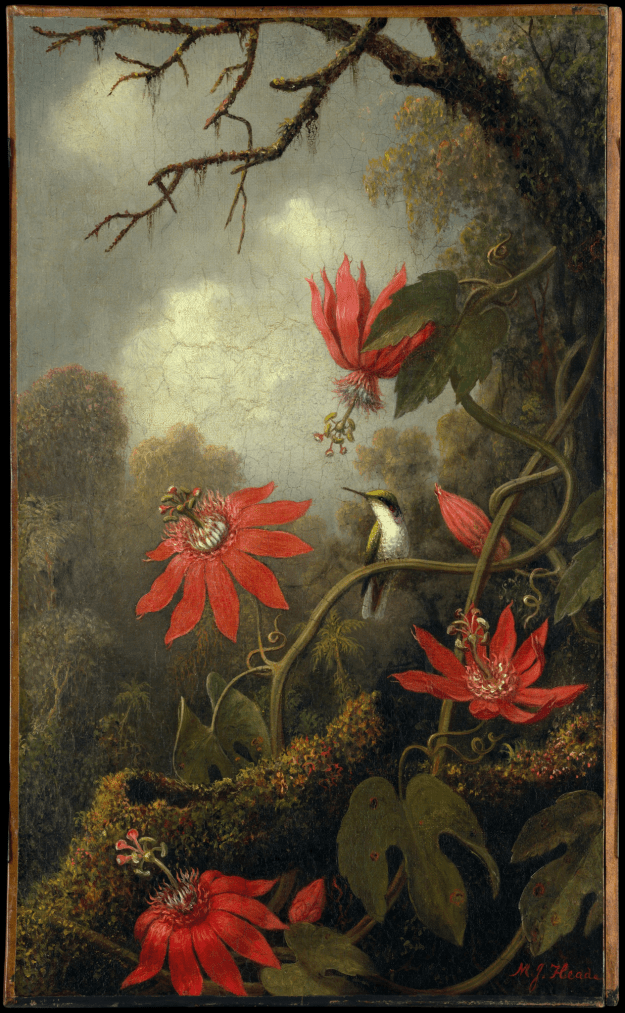
Hummingbird and Passionflowers

by Howard Hain
1509123983639705942327.jpg

Martin Johnson Heade, “Hummingbird and Passionflowers” (ca. 1875-85) (The Met)

The delicate little bird that resides within each of us.

It hops to and fro. It stands startlingly still.

Very often we are the very ones who chase it away.

But it doesn’t fly far.

Just to the closest branch, that’s just beyond our reach.

And it looks back at us, as if to ask, “Why are you afraid?”

The tiny head of a tiny bird, slightly cocked to the side—a question mark floats from its beak.

It longs to return, to live within us, to build a nest, to raise its young.

But it doesn’t rush back.

No, it waits.

It waits for us to ask for it to return.

It’s a patient creature, that tiny bird.

One may be tempted to say it’s not very smart, but that’s not it at all.

It’s simple. It’s holy. It knows who it is. It’s not afraid of the fall.


Howard Hain is a contemplative layman, husband, and father.


Web Link: The Met Museum. Martin Johnson Heade, “Hummingbird and Passionflowers” (ca. 1875-85)

Thy Will Be Done On Earth

Thy will be done, on earth as it is in heaven. “This is not that God should do what he wills, but that we may be able to do what God wills,” St. Cyprian says in reflecting on this petition of the Our Father.

Weak as we are, we find it hard to know and to do God’s will, and so Jesus, “ showing the weakness of the humanity which he bore, said Father, if it is possible, let this cup pass from me, and showing his disciples an example, that they should do not their own will but God’s, he went on to say nevertheless, let it not be my will, but yours.”

 Cyprian describes at length how we humans do God’s will: by dealing with others humbly, by holding steadily to our faith, by being just and merciful in what we do, by being moral in our lives.

But God’s will is to be done “on earth,’ we pray. Are only humans involved in doing God’s will, or is the earth itself involved in this petition? 

The psalms call for the earth and all creation to “bless the Lord.” The earth itself is called to do God’s will. It has a place in God’s plan. Our responsibility is to discern what God’s will is for our earthly home and see that it is done. 

Doing God’s will involves more than ourselves and human relationships. It extends to the earth as well.  One of the points Pope Francis makes in Laudato sí.

Hail Mary


Praying the Hail Mary, we ask Mary the Mother of Jesus to lead us to God.  The prayer’s earliest form  developed  in the middle ages with the simple greeting of the angel Gabriel at Nazareth, from St. Luke’s gospel:


Hail Mary,
full of grace,
the Lord is with you.

You are favored by God, the angel announces to her. She brought Jesus Christ into the world. That message continues through the ages and is reflected in us.  Like her, we are favored by God and called to bring God’s Son into the world.  God’s promise of grace to Mary echoes in God’s promise to us. As  promised  to Mary, God will be with us.

Over time her cousin Elizabeth’s greeting to Mary, also recorded in St. Luke, was added to the prayer:
Blessed are you among women
and blessed is the fruit of your womb.

Finally by the 15th century, the remainder of the prayer appeared:
Holy Mary, mother of God,
pray for us sinners
now and at the hour of our death.

The prayer asks Mary, full of the grace of her Son, to intercede for us sinners now and at the hour of our death. She is a model for believers and she knows what it means to believe. She who knew her Son so well, can teach us  the way to him.

On Calvary Jesus entrusted her to us as a mother when he said to his disciple “Behold your mother.” Ever since, she brings Christ into this world. She knew Jesus from the beginning and witnessed his life, death and resurrection. She helps us to know him. She also knows our needs. Aware of  the needs of the newly married couple at Cana in Galilee, she approached Jesus, her Son. She is aware of our needs too.

By the end of the 16th century the practice of saying 150 Hail Marys in series or decades of 10 became popular among many ordinary Christians. Helped by her they remembered  the life, death and resurrection of Jesus. That practice of prayer is known now as the Rosary.

Mary is a model of faith for Christians. When the angel Gabriel came to her, she believed the words he spoke even to the dark test of Calvary. She helps the family of believers on their journey to believe..

The Hail Mary and the Rosary are blessed prayers,  simple and profound. They’re not beyond anyone’s reach; their repetition brings peace to the soul. They draw us into  the joys, sorrows and glory of Jesus, the world Mary knows so well.  We hope to “imitate what they contain and obtain what they promise, through Christ, Our Lord. Amen”

We will be celebrating the Feast of the Assumption of Mary this month..

Your Kingdom come on earth

The wise St. Teresa of Avila says, “We’re people who don’t feel rich until we feel the money in our pocket.” So, we have to pray, “Your kingdom come… on earth.”

We’re earthy people with our feet on the ground, today’s ground. We find it hard to pray: “Give us whatever is good for us.” We find it hard to grasp that God’s kingdom is coming with blessings far beyond what we ask for.

We’re earthy people. We find the prayer of Jesus in the garden hard to imitate: “Not my will, but yours be done.”

“But you know us, my Lord, and you know that we have not given ourselves up to the will of your Father as completely as you did. For us, it is best to pray for specific things…or else we won’t accept what God chooses to give us (even if it is far better than what we asked for) because it’s not exactly what we asked for.”

So we pray that God’s kingdom come “on earth” –for my cousin’s friend who’s paralyzed, for Dennis, Joan, Camille, Mary, and Betty who lost their jobs, for the disturbed woman who visits our garden, for our President and our country, for Vincent in the hospital.” Our prayer is about “specific things” because we live our lives in them; we only know through what we see and feel and experience.

And so, “the good Jesus places these two petitions – Hallowed be thy name and Thy kingdom come next to each other, so that we can understand what we are asking for and why it is important to beg for it and to do all we can to please the one who is able to give it to us.”

The petitions lead us to the prayer of Jesus, “your will be done.”

A wise woman, St. Teresa. No wonder she’s a Doctor of the Church. (The Way of Perfection)

An Immense Sea

View_of_Cliffs_of_Moher
Cliffs of Moher, Ireland

Did St. Gregory of Nyssa ever stand at a place like this? He must have:

“The feelings that come as one stands on a high mountain peak and looks down onto some immense sea are the same feelings that come to me when I look out from the high mountain peak of the Lord’s words into the incomprehensible depths of his thoughts.

“When you look at mountains that stand next to the sea, you will often find that they seem to have been cut in half, so that on the side nearest the sea there is a sheer drop and something dropped from the summit will fall straight into the depths. Someone who looks down from such a peak will become dizzy, and so too I become dizzy when I look down from the high peak of these words of the Lord: Blessed are the pure in heart, for they shall see God.
“These words offer the sight of God to those whose hearts have been purified and purged. But look: St John says No-one has seen God. The Apostle Paul’s sublime mind goes further still: What no man has seen and no man can see. This is the slippery and crumbling rock that seems to give the mind no support in the heights. Even the teaching of Moses declared God to be a rock that was so inaccessible that our minds could not even approach it: No-one can see the Lord and live.
“To see God is to have eternal life – and yet the pillars of our faith, John and Paul and Moses, say that God cannot be seen. Can you understand the dizziness of a soul that contemplates their words? If God is life, whoever does not see God does not see life. If the prophets and the Apostle, inspired by the Holy Spirit, attest that God cannot be seen, does this not wreck all the hopes of man?
 “It is the Lord who sustains our floundering hope, just as he sustained Peter when he was floundering in the water, and made the waters firm beneath his feet. If the hand of the Word stretches out to us as well, and sets us firm in a new understanding when these speculations have made us lose our balance, we shall be safe from fear, held safe in the guiding hand of the Word. Blessed, he says, are those who possess a pure heart, for they shall see God.”