Tag Archives: faith

Lonely Prophets: Elijah

Elijah mcarmel
Elijah


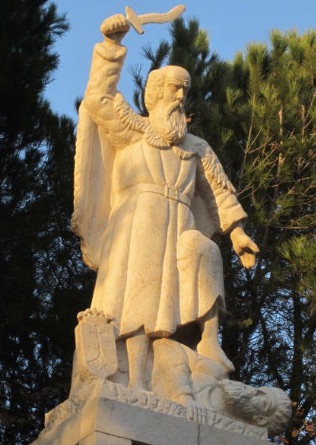
The powerful sculpture of the Prophet Elijah with sword in hand stands on Mount Carmel in northern Israel, where he defeated the false prophets of Ahab –today’s reading, (1 Kings 18:20-39) We will be reading about him this week.

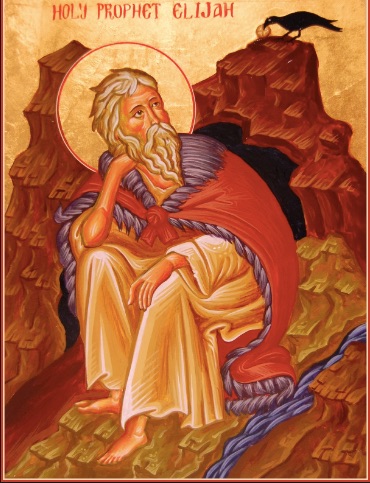
I must confess I like better his picture below where Elijah is huddled in his cloak facing death while a raven behind him offers God’s food. He’s a prophet on a lonely journey. Yes, the powerful prophet forbade the rain to fall and raised the dead, but according to the Book of Kings he spent most of his time on the run, hiding in caves and wadis, depending on someone like a poor widow for food and shelter. He had no support from other religious or political leaders. He was a lonely prophet.

The compilers of our lectionary knew what they were doing when they pared his story with the readings from Matthew’s Sermon on the Mount, also read this week. Some of Jesus’ listeners saw him as Elijah returned. He too had little support from the religious and political leaders of his day.

The Passionist community celebrates today Blessed Lorenzo Salvi, a Passionist priest who lived at the time of the Napoleonic Suppression of the church in 18th century Europe, when most of the religious communities in Italy where disbanded and their places taken over by the government. Lorenzo took part in rebuilding the church in Rome by his constant preaching. I think of him as a lonely prophet and I also see him as an example for the Passionists today. We have a role in rebuilding our church. You can read the story of Lorenzo Salvi here.

Elijah, the lonely prophet, makes me also think of a man who visited us from China about 40 years ago. He had been a seminarian in our seminary in China in the late 1940’s when the communists came to power and began the Cultural Revolution. John was sent for three years to a hard labor camp for “reeducation” because he was a Christian. But when they learned he knew English, government officials made him an English teacher in a Chinese high school.

I asked John what he taught. English literature, he told me. He taught Pearl Buck’s “The Good Earth” because the Chinese loved Pearl Buck. He also taught bible stories, particularly the Old Testament stories about Moses leading the Israelites out of Egypt and Elijah confronting the evil king Ahab and his wife Jezebel.

Bible stories I asked? Didn’t the officials question him? You can’t understand English literature without knowing the stories of the bible, he told them.

Whenever I hear the story of the lonely prophet Elijah in a country completely controlled by a powerful regime, yet still faithfully proclaiming the truth, I think of John. I also think of Lorenzo Salvi. Our society, held strongly now in the grip of a deaf secularism, needs lonely prophets to speak.
Religion and Politics?

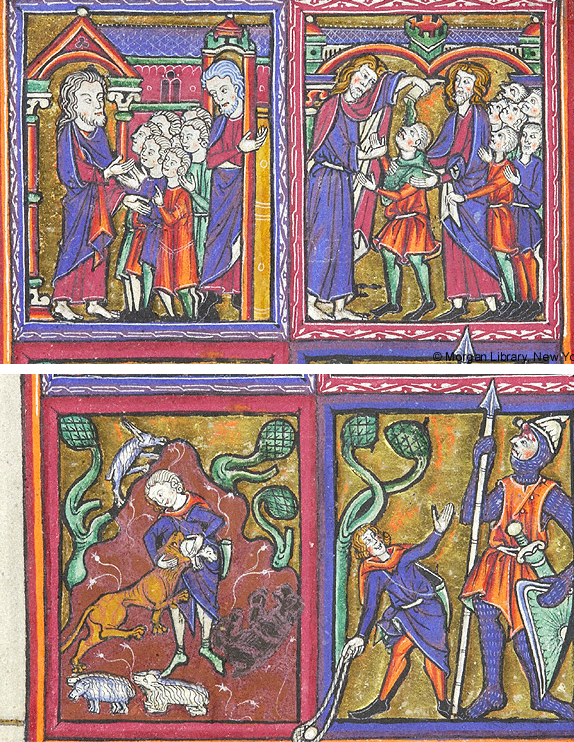
Story of David. Morgan Library, NY

Our reading from the Book of Samuel these days raises that question. Are religion and politics separate lanes that never intersect? Does God has no role in politics? You can’t say that watching the Prophet Samuel repeatedly challenging rulers like Saul and David. It’s also important to notice too that Samuel can get things wrong.

“Fill your horn with oil, and be on your way,” God says to Samuel, “I am sending you to Jesse of Bethlehem, for I have chosen my king from among his sons.” Samuel goes through all of Jesse’s sons, but none fit the bill. “Not him, not him, not him,” God says as one after another are brought to Samuel. “Are these all the sons you have?” Samuel asks.

Jesse replied, “There is still the youngest, who is tending the sheep.” “Send for him,” Samuel says, “we will not begin the sacrificial banquet until he arrives here.” So David is brought to them, ” ruddy, a youth handsome to behold and making a splendid appearance.”

The LORD said, “There–anoint him, for this is he!”

Then Samuel, with the horn of oil in hand, anoints him in the midst of his brothers;   ‘and from that day on, the Spirit of the LORD rushed upon David.” (I Samuel 16,1-13)

“Anoint him, there he is,” God says. The prophet pours the horn of olive oil on David. What does the oil signify? A power not his own, a power that is God’s grace, to lead his people. The grace of God is needed to lead.

We can’t block out the world we live in. The messy, uncertain, brutal, sometimes going nowhere world we read about in the Book of Samuel reminds us that God never abandons the world as it is. It’s not Saul’s world or David’s world or even Samuel’s world; It’s God’s world and God’s plan.

Hard to see in the constant blast of news and political commentaries we get from the media. We think like humans do.We can throw up our hands and turn it all off, but this is our world to understand and care for and pray for.

We’re told to pray for our world, our leaders and ourselves that we may receive God’s wisdom and grace to see and hear God here and now

Almighty and eternal God,
you have revealed your glory to all nations.
God of power and might, wisdom and justice,
through you authority is rightly administered,
laws are enacted, and judgment is decreed.

Assist with your spirit of counsel and fortitude
the President of these United States,
that his administration may be conducted in righteousness, and be useful to your people over whom he presides.

May he encourage due respect for virtue and religion.
May he execute the laws with justice and mercy.
May he seek to restrain crime, vice, and immorality.

Let the light of your divine wisdom
direct the deliberations of Congress,
and shine forth in all the proceedings and laws framed
for our rule and government.
May they seek to preserve peace, promote national happiness, and continue to bring us the blessings of liberty and equality.

We pray for the governor of this state 

for the members of the legislature,
for judges, elected civil officials,
and all others who are entrusted to guard our political welfare.
By your powerful protection, may they discharge their duties with honesty and ability.

We likewise commend to your unbounded mercy
all citizens of the United States,
that we be blessed in the knowledge and sanctified in the observance of your holy law.

May we be united in that peace which the world cannot give and, after enjoying the blessings of this life, be admitted to those which are eternal.

We pray to you, who are Lord and God,
for ever and ever. Amen.

(Adapted from a prayer for the inauguration of George Washington by Archbishop John Carroll, first Catholic bishop in the United States)

Visits and Gifts

Visits, gifts, greeting cards ( now by email) are a good part of the holiday experience.  How can we love everyone all at once? I don’t know.

But Luke’s gospel makes visiting a part of the Christmas mystery. Mary goes into the hill country to visit her cousin Elisabeth after she hears the angel’s message. They meet, not just to trade family news and pass the time together, but they share faith.

They’re two believers who reveal to each other the mystery hidden within them in their unborn children. And they rejoice in their common gift.

We gather with others at Christmas time; people of faith, believers in a mystery we do not see. At Christmas, believers meet, even believers to a degree.

More than we know, we’re signs to each other, like the bread and wine, sometimes hardly evident. In his commentary today on the gospel of the visitation, St. Ambrose says we’re like Mary and Elizabeth; “Every soul that believes–that soul both conceives and gives birth to the Word of God and recognizes his works.”

So we visit and give our gift.

The Genealogy of Jesus

Advent began two weeks ago with Isaiah’s promise that all nations, along with his chosen people in exile, would hear God’s call to dwell in peace on God’s holy mountain. On December 17 our liturgy turns to Matthew’s gospel and the account of the genealogy of Jesus, “son of David, son of Abraham.” Matthew’s gospel traces his ancestry back to his Jewish beginnings. ( Matthew 1,1-17)

Whenever we read this gospel, filled with so many hard to pronounce names I am reminded of my mother.  She had a remarkable memory for relationships, whether her own family relations or others. Honestly, I often tuned out as she probed with delight family trees. After she died I realized I had lost my connection with countless relatives and people she had firmly in mind.  She would have appreciated the genealogy above.

This is not a superfluous project the evangelists are engaged in. They’re intent on describing the Incarnation of Jesus. He wasn’t isolated from humanity, above it all, but  he was part of the human family. And his family tree was not an army of saints; sinners are there for sure.

We will hear from some of his saintly forbears in the next few days, Mary, Joseph, Elizabeth and Zachariah. But let’s not forget the others.They are his family too. He loved them all.

In our family tree above Mary points to Joseph. Like her his ancestry goes back to David and Abraham. Appearing to him in a dream the angel says “Joseph, son of David, do not be afraid to take Mary your wife into your home. For it is through the holy Spirit that this child has been conceived in her.”

The Gift of the Old: 1 and 2 Maccabees

This week our first readings at Mass are from the First and Second Books of Maccabees commemorating the Jewish revolt against Antiochus Epiphanes, successor to Alexander the Great. The revolt led to the rededication of the temple by Judas Maccabeus after its profanation by foreign invaders.  The Jewish Feast of Hannukah recalls the event. (Thursday) The revolt took place over a hundred years before the time of Jesus.

The Maccabean revolt is one reason why the times of Jesus were so politically sensitive. On his journey to Jerusalem, some “thought that the kingdom of God would appear there immediately.” (Luke 19,11)  A number of his disciple probably thought that would happen by an armed uprising against the Romans, like the revolt  against Antiochus Epiphanes.

Our readings this week, however, are not battle accounts from the uprising but rather stories of two elderly faithful Jews: Eleazar, a scribe who refused to assimilate to the culture of the conquerors, and a mother who inspired her seven sons to resist the invaders. (Tuesday and Wednesday)

All Eleazar had to do was pretend to eat the meat of sacrifice, but the ninety-year old chose to die rather than give bad example to the young.
“I will prove myself worthy of my old age, and I will leave to the young a noble example of how to die willingly and generously for the revered and holy laws.” (2 Maccabees 6. 30-31)

The Jewish mother, seized with her seven son and witness to their torture and death,  urged them to keep their faith and persevere:
“I do not know how you came into existence in my womb; it was not I who gave you the breath of life, nor was it I who set in order the elements of which each of you is composed. Therefore, since it is the Creator of the universe who shapes each man’s beginning, as he brings about the origin of everything, he, in his mercy, will give you back both breath and life, because you now disregard yourselves for the sake of his law.” (2 Maccabees 7,1, 21-31)

Pope Francis often speaks of the wisdom and influence of the elderly.  We rely on them. Maybe now more than ever.

The Faith of Abraham

Abraham and Isaac
Roman catacombs, 3rd century

What does it mean to believe? Abraham is “our father in faith.” We read his story from the Book of Genesis at the Easter Vigil, where it appears as a key reading, and in odd years from Monday of the 12th week of the year to Thursday of the 13th week of the year.

First, faith is a gift by which God invites us to a life far beyond what we have now. “The Lord said to Abram: ‘Go forth from the land of your kinsfolk and from your father’s house to a land I will show you.’” It’s not a land we discover, but a land God shows us. We must leave a land we know and enter a land unknown.

Faith’s a gift, but also a challenge. Genesis 22,1-19 begins: “God put Abraham to the test.” There would be no greater test for Abraham than to take his son, Isaac, “your only one, whom you love,” and go up a high mountain and “offer him up as a burnt offering.”

Intimations of the Passion of Jesus are here: “the high mountain… the only son, whom you love.” Approaching the mountain, Abraham takes “the wood for the burnt offering and laid it on his son Isaac’s shoulders.” “God will provide the sheep.” Abraham tells Isaac. He builds an altar and arranges the wood. “Next he ties up his son Isaac, and put him on top of the wood on the altar.” All suggesting the Passion of Jesus.

But when Abraham takes his knife, God stops him. “I know how devoted you are. You did not withhold from me your beloved son.” And God blesses him. “I will bless you abundantly and make your descendants as the stars of the sky and the sands of the sea.”

The Letter to the Hebrews says, “By faith Abraham, when put to the test, offered up Isaac, and he who had received the promises was ready to offer his only son of whom it was said, ‘Through Isaac descendants shall bear your name.’ He reasoned that God was able to raise even from the dead and he received Isaac back as a symbol.” (Hebrews 11,18-19)

“He reasoned that God was able to raise even from the dead.” He faces sadness and cruelty. He’s not a dumb executioner, immune to what he was to do, but “he reasoned,” he believed deep within that God was a God of life. Like Jesus, Abraham faced an absurd death like this, and he believed in a God of love and promise. Like Jesus, his answer was “Not my will, but yours be done.”

The commentator in the New American Bible describes Abraham’s test. “… after the successful completion of the test, he has only to buy a burial site for Sarah and find a wife for Isaac. The story is widely recognized as a literary masterpiece, depicting in a few lines God as the absolute Lord, inscrutable yet ultimately gracious, and Abraham, acting in moral grandeur as the great ancestor of Israel. Abraham speaks simply, with none of the wordy evasions of chapters 12 and 21.  The style is laconic; motivations and thoughts are not explained, and the reader cannot but wonder at the scene.

We ask for Abraham’s faith.

Abraham’s sacrifice is portrayed frequently in the Christian catacombs of Rome, where believers also faced the mystery of death. (above)

A medieval book for artists, “Speculum humanae salvationis,” the prime resource medieval artists used for comparing New Testament stories with the Old Testament, pairs the story of Abraham bringing Isaac to be sacrificed with the story of Jesus carrying his cross to Calvary, as shown in the example below:

abraham Passion

Abraham, The Unwavering Nomad

We reading the story of Abraham in our lectionary this week. He is called “Our father in faith” in our 1st Eucharistic Prayer. That’s because Abraham believed when God called him to leave his own land and go to a land he did not know. He believed in God’s call.

A pastoral nomad who settled down and then moving on. Abraham moved on to a permanent home. That’s us too. Abraham trusted in God rather than in himself. As an old man, he believed God who said he would have a child. His wife Sarah was old too.

The great patriarch was tested. Faith grows through testing. Abraham’s greatest test came when God asked him to sacrifice his only son Isaac.

My favorite reflection on Abraham is Jessica Power’s beautiful poem:

“I love Abraham, that old weather-beaten
unwavering nomad; when God called to him
no tender hand wedged time into his stay.
His faith erupted him into a way
far-off and strange. How many miles are there
from Ur to Haran? Where does Canaan lie,
or slow mysterious Egypt sit and wait?
How could he think his ancient thigh would bear
nations, or how consent that Isaac die,
with never an outcry nor an anguished prayer?

I think, alas, how I manipulate
dates and decisions, pull apart the dark
dally with doubts here and with counsel there,
take out old maps and stare.
Was there a call after all, my fears remark.
I cry out: Abraham, old nomad you,
are you my father? Come to me in pity.
Mine is a far and lonely journey, too.

Is This All There Is?

DSCN1720

In John’s readings from the Last Supper today and tomorrow, Jesus’ disciples , Thomas and Philip, appear unsure of the way and the power of Jesus himself. An important question raised in mystagogic catechesis.

 St. Ambrose in the 4th century met the same uncertainty of signs as he spoke to the newly baptized of his time. They signify so much, but we find them hard to accept. “Is this it?” he hears them say as they approach the waters of baptism and the table of the Eucharist.

Encountering God through sacraments in weakened further today by a lack of a symbolic sense, Pope Francis writes in his letter Desiderio Desideravi . Now, more than ever, human beings, like Thomas and Philip, want to see. We want immediate experience.

Ambrose calls on stories of the Old Testament. The Israelites were saved as they flee from Egypt through the waters of the Red Sea, the cloud that guides them on their way–foreshadowing the Holy Spirit, the wood that makes the bitter waters of Marah sweet–the mystery of the Cross.

“You must not trust, then, wholly to your bodily eyes. What is not seen is in reality seen more clearly; for what we see with our eyes is temporal whereas what is eternal (and invisible to the eye) is discerned by the mind and spirit.” (On the mysteries)

The Assyrian general, Naaman, doubted as he stood before the healing waters of the Jordan, Ambrose reminds his hearers. There’s more here than you see or think.

So we’re invited into an unseen world. Still, we’re like those whom the gospel describes and the saint addresses. Is this it? Moreso now, schooled as we are in the ways of science and fact, we look for proof from what our eyes see. We live in a world that tells us what we see is all there is.

Faith is a search for what we don’t see. God desires to approach us through signs. Will he not help us approach him that way? Believe in me, Jesus says.

Readings here.

Poor in Spirit

Christmas is a time of poverty. The Spirit of Bethlehem is one of smallness, of tiny new beginnings that open our minds to the infinite largeness of Incarnate Wisdom. The Christ Child heals us of our presumption. The New Born shows us that we simply don’t know what God has in store. His impoverished delivery stops us in our tracks. We stand like beasts in a stable, our knowledge, our understanding, our science, our facts, our truths stripped of eternal value. All that remains, whether we’re shepherds or kings or someone in between, is for us to nod along with the tiny beat of the drummer boy offering his seemingly meaningless gift. Let’s welcome Christ Jesus, Innocence itself, by being poor with Him. Let’s let go of preconceived notions of having control. To stand before the Lord in our nothingness is worth more to Him than any amount of gold, frankincense or myrrh. Our humility before the bright light is pure praise and prayer to the One Who offers us everything.

—Howard Hain

Mary’s Mother

by Howard Hain

durer

Albrecht Durer, “Virgin and Child with Saint Anne”, ca. 1519 (The Met)

Christmas is a time for grandmothers.

They bake and cook and decorate. Their homes become mini North Poles, diplomatic outposts of Santa’s Castle.

At its core, Christmas is of course all about Jesus. All about Jesus, Mary, and Joseph. All about the Holy Family.

The Holy Family is an extended family though. And it doesn’t stop at grandmothers and grandfathers, aunts and uncles, or even cousins and distant cousins.

Just ask Saints Joachim and Anne, Zechariah and Elizabeth, or John the Baptist—not to mention all the unknown relatives whom the child Jesus surely encountered throughout His Galilean days. Ask any one of them about the far-reaching ripple effects of family grace.

Those touched by Jesus have a tendency to appear bigger than life.

Look at Santa Claus.

Most of us are aware that he is really Saint Nick.

But do we stop to wonder who Mrs. Claus really is?

I think she’s Saint Anne.

After all, Mrs. Claus is seen as everyone’s grandmother, especially when it comes to holiday cheer. But when it comes to truly celebrating the birth of Jesus, it is through Saint Anne that we approach the gates of Christ’s Nativity.

Mary’s Mother holds a special key. She is first among grandmas, first among those who pinch chubby cheeks, who pass along one more extra sugary treat.

———

Saint Anne help us. Speak to us. Show us how to be grand parents to all those around us, especially the little ones. Stir up the spirit of Advent. Bake away the holiday blues. Cook up a dish of Christmas love that only your hearth can serve.

———

Come one, come all, to the home of Saint Anne. Come with me to Grandma’s house for a holiday visit. Taste and see. Enter her kitchen, where the hot chocolate can always fit a little more whipped cream, where you hear the constant refrain: “eat…eat…eat…”

At Grandma’s your plate is never empty.

Her table is continually set.

She always sees Jesus as having just been born.

She is always wrapping Him up tightly in swaddling clothes.

It is simply grand.

To Grandma, Jesus is always an innocent child.

And she can’t help but see Him deep within both you and me.


(Dec/21/2017)

Howard Hain is a contemplative layman, husband, and father. He blogs at http://www.howardhain.com


Web Link: Metropolitan Museum of Art. Albrecht Durer, “Virgin and Child with Saint Anne”, ca. 1519