Thoughts Upon The Cross: A Child Named Marriage

by Howard Hain

.

“This is why a man leaves his father and mother and becomes attached to his wife, and they become one flesh.”

—Genesis 2:24


.

Shouldn’t we ask the Lord to purify our flesh?

And if we should, shouldn’t we ask Him to purify all our flesh?

The answer seems obvious. Yet, it has tremendous and exceedingly beautiful consequences—consequences that are too often divorced from day-to-day reality.

For just as we ask the Lord to purify our flesh, we should also ask Him to purify our marriages. Or do we not really believe that bridegroom & bride become “one flesh” once they become husband & wife?

The answer, between you and me, should be a resounding: “I do.”

———

Just as we ask for our bodily flesh to purified, those of us who are married need to ask for our “marital” flesh to be purified as well. By doing so we send the Lord a birth announcement—for before we were married the “one flesh” of marriage that now exists within a specific time and place of human history only existed in the mind of God. In earthly terms, what existed in potentiality did not yet exist in actuality, what was possible was not yet real, or to put it yet another way, the divine idea was not yet “incarnate”—the marriage was not yet “made flesh“.

But once the seal of the sacrament drifts down “like the dewfall” upon the divine idea, a new life, a new flesh, a new “being”—a living, breathing “child” named marriage—comes into existence—just as with an individual child, who exists only in the mind of God but then comes into physical reality at the moment of conception, at the permanent merger of sperm and egg.

Therefore, just as with a “real” child—especially an infant—shouldn’t we be boundlessly gentle, soft, kind, patient, tolerant, and self-sacrificing with a new marriage? And no matter how “old” the marriage becomes, shouldn’t we also remember that it is always a child, a new creation of God spawned from the union of two committed souls vowing unity and oneness, all for the greater glory of God?

More so, shouldn’t a child named marriage, as with any child, be treated as an offspring of God’s grace, and therefore as something we do not own or possess but instead as something we have been appointed to steward—to care for and nurture as God Himself wills and directs?

“Yes”, “Yes”, and “Yes”, to all of the above.

So next time you’re about to yell at each other, remember: Don’t wake the baby!

———

And that’s the crux of it, isn’t it? It’s not about you anymore.

No, there’s a new life in your hands—and just imagine what good parents we’d all become for our “actual” children if we first practiced parenting on the very marriage that begets those precious babes?

———

One more thought, if we can’t apply purification to the “one flesh” of earthly matrimony, what makes us believe we will ever be properly prepared for the ultimate wedding feast to come—that feast of all feasts—that day, that hour, when the Eternal Bridegroom, Christ Jesus, will come for His bride, The Universal Church?

For if we are truly within Christ’s Church shouldn’t we be preparing ourselves to be beautified mini-brides within the One, Holy, and Universal Bride?

Let us prepare.

Let us practice.

Let us not be left at the altar.

And let us start today: For God has birthed a mini-book of revelation, and its name is your marriage—a living, breathing, child of God.

———

And for those not married, the lesson still applies, for shouldn’t all close relationships, if not all relationships, be treated as precious infants, full of promise and hope, as clean slates, or better yet, as new, purified flesh?

Yes, they should, for it is no longer simply between the two of you—it is about “a new creation” floating among and above you.


.

“What came to be through him was life, and this life was the light of the human race…”

—John 1:3


.

.

Immaculate Conception Church, Irvington on the Hudson

The Archdiocese of New York has a renewal program called Revive taking place in its parishes this year. The program comprises a reading from scripture, a sermon on the purpose of life, a witness talk, prayers and hymns.

This week, Monday, Tuesday and Wednesday evenings at 7:00 PM, I’m taking part in the Revive program at Immaculate Conception Parish, Irvington on the Hudson, NY. Besides Immaculate Conception, Sacred Heart, Our Lady of Pompeii, St. Matthew, and Our Lady of Perpetual Help Parishes are taking part in Revive.  I’m giving the sermon and will be offering some of the prayers.

Here’s the way I opened our mission this evening:

4th Sunday of Easter

Some time ago a Hollywood newspaper ran an article entitled “Jesus in Film and TV: 13 Devilishly Handsome Actors Who’ve Played the Son of God.”

The article showed pictures of all the devilishly handsome actors who played Jesus in the movies or on television in recent years. To tell the truth, none of them looked like Jesus to me.

In his Letter to the Philippians St. Paul says that Jesus took on the form of a slave. That seems to mean that if we met him on the street, we wouldn’t recognize him. He would look like one of the crowd. Jesus may not have been particularly handsome, but of course Hollywood can’t believe that. We’re so sure that looks, appearances, image are everything.

Jesus describes himself as a shepherd, a good shepherd, in today’s gospel. Now, I don’t know too much about shepherds or what they look like, but from the little I know they’re not a particularly handsome group. They’re men who spend most of their time outside in the cold or the heat; weather-beaten, scruffy looking, with little time or reason for grooming themselves– not much to look at. It’s a tough job, being a shepherd.

But the good shepherd cares for his sheep. That’s what Jesus does; he cares for his sheep. He cares for his sheep no matter what the weather, cold or hot. He makes the journey with them, no matter how hard it is. He doesn’t abandon his sheep, no matter what. He searches for the ones who are lost and he looks for others to enter his flock.

That’s the way Jesus, the Risen Jesus, describes himself in John’s gospel:

“I am the good shepherd.
A good shepherd lays down his life for the sheep.”

He’s not doing it for pay, he’s not someone hired, putting in his time, caring little for his sheep, ready to run away when the wolf comes and the sheep are scattered.

“I am the good shepherd,
and I know mine and mine know me,”

He knows his sheep, Jesus says, not in an impersonal way. He speaks and they hear his voice. ‘Just as the Father knows me and I know the Father,” he says, and “I will lay down my life from them.”

Let’s listen to his voice. He’s never far away.

May

This month of May we continue to celebrate Easter. We’re in the Easter season. Notice what we call the Sundays of this month- the Sundays of Easter. The Risen Lord stays with his church on its pilgrim way and walks with her step by step. Far from leaving us orphans, Jesus is with us, especially in the sacrament of the Eucharist where we know him in “the breaking of the Bread.”

Another gift we remember in May is Mary, the Mother of Jesus. We honor her this month and ask her to guide us into the mysteries of Jesus, her Son. She knew him better than any of his creatures. May she lead us to him.

On May 16 the Passionists remember St. Gemma Galgani, the young woman from Lucca, Italy, who wanted to join the Passionist Nuns but was prevented from doing so by poor health. That did not stop God from bestowing graces in abundance on “Poor Gemma,” as she called herself. Jesus shared with her the marks of his Passion.

Our readings at Mass this month are often from the Acts of the Apostles, which show the church, fresh from being anointed by the Holy Spirit, expanding from Jerusalem to bring the Good News to the ends of the earth.

The two American Passionist provinces of men are having a joint retreat in Detroit at the beginning of this month. We’re asking God for his grace and guidance to see from “the signs of the times” what to do that God’s kingdom may come.

Pray for us, please.

In Gratitude for His Love

In today’s Gospel (Jn 3: 16-21 ) Jesus has just finished telling Nicodemus about His coming Passion : ” And just as Moses lifted up the serpent in the desert so must the Son of Man be lifted up, so that everyone who believes in Him may have eternal life. ” ( v.v., 14-15 ) . Then Jesus goes on to say :

” For God so loved the world that He gave His only Son, so that everyone who believes in Him
might not perish but might have eternal life. For God did not send His Son into the world to
condemn the world, but that the world might be saved through Him. ” ( v.v., 16-17 )

This is one of the great statements  in the Gospels which clearly indicates that the Passion and death of our Lord up on that cross was, more than anything, an act of Divine love, love for us, sinful humanity, so undeserving of His mercy.
I walk in this world, seeing all the evil and darkness that cause so much suffering and death, and wonder why God has kept us from extinction for so long. I walk in the world, knowing that I have done various things that hurt others and myself, and although I am so grateful for all the wonderful things that God has given me in my life, I see that I did not deserve them. Frankly, if my life were to end in oblivion and darkness, I would not think it unfair.
Yet I realize that I am so loved, with an immense love that is beyond my understanding. Why do you cherish us like this, my God? Creation already is so magnificent. Human life can feel so wonderful, even the simple act of breathing. And You, dear Lord, offer us an entranceway, a gate into yet another unexpected realm of existence beyond our comprehension : eternal life….. with You !
This entrance, this gateway is the bloodstained cross of Jesus, our beloved savior, friend, human being, God all-powerful. I am not going to start, like I often do, questioning : Why this terrible Passion of our Lord? Why this mercy for us? Why do so many reject it? Are they hopelessly condemned?… and so on. Today I just want to go on my knees and simply thank you again and again, Great One. You have suffered and died for me. You have saved me. You have turned my stubborn head around and made me one of those who believe in You. You have enabled me to see You as the truth, and to experience the joy of living in You, and living for You! Lord, have mercy on those that don’t know You. Help me be strong, to be an instrument of Your salvation and preach by example :

” Whoever lives the truth comes to the light, so that his works may be clearly seen as done in God.” ( v.21 )

Orlando Hernandez

Jesus, the Teacher


This evening at our mission at St. Theresa’s Parish in Staten Island, NY, I spoke about Jesus, the Teacher. I like Rembrandt’s drawing of Jesus preaching to a crowd. For one thing, the crowd around him seems to represent all ages, shapes and sizes of ordinary humanity. Jesus’ disciples, like Peter, James and John may be there, but they don’t seem to stand out. Maybe some of his enemies are there, but they don’t stand out either. They’re all there listening, except maybe the little child on the ground playing with something he’s found. And Jesus teaches them.

Did Rembrandt find these faces in the people of his neighborhood, ordinary people? If that’s so, this crowd could be us.

Luke’s gospel seems a lot like this painting to me. In much of Luke’s gospel Jesus makes his way from Galilee to Jerusalem, and as he goes his way he calls everybody to follow him. Some women from Galilee follow him. He calls Zachaeus, the tax collector, down from a tree to join him. Follow me, he says to a blind man begging in the same place for years. He called people in every shape and form, sinners, tax-collectors, everyone.

It was not just to see him die that he calls them to follow him, but to go with him onto glory. “Come with me this day to paradise, “ Jesus says to the thief on the cross. Our creed says he descends into hell, which means he goes to those who have been waiting for centuries for the redemption he brings. He calls to all, to them and to us, to follow him.

What does following Jesus mean? I spoke of two things. Jesus said to follow him we must take up our cross each day. He also said we must become like little children. He taught us about spiritual childhood.


St. Theresa, Staten Island

The Archdiocese of New York has a renewal program called Revive taking place in its parishes this year. The program comprises a reading from scripture, a sermon on the purpose of life, a witness talk, prayers and hymns.

This week, Monday, Tuesday and Wednesday evenings at 6 PM, I’m taking part in the Revive program at St. Theresa Church in Staten Island. I’m giving the sermon and will be offering some of the prayers.

Here’s the way I opened our mission this evening:

Thoughts Upon The Cross: The Fiddlehead

by Howard Hain

.

“Oh Thou, before whom all words recoil…”

—Shankara, 8th century Hindu philosopher and theologian

.


.

Truth is Truth is Truth.

Find it where it’s planted. Find it where it grows. Find it where it bears fruit.

Find it in the soil. Find it in the stem. Find it in the apple.

Throw it in the air

Launch it toward the sky

Watch it turn back

See it return to earth

Up, up, and away…

When the cat’s away the mice can play…

It’s a bird…

It’s truth…

It’s not to be held by any man.

———

“Holy, Holy, Holy…”

“Heaven and Earth are Full of Your Glory…”

“Hosanna in the Highest!”

———

Try, try, and try again…

We adore

We praise

We acclaim

We toss up

We watch rain

Back upon us

Our own words fall

Down, down, down…

“Oh Thou, before whom all words recoil.”

———

The strongest heart

The loudest cry

The hardest throw

All fall short

Thus Beauty smiles

For even in failure

Praise and Grace

Go hand in hand

With growth and motion

And a music man

For what goes up

Must come down

To leave a wake

A delightful shape

No man may make

Nor no violin display.

———

A fiddlehead

A fern

A plant

A plan

A play

Upon which

All Truth

All Beauty

All Joy

On full display.


.

“Oh Thou, before Whom all words recoil…”

“…hallowed is Thy name…”

.


.

Thoughts Upon The Cross: Black Ashes, Red-Hot Coals

by Howard Hain


marc-chagall-the sacrifice-of-isaac-1966 detail

Marc Chagall, “The Sacrifice of Isaac”, (1966), detail

.

When it was already dawn, Jesus was standing on the shore; but the disciples did not realize that it was Jesus.

When they climbed out on shore, they saw a charcoal fire with fish on it and bread. Jesus said to them, “Bring some of the fish you just caught.”

Jesus said to them, “Come, have breakfast.” And none of the disciples dared to ask him, “Who are you?” because they realized it was the Lord.

—John 21:4,9-10,12

———

When is it that we break-fast?

Perhaps it is at morning Mass, when the long night of daily winter is slowly burned away by “the dawn from on high”.

Perhaps it is there, at the altar of our Lord, at the breakfast table of our one united body, that we come to see the Crucified Christ truly risen and waiting for us, “standing on the shore”.

We take so much for granted, so much we just assume is already prepared, without giving much thought to just how much goes into each meal. But we are in good company, Peter and the rest of the apostles, like us, come to a meal already in progress.

And just as Jesus called the apostles to a new morning meal, He calls each one of us each new day to a meal prepared ahead of time—in fact it was ordained a long, long time ago—for even upon those hot coals which the apostles approached two millennia ago, fish were already waiting.

It is to this ongoing meal that He asks all apostles to bring their fish, their most recent catch—to add to the fire—to the feast ever being prepared for those still yet to come.

The Fisher of Men, who calls others to become fishers as well, asks His disciples to contribute not only their earthly catch but the eternal offering of themselves.

But who is it that we find already lying upon the charcoal fire, upon the table of the Lord, waiting for us each morning as we approach the altar with our daily catch?

Is it not all those who have walked in faith before us? Is it not the communion of saints, the cloud of witnesses, the community of believers?  Is it not those who pray in silence this very day for the conversion of sinners, the salvation of souls, the release of those in purgatory, the return to a unified Church?

Is it not those who suffer each and every day for the sake of Christ?

We will never really know exactly who, at least not while we walk within these “earthen vessels” we call bodies—not while we continue our pilgrimage through this valley of tears and wage our military-like mission against the powers of darkness.

We will never know while here on earth just how many fish are laid upon the fiery altar each new day, just how many join Jesus in His one perfect offering, just how many “share in his glory” because they “share in his suffering”.

But God does know, and he orchestrates it all. He knows exactly how many, and who. He misses not a tear, not a moan, not the slightest prick of a pin. He knows each and every one of His silent, unknown martyrs—those whose suffering “completes” what is “lacking in Christ’s afflictions”.

The Mystery. The Love. The Wisdom of the Cross. The Grandeur of God’s Salvific Plan. Praise be to God. Praise be to Christ Crucified and Risen. Praise be to the Holy Spirit: “O font of life! O fire of love!”

Let us then join the breakfast feast.

And let us not only eat but add to the meal.

Let us offer up all our “prayers, works and sufferings of this day in union with the Holy sacrifice of the Mass throughout the world…”

And let us dare to wonder with true childlike joy and adoration. Let us wonder who it is that is already laid upon those ancient coals as the apostles approach that gloriously simple meal on the shining shore of a most placid sea.

Is the fish already in place Jesus Himself? Jesus who is priest and sacrifice and altar?

Yes. Of course it is Him.

But perhaps it is someone else too.

Perhaps among that first batch of fish is also the first follower of Christ: the first to surrender all “possessions”, the first to pick up the cross daily, the first to follow Jesus through the completion of His Passion.

Yes, perhaps it is Mary, His mother, His first disciple…our mother and the queen of all apostles. And perhaps it is also that “upright” man whom Jesus Himself saw as a father, the “righteous” Joseph who suffered so much in the name of Jesus. Perhaps that first batch contains all three: Jesus, Mary, and Joseph, that most blessed of families—The Holy Trinity “made flesh”—The One Triune God dwelling in a humble hut in a little town named Nazareth.

In that sense, perhaps that first batch of fish is also you and me, your family and mine—and perhaps then “our” little “sacrifice” is already being offered up, right here in each of our “humble” homes and within the boundary lines of our own “Nazareths”.

Perhaps that first batch is waiting to be joined to all other offerings, to be joined together with all the other individuals and families that are called to be a “living sacrifice”.

Perhaps that first batch is within each one of us and is longing to be united to the one true sacrifice—the sacrifice of God’s crucified love, eternally offered upon the white-hot coals of God’s infinite charity.

———

Another angel came and stood at the altar, holding a gold censer. He was given a great quantity of incense to offer, along with the prayers of all the holy ones, on the gold altar that was before the throne. The smoke of the incense along with the prayers of the holy ones went up before God from the hand of the angel. Then the angel took the censer, filled it with burning coals from the altar, and hurled it down to the earth…

—Revelation 8:3-5


.

It’s the Lord!

sinful man
John 21, 1-18

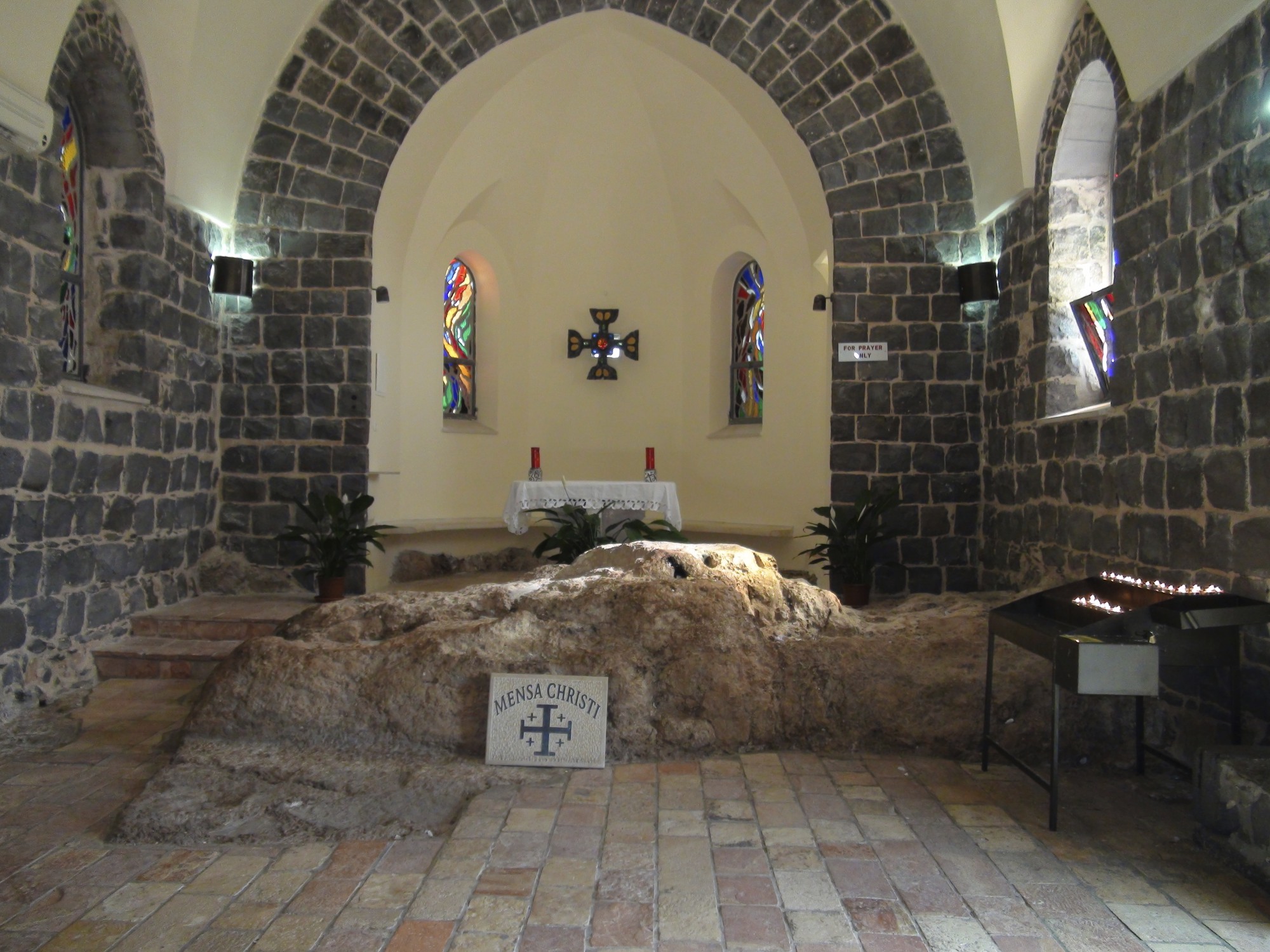
I think I know where this gospel took place– Tabgha, a quiet, wooded area on the Lake of Galilee just south of the ancient town of Capernaum. Easy walking distance from the town that was the center of Jesus’ ministry.

The name Tabgha comes from the seven springs of water flowing into the lake there. When I visited some years ago, flocks of birds were singing in the trees and drinking from the streams of water.

For centuries fishermen must have pulled for fresh water from the springs, and perhaps fry some fish over a fire on the beach. It’s a likely place where Jesus would come to pray. Tradition– two centuries-old churches are on the site–says he met his disciples here after his resurrection.

DSC00042

John’s gospel says that Peter and other disciples of Jesus came to Galilee after the Lord’s death and resurrection and went fishing. Through the night they caught nothing, but at dawn they heard a call from the shore to cast their nets out again.
“… Jesus was standing on the shore; but the disciples did not realize that it was Jesus.”

They caught of large catch of 153 fish. Jesus then called from the shore to come eat some fish at a fire he had started and he gave them bread and some fish to eat and revealed himself to them.

Peter has a leading role in this story. He jumped into the water to get to the shore. Then after they have eaten, Jesus takes him aside and three times asks the disciple who denied him three times, “Do you love me?” A beautiful statue  (above) marks that moment.

Three times the apostle who cursed and swore in the courtyard of the High Priest that he did not even know Jesus answers “Yes, I do. I love you.” And Jesus tells him “Feed my lambs. Feed my sheep.”

A great example of forgiveness . No scolding words or recriminations. No “I told you so.” No warning, “You do that again and …” No demotion, no putting on parole. Rather, Jesus gives Peter new responsibility. “Feed my lambs” as I do. A beautiful picture of God’s mercy.

Instead of punishing him, God calls Peter to new things. The mercy of God always calls us to something new, some new life.

Tabgha, along the Lake of Galilee where Jesus met his disciples, is a wonderful place to visit. I wonder if Jesus prayed here during his days in Capernaum and called his disciples to rest awhile. Here he communed with God his Father; here he prayed and forgave. His memory lingers at this lovely place besides the Sea of Galilee.

Prayer and forgiveness go together Jesus taught. “Forgive us our trespasses as we forgive those who trespass against us.” Today’s gospel tells us to pray and forgive. Maybe  someone  has hurt us, maybe there’s some situation we’re facing now. A job we don’t like, a home situation we’re angry about, something in society that upsets us.

Pray and forgive.