Category Archives: Passionists

A Voice That Passes Away

Spring Lake even

John the Baptist is a voice that passes away, according to St. Augustine:  “John is the voice, but the Lord is the Word who was in the beginning. John is the voice that lasts for a time; from the beginning Christ is the Word who lives for ever.”

John’s “voice” passes away. He no longer baptizes at the Jordan River. He cedes to the Word, and so should we. Our voice passes away; something of ourselves has to go– some of the things we hold dear, the friends who surround us,  the institutions that have upheld us.  Our way must give way to  God’s way.

We think so little of this.

Listen again to Augustine:  “What does prepare the way mean, if not be humble in your thoughts? We should take our lesson from John the Baptist. He is thought to be the Christ; he declares he is not what they think. He does not take advantage of their mistake to further his own glory.

“If he had said, “I am the Christ,” you can imagine how readily he would have been believed, since they believed he was the Christ even before he spoke. But he did not say it; he acknowledged what he was. He pointed out clearly who he was; he humbled himself.

“He saw where his salvation lay. He understood that he was a lamp, and his fear was that it might be blown out by the wind of pride.”

Feast of St. Nicholas

You would do a little friend, or child, or relative of yours a favor if you would introduce him or her to the real Santa Claus, St. Nicholas, whose feastday is today. My good friend, Mauro DeTrizio, whose family comes from Bari, Italy, has had a lifelong devotion to St. Nicholas. He’s also a good videographer and his dream has been to produce a video on St. Nicholas, our Santa Claus.

So we teamed up to produce a couple of them as part of our campaign for saving Santa Claus. Santa’s more than a salesman; he’s a saint, and his gift for quiet giving is in the spirit of our coming season of Advent and Christmas. He mirrors God’s love shown in Jesus Christ.

Telling his story is one of the ways to save him from being captured by Macys and Walmart. Previously, we offered a version for little children. Now here’s another modest contribution for bigger children– like us:

http://www.youtube.com/watch?v=ADevygB9jNs

Macarius, the Desert Monk

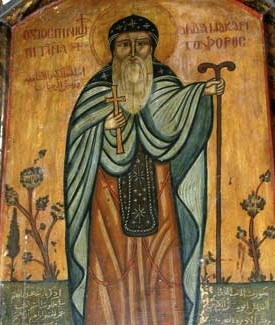
Macarius, a monk from 4th century Egypt, tells us why God sent Jesus, his Son, into a world that’s become a desert, an empty house, an unused path. One reason monks like him preferred to live in the desert was their belief that a redeeming God could make a desert  flower again.

“When a farmer prepares to till the soil he must put on clothing and use tools that are suitable. So Christ, our heavenly king, came to till the soil of humanity devastated by sin. He assumed a body and, using the cross as his ploughshare, cultivated the barren human soul. He removed the thorns and thistles which are the evil spirits and pulled up the weeds of sin. Into the fire he cast the straw of wickedness. And when he had ploughed the soul with the wood of the cross, he planted in it a most lovely garden of the Spirit, that could produce for its Lord and God the sweetest and most pleasant fruit of every kind.”

Artists, like the one who painted Macarius (above),  clothed the desert monks in the finest, brightest clothes, though in real life they were surely quite shabbily dressed. Yet because they were God’s redeemed they were robed in fine cloths, no matter  how their neighbors saw them. They walked in a “lovely garden of the Spirit that could produce for its Lord and God the sweetest and most pleasant fruit of every kind.”

They were signs of a redeemed world.

Caring for Creation

f

St. Francis is one of those super saints  to keep in mind, even after his feast day. I mentioned in a previous blog the statue of Francis facing St. John Lateran and Pope Innocent’s dream of a young man who, like Francis, held up the church’s walls ready to fall.  Francis helped renew the church.

In his encyclical Laudato Si, Pope Francis paints a verbal picture of Francis, holding his arms out to the created world, caring for our endangered planet:

“I believe that Saint Francis is the example par excellence of care for the vulnerable and of an integral ecology lived out joyfully and authentically. He is the patron saint of all who study and work in the area of ecology, and he is also much loved by non-Christians. He was particularly concerned for God’s creation and for the poor and outcast. He loved, and was deeply loved for his joy, his generous self-giving, his openheartedness. He was a mystic and a pilgrim who lived in simplicity and in wonderful harmony with God, with others, with nature and with himself. He shows us just how inseparable the bond is between concern for nature, justice for the poor, commitment to society, and interior peace.

“Francis helps us to see that an integral ecology calls for openness to categories which transcend the language of mathematics and biology, and take us to the heart of what it is to be human. Just as happens when we fall in love with someone, whenever he would gaze at the sun, the moon or the smallest of animals, he burst into song, drawing all other creatures into his praise. He communed with all creation, even preaching to the flowers, inviting them “to praise the Lord, just as if they were endowed with reason”.

“His response to the world around him was so much more than intellectual appreciation or economic calculus, for to him each and every creature was a sister united to him by bonds of affection. That is why he felt called to care for all that exists. His disciple Saint Bonaventure tells us that, “from a reflection on the primary source of all things, filled with even more abundant piety, he would call creatures, no matter how small, by the name of ‘brother’ or ‘sister’”. Such a conviction cannot be written off as naive romanticism, for it affects the choices which determine our behaviour.

“If we approach nature and the environment without this openness to awe and wonder, if we no longer speak the language of fraternity and beauty in our relationship with the world, our attitude will be that of masters, consumers, ruthless exploiters, unable to set limits on their immediate needs. By contrast, if we feel intimately united with all that exists, then sobriety and care will well up spontaneously. The poverty and austerity of Saint Francis were no mere veneer of asceticism, but something much more radical: a refusal to turn reality into an object simply to be used and controlled.

What is more, Saint Francis, faithful to Scripture, invites us to see nature as a magnificent book in which God speaks to us and grants us a glimpse of his infinite beauty and goodness. “Through the greatness and the beauty of creatures one comes to know by analogy their maker” (Wis 13:5); indeed, “his eternal power and divinity have been made known through his works since the creation of the world” (Rom 1:20). For this reason, Francis asked that part of the friary garden always be left untouched, so that wild flowers and herbs could grow there, and those who saw them could raise their minds to God, the Creator of such beauty. Rather than a problem to be solved, the world is a joyful mystery to be contemplated with gladness and praise.”

I like the pope’s words: “Rather than a problem to be solved, the world is a joyful mystery to be contemplated with gladness and praise.”

The Conversion of Paul

Saints show us our capabilities, how far we can rise, from the depths to the heights. That’s why the church recalls the conversion of St.Paul a number of times in the church year. Today we hear it as part of our readings from the Acts of the Apostles.  As he readily acknowledges, Paul rose from the dust and became a powerful force in his church and in the world through God’s grace.

St. John Chrysostom says of him:  “Paul, more than anyone else, has shown us what we really are, and in what our nobility consists, and of what virtue a human being is capable. Each day he aimed ever higher; each day he rose up with greater ardour and faced with new eagerness the dangers that threatened him. He summed up his attitude in the words: I forget what is behind me and push on to what lies ahead. When he saw death imminent, he bade others share his joy: Rejoice and be glad with me! And when danger, injustice and abuse threatened, he said: I am content with weakness, mistreatment and persecution. These he called the weapons of righteousness, thus telling us that he derived immense profit from them…

The most important thing of all to him, however, was that he knew himself to be loved by Christ.”

May God raise up the Paul in us.

Accounts of Jesus’ Resurrection

A Book for Lent

St. Paul Cross

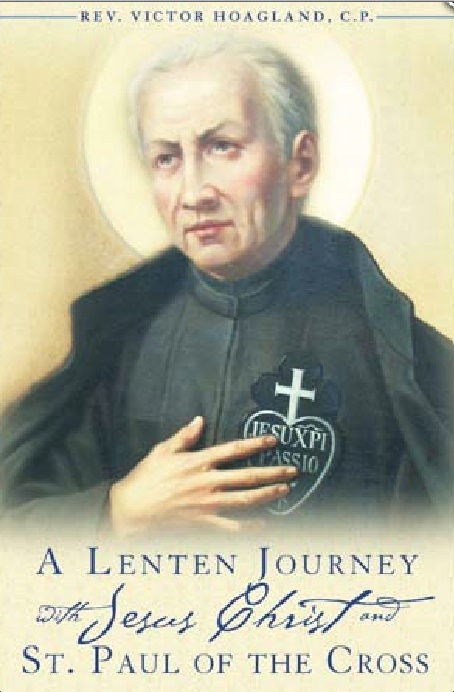
Lent begins next Wednesday, February 14th. Some years ago a publisher asked me to write a book entitled A Lenten Journey with Jesus Christ and St. Paul of the Cross, to be part of a series of reflections on the daily lenten gospels that included thoughts of saints of different religious orders. The book has just been translated into Japanese.

I was initially skeptical about the project. From early on I’ve seen lent as a time to give up something and take up some devotional practice like the Stations of the Cross. Yes, Lent was a journey with Jesus, and I appreciate the daily scriptures that take us through the season with him, but where does a saint come in, even a saint important to me, like St. Paul of the Cross, the 18th century founder of my community the Passionists ?

Working on the book made me see lent differently. First, for St. Paul of the Cross lent was a time to leave the quiet mountain at the edge of the Mediterranean Sea where he lived and prayed and go to work in the Tuscan Maremma, then a swampy, malaria infested region of Italy, overrun with robbers and desperately poor. All through lent, carrying a cross and a bible Paul went from village to village preaching God’s love to people whose lives were often on edge with fear and lost hope.

Lent isn’t a time for turning inward, away from world you live in, Paul reminds me. Lent is a time to go out to the wounded world before you.

Secondly, Paul engaged his world, the world of the Tuscan Maremma, in the light of the gospel, especially the Passion of Jesus Christ. For him that mystery was not limited to a time long ago, when Jesus suffered on a Cross; it was there in the people before him. From village to village, he held up a Cross to anyone who would hear as a mirror of their reality and a pledge of the great mercy of God. Jesus died and rose again.

The Passionists celebrate two feasts immediately before Ash Wednesday to prepare for Lent. Last Friday we celebrated the Commemoration of the Passion of Jesus Christ. Tomorrow, Tuesday before Ash Wednesday, we celebrate the Prayer of Jesus in the Garden. Both feasts come from our missionary founder.

I can see him packing his bags for his lenten journey down the quiet mountain for the villages and towns of the Tuscan Maremma. He must remind himself what he will see. He must pray so he doesn’t forget.

“May the Passion of Jesus Christ be always in our hearts.”

How Do We Learn and Pray Now?

Education is up in the air these days. Our schools are struggling. How will kids be educated?

Our faith formation programs are struggling too. The Mass and sacraments–ordinary ways we pray–are drastically curtailed. What do we do?

Could our homes and families become our churches? Can we find teachers and  temporary sacraments there?

A friend of mine was in prison for awhile and ended up once in solitary confinement after a fight he had with another inmate. He told me he remembered in the dark what a nun had told him about the rosary. Ten Hail Mary’s and an Our Father. He started counting the prayers on his fingers and, after awhile, he found a great peace came over him, so much so that after getting out of confinement he asked the chaplain for a rosary. It led to a profound conversion. He was changed by the experience there in the dark.

We’re living in the dark these days, but do these days have to diminish us? Maybe we can learn to pray more simply these days. Simple prayers we may have abandoned, maybe there’s a bible or a prayerbook lying forgotten in a drawer. Simple prayers are always the best,  because God takes simple form to come to us. Jesus came “in the form of a slave,” remember, he used simple things like bread and wine to bring us his greatest gift. 

This could be a time to pray simple prayers and to teach them to our kids. You never know when they’ll bring them peace.

Martha Revisited

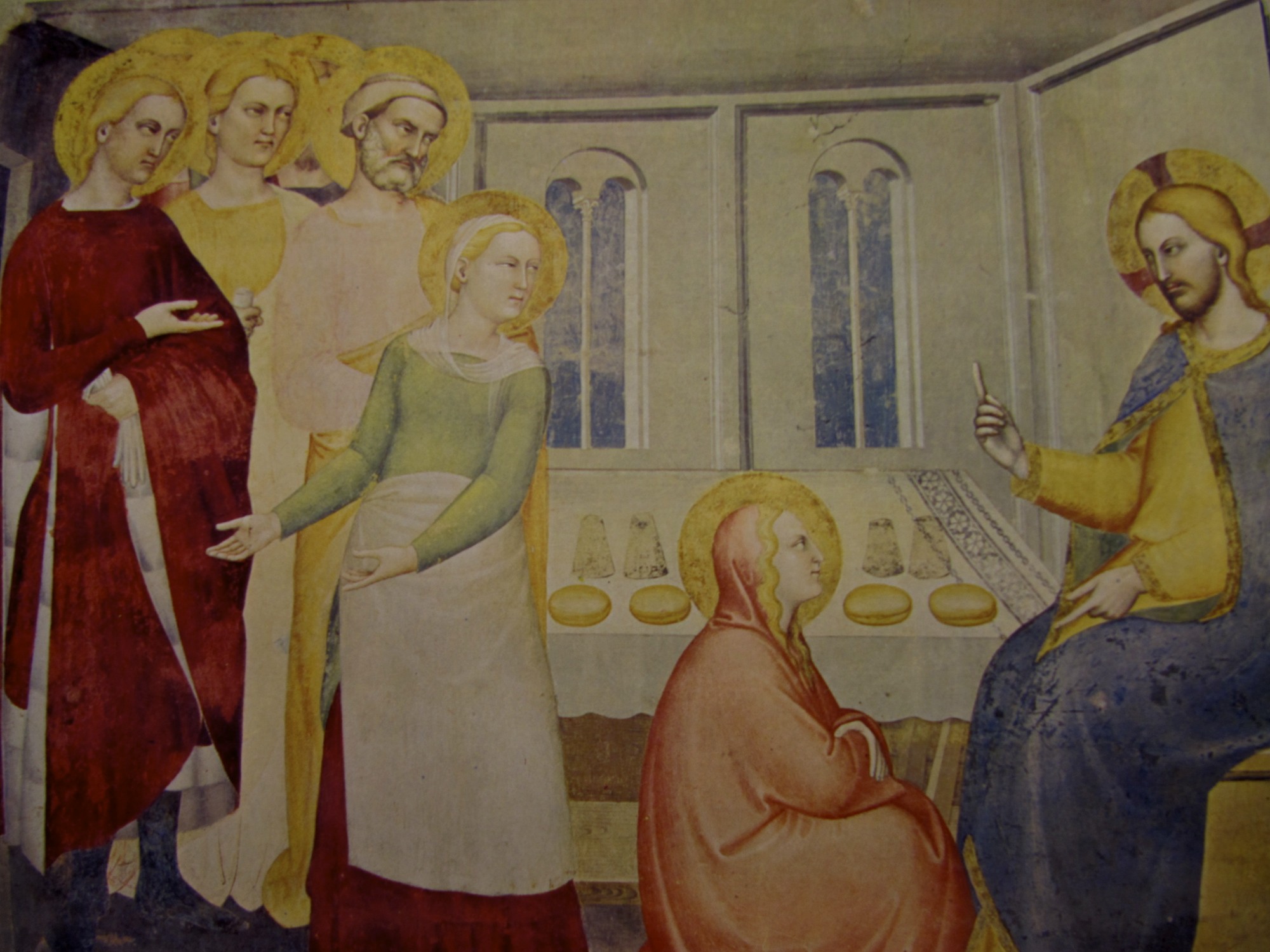
We listen to scholars who study the bible. How about artists too? Here’s  the 13th century Tuscan artist, Giovanni di Milano, looking into Luke’s gospel about  Jesus with Martha and Mary at Bethany.

The artist adds some delightful details of his own to Luke’s account. He’s let his imagination roam. The table’s set for four people. That would be Jesus, Lazarus, Mary and Martha.

But, who are those others coming in the door?  Obviously, they’re Jesus’ disciples, led by Peter. One of them gestures towards Peter, as if saying, “He told us to come.”

Poor Martha in her apron holds up her hands, “What are we going to do?”

There will be no miracle, except the miracle of Martha’s hospitality.

More than four are going to be fed.

We need to read the gospels like this too.

Almighty ever-living God, your Son was welcomed in Martha’s house as a guest, grant, we pray, that through her intercession, serving Christ faithfully in our brothers and sisters, we may be received by you in the halls of heaven.Through our Lord Jesus Christ, your Son, who lives and reigns with you in the unity of the Holy Spirit, one God, for ever and ever.

Kateri Tekakwitha (1656-1680)

KATERI

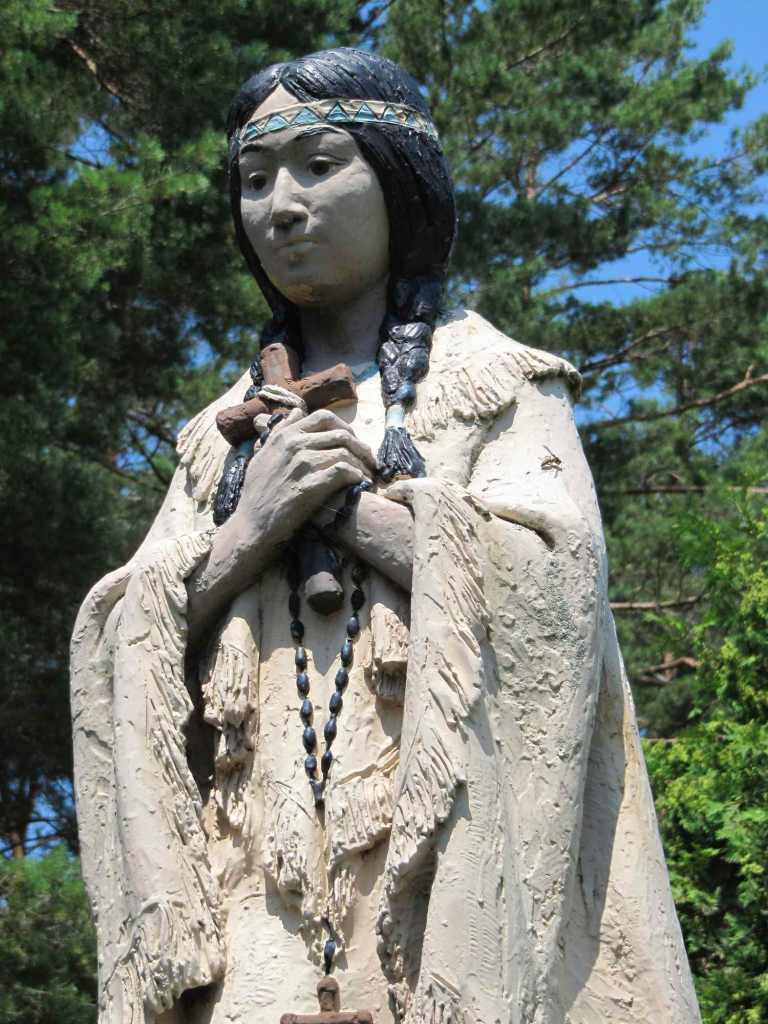
Kateri statue, Auresville

Sometime ago I stumbled on a map of New York rivers and lakes.  The rivers and lakes were the roads and highways used by the native peoples and early settlers centuries ago. Even today, the New York Thruway follows the Hudson and Mohawk Rivers from New York City to Buffalo.

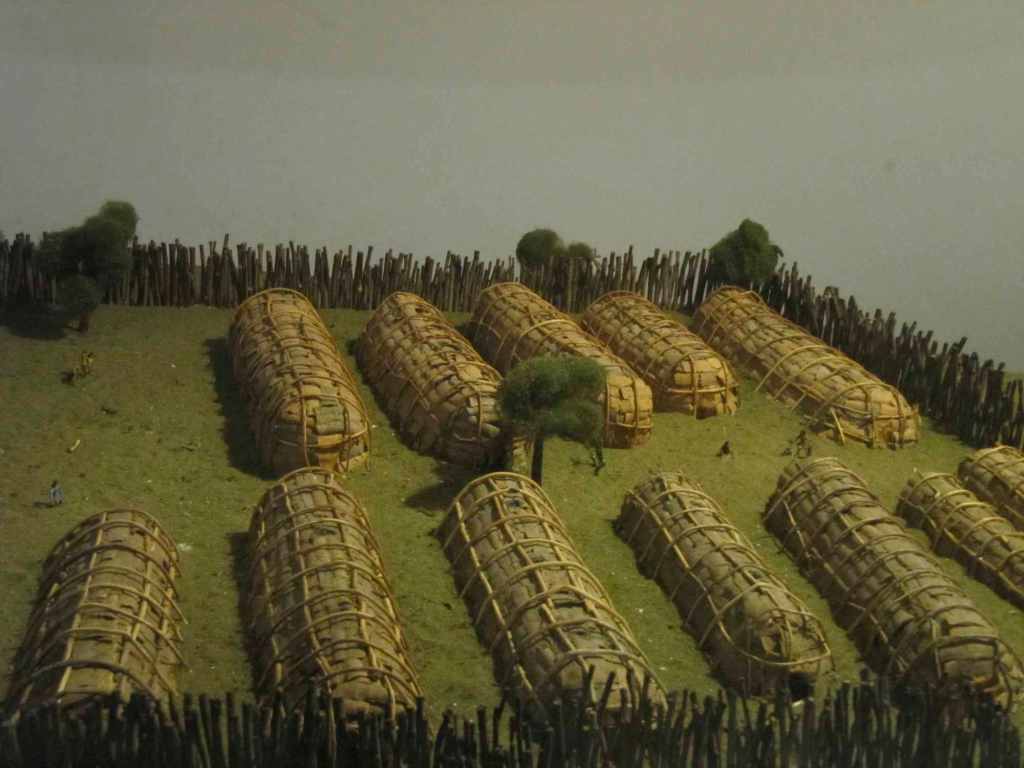
Just north of Albany near the town of Fonda are the ruins of the17th century Mohawk village of Caughnawaga, excavated in the 1950s by a Franciscan priest,  Thomas Grassmann. In the excavated village are traces of 12 long houses surrounded by a fortified stockade which was built in 1666 after a French army from Quebec destroyed an earlier Mohawk village at Osserneron (today, Auriesville) a few miles south.
VILLAGE

Model of Longhouses, Fonda

The French army was punishing the Mohawks for their part in the Iroquois-Huron wars, when they plundered and destroyed villages along the St. Lawrence River belonging to the Hurons and Algonquins, Indian allies of the French. The Mohawks, members of the Iroquois confederation, wanted to gain control of the fur trade from their northern neighbors.

In destroying Ossernenon, the French army was also probably avenging the deaths of Fr. Isaac Jogues, SJ, and Rene Goupil and Gabriel Lalande, three French missionaries  killed in that village some years before:  honored  today by the Church as martyrs.

In the war against their neighbors to the north, the Mohawks  took women and children captive.  At the time,  native tribes replenished  their own numbers–diminished by wars or disease– by kidnapping members from other tribes. One of the Christian Algonquin women captured in an earlier raid married a Mohawk brave from Ossernenon and they had a daughter,  Kateri Tekakwitha (1656-1680), whom the Catholic Church  honors as a saint.

An epidemic of smallpox ravaged Ossernenon when Kateri was four years old, killing   many children and adults. The young girl almost died of the disease that left her disfigured. Her early Jesuit biographer says, “ She almost lost her eyesight, and her eyes hurt so much from this illness that she covered herself with a blanket when out in strong light.” (The Life of the Good Catherine Tekakwitha, Claude Chauchetiere, SJ , 1695)

Both parents died when Kateri was a little girl and she was taken in by relatives in the new Mohawk village of Caughnawaga, where she lived most of her life. Her mother was a devout Christian and must have told her about Christianity, but Kateri’s new family and  tribe strongly opposed the religion.

The French military, as one condition for not returning to the Mohawk villages, demanded that Jesuit missionaries be allowed to visit them and minister to captive Christians or others interested in their faith. Jesuit missionaries visited Caughnawaga for three days in 1667 and received hospitality in the long house where Kateri lived with her uncle, a Mohawk leader opposed to Christians.

According to witnesses, Kateri  was a normal Indian girl and young woman.  “She brought wood and tended the fire when her aunt ordered her, and got water when those in the long house needed it. When she had nothing to do she amused herself making small jewels and dressing as other girls of her age. She placed shell bead necklaces around her neck, shell bead bracelets on her arms, rings on her fingers and ornaments in her ears.” (The Life of the Good Catherine Tekakwitha, Claude Chauchetiere, SJ , 1695)
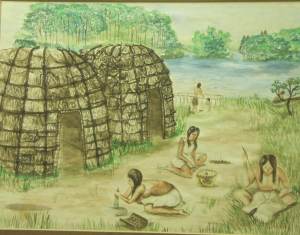
Though sickly, she was not lazy or proud. She never talked about others. Timid, she avoided dances and games. She didn’t like seeing captives harmed or people tortured, witnesses said.

In the spring of 1675  Jesuit Father Jacques de Lamberville visited Caughnawaga . Kateri was alone in her long house because a foot injury prevented her from working in the fields and the priest entered her lodge. She spoke to him of her desire to receive baptism and on Easter, 1676, the young Indian girl was baptized and took the name Kateri, after St. Catherine of Siena, the mystic and a favorite patron of Christian Indian women. She was 20 years old.

Her uncle and relatives in the long house opposed her conversion to Christianity and pressured her to marry and follow their ways, though against  her beliefs. The early Jesuits considered it a miracle for a Christian to resist family and tribal pressure such as Kateri experienced in Caughnawaga. Yet, her early biographer says “She practiced her faith without losing her original fervor and her extraordinary virtue was seen by all. The Christians saw her obeying their rules exactly, going to prayers every day in the morning and evening and Mass on Sunday. At the same time she avoided the dreams feasts and the dances,” practices endangering her belief.  (The Life of the Good Catherine Tekakwitha, Claude Chauchetiere, SJ , 1695)

Father de Lamberville finally recommended that Kateri escape to the newly-established  Indian Christian village in Kahnawake near Montreal, where she could live her faith more easily. In 1676, aided by other Christian Indians, she made the dangerous journey northward.  There she lived a fervent life of prayer and faith;  she died and was buried on April 17th, 1680.

KATERI 2

Early Painting of Kateri, Fonda

She was canonized by Pope Benedict XVI on October 21, 2012, Her feast day is July 14.