Category Archives: Passionists

Praying with the Creed

I often find myself these days praying the Apostles’ Creed and dwelling especially on that first statement: “I believe in God the Father Almighty, creator of heaven and earth.” I need to strengthen my belief  that God created our world, sustains it in being and guides it to glory.

Two different versions of the creed have come down through the centuries. The Apostles’ Creed is the oldest, still in use today. It’s a summary of faith given to men and women who were being baptized in the early church to help them remember Christian belief. It summarized a faith taught by the apostles.

I like that creed because it’s so simple. In the Catholic church it can be used in the liturgy during Lent and at other times in place of the Nicene Creed. It’s traditionally said at the beginning of the rosary. Prayer books recommend we say it at the beginning of prayer. Good idea.

In a sermon preached in 4th century to prepare people for baptism, St. Cyril of Jerusalem said the creed is related to the scriptures and the rest of the things in church.

“Although not everyone is able to read the Scriptures, some because they have never learned to read, others because their daily activities keep them from such study, still so that their souls will not be lost through ignorance, we have gathered together the whole of the faith in a few concise articles…

“So for the present be content to listen to the simple words of the creed and to memorize them; at some suitable time you can find the proof of each article in the Scriptures. This summary of the faith was not composed at man’s whim, the most important sections were chosen from the whole Scripture to constitute and complete a comprehensive statement of the faith.

“Just as the mustard seed contains in a small grain many branches, so this brief statement of the faith keeps in its heart, as it were, all the religious truth to be found in Old and New Testament alike. That is why, my sisters and brothers, you must consider and preserve the traditions you are now receiving. Inscribe them in your heart.”

The creed sums up all our belief; like a searchlight it gives power to see so much more, it leads us into the most profound  mysteries, and at the same time in its simplicity it helps us find our way through an often bewildering world. The creed is something we can fall back on to go forward.

Here’s  the Apostles’ Creed:
I believe in God, the Father almighty,
creator of heaven and earth.
and in Jesus Christ, his only Son, our Lord.
who was conceived by
the Holy Spirit,
born of the Virgin Mary,
suffered under Pontius Pilate,
was crucified, died and was buried;
he descended into hell;
on the third day he rose again
from the dead.
He ascended into heaven
and is seat at the right hand
of God the Father almighty;
from there he will come to judge
the living and the dead.
I believe in the Holy Spirit,
the holy, catholic Church,
the communion of saints,
the forgiveness of sins,
the resurrection of the body
and life everlasting. Amen


Ezekiel, Words for Hard Times

jewsinexile
Jewish captives led to Babylon, 6th century BC


We begin reading the Prophet Ezekiel weekdays at Mass. He was a priest brought captive to Babylon along with King Johoiachin and members of the Jewish elite after the Babylonians crushed the Jewish revolt  in 597 BC. He could be one of those pictured above, on their way to exile .

The Jewish elite taken to Babylon were convinced God would never permit Jerusalem to be destroyed. When it was destroyed, they were just as convinced it would be rebuilt quickly. You’re wrong in both cases, Ezekiel tells them. Jerusalem will be destroyed and it won’t be God’s fault– it’s yours. You are unfaithful leaders.

“Thus says the Lord GOD: Woe to the shepherds of Israel
who have been pasturing themselves!
Should not shepherds, rather, pasture sheep?
You have fed off their milk, worn their wool,
and slaughtered the fatlings,
but the sheep you have not pastured.
You did not strengthen the weak nor heal the sick
nor bind up the injured.”

Jerusalem won’t be restored by your power either, Ezekiel says. It will take time, and it will come in God’s time, not yours, by God’s power, not yours. In the meantime, ask God to take away your hearts of stone and give you natural hearts.

The Jewish leaders didn’t like Ezekiel’s message:

“Son of man, listen! The house of Israel is saying, ‘The vision he sees is a long time off; he prophesies for distant times!’ Say to them therefore: Thus says the Lord GOD: None of my words shall be delayed any longer. Whatever I say is final; it shall be done.”

Hard times lead to impatience, to blaming others, to thinking God is absent, but hard times are blessed times, Ezekiel says, when God is more present than ever. God will save his people.

“Thus says the Lord GOD,”

I swear I am coming… I will claim my sheep…I will save my sheep…
I myself will look after and tend my sheep.” (Ezekiel 34,1-11)

Good words for us today?

Browsing Through A Library

From time to time I like browsing through the large collection of books we have downstairs. Libraries, bookstores, now the internet, are treasuries and junkyards all at once. You never know when you’re going to stumble upon something that sparks questions or open your mind. 

Awhile ago, I stumbled on a book called Pride of Place: The Role of Bishops in the Development of Catechesis in the United States, by Sr. Mary Charles Bryce. It’s  a study of catechisms and catechesis in our country from the time of Bishop John Carroll, way back in the 18th century, to the 1980’s. How are we going to teach and form our people in faith? That’s the question they were asking then. It’s a question we face now.

Catechesis is on my mind lately. We’ve had a big development in theology and scripture and liturgy since the Second Vatican Council in the 1960s, but has that reached the ordinary people of the church, young or old? I think we need a better way to make the riches of our faith available to them. Catechesis is one of our prime needs as Catholic schools decline and dioceses, parishes, religious orders and their resources diminish.

“Pride of Place” Sister Bryce called her book, a title from an old pastoral letter of the American bishops on catechesis. Not a bad priority for the church today. How are we going to pass on the faith we have received in our time. What are the words and ways we’re going to use? Pope Francis in his recent letter Desiderio Desideravi calls us to see the liturgy as a catechetical school.

The Eternal Word needs to become incarnate from age to age:

“For last year’s words belong to last year’s language
And next year’s words await another voice.”  (T.S. Eliot)

We need to renew our liturgical life. We need  good catechetical sites online and there’s still something to be said for the books in our library downstairs. They were gathered by people before me, who were wondering about things as I am now.  Someone recognized  Sister Bryce’s book was a good book to hold on to.

Thanks.

Daily Prayer

We celebrate the feast of St. Thomas More today, June 22. Holbein’s painting of More and his family, holding their books, portrays a family that prized learning and prayer. More made sure his daughters were well-educated.

Some of those books, I would guess, are their prayerbooks, not unusual in those days. Daily prayer is part of Catholic life and prayerbooks with psalms, prayers and personal reflections were important to those who could read and afford them.

In these uncertain days, are we being called to daily, personal prayer? Prayerbooks (and blogs) may becoming more important for us, as Sunday Mass and parish based sacraments become weaker. So thank you, More and your family, for reminding us what we might do at home.

The prayer Jesus taught his disciples, the Our Father, was a daily prayer, one of the ways we get ready for what God sends each day. We’re children of God and should act like God’s children each day.

We need to live each day with large vision, doing our part that God’s kingdom come, “on earth as it is in heaven.” We need “daily bread” of all kinds. We’re part of a messy world that’s torn apart by selfishness and smallness and pride. “Forgive us our trespasses, as we forgive those who trespass against us.” We need light to go by the right path. “Deliver us from evil” and guide us to do good.

I don’t think St. Thomas More could have lived so heroically in the world he lived in without daily prayer. It brings vision and grace to us; it’s daily bread.

Daily Readings, Daily Bread

Reading the scriptures daily and on Sundays in the lectionary and the Liturgy of the Hours is one of the great reforms begun by the Catholic Church after the Second Vatican Council. It’s an effort to seek renewal through the Word of God, yet after 60 or so years we’re still getting used to it. Not too many individuals or parishes or other groups in the Catholic Church focus on it, in my view.

Early Christianity saw the scriptures as daily bread. Today we may think the scriptures old and and not up to offering wisdom to our age. More than ever, we have to trust if we search for “the face of God” in scripture we will find it there.

“If today you hear his voice, harden not your hearts.” The daily scriptures are daily bread, but they may not be easy to digest. We go from Matthew, preoccupied with the tensions of his church with Pharisaic Judaism,  to Luke preoccupied with an outreach to the gentiles, to the other New Testament writings, each with its own purpose.

Then there are the various readings of the Old Testament. They can be hard to understand, but the church wisely keeps them side by side with the New Testament. They hold a treasure all their own. We need to understand them better.

We need help to appreciate this daily bread, this varied diet served up. We need people like those hosts on the cooking shows on television who not only  tell you what to eat but make those strange dishes appetizing and appealing. We need good homilists and good catechists.

We need a “lamp, shining in a dark place.” So we ask: Come, Holy Spirit, fill our hearts with your light.”

Lamp for a Dark Place

Spring Lake even

The sky over the boardwalk at Spring Lake, New Jersey, is sometimes swept with colors before nightfall. Then, a lamp becomes the only light till dawn.


“I came into the world as light,” Jesus says in today’s gospel” so that everyone who believes in me might not remain in darkness.( John 12:44-50)


The sun will rise again and the great Sun will also rise again, Augustine says in one of his sermons. Then  “lamps will no longer be needed. When that day is at hand, the prophet will not be read to us, the book of the Apostle will not be opened, we shall not require the testimony of John, we shall have no need of the Gospel itself. Therefore all Scriptures will be taken away from us, those Scriptures which in the night of this world burned like lamps so that we might not remain in darkness.”

Darkness is temporary; we are meant for light.

“I implore you to love with me and, by believing, to run with me; let us long for our heavenly country, let us sigh for our heavenly home, let us truly feel that here we are strangers. What shall we then see? Let the gospel tell us: In the beginning was the Word and the Word was with God and the Word was God. You will come to the fountain, with whose dew you have already been sprinkled.

“Instead of the ray of light which was sent through slanting and winding ways into the heart of your darkness, you will see the light itself in all its purity and brightness. It is to see and experience this light that you are now being cleansed. Dearly beloved, John himself says, we are the sons of God, and it has not yet been disclosed what we shall be; but we know that when he appears we shall be like him, because we shall see him as he is.

“I feel that your spirits are being raised up with mine to the heavens above; but the body which is corruptible weighs down the soul, and this earthly tent burdens the thoughtful mind. I am about to lay aside this book, and you are soon going away, each to his own business. It has been good for us to share the common light, good to have enjoyed ourselves, good to have been glad together. When we part from one another, let us not depart from him.”

A Little Boy, Five Barley Loaves and Two Fish

Andrew, brother of Peter, says to Jesus when he asked his disciples to provide food for a hungry crowd: “There is a boy here who has five barley loaves and two fish; but what good are these for so many?” (John 6:1-15)

Duk Soon Fwang, an artist friend of mine, has been thinking a good while about that little boy and what he brought to Jesus. “We don’t know the little boy’s name and he only has a few loaves and fish to give. He’s like me,” she said. “But Jesus sees what he brings and makes it more.” 

She’s almost completed a painting of the boy and Jesus, which you can see above. 

At Mass this morning, we read that gospel story before we brought small pieces of bread and a cup of wine to the altar. I remembered what she said. This is our story. We bring what we have and God makes it more.

More on Duk Soon and her work here and here.

Where did it happen?

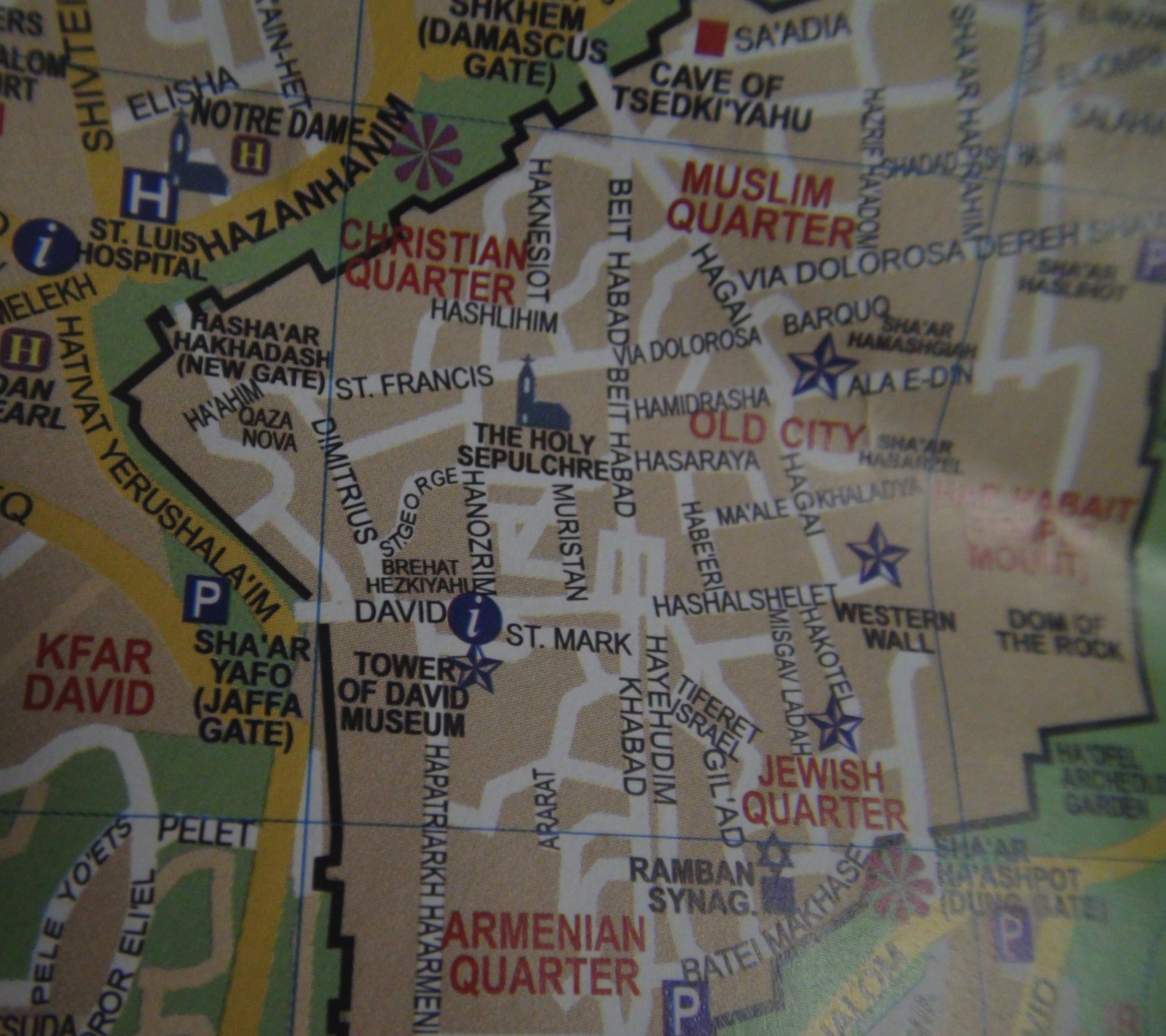
We wonder where the gospel events took place, especially during Holy Week.. Where was Jesus judged by Pilate? What way did he go to Calvary?  Where was he crucified and where was he buried?

Reliable historians generally agree that the tomb of Jesus and the site of Calvary are  in the Church of the Holy Sepucher.  “Is this the place where Christ died and was buried?” Jerome Murphy-O’Connor asks in his solidly researched “The Holy Land: An Oxford Archaeological Guide” (New York, 2008). “Yes, very probably,” he answers. (p 49)

Holy sepul

Church of the Holy Sepulcher, Jerusalem

Jerusalem’s “Via Dolorosa”, the traditional way of the cross,  is less historically reliable. Beginning near St. Stephen’s Gate, where the Fortress Antonia once stood, it winds up at the Church of the Holy Sepulcher.  Murphy-O Connor says it is “defined by faith and not by history.” (pp 37-38) Early Christian pilgrims created it.

DSC00267

Pilgrims on the Vis Dolorosa

After the Christian church was established by Constantine in the 4th century, pilgrims from Mount of Olives, where many stayed, walked through St. Stephen’s Gate up to the Church of the Holy Sepulcher, stopping at certain places to recall incidents from the passion of Jesus. The present Via Dolorosa was formed from their devotions over the centuries.   (cf. Murphy-O’Connor, p 37) Pilgrims, not archeologists, have given us the present Via Dolorosa.

Jerusalem

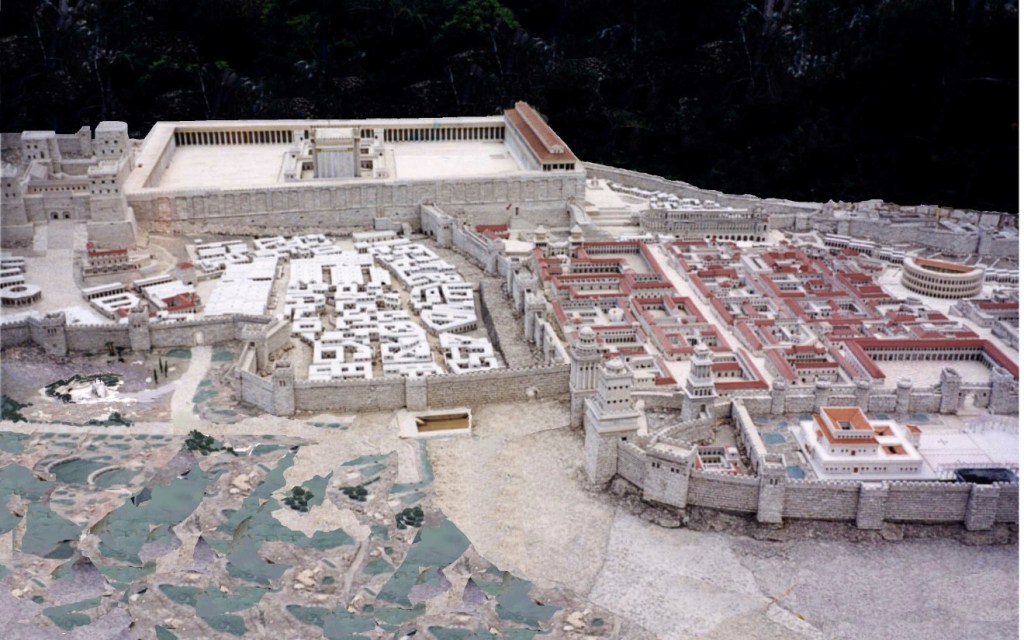
Jerusalem at the Time of Jesus

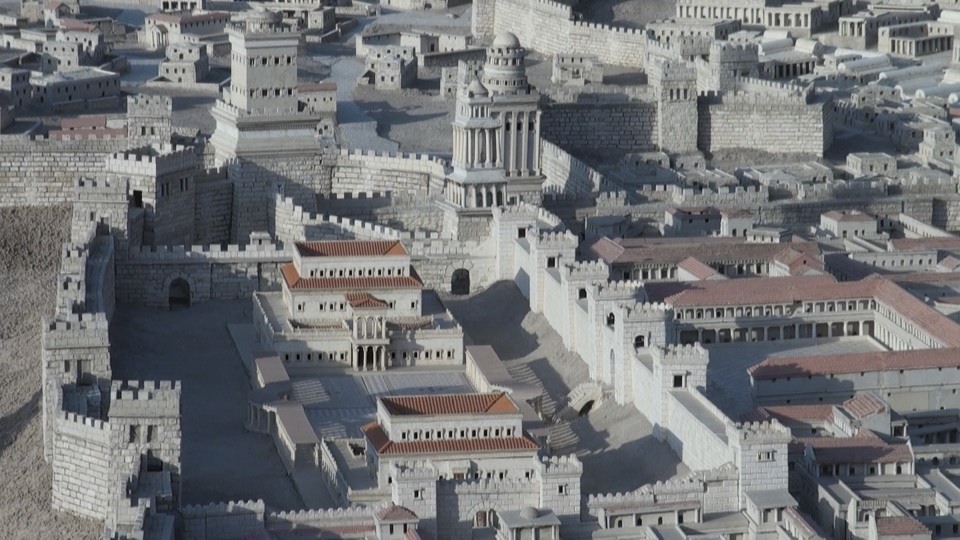
Is their a more reliable way?  A reconstruction of Jerusalem (above) from the time of Jesus at the Israel Museum–somewhat altered here– suggests another way that  Jesus was led to Calvary.  At the bottom right is the luxurious palace complex built by Herod the Great. (below) When Pontius Pilate came from Caesaria Maritima for Passover he probably stayed there and judged Jesus in the courtyard outside the palace.

DSC00291

Herod’s Palace, the Citadel

After sentencing Jesus to death, Pilate handed him over to a detachment of soldiers quartered somewhere in the great towers to the left of the palace, who scourged him and crowned him with thorns.

They then led him away to Calvary, probably parading him through part of the upper city as a warning to others. In our map of Jerusalem above, the rock outcropping near to the city wall is the site of Calvary where Jesus was crucified. The gospels say  he was buried in a tomb only a stone’s throw away.
DSC00317

In Jerusalem today the Citadel stands on the ruins of Herod’s palace, still dominating the western part of the Old City.

You can walk on the southern ramparts of the city wall where Herod’s palace once stood and view some few remains of Herod’s building;  the towers have been rebuilt.

Murphy-O’Connor suggests a way  Jesus was taken to Calvary from here. “If, as seems likely, Jesus was brought into the city on his way to execution, the approximate route would have been east on David Street, north on the Triple Suk, and then west to Golgotha.” (p.38)

I walked that way some years ago, down David Street, to the Triple Suk and then west to Golgotha and the Church of the Holy Sepulcher.  My sense is Murphy-O’Connor is right, but I think we better not change the Via Dolorosa. For one thing,  good piety has given us the present Via Dolorosa and it has a truth and beauty all its own.  More importantly, it would start a war in Jerusalem, and the city has enough grief now.

DSC00289

For more information on the places of the Passion, see

Discovering Him

 I retired about fourteen years ago. My husband, Orlando and I had great plans for our retirement. We wanted to travel, to relax, to have fun! But that wasn’t to be. God had other plans for us! Orlando’s parents in Florida got very ill and we were needed there. We became snowbirds , 6 months here and 6 months in Florida. Around that same time Orlando and I baptized our fourth grandchild, Isabel in a church if Florida. The day of the baptism our son and his wife had a surprise for us. After the baptism we were able to renew our marriage vows in front of our Lord Jesus Christ. For us that was very special because we had not gotten married in the church, we had been married about 25 years but at the court. It didn’t matter to us back then. We had spent over 40 years without God, at that time a church wedding hadn’t been important to us. Neither one of us had come from a religious family. When the priest started blessing us and our rings something happened to us in that ceremony. We were crying and laughing both at the same time. Grace was being poured on us from above!

    After that experience Orlando started convincing me to go to church on Sundays. He had been caught by the fever! Jesus had gotten his hands on him. Not so for me! Going to mass was a burden. Many times I would leave the church worse than how I had gone in. It was boring and ritualistic. But yet I wanted to make Orlando happy, so I would go. For some reason around that time I started having the urge to get married in front of God. I loved Orlando so much that I felt that maybe this would make our marriage even stronger.

    I had never been confirmed. My parents weren’t very religious. In Cuba, where I come from, I got baptized and had my First Communion but after that church did not come back into my life. Here in the U. S. life was hard. We were refugees . The Catholic Church was a great help but it didn’t inspire us to go back to it.

Well you can see what my problem was. I tried to marry Orlando in the Catholic Church but then I found out I needed to be confirmed. Was it worth it? Did I really need to marry Orlando in front of God? How was I going to work it out? I was here in NY for 6 months and in Florida the next 6 months. How would it work out with RCIA? You know now I realize that God had a plan for us as a married couple. Things worked out between our local parish here, American Martyrs Church in Bayside. NY,  and the local church in Hallandale Beach, FL where we were renting.

     In 2011 I was finishing my RCIA in St Matthew’s Church in Florida. We were told there was going to be a four day Mission at the church. We weren’t sure what that was but yet we were intrigued by what it might be. The first day we were there a priest all dressed in black with a giant heart on the left side of his chest, a giant rosary hanging from this thick belt, and a giant crucifix in his hand came to the pulpit and introduced himself, ” I am Fr. Vincent Youngberg and I am an alcoholic. ” That was a great way to start! He was a sinner just like me! During the next few days with his story and his preaching he slowly brought me closer to understanding why I was doing what I was doing. He led me to believe that Jesus, that God, wanted a relationship with me. He helped me to believe that he did exist!

The last day of the Mission Fr Vincent led us in a meditation. He said:

    “Everyone please close your eyes. Now imagine yourself sitting on the sand. You’re watching the ocean, relaxing under the warm sun. From the corner of your eye you notice a person walking towards you. You can’t see him well yet, but he looks like he might be walking straight for you. He is getting closer and closer and your heart is beating faster and faster because you can’t believe your eyes. Suddenly you realize that the person you saw in the distance that now is so close to you is no other than our Lord Jesus Christ. He comes close to you extends his hand towards you and gets you to stand up…..”

    Fr. Vincent continued but I was no longer listening. I was face to face with Jesus! I couldn’t believe what was happening to me. I was crying and laughing. I couldn’t find words to say, but I didn’t have to. He took me in his arms and said, ” Berta, you have no idea how much I love you. I have been wanting you to open the door to me for a long time. I am so happy that you are in my arms now. I will never let you go!” I had melted into his body. The hug he was giving me was delicious! Life was perfect. But then I became aware of Fr. Youngberg’s voice again bringing us back. I didn’t want to leave my Jesus, now that I had met him. But it was time and we had to part. I was back in the church crying like a little girl. They weren’t tears of sadness,no , they were tears of joy! Now I understood! I had been looking for him all my life, but didn’t know it. I knew for many years that there was something missing in my life and on that beautiful Lenten day I found it . God put Fr. Vincent Youngberg in my path. He was the one that led me through the whole process. My husband, my son and his wife, Isabel my granddaughter, the RCIA teachers and volunteers, the priests with their homilies, the new friends I had met in church, they all had a hand in leading me to meet Him!It was all designed by Him!

    In 2011 I became confirmed  during the Easter Vigil at American Martyrs Church. That summer Orlando and I convalidated our marriage on August 7, 2011 in front of our dear God, our family and our friends. In September 2011 I had my first retreat at Bishop Molloy Retreat House in Jamaica, Queens. I had found out that Fr. Vincent was a Passionist priest and his order had a Monastery and a Retreat House 15 minutes from my house! Orlando and I felt the need to go to the Holy Land and in November 2011 we joined a group from Texas and ended up with a Franciscan guide and our beautiful Lord Jesus leading us !

    All I can say about my new life is ” Thank You Jesus for your Love, and the blessings and grace you have brought into our lives! ” “Thank you for the beautiful Passionist priests that are now our friends, thank uou for the prayer group we are part of, thank you for my new friends, thank you for knowing that I am never alone! I love you my Triune God, without you I am nothing!!!!!”

Berta Hernandez

Bless the Tree in Your House

Don’t forget to bless your Christmas Tree which reminds us that, besides the blessings of the human family, we’re blessed through creation.

Long ago, God placed a tree of life in the garden of paradise as a sign of the wisdom, knowledge,  and every good thing the created world brings us.

Our Christmas Tree reminds us of creation’s blessings  and the blessings we receive through Jesus Christ who renews the created world through his coming.

IMG_1347

IMG_1348