Category Archives: Passionists

Sustainable Development Goals:2023


In September 2015 world leaders at the United Nations agreed to work for 17 Sustainable Development Goals by 2030. The goals aim to “eliminate poverty, fight inequality and tackle climate change, while ensuring no one is left behind. They recognize that ending poverty must go hand-in-hand with strategies that build economic growth and address a range of social needs including education, health, social protection, and job opportunities, while also tackling climate change and environmental protection.” https://www.un.org/sustainabledevelopment/development-agenda/

The United Nations will convene a summit on the Sustainable Development GoalsDG 18-19 September 2023 at its Headquarters in New York, during the General Assembly high-level week. The goals at this point “are in deep peril. For the first time in decades, development progress is reversing under the combined impacts of climate disasters, conflict, economic downturn and lingering COVID-19 effects. The SDG Summit serves as a rallying cry to recharge momentum, for world leaders to come together, to reflect on where we stand and resolve to do more. It is a moment to recommit to a vision of the future that ensures no one is left behind. Fundamental shifts in commitment, solidarity, financing and action must put us back on track to end poverty, realize just societies and reset a balanced relationship with the natural world.” (UN report)

Cities are still an important focus for Sustainable Development, because today more than half the world’s population lives in cities and that number is expected to reach two-thirds by the year 2060. In cities “the battle for sustainability will be won or lost,” one UN expert remarked. https://www.un.org/sustainabledevelopment/blog/2018/07/un-forum-spotlights-cities-struggle-sustainability-will-won-lost/

The 11th goal of Sustainable Development is “making cities safe, inclusive, resilient and sustainable by 2030. Sustainability differs from city to city, but quality of life means among other things, adequate housing, work and employment, clean water and air, access to public transportation.

Today many countries are at war, building walls and wondering only about themselves. Why not think big? What can we do? The USA ranks 39th in fulfilling the goals. Our church, at least here in the US doesn’t seem active enough. Maybe better said: we’re not active enough. Yesterday’s blog was on the Israelites grumbling in the desert. Could be us.

Here’s the current report on the goals: https://sdgs.un.org/gsdr/gsdr2023

The Faith of Abraham

Abraham and Isaac
Roman catacombs, 3rd century

What does it mean to believe? Abraham is “our father in faith.” We read his story from the Book of Genesis at the Easter Vigil, where it appears as a key reading, and in odd years from Monday of the 12th week of the year to Thursday of the 13th week of the year.

First, faith is a gift by which God invites us to a life far beyond what we have now. “The Lord said to Abram: ‘Go forth from the land of your kinsfolk and from your father’s house to a land I will show you.’” It’s not a land we discover, but a land God shows us. We must leave a land we know and enter a land unknown.

Faith’s a gift, but also a challenge. Genesis 22,1-19 begins: “God put Abraham to the test.” There would be no greater test for Abraham than to take his son, Isaac, “your only one, whom you love,” and go up a high mountain and “offer him up as a burnt offering.”

Intimations of the Passion of Jesus are here: “the high mountain… the only son, whom you love.” Approaching the mountain, Abraham takes “the wood for the burnt offering and laid it on his son Isaac’s shoulders.” “God will provide the sheep.” Abraham tells Isaac. He builds an altar and arranges the wood. “Next he ties up his son Isaac, and put him on top of the wood on the altar.” All suggesting the Passion of Jesus.

But when Abraham takes his knife, God stops him. “I know how devoted you are. You did not withhold from me your beloved son.” And God blesses him. “I will bless you abundantly and make your descendants as the stars of the sky and the sands of the sea.”

The Letter to the Hebrews says, “By faith Abraham, when put to the test, offered up Isaac, and he who had received the promises was ready to offer his only son of whom it was said, ‘Through Isaac descendants shall bear your name.’ He reasoned that God was able to raise even from the dead and he received Isaac back as a symbol.” (Hebrews 11,18-19)

“He reasoned that God was able to raise even from the dead.” He faces sadness and cruelty. He’s not a dumb executioner, immune to what he was to do, but “he reasoned,” he believed deep within that God was a God of life. Like Jesus, Abraham faced an absurd death like this, and he believed in a God of love and promise. Like Jesus, his answer was “Not my will, but yours be done.”

The commentator in the New American Bible describes Abraham’s test. “… after the successful completion of the test, he has only to buy a burial site for Sarah and find a wife for Isaac. The story is widely recognized as a literary masterpiece, depicting in a few lines God as the absolute Lord, inscrutable yet ultimately gracious, and Abraham, acting in moral grandeur as the great ancestor of Israel. Abraham speaks simply, with none of the wordy evasions of chapters 12 and 21.  The style is laconic; motivations and thoughts are not explained, and the reader cannot but wonder at the scene.

We ask for Abraham’s faith.

Abraham’s sacrifice is portrayed frequently in the Christian catacombs of Rome, where believers also faced the mystery of death. (above)

A medieval book for artists, “Speculum humanae salvationis,” the prime resource medieval artists used for comparing New Testament stories with the Old Testament, pairs the story of Abraham bringing Isaac to be sacrificed with the story of Jesus carrying his cross to Calvary, as shown in the example below:

abraham Passion

The Community of Believers

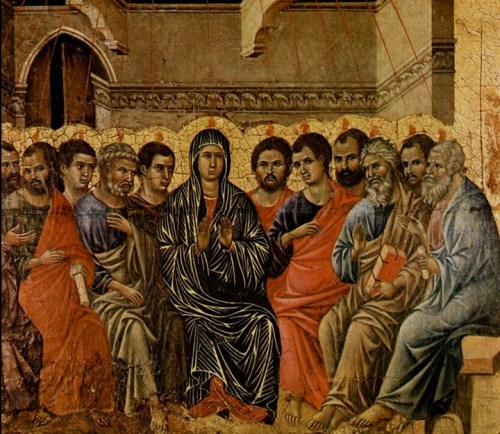
Pentecost

Today’s first reading at Mass describes the early Christian community in glowing terms: “The community of believers was of one heart and mind, and no one claimed that any of his possessions was his own but they had everything in common. With great power the Apostles bore witness to the resurrection of the Lord Jesus, and great favor was accorded them all. There was no needy person among them, for those who owned property or houses would sell them, bring the proceeds of the sale, and put them at the feet of the Apostles, and they were distributed to each according to need. (Acts 4, 32-37)

The community described here and in Acts 2, 33-47  is an important model  for the church. It has influenced Catholic social teaching over the centuries. What would our world be like if the world community, individual nations, the church, the parish, the family could be like this? In a society like ours where excessive individualism is so strong, where so much wealth and power are concentrated in the hands of so few, this ideal is surely appealing. 

A note in the New American Bible, however, cautions that Luke is painting a “somewhat idyllic” picture of the early Christian community. Idyllic means idealized, even unsustainable. In other words, given human nature, the early Christian community never measured up altogether to the picture Luke paints.

The commentator Luke Timothy Johnson suggests Luke’s glowing picture might be influenced by the Hellenistic writers of his time– like Plato–who describes the early days of Athens as a time when “none of its members possessed any private property but they regarded all they had as the common possession of all.” Early writers also put great stock in friendship; people of “one heart and mind become builders of community. ” (The Acts of the Apostles. Sacra Pagina, Collegeville, Min 1992 p. 62)

Reading Luke’s description of the Christian community, then, we need to avoid the temptation to look for utopias. We can’t expect perfect communities anywhere. They don’t exist here on earth. Nor should we think they existed in the past and all has gone downhill since. That’s  “Golden Age” thinking. Our readings from Acts of the Apostles in the Easter season describe an enthusiastic, dedicated group of Jesus’ followers. The gospels describe more skeptical followers, like Thomas and Nicodemus.  We have to keep both groups in mind; they make up our church too.

At the same time, though, we can’t give up on the ideal Luke presents and think it unreal. It’s an ideal to be aimed at, a norm to measure ourselves and the communities we belong to. Not to strive for Luke’s ideal is to lose faith in the mystery of the resurrection. Jesus taught us to pray, “Your kingdom come on earth as it is in heaven.” We have to pray for and work for God’s kingdom to come now, here and now.

Looking Out The Window: Llght and Darkness

FullSizeRender

Light and darkness are important in the Genesis story; they’re also important in our morning and evening prayers. Daily prayer is deeply influenced by the Genesis story .

“God saw light and said it was good.” the Book of Genesis says. God creates light, then sunlight, first. Then, holding this bright lamp, God goes about creating the world day by day out of darkness.  Each day ends in darkness, but God goes to work the next day, light in hand, and new things come to be. Like us, God works day by day.

“Send forth your light and your truth, let these be my guide.” The morning psalms each day repeatedly ask for light to continue God’s work.

“Your word is a lamp for my steps, a light for my path.” The evening psalms prepare us for the darkness of night, when we rest. But God’s work goes on. Night for us is a time for trust and leaving the world in God’s hands. “Truly I have set my soul in silence and peace, As a child in its mother’s arms. even so my soul.” (Psalm 131, Tues.3)

Before television and radio and the complex scientific weather reports we get now, I think we looked out the window more to see the dawn, the dusk, the light and darkness. Should we stop looking out the window?

I don’t think so. Maybe we should look out the window more each morning and evening and try to see the light and darkness as the Book of Genesis suggests. We learn from them. God works day by day. So, “What am I going to do today?” Whatever we do, we should do it thankfully, by the light of God’s grace.

And don’t forget how the days of Genesis end. God rests and says it’s good. Something of God’s rest and appreciation, praise and thanksgiving, should be in us as we go through our days of creation.

In the New Testament, Jesus Christ, the Word of God, is called “the true light that enlightens everyone who comes into this world.”

The everyday sun promises the Sun that enlightens everyone.

Nazareth: Where Jesus Was Raised


What was Nazareth like? We might think it was a quiet little town far from anywhere else in Jesus’ time; the gospels indicate his early years were spent in such a place.  Recent historical studies tell a different story. The town was not as isolated as once believed.  Just four miles away was the thriving Greco-Roman city of Sepphoris, recently uncovered by archeologists, and nearby were roads to Tiberias, Jerusalem, the sea coast and the rest of the world.

 Galilee’s economy was booming then, thanks to the rich soil of the Esdraelon plains, the fishing villages along the Sea of Galilee, the stability of Roman rule and Herod Antipas, a skillful administrator and builder who was firmly in charge then.  His new regional capital, Tiberias–a model of Greco-Roman city planning– dominated the shores of the Sea of Galilee. A new port, Caesaria Maritima linked Galilee to the rest of the Roman world. 

Could Nazareth, 15 miles east of the Sea of Galilee and 20 miles west of the Mediterranean Sea, situated in a thriving province, be shut off from this world?

How did Jesus get there?

Some historians say Joseph and Mary were not from Nazareth in Galilee, but from Judea.  Matthew’s gospel, in contrast to Luke’s, indicates that Joseph was a Judean associated with Bethlehem, David’s city. Mary’s family may have been associated with the temple in Jerusalem. The Church of St. Ann there claims to mark Mary’s birthplace in that city. 

Another tradition, however, says Mary was born in Sepphoris, near Nazareth. After Jesus’ birth in Bethlehem, the gospels indicate his family moved north to the small town of Nazareth to escape the clutches of Herod the Great, who ordered the slaughter of infants. When Herod died, he was succeeded by his son Archelaeus, who was just as unstable as his father. Herod Antipas, another of Herod’s sons yet slightly less dangerous than Archelaeus, inherited power in Galilee after his father’s death in 6 BC and ruled till about 36 AD, in the lifetime of Jesus. He began building the city of Sepphoris in 3 BC. Workers from nearby Nazareth would likely have been recruited to build that city.

Jesus and his followers rejected

Whatever its history, Nazareth will always be a mystery. Instead of supporting Jesus, the Nazareans turned their backs to him, the gospels say. They drove him out of their synagogue when he announced his mission and said he was mad. (Mt 13,54-58)  After his resurrection, there is no evidence Jesus appeared there; his followers in Nazareth were few. “No prophet is without honor except in his native place,” Jesus said. (Mt 13,54)

A Christian Minority through the Centuries

Followers of Jesus in the town where he was raised continued to be few, it seems. By the time Matthew’s Gospel was written, around the year 90, after the destruction of Jerusalem and the temple in 70 AD,  scribes and temple officials as well as the pharisees from that city had moved to the Galilean cities of Tiberias and Sepphoris, near Nazareth, and began a powerful new movement in Judaism.

Did they drive the followers of Jesus out of the Galilean synagogues just as his contemporaries drove him out of Nazareth?  Matthew’s gospel offers numerous warnings that the disciples would be handed over to the courts and scourged in the synagogues. (cf. Mt 10, 17)

“Slender evidence suggests that a Jewish Christian community survived in Nazareth during the C2 and C3 AD, “ writes Jerome Murphy-O”Connor. (The Holy Land, 423) The nun Egeria, one of the few early Christian visitors to Nazareth, found a cave considered part of Mary’s house in the 4th century,  but she did not stay long in the town.  In 570 AD a pilgrim from Piacenza found Nazareth a hostile place:  “there is no love lost in the town between Christians and Jews.” Two Christian churches were built at that time, but after the Muslim conquest of Palestine in the 7th century the number of Christians in Nazareth declined further and their churches were destroyed.

When the Crusaders conquered the town in the 11th century, they rebuilt the Byzantine shrines and added their own buildings; some remains are visible today. But after the defeat of the Christians in the 12th century, Nazareth once more became a Muslim stronghold and Christians a minority.

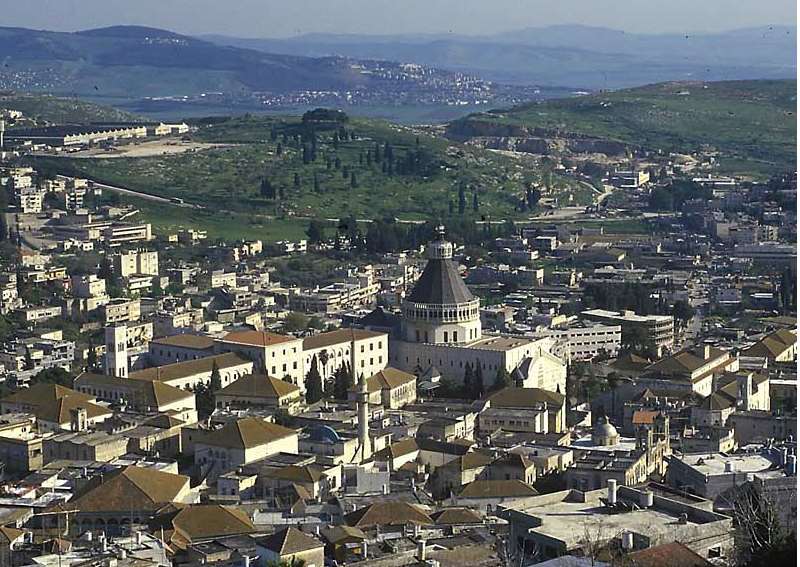
Through the ages, the Christian presence in Galilee remained small, dependent mostly on Christian pilgrims to the Holy Land. After the crusades, it was considered dangerous for Christians to enter Nazareth.  In 1620 the Franciscans bought a site in the  town where the house of Mary was said to be and they continued to nourish a Christian presence in the town. Through their efforts the large Basilica of the Annunciation, built over the early Byzantine and Crusader churches and archeological remains from the ancient town, was dedicated in 1968. The Greek Orthodox church also continued its ministry in this revered spot.

Nazareth itself remained poor and undeveloped from the time of Jesus until recently, when it became the provincial capital of Galilee and its population soared. From less than 1,000 inhabitants in Jesus’ time, the number has grown today to 70,000, mostly Muslim.

The large basilica of the Annunciation, with its extensive collection of art from all over the world honoring this mystery, is a gathering place for Catholic pilgrims. Here faith attempts to interpret this mysterious town “where our feeble senses fail.”

19th Century Nazareth

An English vicar left this quaint description  as he approached Nazareth towards the end of the 19th century. Unlike its neighbor, Cana, the town then was experiencing a modest revival:

“Our horses began to climb the steep ascent of 1,000 feet that brings one to the plateau in a fold of which, three miles back among its own hills, lies Nazareth.

“At last, all at once, a small valley opened below, set round with hills, and a pleasant little town appeared to the west. Its straggling houses of white soft limestone, and mostly new, rose row over row up the steep slope. A fine large building,with slender cypresses around it, stood nearest to us; a minaret looked down from the rear.

“Fig trees, single and in clumps, were growing here and there in the valley, which was covered with crops of grain, lentils and beans. Above the town, the hills were steep and high, with thick pasture, sheets of rock, fig trees now and then in an enclosed spot.   Such was Nazareth , the home of our Lord. (p 513)

“The town is only a quarter of a mile long, so that it is a small place, at best; the population made up of about 2,000 Mohammedans, 1,000 Roman Catholics, 2,500 Greek Catholics and 100 Protestants – not quite 6000 in all; but its growth to this size is only recent, for thirty years ago Nazareth was a poor village.”  (p 516)

The Catholic shrines of Nazareth were not among the English vicar’s favorite places to visit, but he does recognize one of the town’s enduring holy places:

“The water of Nazareth is mainly derived from rain-cisterns, for there  is only one spring, and in autumn the supply is precarious. A momentous interest, however, gathers around this single fountain, for it has been in use for immemorial ages, and, no doubt, often saw the Virgin and her Divine Child among those who frequented it morning and evening, as the mothers of the town, many with children at their side, do now.” (p.515)

“The Virgin’s Spring bursts out of the ground inside the Greek Church of the Annunciation, which is modern, though a church stood on the same site at least as early as 700 AD.They say that it was on this spot that the Angel Gabriel appeared to the Virgin; and if there is nothing to prove the legend there is nothing to contradict it.  Indeed, the association of the visit with the outflow of living water from the rock has a certain congruity that is pleasing. “ (p.516)

The Word Made Flesh

Nazareth, where Jesus lived most of his time on earth, offers few traces of the town he knew. Those were hidden years when the Son of God “humbled himself” by living inconspicuously, immersed in the steady, ordinary rhythms of a small 1st century Jewish town.  Jesus “became flesh” in Nazareth,  “one like us in all things but sin.”

Instead of Nazareth of the past, then, we may find him just as well in Nazareth of the present–or in any town or city or anyplace today, for that matter.

Jesus did not come only for the world then, he comes also for the world now, to dwell among us. Nazareth may help us understand the mystery of his Incarnation in our town and place.

The Humanity of God

You can’t say it more beautifully than St. Bernard does in this sermon.

“The kindness and love of God our savior have appeared.  Thanks be to God, we receive such abundant kindness in this pilgrimage, this exile, this distress through him.

” Before his humanity appeared, God’s kindness lay concealed. Yes, it was already there, because the mercy of the Lord is eternal, but how could we know it was so great? It was promised but not yet experienced, and so many did not believe in it.  At various times and in various different ways, God spoke through the prophets, saying I know the plans I have in mind for you: plans for peace, not disaster.

“Now at last let us believe our own eyes, because all God’s promises are to be trusted. So  even our troubled eyes can see, He has set up his tabernacle in the sun. Peace is no longer promised, but given; no longer delayed, but present; no longer predicted, but here.

“Behold, God has sent down to earth a message of mercy, at his passion our ransom was poured out on us. A small child was given to us, but all the fulness of the Godhead dwells in him.

“After the fulness of time had come, there came too the fulness of the Godhead. He came in the flesh to reveal himself to our earthly minds; his kindness would be known when his humanity appeared. Where the humanity of God appears, his kindness can no longer be hidden. Could he better reveal his kindness than by assuming my flesh? My flesh, that is, not Adam’s, as it was before the fall.

“What greater proof could God give of his mercy than by taking upon himself that very thing which needed mercy? Could there be a better loving-kindness than for our sake the Word of God became perishable like the grass? Lord, what is man, that you make much of him or pay him any heed?

“Let us know  how much God cares for us from this. Let us know from this what God thinks of us, what he feels about us. Do not ask about your own sufferings; but about what God suffered. Learn from what he became for you what he wishes you to become. Know his kindness from his humanity.

“The more he humbled himself in his humanity, the greater has he shown his kindness. The more he humbles himself on my account, the more I love him. The kindness and humanity of God our Saviour appeared says St Paul. The humanity of God shows the greatness of his kindness.

The One who added humanity to the name of God gave proof of God’s kindness.”

The World Waits for Mary’s Reply

The world waited for Mary's reply, St. Bernard says:
The price of our salvation is offered to you. We shall be set free at once if you consent. In the eternal Word of God we all came to be, and behold, we die. In your brief response we are to be remade in order to be recalled to life.
Tearful Adam with his sorrowing family begs this of you, O loving Virgin, in their exile from Paradise. Abraham begs it, David begs it. All the other holy patriarchs, your ancestors, ask it of you, as they dwell in the country of the shadow of death. This is what the whole earth waits for, prostrate at your feet. It is right in doing so, for on your word depends comfort for the wretched, ransom for the captive, freedom for the condemned, indeed, salvation for all the sons of Adam, the whole of your race.
Answer quickly, O Virgin. Reply in haste to the angel, or rather through the angel to the Lord. Answer with a word, receive the Word of God. Speak your own word, conceive the divine Word. Breathe a passing word, embrace the eternal Word…
And Mary says, ‘I am the handmaid of the Lord. Be it done to me according to your word.'”

Friday, 3rd Week of Advent


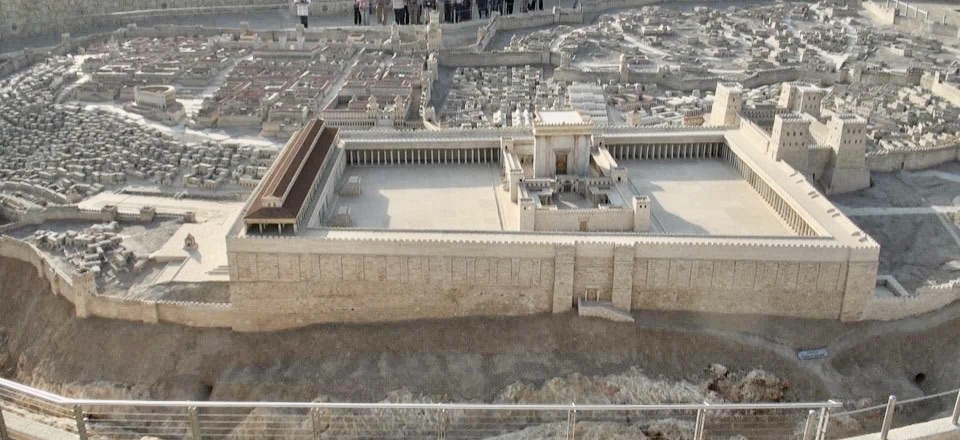
Prophets like Isaiah promised that all nations would come to Jerusalem, to the house of the Lord. And so the temple in Jerusalem provided a Court of the Gentiles, an extensive place surrounding the Holy of Holies (above) where foreigners as well as Jews could come to hear the word of God,

Them I will bring to my holy mountain
and make joyful in my house of prayer;
Their burnt offerings and sacrifices
will be acceptable on my altar,
For my house shall be called
a house of prayer for all peoples.
Thus says the Lord GOD,
who gathers the dispersed of Israel:
Others will I gather to him
besides those already gathered. (Isaiah 56)

It’s significant that Jesus in a symbolic act when he arrives in Jerusalem at the end of his public life cleanses the temple as a sign that that time had come. The Gentiles are called; he calls them to himself. In John’s gospel, read today, Jesus speaks from the temple, most likely from the Court of the Gentiles. He’s the One whom John the Baptist has pointed out and his mission will be confirmed by his Father who will glorify him in his Kingdom.

The Advent and Christmas seasons are not only celebrations for believers, confined to a church or the homes of believers. They take place in the “Court of the Gentiles”, they bring light to the world beyond Christianity. We may not realize it, but the world listens and sees, however dimly that may be. The light of our celebrations shine in a dark world that needs hope.

In the Advent and Christmas seasons, Jesus speaks in the “Court of the Gentiles”.

Readings here.

Friday, 2nd Week of Advent

Too strict, not strict enough. That’s the judgment in public opinion Jesus and disciples faced in their day, today’s Advent reading from Matthews’ gospel seems to say. That’s often the way our church is looked on in the marketplace today. 

Public opinion then– Jesus likens it to “children in the marketplace”– saw him and his disciples in two derogatory ways. For some, Jesus and his followers were not strict enough. Jesus ate too many meals with the wrong kind of people, among other things.  Others saw this movement as too strict. Like John the Baptist, they were crazy eccentrics, out of step with the real world, the world of the marketplace.

Too strict, not strict enough. We would like to answer that criticism of our church with a better public relations campaign and all that goes with it –better catechesis, better homilies, better media, but those responses don’t seem to be on the horizon. 

But listen to the promise our Old Testament readings offer:

“Those who follow you will have the light of life, O Lord.”

Thus says the LORD, your redeemer, the Holy One of Israel:
I, the LORD, your God, teach you what is for your good,
and lead you on the way you should go. If you would hearken to my commandments, your prosperity would be like a river,
and your vindication like the waves of the sea. (Isaiah 48:17-19) 

Blessed Grimoaldo

Blessed Grimoaldo Santamaria was born in Pontecorvo, Italy. May 4, 1883 and died in the Passionist monastery at Ceccano, Italy, on November 18, 1902. Today’s his feastday.

Like another young Passionist saint, St. Gabriel Possenti, it’s hard to discover anything spectacular about Grimoaldo. He died a Passionist student, preparing for ordination, immersed in the ordinary routine of study and prayer usual for that period of life.  He never reached that goal but died of meningitis. Dying from a sickness alone doesn’t make someone holy, does it?

The gospel reading from a few days ago may give us a clue to his holiness. It’s Luke’s account of the nobleman who goes on a journey and entrusts one of his servants with ten gold coins, another five, and finally another with one. Returning, he upbraids the servant who hides his one coin.

Why so severe with the one who chose to be safe? Is it a warning not to take small gifts for granted, not to keep out of life’s marketplace because we’re afraid we wont make a difference.

God sees small gifts as important, the ordinary tools of human love and service. If you wait for something “big” to happen, you miss out on most of living. So throw yourself bravely and generously into the life you have.

Did Grimoaldo understand that?