Category Archives: Passionists

Seed on Tough Ground: Matthew 13:1-9

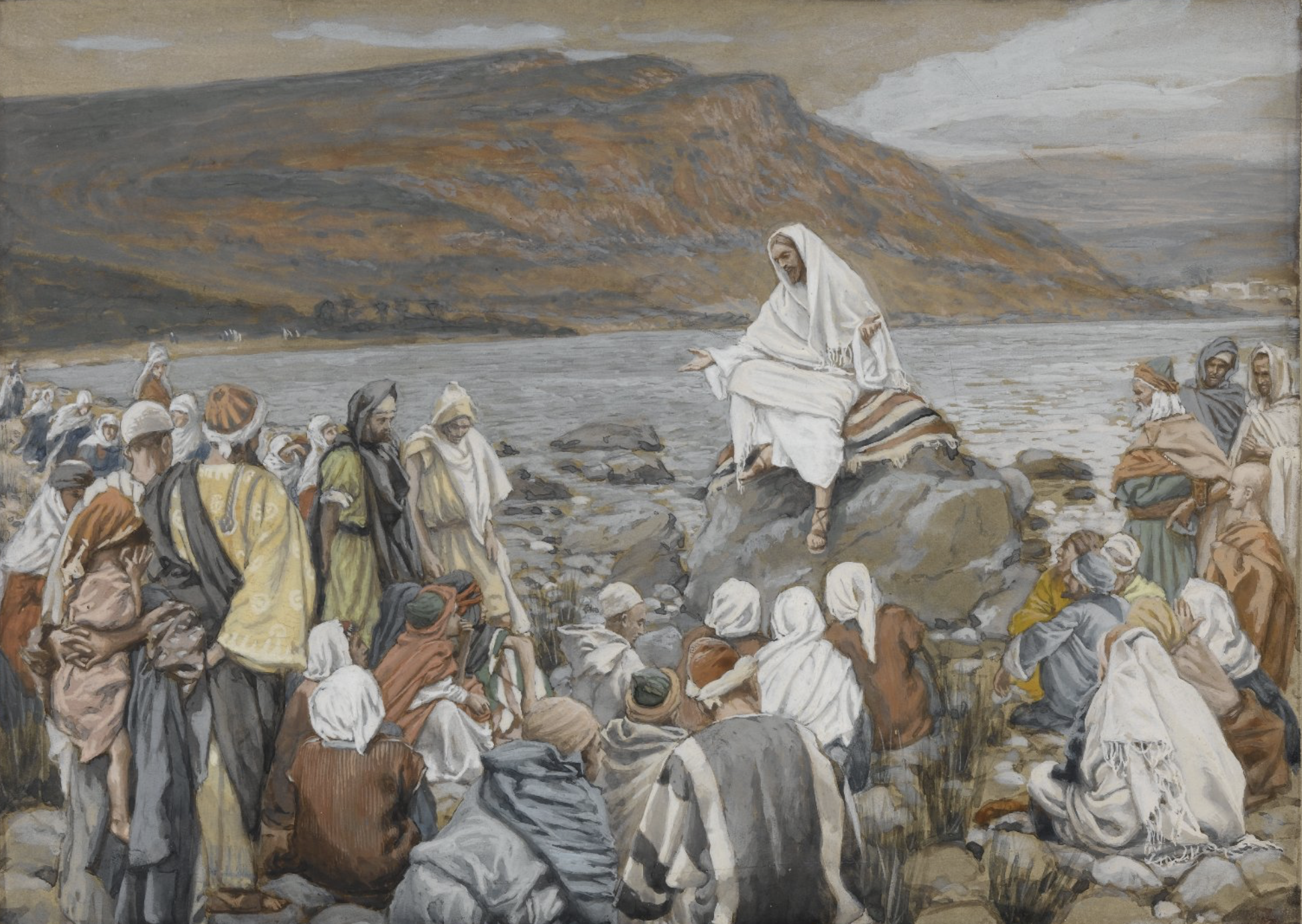
Teaching by the Sea. James Tissot

“A sower went out to sow. some seed fell on the path, and birds came and ate it up. Some fell on rocky ground, where it had little soil. It sprang up at once because the soil was not deep, and when the sun rose it was scorched, and it withered for lack of roots.Some seed fell among thorns, and the thorns grew up and choked it.” ( Matthew 13:1-9)

Jesus tells the crowd at the lakeside the parable of the sower after the Pharisees, the towns where he taught and worked wonders and his own family from Nazareth oppose him. (Matthew 11-12) Previously, Jesus sent his own disciples out to proclaim his life-giving message but he tells them:   “Do not go into pagan territory or enter a Samaritan town. Go rather to the lost sheep of the house of Israel. As you go, make this proclamation: ‘The Kingdom of heaven is at hand.’” (Matthew 10:

When they proclaimed his message to the lost sheep of Israel the seed fell on tough ground. They found the same opposition that Jesus did, more than they expected. .

Our reading today is an example of how an evangelist like Matthew used what Jesus experienced as an example for the church of his time. Matthew’s gospel was written around 90 AD with an eye on the religious conditions then in Galilee. The area had changed since the time of Jesus. After the Romans destroyed Jerusalem in 70 AD, many Jews influenced by the Pharisees moved into Galilee seeking to rebuild Judaism. They strongly opposed the followers of Jesus of Nazareth.

Matthew’s gospel reflects the increasing tension between Christians and Jews in his day. The parable Jesus originally taught throws light on this new situation. The ground is hard, rocky, with little soil. Still, the seed must be sown, however it’s received. Don’t give up on the tough ground, don’t judge it hopeless, Matthew’s gospel insists: Some seed falls on good ground.

A lesson for us today? Seems so. The soil was unwelcoming then, Matthew’s gospel says. Our soil seems unwelcoming now… Still!

Mary, Mother of Mercy

olp


“Hail Holy Queen, mother of mercy, our life, our sweetness and our hope.” Why is Mary called “mother of mercy?” First of all, because she knew she had received the mercy of God which, like the oil poured on kings and priests, gave her power “to fulfill what is beyond human capabilities.” (Anthony Bloom)

Her cousin Elizabeth declared her “blessed among women and blessed is the fruit of your womb.”
Mary’s responded: ‘The Lord who is mighty has done great things to me, holy is his name.” She knew God’s mercy was a work in her to restore the human race. (Luke 1, 43-48)

How, then, was Mary merciful? How did she do what Jesus taught “Be merciful as your heavenly Father is merciful?” How did she live a merciful life? How did she do those works of mercy that tradition ascribes to the merciful person:
• Feed the hungry
• Give drink to the thirsty
• Clothe the naked
• Shelter the homeless
• Visit the sick
• Visit the imprisoned
• Bury the dead

• Admonish the sinner
• Instruct the ignorant
Comfort the sorrowful
Bear wrongs patiently
• Forgive all injuries
• Pray for the living and the dead

The scriptures say hardly anything about her. “Do whatever he tells you.” she says at the marriage feast of Cana. She had no teaching of her own, but always  points  to the teaching of her Son. The mystery of the Incarnation says that  Jesus took his human nature from Mary, his mother. Can we say he who became like us became like her and Joseph, the man who raised him as a child and into his adult years? From Jesus we can tell what Mary was like, a woman of mercy, and her first school was Nazareth. Now she is a teacher in the church.

Resurrection Thinking

Some  years ago  Anglican Bishop N. T. Wright, a highly regarded New Testament scholar, addressed the Catholic Bishops of Italy on the resurrection of Jesus Christ.  His thoughts on the  resurrection were particularly interesting. The theme of the Italian bishops’ conference was “Jesus, our Contemporary.”

He began  with this challenging picture of the Risen Christ.

“ On the one hand, it is precisely because Jesus is risen from the dead that he is alive in a new, unique way; that he is able to be with us as a living presence, which we know in prayer and silence, in reading scripture and in the sacraments, and (not least) in the service of the poor.

“Jesus is truly our contemporary. But at the same time in his resurrection Jesus stands over against us. He is different. He is the first fruits; we are the harvest that still awaits. He has gone on ahead while we wait behind.

“What is more, the meaning of his resurrection cannot be reduced to anything so comfortable as simple regarding him as ‘contemporary’ in the sense of a friend beside us, a smiling and comforting presence. Because he is raised from the dead, he is Lord of the world, sovereign over the whole cosmos, the one before whom we bow the knee, believing that in the end every creature will come to do so as well.

“It’s not enough that Jesus intervenes at the moment of our death. He is the Lord of creation.”

According to Wright our belief in Jesus as Lord of creation has been undermined by the thinking of the Enlightenment, which placed God (if God exists) beyond our world. We are the lords of creation. This life and all in it is in our hands to shape and control as we think best.

Our belief in the Risen Christ is influenced by this thinking, Wright believes. The only role we give to the Risen Lord is to save us from death and bring us to heaven. But he is Lord of Creation, present here and now. We must live in him today and continue his work, not in a heavy-handed way, but humbly as Jesus called for in his teaching on the beatitudes.

“This is how Jesus wants to run the world: by calling people to be peacemakers, gentle, lowly, hungry for justice. When God wants to change the world, he doesn’t send in the tanks; he sends in the meek, the pure in heart, those who weep for the world’s sorrows and ache for its wrongs. And by the time the power-brokers notice what’s going on, Jesus’ followers have set up schools and hospitals, they have fed the hungry and cared for the orphans and the widows. That’s what the early church was known for, and it’s why they turned the world upside down. In the early centuries the main thing that emperors knew about bishops was that they were always taking the side of the poor. Wouldn’t it be good if it were the same today.”

The Spring Rains Come

 April showers. Spring rains. A bowl of Easter Water stands near our altar during the Easter season.

Cyril of Jerusalem has a wonderful sermon on water that he preached to catechumens centuries ago. Here are a couple of lines:

“Water comes down from heaven as rain, and although it is always the same itself, it produces many different effects, one in the palm tree, another in the vine, and so on throughout the whole of creation. It does not come down, now as one thing, now as another, but while remaining essentially the same, it adapts itself to the needs of every creature that receives it.”

The saint goes on to say that just as water adapts itself to every creature, the Holy Spirit gives life to each one according to its needs and to benefit the common good. The Spirit’s coming is gentle, not felt as a burden, with tenderness, as a true friend, to save, heal, counsel, strengthen and console.

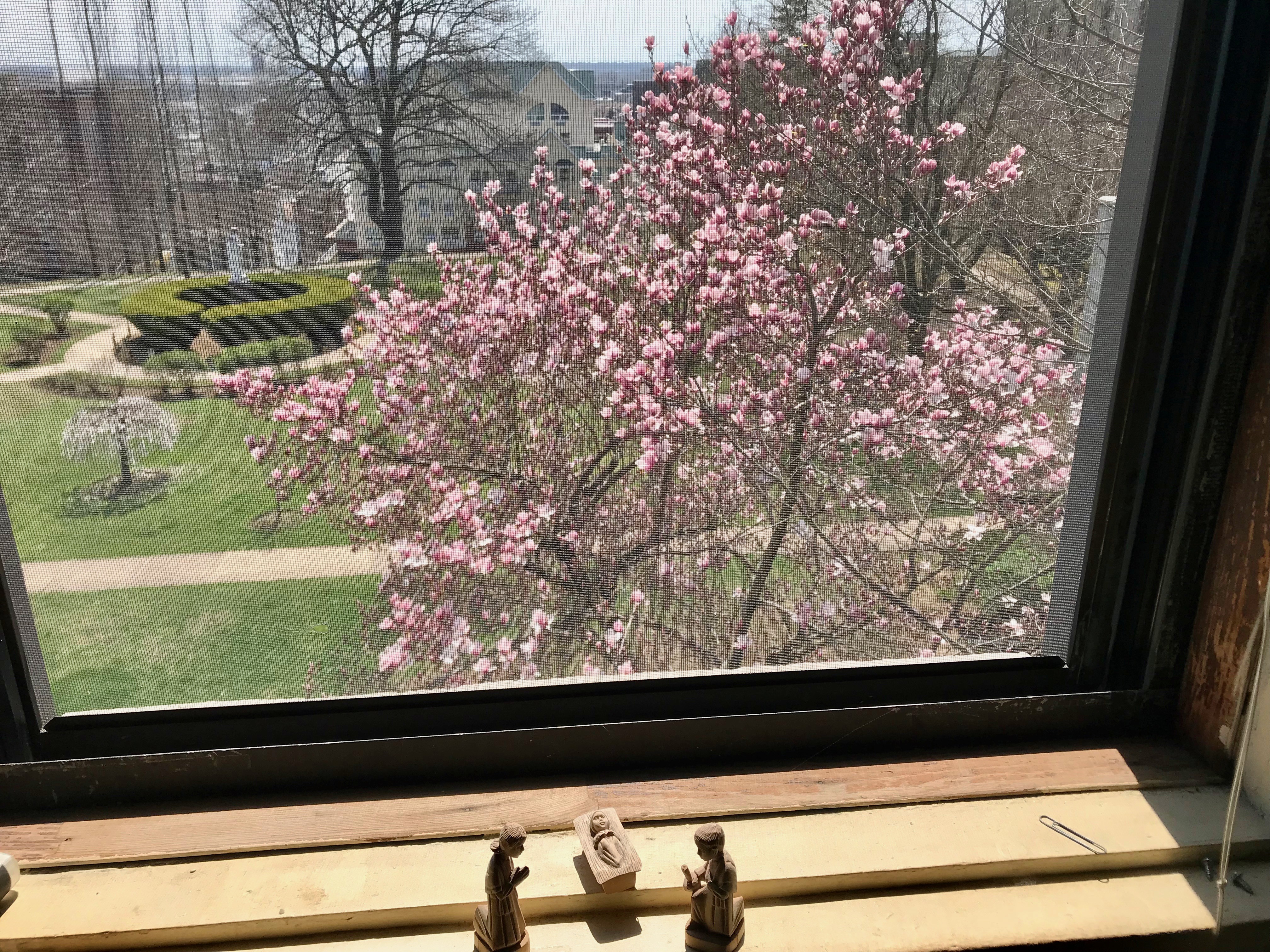
So back to spring rains. They have come this year.  The magnolia trees outside my room testify they’ve come, and the other trees and plants in our garden testify too. The rain falling on the earth does what it always does. Like the Spirit of God, water brings life.

Might we learn from the spring rains bringing life to all the varied plants, all shapes, all sizes, even some we might think useless or of no account?. Might we learn from the spring rains?

Send the spring rains, Lord, on our varied earth and human family.

Religion and Politics?

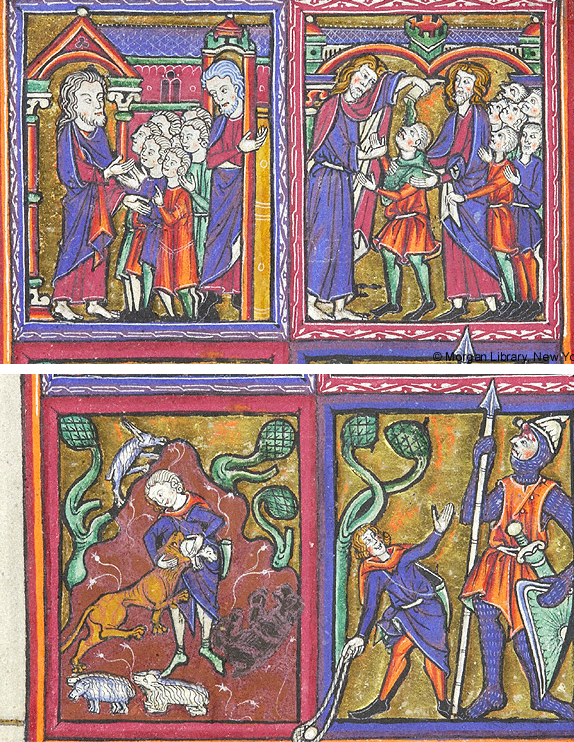
Story of David. Morgan Library, NY

Our reading from the Book of Samuel these days raises that question. Are religion and politics separate lanes that never intersect? Does God has no role in politics? You can’t say that watching the Prophet Samuel repeatedly challenging rulers like Saul and David. It’s also important to notice too that Samuel can get things wrong.

“Fill your horn with oil, and be on your way,” God says to Samuel, “I am sending you to Jesse of Bethlehem, for I have chosen my king from among his sons.” Samuel goes through all of Jesse’s sons, but none fit the bill. “Not him, not him, not him,” God says as one after another are brought to Samuel. “Are these all the sons you have?” Samuel asks.

Jesse replied, “There is still the youngest, who is tending the sheep.” “Send for him,” Samuel says, “we will not begin the sacrificial banquet until he arrives here.” So David is brought to them, ” ruddy, a youth handsome to behold and making a splendid appearance.”

The LORD said, “There–anoint him, for this is he!”

Then Samuel, with the horn of oil in hand, anoints him in the midst of his brothers;   ‘and from that day on, the Spirit of the LORD rushed upon David.” (I Samuel 16,1-13)

“Anoint him, there he is,” God says. The prophet pours the horn of olive oil on David. What does the oil signify? A power not his own, a power that is God’s grace, to lead his people. The grace of God is needed to lead.

We can’t block out the world we live in. The messy, uncertain, brutal, sometimes going nowhere world we read about in the Book of Samuel reminds us that God never abandons the world as it is. It’s not Saul’s world or David’s world or even Samuel’s world; It’s God’s world and God’s plan.

Hard to see in the constant blast of news and political commentaries we get from the media. We think like humans do.We can throw up our hands and turn it all off, but this is our world to understand and care for and pray for.

We’re told to pray for our world, our leaders and ourselves that we may receive God’s wisdom and grace to see and hear God here and now

Almighty and eternal God,
you have revealed your glory to all nations.
God of power and might, wisdom and justice,
through you authority is rightly administered,
laws are enacted, and judgment is decreed.

Assist with your spirit of counsel and fortitude
the President of these United States,
that his administration may be conducted in righteousness, and be useful to your people over whom he presides.

May he encourage due respect for virtue and religion.
May he execute the laws with justice and mercy.
May he seek to restrain crime, vice, and immorality.

Let the light of your divine wisdom
direct the deliberations of Congress,
and shine forth in all the proceedings and laws framed
for our rule and government.
May they seek to preserve peace, promote national happiness, and continue to bring us the blessings of liberty and equality.

We pray for the governor of this state 

for the members of the legislature,
for judges, elected civil officials,
and all others who are entrusted to guard our political welfare.
By your powerful protection, may they discharge their duties with honesty and ability.

We likewise commend to your unbounded mercy
all citizens of the United States,
that we be blessed in the knowledge and sanctified in the observance of your holy law.

May we be united in that peace which the world cannot give and, after enjoying the blessings of this life, be admitted to those which are eternal.

We pray to you, who are Lord and God,
for ever and ever. Amen.

(Adapted from a prayer for the inauguration of George Washington by Archbishop John Carroll, first Catholic bishop in the United States)

Visits and Gifts

Visits, gifts, greeting cards ( now by email) are a good part of the holiday experience.  How can we love everyone all at once? I don’t know.

But Luke’s gospel makes visiting a part of the Christmas mystery. Mary goes into the hill country to visit her cousin Elisabeth after she hears the angel’s message. They meet, not just to trade family news and pass the time together, but they share faith.

They’re two believers who reveal to each other the mystery hidden within them in their unborn children. And they rejoice in their common gift.

We gather with others at Christmas time; people of faith, believers in a mystery we do not see. At Christmas, believers meet, even believers to a degree.

More than we know, we’re signs to each other, like the bread and wine, sometimes hardly evident. In his commentary today on the gospel of the visitation, St. Ambrose says we’re like Mary and Elizabeth; “Every soul that believes–that soul both conceives and gives birth to the Word of God and recognizes his works.”

So we visit and give our gift.

Advent: Monday, 2nd Week

Today’s readings from the Old and New Testament complement one another, as the readings all through Advent do. Isaiah 35:1-10 speaks to Jewish exiles in Babylon, calling them to take a “holy way” through the wilderness to Jerusalem’s “holy mountain. Yet not just exiles in Babylon are called, God calls all nations to take the journey. All people, even the frailest, the weakest, are called to take it: the blind, the deaf, the lame, the fearful will take it, for God will strengthen them. The lame will leap “like a stag” and the “tongue of the mute will sing.”

The paralyzed man brought to Jesus in the gospel and sent away singing and dancing, (Luke 5:17-26), is a symbol of a paralyzed world that Jesus invites to take this journey, and humanity’s hopes are fulfilled as well as the hopes of prophets and peoples of the Old Testament are fulfilled. Our hopes as well. God wishes to heal our paralyzed world. Isaiah’s vision isn’t small.

Our vision shouldn’t be small either. When we hear ourselves saying “They’re not going anywhere.” “They’ll never change.” “The world’s never going to change.” we need to listen to ourselves. We’re living in a cynical world. We shouldn’t let our hope become too small.

Let’s not forget those in the gospel who lowered the paralyzed man from the roof down to where Jesus was. They were people of hope, willing to chance it with someone who looked like he would never move his limbs again. We need more of their kind today.

“They will see the glory of the LORD, the splendor of our God. Strengthen the hands that are feeble, make firm the knees that are weak, Say to those whose hearts are frightened: Be strong, fear not! Here is your God, he comes to save you.Then will the eyes of the blind be opened, the ears of the deaf be cleared; Then will the lame leap like a stag,then the tongue of the mute will sing… A highway will be there, called the holy way;
No one unclean may pass over it,
 nor fools go astray on it.
 No lion will be there,
  nor beast of prey go up to be met upon it.   It is for those with a journey to make,
 and on it the redeemed will walk.”

Creator of Heaven and Earth

God reveals himself in creation, Paul the Apostle reminds us as he begins his Letter to the Romans. “Ever since the creation of the world, his invisible attributes of eternal power and divinity have been able to be understood and perceived in what he has made.” (Romans 1:16-25)  God reveals himself in creation, not just to one people, the Jews, but to all people.

“The heavens declare the glory of God,” our psalm response for Tuesday declares. Yet human beings, blind to the God of creation, turn from this revelation and create gods of their own, and they lose sight of the One who made all things.

As an apostle sent by God into a world blinded by this sin, Paul announces a message of recreation and grace. God sends Jesus Christ, his Son, as our Savior and Lord.

Paul’s message takes on added meaning in a world failing to care for creation itself.

In his letter Laudato sí , on caring for the earth our common home, Pope Francis notes that certain times in history provoke a spiritual crisis which leads to a deeper faith in God. The Babylonian captivity when the Jewish people went into exile in the 6th century before Christ and the fierce Roman persecution of Christians at the beginning of the 4th century AD are examples he cites.  

These crises led to  “a growing trust in the all-powerful God: ‘Great and wonderful are your deeds, O Lord God the Almighty! Just and true are your ways ‘ (Rev 15:3). The God who created the universe out of nothing can also intervene in this world and overcome every form of evil.” (74) 

Our world now is paralyzed and will not be the same. Are we at one of those crucial moments? Will God intervene?  God, the Father, Creator of heaven and earth, God who is surprisingly creative? 

Don’t forget God, the Creator, the pope says. If we do ” we end up worshipping earthly powers, or ourselves usurping the place of God, even to the point of claiming an unlimited right to trample his creation underfoot. The best way to restore men and women to their rightful place, putting an end to their claim to absolute dominion over the earth, is to speak once more of the figure of a Father who creates and who alone owns the world. Otherwise, human beings will always try to impose their own laws and interests on reality.” (75)

Important as it is, science alone is not enough, the pope says. We need to look also to our own tradition for hope and inspiration. Our prayers, our sacraments, currents of our spirituality waiting to be recognized and developed can guide us now to what God has planned from eternity.

Paul’s Letter to the Romans speaks for today as well as yesterday.

If sacred history tells us anything, God the Creator never stops fashioning a beautiful unknown.

Paul’s Letter to the Romans, a basic statement of faith, is timely. We need to follow the path that leads to creation.

Woe to Us Too!

Woe to Us Too!

We’re reading from the 23rd  Chapter of Matthew today, always a tough section to talk about.

One benefit modern scriptural studies give us– and we should be thankful for it– is a better understanding of the past. For instance, as we read from the 23rd chapter of Matthew’s gospel today, it helps to understand the times they were written. Otherwise, we can get a distorted picture of the people whom Jesus loved, the Jews, whom he seems to condemn exclusively in our gospel today.

Matthew’s gospel was written in Syria or Galilee about 40 or 50 years after Jesus had died and rose again. By then, relations between his followers and the followers of the Pharisees had soured as Pharisaic Judaism tried to pull together Jewish life after the terrible destruction of Jerusalem and its temple in 70 AD.

Relations between the two groups were not amicable, to say the least, and as we know, when tempers flare, words can become unfair.

We’re hearing some unfair words in Matthew’s gospel today. Matthew’s sharp polemic, says Rudolf Schnackenburg, a modern commentator on the gospel, “does not really do justice to the conduct of the scribes and Pharisees, not even for the time of alienation between Judaism and Christianity.“ In other words, Matthew’s exaggerating the faults and weaknesses of his opponents.

So, should we ignore these powerful “woes” Jesus speaks? Better, perhaps, to apply them to a wider audience than Matthew does. The 19th century British historian Lord Acton famously said, “Power tends to  corrupt, and absolute power corrupts absolutely.” He was speaking about the temptation that affects anybody in power to use it for his or her own aims.

Matthew’s woes apply just as well to Christians and their leaders. They can be hypocritical, proud and opinionated too. Instead of hearing Jesus’ words meant only for others, then, let’s hear them meant for his followers–and ourselves as well.

Woe to us too!

Calming the Storms (Matthew 14:22-36)

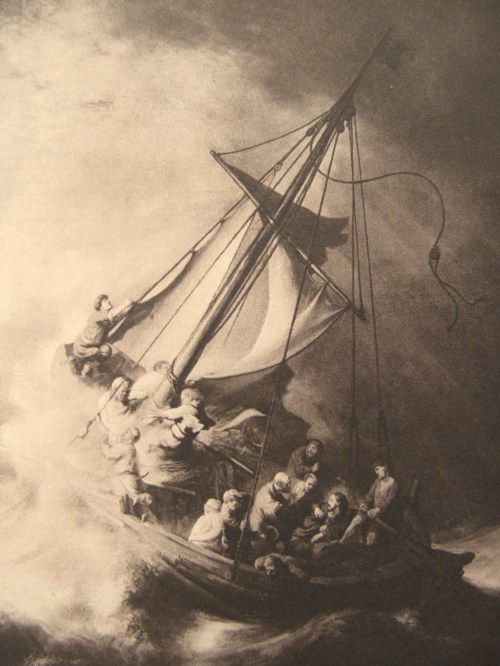
Jesus storm at sea
The giant waves on the Sea of Galilee in Rembrandt painting would be hard to survive, let alone walk on, but that’s what Jesus did, Matthew’s gospel today tells us. Jesus walked on the waters and tamed them. Only God does that, the psalms say.

“You uphold the mountains with your strength.
You are girded with power.
You still the roaring of the seas
And the roaring of their waves,
And the tumult of the peoples. “ Psalm 65

We usually read the stories of the disciples in the storm at sea as stories of rescue, and they are. God saves us from the storms we face on our life journey. But first, the stories testify to Jesus’ mastery over creation. On the shore his power touched human beings, like the leper, the deaf and those who could not speak; on the sea he rules creation. “Truly, you are the Son of God,” his disciples say after he gets into the boat and the wind dies down. (Matthew 14,22-36)

In his encyclical on the environment “Laudato Si” Pope Francis emphasizes the power of God over creation. As creator and savior, God gives all things their dignity and purpose. Human beings are not lords of this world, God alone is.

The story of Peter in our gospel takes on new interest in that perspective. Jesus invites him to walk on the water, giving him a share in God’s power. But Peter’s fear and lack of faith overcomes him. He begins to sink.

In our unfolding environmental crisis (storms, winds, floods) are we like Peter, called to share God’s power but turning away from our responsibility to calm the waters? Too big for us to take on. If that’s so, we sink.