Tag Archives: Word of God

Timothy and Titus: January 26

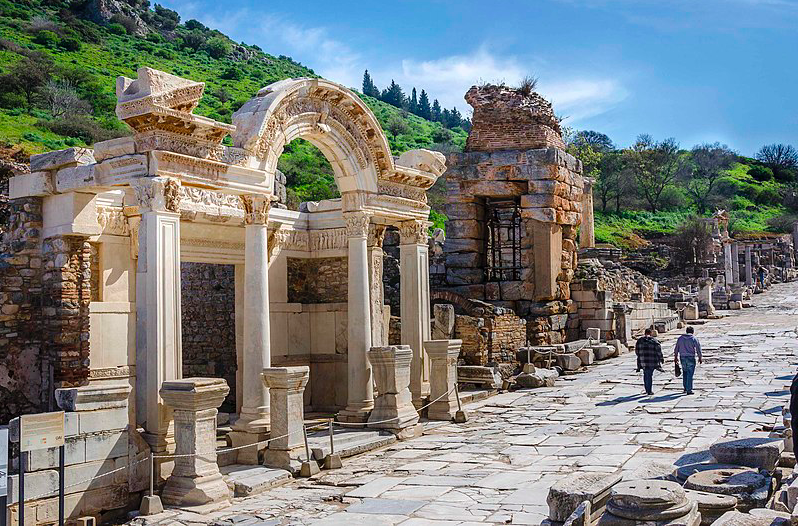
Ephesus, Main Street, Wikipedia Commons

Timothy and Titus were companions of St.Paul on his missionary journeys and continued his mission. Timothy led the church at Ephesus; Titus assumed leadership of the church in Crete. Paul wrote letters of advice to them: one letter to Titus and two letters to Timothy, most likely written from house arrest in Rome.

Like Jesus, Paul never saw himself handing on a church that was completely developed. He ministered to a church evolving from a “way”, a movement, to a church settled in places like Ephesus and Crete. He had men and women companions at his side.

Timothy and Titus were important companions who represent another stage in Paul’s ministry.  While Paul and other apostles went out to the nations, the church had to be firmly established in every place they visited. The roles of bishops, priests and other ministries evolved to fulfill that task. A local church needed to be organized. The church is missionary, global, sent by Jesus to the nations, but it’s also local, part of a town. city, neighborhood.

The feasts of the Conversion of Paul and Timothy and Titus represent those two aspects of the church.

Paul’s  advice to Timothy is especially interesting. “Stir into flame the gift of God that you have through the imposition of my hands. For God did not give us a spirit of cowardice, but rather of power and love and self-control. So do not be ashamed of your testimony to our Lord, nor of me, a prisoner for his sake; but bear your share of hardship for the Gospel with the strength that comes from God.”

Is Paul trying to bolster Timothy’s confidence as he loses a powerful mentor. Timothy needs the gift of God to make the church in Ephesus a flourishing local church. 

Timothy and Titus were given “apostolic virtues” by God to continue the work of Paul and the other apostles, the opening prayer of their feast says. And “May we merit to reach our heavenly homeland” by “living justly and devoutly in this present age.” Like them “we” also are given a task –to work for the church’s growth and development in this present age.

Let’s remember them as our mentors, mindful that God “ does not give a spirit of cowardice, but rather of power and love and self control.” Like the two followers of Paul, we have to hold on to what we’re given and continue their work: “Go into all the world, and proclaim the gospel. I am with you always, says the Lord.”

I see in the notes in the American Bible that the deacons Paul refers to in I Timothy 3, 8-13 may include women as well as men. “This (deacons) seems to refer to women deacons, but may possibly mean the wives of deacons. The former is preferred because the word is used absolutely…”

Why not today? We need women in roles of leadership. I have some in mind who would fit the role very well. I wonder if Timothy’s mother Eunice and grandmother Lois found a home and were involved there. I wonder what my mother would say.

God’s Word, the Tree of Life

“God’s Word, the Tree of Life”
A reflection on Proverbs 30:5-9 and Luke 9:1-6
Wednesday of the Twenty-Fifth Week in Ordinary Time (Year II)
©️2024 Gloria M. Chang

Putting God First

Every word of God is tested;
he is a shield to those who take refuge in him.
Add nothing to his words,
lest he reprove you, and you will be exposed as a deceiver.

Two things I ask of you,
deny them not to me before I die:
Put falsehood and lying far from me,
give me neither poverty nor riches;
provide me only with the food I need;
Lest, being full, I deny you,
saying, “Who is the LORD?”
Or, being in want, I steal,
and profane the name of my God.

Proverbs 30:5-9

“Every word of God is pure (tested, refined),” like fruit from a tree of life. “He is a shield to those who take refuge in him.” Comparing divine wisdom to a tree of life (Proverbs 3:18), the Book of Proverbs guides us toward healing our broken relationship with God that occurred in the Garden of Eden. God created us for abundant life, which we reap by hearing and heeding his word. 

Ordering life around God, the sage asks for a truthful heart and for “neither poverty nor riches.” Luxury may tempt him to deny the Lord, while penury may incite him to steal and dishonor the name of God. Our heavenly Father, who knows what we need, will give us our “daily bread.” When making choices, the sage seeks the honor and glory of God above all.

Neither poverty nor riches, seek I,
But to honor God and him glorify.

God Provides


Jesus summoned the Twelve and gave them power and authority over all demons and to cure diseases, and he sent them to proclaim the kingdom of God and to heal the sick. He said to them, “Take nothing for the journey, neither walking stick, nor sack, nor food, nor money, and let no one take a second tunic. Whatever house you enter, stay there and leave from there. And as for those who do not welcome you, when you leave that town, shake the dust from your feet in testimony against them.” Then they set out and went from village to village proclaiming the good news and curing diseases everywhere.

Luke 9:1-6

Jesus sends his twelve apostles to proclaim the kingdom of God, the fulfillment of his word. The word of the Lord (dabar YHWH), which led the Israelites from Sinai to Jerusalem, has become flesh with divine authority to heal and cast out demons. Jesus, whose Father provides for his children, enjoins the Twelve to “take nothing for the journey.” 

The apostle, like the sage of the Book of Proverbs, lives on and through the Word of God, who is a “shield” and refining fire. Christ, the Word of God and Tree of Life, feeds us with himself in the sanctifying Eucharist.

Your word, O Lord, is a lamp for my feet.

Psalm 119:105 (Responsory)

God’s Word protects and purifies
Apostles who evangelize.


This content by Gloria M. Chang was originally published online at Shalom Snail: Journey to Wholeness

The Word of God

Here’s a Christmas sermon by St. Augustine, reflecting on the mystery of Jesus Christ. If you think about it, many of the paradoxes we see in Jesus are analogously evident in us. “Wonderfully, fearfully made,” “children of God” we are godlike, yet at the same time we experience the limits of a fallen humanity. Revealing who he is, the Word made flesh reveals who we are.

The Word of God, maker of time, becoming flesh was born in time.
Born today, he made all days.
Ageless with the Father, born of a mother, he began counting his years.
Man’s maker became man; the ruler of the stars sucked at a mother’s breasts,
Bread hungered,
the Fountain thirsted,
the way was wearied by the journey,
the truth was accused by false witnesses,
the life slept in death,
the judge of the living and the dead was judged by a human judge,
justice was condemned by injustice,
the righteous was beaten by whips,
the cluster of grapes was crowned with thorns,
the upholder of all hung from a tree,
strength became weak,
health was stricken with wounds,
life died.
He humbled himself that we might be raised up.
He suffered evil that we might receive good,
Son of God before all days, son of man these last days,
from the mother he made, from the woman who would never be, unless he made
her. (Augustine, Sermon 191, 1; PL 38, 1010)

Readings here.

Word by Word


As we walk along and lean more and more on God and less and less on human consolation we discover we are never alone.

When we truly give thanks to God for the human consolation that comes our way we discover just how many angels and saints God has placed along the path.

Everyone and everything is originally from God.

He is the only true creator, at the beginning, and at the end of the day.

If we love only Him we love everyone and everything.

Evil is the denial of such undeniable truth.

Evil is the denial of God’s supreme creativity.

Evil is the absence of good.

And shadows and darkness need spaces and voids in order to exist.

Jesus came to cast providential light.

For as the sun rises toward “straight above” the length of negativity surely disappears.

And at perfect high noon darkness does not stand a chance.

For Jesus was raised up upon the crisscrossed tree of life.

Good squelching evil for all the world to see.

———

The foot of that Cross still remains.

The closer we get the brighter the day.

Spaces and voids fill with pure light.

Absence disappears.

Evil is cast into hell.

For what God creates He intends for good.

———

Will we then live good lives?

Will we allow our absences to be filled with genuine goodness?

Will we speak life?

Will we help build the kingdom?

Let us do so.

One stone at a time.

One flickering light at a time.

One Eucharistic encounter at a time.

———

Let us live “on every word that comes forth from the mouth of God.

For when we do,

Stones become bread,

Water becomes wine,

And bread and wine become the Body and Blood of Christ.

———

Lord Jesus, cover us with Your Blood.

Let us hug the foot of Your Cross.

Let us adore Your feet nailed to the trunk of the tree.

Let us get so close that not even a speck of darkness can get in between.

Let us truly ask this in Your Holy and Perfect Name.

Amen.


.

—Howard Hain

http://www.HowardHain.com

.

Morning Thoughts: God’s Wealth

by Howard Hain

.

Then they handed him the Roman coin.

He said to them, “Whose image is this and whose inscription?”

They replied, “Caesar’s.”

At that he said to them, “Then repay to Caesar what belongs to Caesar and to God what belongs to God.”

—Matthew 22:19-21

.


.

What has value? What has true, lasting value?

And how do we distinguish between arbitrary and absolute value?

Good questions. Meaningful questions. Questions with great relevance since the first moment of man, and questions still very much relevant today—maybe more so than ever before—as cultures become increasingly pluralistic, governments increasingly complex, and economies, natural resources, and “manpower” increasingly intertwined and qualitatively and quantitatively obscure.

And perhaps nothing better expresses this uncertainty than the incredibly difficult task of evaluating the meaning of money—something that for so long has been so generally accepted—but now a question our present day begs us to ask anew.

What then is the role of currency within our ever-increasing global complexity?

Does “currency” still mean what it meant in its most basic form: A medium of exchange, generally accepted, and possessing integrity with regard to accurately representing the goods, services, and/or resources involved in an exchange?

Complex times, complex questions. I’m sure polished academics, investors, and politicians have complex answers—if they’d even recognize such a naive question in the first place.

Though I have a hunch that if we ask the common man and woman—those who are the actual “human resources” bundled together, broken apart, and tossed back and forth like various sizes of sacks of potatoes—we’d hear a common concern.

I bet the consensus is a growing sense of separation between the real connection between “currency” and the actual “items” being evaluated and exchanged—that the “general acceptance” sees a serious disconnect—no matter how simple or straightforward the words or expressions used to describe it.

Maybe we should follow their common lead. For it just may be our common sense that best suggests the level road. Let’s then move forward by asking a simple and straightforward question: What is made by man and what is made by God?

Such a question quickly restores a humble perspective—one in which the questioner is once again seen as part of the question—viewing God as the Uncreated Creator of all creation, and viewing man as part of it, not the cause of it.

Such a question also reminds us of a comforting reality, one that helps build up our view of humanity, not devalue it: For in God’s eyes, man always has a certain, absolute value, as do animals, plants, and all the earth’s resources: air, soil, water, minerals, metals…every nook and cranny. For God made it all. And what God makes He values. And what God values He values absolutely.

On the other hand, the price we place on them—the fluctuations in “perceptive” worth—is most certainly arbitrary value—completely man-made. In fact, without man there can be no arbitrary value: No man, no human perception, therefore no arbitrary value.

It is worth noting that there seems to be nothing inherently wrong with arbitrary value. But we also know through real experience that freewill and temptation continuously battle it out. We’ve all seen firsthand how arbitrary value can be used quite negatively. It can be manipulated. It can be unjust. It can be a weapon man uses against his fellow-man.

Absolute value is not the same. It never undergoes corruption or discriminates. It never hurts life or creation.

But why do we ask these questions? Why should we wonder about such issues?

Because without big questions—the panoramic views—we ironically lose sight of the intricacies and peaceful beauty of day-to-day reality. In other words, we need philosophers. We need those who ask questions from mountain-peak perspective in order to properly value even the smallest creature within the deepest valley.

It’s about divine perspective. About wisdom: Knowing there’s One Source of all creation, and that all creation—no matter how seemingly infinite and minute its manifestation—is always a reflection of the totality and unity of the One Source.

For the enterprise of philosophy—literally the “love of wisdom”—is not narrow or shallow. It is neither micro nor macro. It is never “either-or”.

Philosophy is not a specific knowledge of a specific something. It is not a specific science encompassing a specific field or a specific mastery of a specific craft or trade. Philosophy is not even a specific art expressing itself through a specific medium.

Philosophy is a relationship. A specific relationship. A love-propelled relationship with wisdom itself. And wisdom is not merely a word existing solely of sound waves and vibrations, nor is wisdom merely a concept existing solely in man’s mind. No, wisdom is beyond words, beyond concepts, beyond ideas. Wisdom is the Ultimate Idea, the Only Concept, and the Unspeakable Word.

Wisdom is. Always. Purely. Absolutely. No starts or stops. No lines, no boundaries. It possesses no arbitrary or man-made qualities.

Wisdom is God Himself.

The philosopher is therefore a lover of God. A lover of the Incarnate Word. Of Incarnate Wisdom. The philosopher is a lover of Jesus Christ—in all His manifestations—in all His creation.

This is why we ask such questions.

True lovers never lose sight of the Beloved. We therefore must never lose sight of true worth and the source of all that has worth. We must correctly identify reality and all that is rightly extracted from it. Leaving behind the rest. For all experience runs through the philosopher’s fingers as if sifting for precious metals—knowing that even what is priceless is not yet our possession.

The philosopher is also a child of faith. And therefore a descendant of the patriarch Abraham, our father in faith, who was promised descendants as numerous as the sand on the seashore. We must therefore be willing to lift up and cherish every “worthless” grain. A task we can hardly achieve. But God who created us shows us how.

The answer is quite absurd—making little logical sense—but it is certain and perfect nonetheless. We must recall Christ’s suffering. And we must partake. It is the only way. For by His Cross and Resurrection, Christ sets us free. Free to use freewill properly. Free to distinguish God’s worth from that which disordered man imposed.

And how does that translate into a more pragmatic approach, into a “practical philosophy” that helps “order our days“?

Hope tells us we must stay grounded. Our toes in the dirt. The nitty-gritty of day-to-day life filling our sensitive nose. Our arms stretched wide, unafraid of having our wind unexpectedly knocked out. And all the while, our chins slightly tilted up and away. Our eyes fixed on the Light of Creation—the One Source that burns away all artificial value.


..
Morning Thoughts: Word by Word

.

As we walk along and lean more and more on God and less and less on human consolation we discover we are never alone.

When we truly give thanks to God for the human consolation that comes our way we discover just how many angels and saints God has placed along the path.

Everyone and everything is originally from God.

He is the only true creator at the beginning and at the end of the day.

If we love only Him we love everyone and everything.

Evil is the denial of such undeniable truth.

Evil is the denial of God’s supreme creativity.

Evil is the absence of good.

And shadows and darkness need spaces and voids in order to exist.

Jesus came to cast providential light.

For as the sun rises toward “straight above” the length of negativity surely disappears.

And at perfect high noon darkness does not stand a chance.

For Jesus was raised up upon the crisscrossed tree of life.

Good squelching evil for all the world to see.

———

The foot of that Cross still remains.

The closer we get the brighter the day.

Spaces and voids fill with pure light.

Absence disappears.

Evil is cast into hell.

For what God creates He intends for good.

———

Will we then live good lives?

Will we allow our absences to be filled with genuine goodness?

Will we speak life?

Will we help build the kingdom?

Let us do so.

One stone at a time.

One flickering light at a time.

One Eucharistic encounter at a time.

———

Let us live “on every word that comes forth from the mouth of God.

For when we do,

Stones become bread,

Water becomes wine,

And bread and wine become the Body and Blood of Christ.

———

Lord Jesus, cover us with Your Blood.

Let us hug the foot of Your Cross.

Let us adore Your feet nailed to the trunk of the tree.

Let us get so close that not even a speck of darkness can get in between.

Let us truly ask this in Your Holy and Perfect Name.

Amen.


.

—Howard Hain

.

The Seed and the Sower (15th Sunday A)

In today’s gospel from Matthew 13, 1-23, Jesus offers a parable that interprets the mounting opposition he faces from many sides early in his ministry.  For one thing, people in Chorazin, Bethsaida, Capernaum–cites and towns along the Sea of Galilee that received him warmly for his miracles and his teaching– begin to turn away from him. (Matthew 11,16-24)) The Pharisees and scribes, the Jewish religious leaders, accuse him of breaking Jewish laws and being possessed by the devil. (Matthew 12,22-34) Some of his own family from Nazareth come to take him home because they think he’d out of his mind. (Matthew 12, 46-50) Finally, his own disciples don’t seem to understand him.

What explains the desertion, opposition, lack of understanding towards him and his  ministry that began with great acclaim?

The parable of the seed and the sower is Jesus‘ answer to what he faced, but also what the Word of God faces continually from humanity.  God’s Word is received by the human heart like seed received in the ground.

The seed is life-giving,  but if it falls on rocky ground it’s eaten right away by the birds of the air. If it falls on thin soil it fails after awhile because it has no roots; if it falls among thorns and weeds they choke it. But if it falls on good ground the seed produces fruit beyond anything you expect.

The parable first applies to the world Jesus faced, but it’s also a picture of how  humanity in every age receives the Word of God.  Our hearts can be hard, fickle, vain, proud, unheeding, but we can also accomplish great deeds. The seed’s not at fault, it’s the ground it falls on.

Still, the sower never stops sowing seed. life-giving seed. That’s also important to remember. God never withholds his grace.

In a poem called “Putting in the Seed”  Robert Frost describes a farmer’s love affair with the earth. It’s spring and getting dark, yet the farmer keeps working his field. Someone from the house goes to fetch him home. Supper’s on the table, yet he’s a

  “ Slave to a springtime passion for the earth.

   How Love burns through the Putting in the Seed

   On through the watching for that early birth

   When, just as the soil tarnishes with weed,

 The sturdy seedling with arched body comes

 Shouldering its way and shedding the earth crumbs.”

Is Frost’s farmer zestfully casting seed on the waiting earth an image of God, the Sower, casting saving grace onto the world, in season and out, because he loves it so ?

Jesus’ parable of the seed and the sower seems to suggest it. The land surrounding the Sea of Galilee where Jesus ministered is still a fruitful land where crops grow in abundance, as they did in his time. It’s a blessed place. In a place like that, the sower scatters his seed confidently, not afraid where it goes: on rocky ground, or amid thorns, or on the soil that gives a good return. Because of his love and trust of the land,  the sower keeps sowing.

Can we say that God the Sower sows blessed seed, no matter how badly our human world appears, or how badly it receives? Like the seasons that bring snow and rain, grace is never withheld.  God, who loves it so, blesses the earth and all of us.

The sower still sows; the snow and rain still fall. That brings us hope.

Following the Word

Hippolytus, an early Roman theologian reflects on the mystery of the Word made flesh:

“ We know that Christ’s humanity was of the same clay as our own; if this were not so, he would hardly have been a teacher who could expect to be imitated. If he were of a different substance from me, he would surely not have ordered me to do as he did, when by my very nature I am so weak. Such a demand could not be reconciled with his goodness and justice.

No. He wanted us to consider him as no different from ourselves, and so he worked, he was hungry and thirsty, he slept. Without protest he endured his passion, he submitted to death and revealed his resurrection. In all these ways he offered his own humanity as the first fruits of our race to keep us from losing heart when suffering comes our way, and to make us look forward to receiving the same reward as he did, since we know that we possess the same humanity.”

The Word became flesh. What does his early life tell us? In one sense, his birth and early life show us the helpless Word, carried along and cared for by others, part of an extended family that nourishes and instructs him, one of the nameless crowd swept along by the strong currents of his time.

Isn’t that what happens to all of us?

Called by God’s Word

Yesterday’s gospel for the feast of St. Andrew the Apostle says that Jesus called the two fisherman, Peter and Andrew, from their boat on the Sea of Galilee to follow him as his disciples. We easily picture the scene–the sea, the fishing boat, the smell of the nets, two men in a boat facing another on the shore.

Not so easily pictured is the mystery enveloping the scene. Who calls the two ordinary men from the shore?  Why are they called? They’re not just to accompany him for a few days, or a few years. Who is he?

“The very Son of God, older than the ages, the invisible, the incomprehensible, the incorporeal, the beginning of beginning, the light of light, the fountain of life and immortality, the image of the archetype, the immovable seal, the perfect likeness, the definition and word of the Father: he it is who comes to his own image and takes our nature for the good of our nature, and unites himself to an intelligent soul for the good of my soul, to purify like by like.

He who makes rich is made poor; he takes on the poverty of my flesh, that I may gain the riches of his divinity. He who is full is made empty; he is emptied for a brief space of his glory, that I may share in his fullness. What is this wealth of goodness? What is this mystery that surrounds me? I received the likeness of God, but failed to keep it. He takes on my flesh, to bring salvation to the image, immortality to the flesh. He enters into a second union with us, a union far more wonderful than the first.”  (St. Gregory Nazianzen)