Tag Archives: Passionists

How Bad Can It Get

The Disciples’ Unbelief Charter

The gospel is supposed to be life at its best, but it also presents life at its worst. What’s worse than being a lamb among wolves? Than living with people who don’t support you and in fact hate you? Than having people beat you with whips? Than having your own brothers and sisters turn against you? Than having people throw you out of town?

Can it get worse than that? You’ll experience all these things, Jesus says in today’s gospel to the Twelve and those who go out with them.

Today’s gospel from Matthew is part of the commissioning of disciples whom Jesus sends as heralds of the kingdom of heaven. They have power to “cure the sick, raise the dead, cleanse lepers and drive out demons.” Great powers. But that’s not all. They must exercise these powers in the real world.

We can’t forget we live in the real world that Jesus describes in today’s gospel. His way of living in this world is unique. He doesn’t send out armed divisions or powerful super salespeople, but vulnerable lambs. Yet, his lambs are stronger than wolves. Don’t be awed by governors and kings or crushed by adversity or rejection, Jesus says. Just listen to the “Spirit of your Father speaking in you,” and you’ll have wisdom enough.

Even if you’re thrown out of one town, another town waits for the coming of the Son of Man. The real world is not as strong as it seems.

Lamp for a Dark Place

Spring Lake even

The sky over the boardwalk at Spring Lake, New Jersey, is sometimes swept with colors before nightfall. Then, a lamp becomes the only light till dawn.


“I came into the world as light,” Jesus says in today’s gospel” so that everyone who believes in me might not remain in darkness.( John 12:44-50)


The sun will rise again and the great Sun will also rise again, Augustine says in one of his sermons. Then  “lamps will no longer be needed. When that day is at hand, the prophet will not be read to us, the book of the Apostle will not be opened, we shall not require the testimony of John, we shall have no need of the Gospel itself. Therefore all Scriptures will be taken away from us, those Scriptures which in the night of this world burned like lamps so that we might not remain in darkness.”

Darkness is temporary; we are meant for light.

“I implore you to love with me and, by believing, to run with me; let us long for our heavenly country, let us sigh for our heavenly home, let us truly feel that here we are strangers. What shall we then see? Let the gospel tell us: In the beginning was the Word and the Word was with God and the Word was God. You will come to the fountain, with whose dew you have already been sprinkled.

“Instead of the ray of light which was sent through slanting and winding ways into the heart of your darkness, you will see the light itself in all its purity and brightness. It is to see and experience this light that you are now being cleansed. Dearly beloved, John himself says, we are the sons of God, and it has not yet been disclosed what we shall be; but we know that when he appears we shall be like him, because we shall see him as he is.

“I feel that your spirits are being raised up with mine to the heavens above; but the body which is corruptible weighs down the soul, and this earthly tent burdens the thoughtful mind. I am about to lay aside this book, and you are soon going away, each to his own business. It has been good for us to share the common light, good to have enjoyed ourselves, good to have been glad together. When we part from one another, let us not depart from him.”

Acts of the Apostle: The Crippled Man


By the old temple gate
lay a poor crippled man,
forced to beg
for the daily needs of life.
He was lame from his birth
with no hope to be healed
until Peter and John came to pray.

Those two friends of the Lord
saw the man lying there
and were filled with compassion and love.
They had no money to share,
so Peter reached out his hand
and gave him the best that they had.

“I have no silver, no gold,
but I give you what I have –
in the Name of Jesus, stand up and walk!
Take this gift of new life
and proclaim to all the world
that the Name of the Lord has set you free!”

By the old temple gate
stands a man strong and free,
singing praise to the Name of the Lord!

Gloria Ziemienski
April 1997

The man crippled from birth who is cured by Peter and John as they enter the temple precincts after Pentecost is an important figure in our readings for the last four days of Easter Week. Crippled from birth, over 40 years old, he’s carried to the gate of the temple each day to beg for alms.  Everyone knows him, he’s a regular. 

After he’s cured he goes into the temple to hear Peter’s message to the crowd about Jesus of Nazareth. As he stands there, relishing his cure, he’s a sign God’s power is a work. Can we see him becoming a believer? The temple leaders, on the other hand, find him an annoying presence whom they try to silence. 

How can he be explained away?

The man was surely at Peter’s side when he spoke to the people in the temple area. Just as miracles accompanied the teaching of Jesus, so now they will accompany the teaching church. We have to expect signs like this, that raise up the poor, to be part of the church’s witness, especially in an unbelieving age.

What other signs can we see in Peter’s words to the crowd as he witnesses to the Resurrection? He points to the tomb of Jesus, in contrast to David’s tomb. It’s empty. We have to keep the holy places associated with Jesus as part of our witness.  He points to the scriptures. We have to keep reflecting on them to enrich our witness. His message is overwhelming a message of forgiveness. Mercy and forgiveness should be our witness too. 

Words are not the only way we witness the Resurrection of Jesus.

Readings here.

Morning and Evening Prayer.  Sunday, Week 1 http://www.praydaybyday.org

Children’s prayers here.

Where did it happen?

We wonder where the gospel events took place, especially during Holy Week.. Where was Jesus judged by Pilate? What way did he go to Calvary?  Where was he crucified and where was he buried?

Reliable historians generally agree that the tomb of Jesus and the site of Calvary are  in the Church of the Holy Sepucher.  “Is this the place where Christ died and was buried?” Jerome Murphy-O’Connor asks in his solidly researched “The Holy Land: An Oxford Archaeological Guide” (New York, 2008). “Yes, very probably,” he answers. (p 49)

Holy sepul

Church of the Holy Sepulcher, Jerusalem

Jerusalem’s “Via Dolorosa”, the traditional way of the cross,  is less historically reliable. Beginning near St. Stephen’s Gate, where the Fortress Antonia once stood, it winds up at the Church of the Holy Sepulcher.  Murphy-O Connor says it is “defined by faith and not by history.” (pp 37-38) Early Christian pilgrims created it.

DSC00267

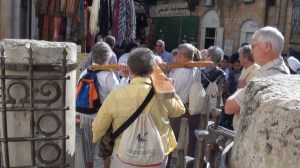
Pilgrims on the Vis Dolorosa

After the Christian church was established by Constantine in the 4th century, pilgrims from Mount of Olives, where many stayed, walked through St. Stephen’s Gate up to the Church of the Holy Sepulcher, stopping at certain places to recall incidents from the passion of Jesus. The present Via Dolorosa was formed from their devotions over the centuries.   (cf. Murphy-O’Connor, p 37) Pilgrims, not archeologists, have given us the present Via Dolorosa.

Jerusalem

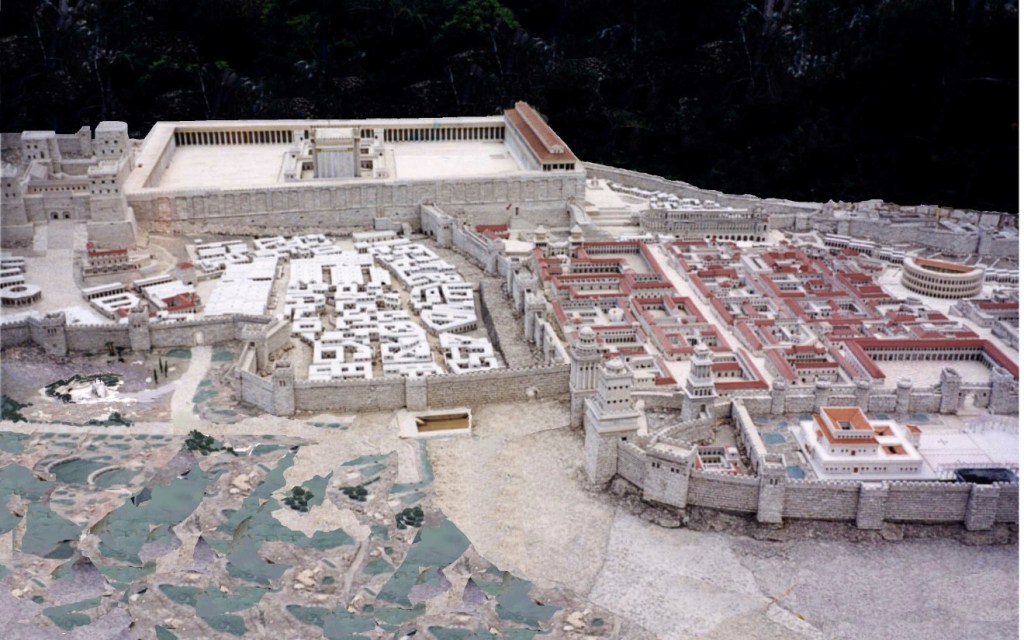
Jerusalem at the Time of Jesus

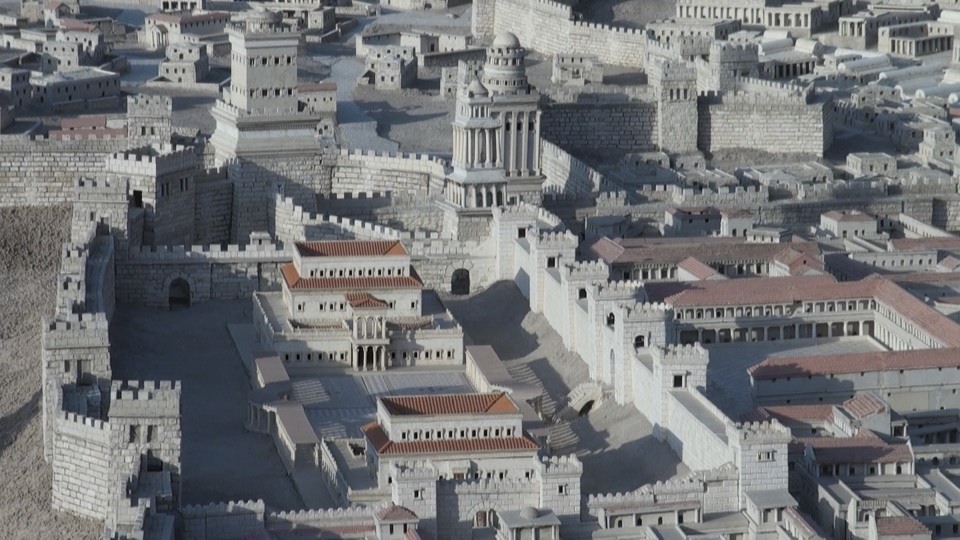
Is their a more reliable way?  A reconstruction of Jerusalem (above) from the time of Jesus at the Israel Museum–somewhat altered here– suggests another way that  Jesus was led to Calvary.  At the bottom right is the luxurious palace complex built by Herod the Great. (below) When Pontius Pilate came from Caesaria Maritima for Passover he probably stayed there and judged Jesus in the courtyard outside the palace.

DSC00291

Herod’s Palace, the Citadel

After sentencing Jesus to death, Pilate handed him over to a detachment of soldiers quartered somewhere in the great towers to the left of the palace, who scourged him and crowned him with thorns.

They then led him away to Calvary, probably parading him through part of the upper city as a warning to others. In our map of Jerusalem above, the rock outcropping near to the city wall is the site of Calvary where Jesus was crucified. The gospels say  he was buried in a tomb only a stone’s throw away.
DSC00317

In Jerusalem today the Citadel stands on the ruins of Herod’s palace, still dominating the western part of the Old City.

You can walk on the southern ramparts of the city wall where Herod’s palace once stood and view some few remains of Herod’s building;  the towers have been rebuilt.

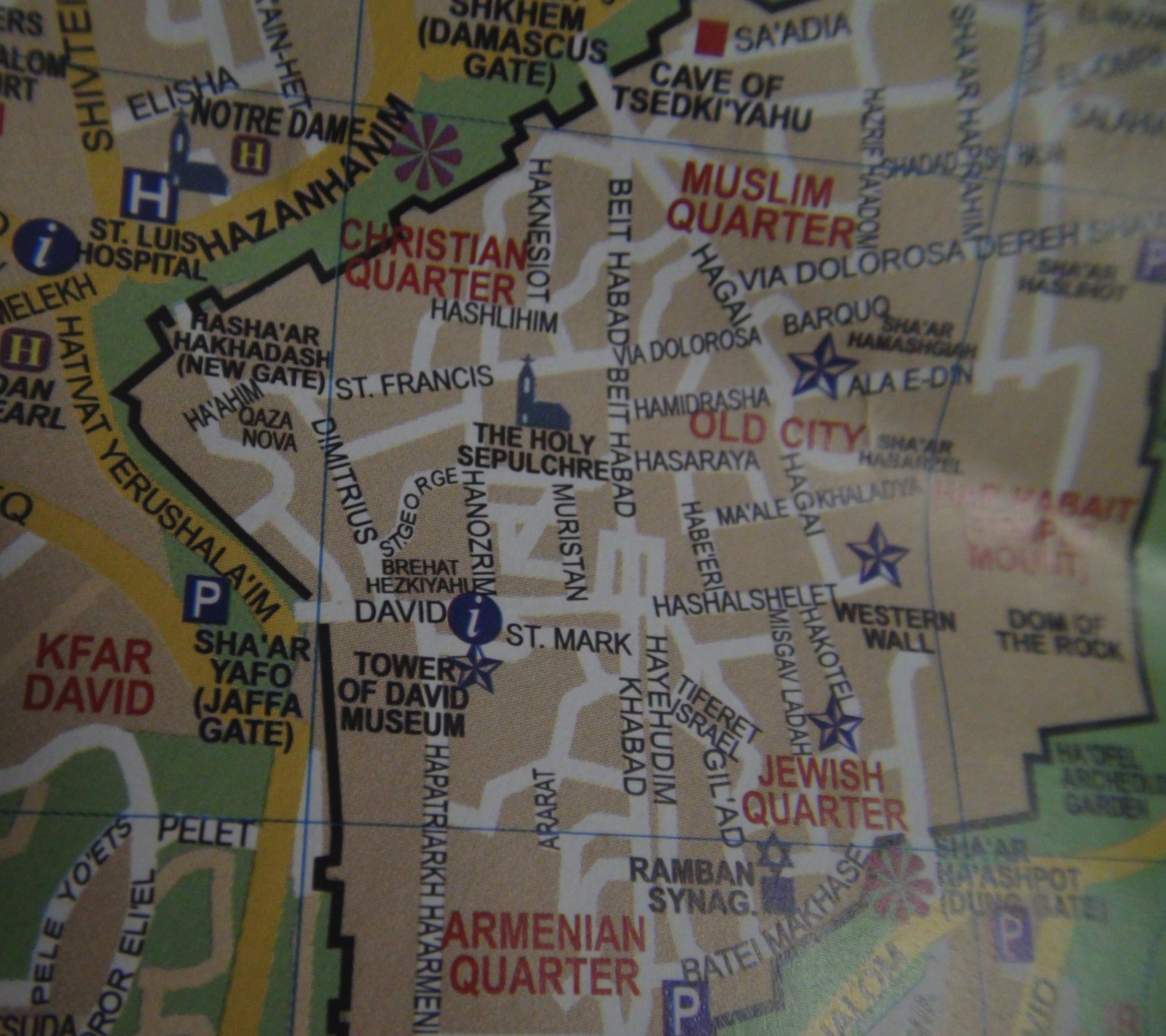
Murphy-O’Connor suggests a way  Jesus was taken to Calvary from here. “If, as seems likely, Jesus was brought into the city on his way to execution, the approximate route would have been east on David Street, north on the Triple Suk, and then west to Golgotha.” (p.38)

I walked that way some years ago, down David Street, to the Triple Suk and then west to Golgotha and the Church of the Holy Sepulcher.  My sense is Murphy-O’Connor is right, but I think we better not change the Via Dolorosa. For one thing,  good piety has given us the present Via Dolorosa and it has a truth and beauty all its own.  More importantly, it would start a war in Jerusalem, and the city has enough grief now.

DSC00289

For more information on the places of the Passion, see

What am I going to do for Lent?

table

Lent begins  Ash Wednesday. What am I going to do for Lent? The supper table is a good place to ask that question, because Lent is about renewing ourselves as we are here and now. The supper table is a sign of life here and now.

Those closest to us there. Doing something for Lent must mean doing something for them, first of all, the people across the table–or maybe those who have left our table because we have driven them away. A scripture reading early on in Lent says: “Don’t turn your back on your own.”  Have we turned our backs on those closest to us because we know them too well or we have hurt them in any way?

Besides the supper table, I guess we should also ask that question “What am I going to do for Lent?” in the place where I work, or where I go to school. Don’t turn your back on them either.

Lent is for renewing ourselves as we are, in real life and real time. We don’t have to leave this world or go to Mars to do that

The Ash Wednesday scriptures say: pray, fast and give alms. What am I going to do for Lent? How about praying each day? How about fasting from my own hard opinions of others? How about looking after someone else instead of myself, someone in need?

How about keeping this terrible situation in the Ukraine in mind? Not just looking at TV Broadcasts or online reports. How about praying for peace there? Looks like  economic sanctions are doing some good. Prayer does more good, if we believe what Jesus says.

Let’s not forget something else, though.  “What’s God going to do for us during Lent?” That’s important. Lent is a time of God’s grace, which is more than we can hope for, beyond what we deserve. The great sign of God’s limitless love is the Passion of his Son, a wondrous love beyond all others.

Following Jesus Christ in Lent

Lent 1

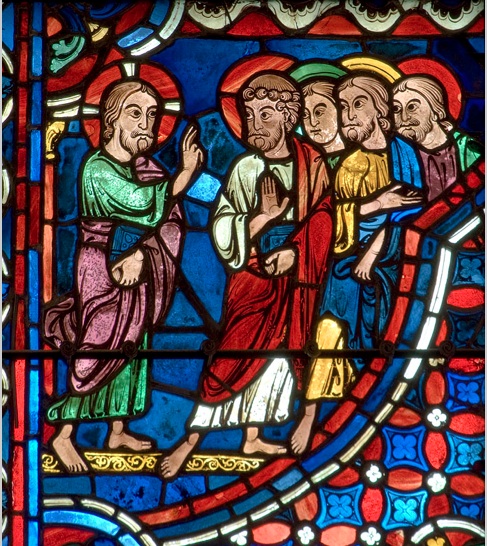
Lent is coming. Let’s join those disciples in our picture above following Jesus. One way to follow him is by reflecting on the lenten scriptural readings recommended for the Sundays and weekdays till Easter. They’re the basic book for lenten reading.

On the 1st Sunday of Lent, this coming Sunday, Luke’s gospel takes us to the Jordan River where Jesus is led into a deserted place by the Spirit and tempted for 40 days after his baptism. Our journey  begins  in a desert. Readings from Luke’s Gospel lead us through the Sundays of Lent this year.

The weekday gospels for the first three weeks of lent are mostly from Matthew, the early church’s favorite gospel for catechesis during Lent. Matthew brings us to Galilee  where Jesus speaks “the words of eternal life” in his Sermon on the Mount.  (Matthew 5-7) Be faithful to prayer and you will grow in wisdom, Jesus says.  ( Tuesday and Thursday, 1st week of Lent)  Love your neighbor, even your enemies and “the least,” whom we easily overlook. ( Monday, Friday, Saturday, 1st week of Lent)

Peter’s confession at Caesaria Phillipi is the highpoint of the first part of Matthew’s gospel. “You are the Christ, the Son of the living God,” Peter says to Jesus. “You have the words of everlasting life.” Lent invites us to join him in that same confession.

Yet, can we possibly love and believe that way, so lofty and challenging? We’re rather weak disciples.  Jesus doesn’t call perfect disciples, the reading for Saturday after Ash Wednesday reminds us. He called  Matthew the tax collector and people like him–not very good keepers of the law. Outsiders and sinners like them tell us we belong in the lenten season. (Luke 5, 27-32)

Matthew’s gospel takes us up the Mount of the Beatitudes. Like most sacred writers, Matthew likes mountains; you see ahead  more clearly from them. On the 2nd Sunday of Lent, we go up to the Mount of the Transfiguration to glimpse the  glory found ahead.

By the 4th week of Lent,  we arrive  in the Holy City, Jerusalem, to the temple mount and  then the Mount of Calvary. Starting with the 4th week most of the weekday lenten gospels will be from the Gospel of John. I’ll say something about them before we get there.

You can follow the lenten readings online here.

I’ll mention some lenten devotions, like the Stations of the Cross, in the next few days.

Speaking the Truth:Mark 10:1-12

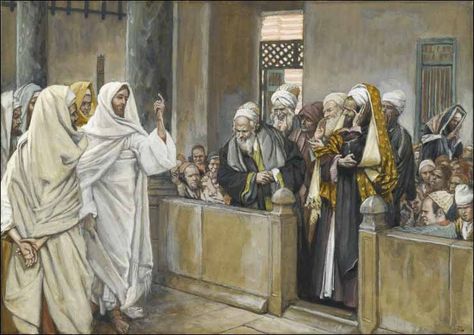
Christ Questioned. James Tissot

Often Mark’s Gospel offers little clues to help us interpret one passage in the light of another. For example, Jesus is sharply questioned by the Pharisees whether it’s lawful for a husband to divorce his wife. The questioning takes place as Jesus “came into the district of Judea and across the Jordan,” on his way up to Jerusalem where he will meet his death.

Mark’s not altogether accurate in his geography but “Judea across the Jordan” was where John the Baptist was put to death for questioning the validity of Herod’s marriage to Herodias, who divorced Herod’s brother Philip to marry him. Mark tells that gruesome story a few chapters before in great detail. (Mark 6, 14-29) The site of John’s death, east of the Dead Sea in what is now the country of Jordan, was lost for more than a thousand years after it was destroyed by the Romans at the end of the First Jewish Revolt in 71/72 A.D. It was definitively identified in 1968, when a German scholar discovered the remains of a Roman siege wall. Since then, the Hungarian architect and archaeologist Dr Győző Vörös has been excavating the site.

Perhaps the Pharisees thought that questioning Jesus here might have two outcomes. Either it might incite Herodias and Herod to do to Jesus what they did to John, or if Jesus didn’t answer the delicate question about divorce, the crowds gathered around him might see him less brave than the Baptist.

Jesus’ answer is brave, and it’s not an abstract one. Marriage is not to satisfy human ambition, like Herodias’ ambition. From the beginning God willed that man and woman be one flesh. The final lines of our gospel, spoken at this time and place, is also a strong judgment on the man and woman who engineered John’s death:

“Whoever divorces his wife and marries another commits adultery against her; and if she divorces her husband and marries another, she commits adultery.”

Feast of St. Polycarp

Agora, Ismir (Smyrna). Wiki Commons

Today’s the feast of St. Polycarp. Some years ago, I visited Izmir in Turkey where Polycarp, a revered Christian bishop, was martyred about the year 155. The city was then called  Smyrna.  Now predominantly Muslim, there’s a small church of St. Polycarp in the city and up the mountain is the ancient agora and the ruins of the stadium where Polycarp was burned to death by the Romans.

The account of his martyrdom, sent to other Christian churches by the Christians of Smyrna, is one of the most interesting documents of the early church. Polycarp was an old man, 86. As a child he knew John the Apostle and was a friend of Ignatius of Antioch, another early bishop martyred for the faith. He was also a teacher of Irenaeus, who became bishop of Lyon in Gaul.

The old bishop went to his death peacefully and heroically, the account indicates:

“When the pyre was ready, Polycarp took off all his clothes and loosened his under-garment. He made an effort also to remove his shoes, though he had been unaccustomed to this, for the faithful always vied with each other in their haste to touch his body. Even before his martyrdom he had received every mark of honour in tribute to his holiness of life.

There and then he was surrounded by the material for the pyre. When they tried to fasten him also with nails, he said: “Leave me as I am. The one who gives me strength to endure the fire will also give me strength to stay quite still on the pyre, even without the precaution of your nails.” So they did not fix him to the pyre with nails but only fastened him instead. Bound as he was, with hands behind his back, he stood like a mighty ram, chosen out for sacrifice from a great flock, a worthy victim made ready to be offered to God.

Looking up to heaven, he said: “Lord, almighty God, Father of your beloved and blessed Son Jesus Christ, through whom we have come to the knowledge of yourself, God of angels, of powers, of all creation, of all the race of saints who live in your sight, I bless you for judging me worthy of this day, this hour, so that in the company of the martyrs I may share the cup of Christ, your anointed one, and so rise again to eternal life in soul and body, immortal through the power of the Holy Spirit. May I be received among the martyrs in your presence today as a rich and pleasing sacrifice. God of truth, stranger to falsehood, you have prepared this and revealed it to me and now you have fulfilled your promise.

“I praise you for all things, I bless you, I glorify you through the eternal priest of heaven, Jesus Christ, your beloved Son. Through him be glory to you, together with him and the Holy Spirit, now and for ever. Amen.”

When he had said “Amen” and finished the prayer, the officials at the pyre lit it. But, when a great flame burst out, those of us privileged to see it witnessed a strange and wonderful thing. Indeed, we have been spared in order to tell the story to others. Like a ship’s sail swelling in the wind, the flame became as it were a dome encircling the martyr’s body. Surrounded by the fire, his body was like bread that is baked, or gold and silver white-hot in a furnace, not like flesh that has been burnt. So sweet a fragrance came to us that it was like that of burning incense or some other costly and sweet-smelling gum.”

One small incident occurred on our visit to Izmir I still remember. It happened during our visit to the Church of St. Polycarp, which is today the only Christian presence in a Muslim city. The custodian asked us to sign our names in the visitors’ book and as I did I noticed many signatures in Korean. When I asked about them, the custodian said the church is a favorite pilgrimage destination for Korean Catholics.

Somebody must have told Polycarp’s story in Korea and it must have impressed them there. A missionary priest or sister, perhaps? Heroes inspire us, old heroes as well as young. Who knows? But we need more Polycarps.

Here’s how Polycarp answered the judge who urged him to renounce his faith and live:

“I have been a servant of Christ for eighty-six years and no evil has come near me: how can I now speak against my king who has saved me?”

A Voice That Passes Away

Spring Lake even

John the Baptist is a voice that passes away, according to St. Augustine:  “John is the voice, but the Lord is the Word who was in the beginning. John is the voice that lasts for a time; from the beginning Christ is the Word who lives for ever.”

John’s “voice” passes away. He no longer baptizes at the Jordan River. He cedes to the Word, and so should we. Our voice passes away; something of ourselves has to go– some of the things we hold dear, the friends who surround us,  the institutions that have upheld us.  Our way must give way to  God’s way.

We think so little of this.

Listen again to Augustine:  “What does prepare the way mean, if not be humble in your thoughts? We should take our lesson from John the Baptist. He is thought to be the Christ; he declares he is not what they think. He does not take advantage of their mistake to further his own glory.

“If he had said, “I am the Christ,” you can imagine how readily he would have been believed, since they believed he was the Christ even before he spoke. But he did not say it; he acknowledged what he was. He pointed out clearly who he was; he humbled himself.

“He saw where his salvation lay. He understood that he was a lamp, and his fear was that it might be blown out by the wind of pride.”

Macarius, the Desert Monk

Macarius, a monk from 4th century Egypt, tells us why God sent Jesus, his Son, into a world that’s become a desert, an empty house, an unused path. One reason monks like him preferred to live in the desert was their belief that a redeeming God could make a desert  flower again.

“When a farmer prepares to till the soil he must put on clothing and use tools that are suitable. So Christ, our heavenly king, came to till the soil of humanity devastated by sin. He assumed a body and, using the cross as his ploughshare, cultivated the barren human soul. He removed the thorns and thistles which are the evil spirits and pulled up the weeds of sin. Into the fire he cast the straw of wickedness. And when he had ploughed the soul with the wood of the cross, he planted in it a most lovely garden of the Spirit, that could produce for its Lord and God the sweetest and most pleasant fruit of every kind.”

Artists, like the one who painted Macarius (above),  clothed the desert monks in the finest, brightest clothes, though in real life they were surely quite shabbily dressed. Yet because they were God’s redeemed they were robed in fine cloths, no matter  how their neighbors saw them. They walked in a “lovely garden of the Spirit that could produce for its Lord and God the sweetest and most pleasant fruit of every kind.”

They were signs of a redeemed world.