Tag Archives: mercy

Saint Jerome: September 30

jerome

St. Jerome, whose feast is September 30, was a scripture scholar who helped western Christians understand the Bible better by his translations from the Greek and Hebrew. “Ignorance of the scriptures is ignorance of Christ,” he said.

Jerome was born in 340 in Stridon, a small town on the eastern Adriatic coast, and received an early education in Rome where he was baptized in 360 by Pope Liberius.

Brilliant and eager for knowledge,  Jerome traveled extensively. In Antioch in Syria he had a dream in which he saw himself rebuked by Christ for wasting his time on worldly knowledge. Moved by the dream, Jerome withdrew into the Syrian desert. There he said he was beset by temptations and “threw himself at the feet of Jesus, watering them with prayers and acts of penance.” In the picture above he’s praying to be delivered from temptation.

We usually think of penance as giving up things; Jerome reminds us it can also be taking on things.For penance Jerome threw himself into the study of scripture. He began by learning Hebrew from a Jewish teacher, which later helped him translate and comment on the Bible. 

Ordained a priest, Jerome arrived in Constantinople about 380 where he studied the scriptures under St. Gregory of Nazianzen. Two years later, he returned to Rome and was given the monumental task by Pope Damasus of revising the latin translations of the Bible. Jerome’s translation,  the Vulgate, along with his learned commentaries and sermons, sparked a flowering of spirituality in the western church. Jerome won a devoted following, especially among Rome’s prominent Christian women eager to understand the bible.

Jerome had a biting tongue and was quick to find enemies. Some in Rome resented his caustic criticism and abrasive style. Because of their opposition, he left Rome in 385 for the Holy Land where he established a community at Bethlehem near the cave where Christ was born to continue studying the scriptures. Besides Jewish scholars, he utilized the great Christian libraries at Jerusalem and nearby Caesarea Maritima.  Friends from Rome joined him, among them the noblewoman Paula and her daughter Eustochia, who founded a monastic community of women in Bethlehem.
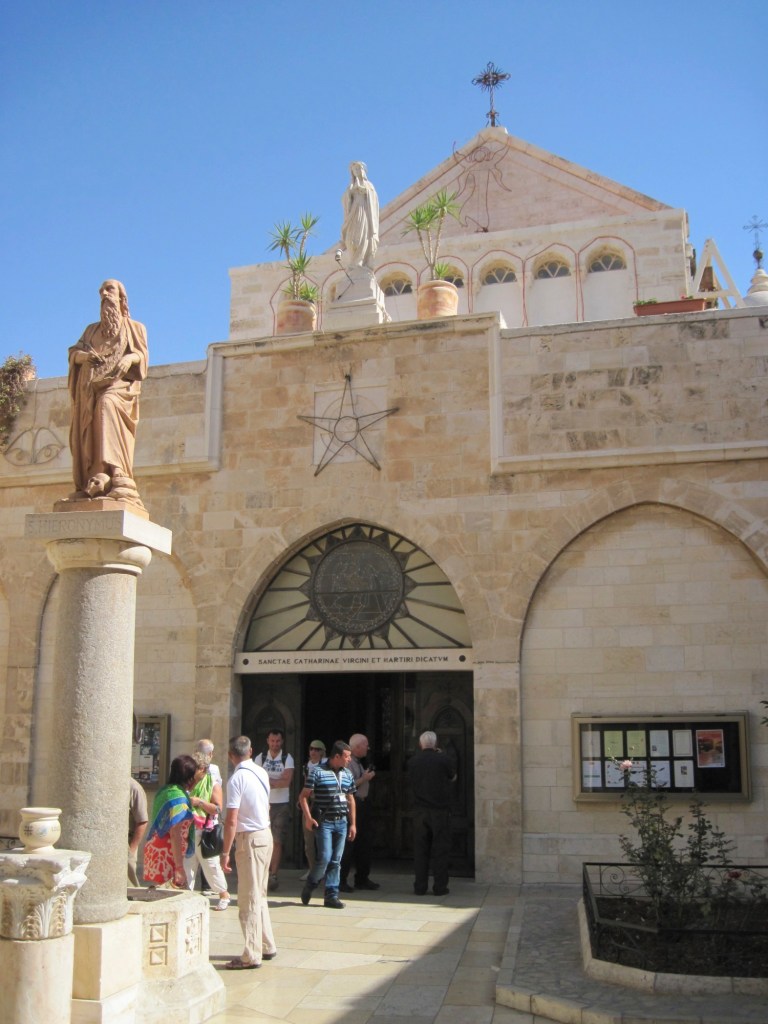
St. Catharine Church, Bethlehem

St. Catharine Church, Bethlehem. Remains of Jerome’s Monastery are under the church

Besides scripture studies, Jerome continued to engage in church controversies, sometimes harshly.

In 410 Alaric and his warriors sacked Rome.  Jerome, shocked by the invasion, provided shelter for Roman Christians fleeing to the safety of the Holy Land. “I have put aside my studies to help them,” he wrote. “Now we must translate the words of scripture into deeds, and instead of speaking holy words we must do them.”

He died in Bethlehem in 420. His remains were taken to the Basilica of St. Mary Major in Rome. A doctor and teacher of the church, he recognized in himsel need for God’s mercy. Jerome is an example that saints are not perfect.

Here are excerpts from his writings:

“Lord, show me your mercy and gladden my heart.
I am like the man going to Jericho, wounded by robbers.
Good Samaritan, come help me.
I am like a sheep gone astray.
Good Shepherd, come seek me and bring me home safe.
May I dwell in your house all my days and praise you forever.”

“I interpret as I should, following the command of Christ: Search the Scriptures, and Seek and you shall find. Christ will not say to me what he said to the Jews: You erred, not knowing the Scriptures and not knowing the power of God. For if, as Paul says, Christ is the power of God and the wisdom of God, and if the man who does not know Scripture does not know the power and wisdom of God, then ignorance of Scripture is ignorance of Christ.
 
Therefore, I will imitate the head of a household who brings out of his storehouse things both new and old, and says to his spouse in the Song of Songs: I have kept for you things new and old, my beloved. In this way permit me to explain Isaiah, showing that he was not only a prophet, but an evangelist and an apostle as well. For he says about himself and the other evangelists: How beautiful are the feet of those who preach good news, of those who announce peace.And God speaks to him as if he were an apostle: Whom shall I send, who will go to my people? And he answers: Here I am; send me.”

Let us glorify Christ In whatever sufferings are ours in this life.

O God, you yourself are both our crown and our shield: May we always follow only you and never depart from you!

Do not put your trust in your sword, or in your own strength; but rather, put your trust in the Lord!

Every day Christ stands at the door to our hearts, longing to enter. Let us open wide our hearts to him, then, that he might come in, and dwell with us always.

God can only speak peace to his people when they hope in him with all their hearts.

God protects us as a Father, and as a hen guarding her chicks, lest a hawk snatch them away.

The shield with which God protects us is spherical, for it keeps us safe on all sides.

All Creation serves God as God ordains: all in Heaven obeys, all on earth obeys, but it is only unhappy man who alone who disobeys.

Every day Christ is crucified in us, for we are crucified to the world. And so Christ is crucified in us.

Happy are those in whose hearts Christ rises from the dead daily. And he will rise in us every day, if we who are sinners will but repent.

Happy the soul in whom God is always enthroned!

Let us never trust in ourselves, but rather, let us always trust In the mercy of the Lord.

Greater by far are the wounds Inflicted by the tongue than those by the sword.

When we give to the poor, let us give thanks to Christ. More than the poor man gives thanks to us, for the poor unknowingly do us a great service. Almsgiving atones for sins.

Quotations selected by Brent Cruz, Confraternity of the Passion.

Mercy Comes to Your House: Luke 20:1-19

Zachaeus

Luke tells many stories of God’s mercy. Today’s reading at Mass is the story of Zacchaeus, the chief tax collector in Jericho, a wealthy man, Jesus called him down from a tree and stayed with on his way to Jerusalem. (Luke 19, 1-10)

As chief-tax collector, Zacchaeus was an agent for Herod Antipas, ruler of Galilee and Perea in Jesus’ day. Uncovering the ruins of Herod’s building projects in Galilee and elsewhere, archeologists point out that Herod built on a grand scale and lavishly, to impress his allies the Romans.

You needed money for building like that, of course, and that’s where tax-collectors came in. There was no dialogue or voting on government spending then. Herod told his army of tax-collectors, “Here’s how much I need; you go out and get it. Go to the fishermen along the Sea of Galilee and the farmers around Nazareth and the shepherds in the Jordan Valley and the merchants in Jericho and get what I need; I don’t care how, but get it.”

And so the tax collectors went out and got the money, keeping some for themselves. You needed to be tough and relentless for the job. It left you hard headed and hard hearted. An unsavory profession. The people resented them.

Zacchaeus, the chief tax collector in Jericho, was the one whom Jesus called and the one he stayed with on his way to Jerusalem. Objections came, not just from the Pharisees and scribes, who usually objected to Jesus’ actions, but everyone objected.

The only thing Jesus says is: “Today salvation has come to this house because this man too is a descendant of Abraham. For the Son of Man has come to seek and to save what was lost.” No thunderous warnings or stern corrections. Salvation has come and they sit down for a feast. You can hear in the story echoes of the Parable of the Prodigal Son, also from Luke’s gospel.

J

Notice that Jesus doesn’t call Zacchaeus to follow him to Jerusalem, like the blind man cured by Jesus in Jericho.  He does not call him to follow him as he did the other tax collector, Matthew. He doesn’t tell Zacchaeus to give up his job and get out of that dirty, complicated situation. No, as far as we can tell Zacchaeus was still chief tax-collector in Jericho after Jesus left, still taking orders from Herod Antipas, still part of a sinful world. But that’s where Zacchaeus will experience salvation, even there.

God’s mercy works in the real world and in real life.

The Little Lost Sheep

Luke 15:1-7

An Excerpt From Pope Francis, General Audience, Saint Peter’s Square
Wednesday, 4 May 2016 

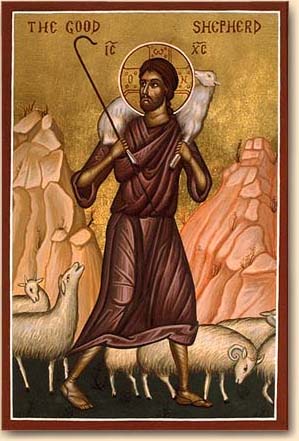
We are all familiar with the image of the Good Shepherd with the little lost lamb on his shoulders. This icon has always been an expression of Jesus’ care for sinners and of the mercy of God who never resigns himself to the loss of anyone. The parable is told by Jesus to make us understand that his closeness to sinners should not scandalize us, but on the contrary it should call us all to serious reflection on how we live our faith. The narrative sees, on the one hand, the sinners who approach Jesus in order to listen to him and, on the other, the suspicious doctors of the law and scribes who move away from him because of his behavior. They move away because Jesus approaches the sinners. These men were proud, arrogant, believed themselves to be just.

The lesson that Jesus wants us to learn is… that not a single one of us can be lost. God’s action is that of one who goes out seeking his lost children and then rejoices and celebrates with everyone at their recovery.

We are all warned: mercy to sinners is the style with which God acts and to this mercy he is absolutely faithful: nothing and no one can distract him from his saving will. God does not share our current throw-away culture… God throws no one away; God loves everyone, looks for everyone: one by one! He doesn’t know what “throwing people away” means, because he is entirely love, entirely mercy.

While he is looking for the lost sheep, he challenges the ninety-nine to participate in the reunification of the flock. Then, not only the lamb on his shoulders, but the whole flock will follow the shepherd to his home to celebrate with “friends and neighbors.”

We should reflect on this parable often, for in the Christian community there is always someone who is missing and if that person is gone, a place is left empty. Sometimes this is daunting and leads us to believe that a loss is inevitable, like an incurable disease. 

In Jesus’ vision there are no sheep that are definitively lost, but only sheep that must be found again. We need to understand this well: to God no one is definitively lost. Never! To the last moment, God is searching for us. Think of the good thief; only in the eyes of Jesus no one is definitively lost. For his perspective is entirely dynamic, open, challenging and creative. It urges us to go forth in search of a path to brotherhood. No distance can keep the shepherd away; and no flock can renounce a brother. To find the one who is lost is the joy of the shepherd and of God, but it is also the joy of the flock as a whole! We are all sheep who have been retrieved and brought back by the mercy of the Lord, and we are called to gather the whole flock to the Lord!

Click here to read the full address by Pope Francis.

Amos:The Quality of Mercy

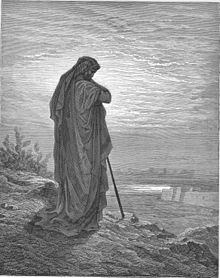
The Prophet Amos. by August Done

We’re reading from the Prophet Amos this week at Mass. His message to 8th century Israel is “one of unrelieved gloom,” one commentator says. Free from wars, Israel was far from gloomy. Its rich were getting richer and enjoying the “good life”, at the expense of the poor. The religious authorities said nothing. The only voice raised was the voice of a poor, uneducated farmer who cultivated figs, Amos.

Amos spoke for God: “I hate, I spurn your feasts…I take no pleasure in your solemnities…Away with your noisy songs! I will not listen to the melodies of your harps.” Destruction awaited a people unconcerned about the poor.

Still, God offers mercy to his people as we hear on Saturday in one of Amos’ most beautiful passages, echoes of which inspired Martin Luther KIng’s “I Have a Dream” speech:

“On that day I will raise up
the fallen hut of David;
I will wall up its breaches,
raise up its ruins,
and rebuild it as in the days of old…
Yes, days are coming,
says the LORD,
When the plowman shall overtake the reaper,
and the vintager, him who sows the seed;
The juice of grapes shall drip down the mountains,
and all the hills shall run with it.
I will bring about the restoration of my people Israel;
they shall rebuild and inhabit their ruined cities,
Plant vineyards and drink the wine,
set out gardens and eat the fruits.
I will plant them upon their own ground;
never again shall they be plucked
From the land I have given them,
say I, the LORD, your God.”  (Amos 9,11-15)

A beautiful definition of mercy. God comes to humanity at its worst, in its sham, its blindness, its evil, and raises it up again. Mercy does not depend on merit. It’s God loving us in spite of ourselves.

We see mercy best as it’s exemplified in the Passion of Jesus. In spite of hypocrisy and injustice, God offers his love to heedless humanity and the promise of a kingdom.

Have mercy on us, O Lord.

Be Merciful, O Lord, For We Have Sinned

David penitent


Because Jesus is often called “Son of David” in the New Testament and so many of the psalms are attributed to David, we may tend to idealize the great king. David united the tribes of Israel and established a nation with its capitol in Jerusalem. Jesus himself appealed to David’s example when his enemies accused his hungry disciples of eating grain on the Sabbath.

Yet, the long narrative we read in the Book of Samuel today and tomorrow at Mass offers a darker picture of the famous king– he was a murderer and an adulterer. David had Urriah the Hittite, a faithful soldier in his army, killed so that he could have Bathsheba, his wife. (2 Samuel 11, 1-17)

Psalm 51 is the response we make at Mass after listening to the king’s sordid deed. Tradition says it’s David’s own response after he realized what he had done. The Book of Psalms calls Psalm 51: “A psalm of David when Nathan the prophet came to him after he had gone in to Bathsheba.”

“Have mercy on me, O God, in your goodness;
in the greatness of your compassion wipe out my offense.
Thoroughly wash me from my guilt
And of my sin cleanse me.”

The psalm, the first of the Seven Penitential Psalms, asks God to take away both the personal and social effects of our sin, for our sins do indeed have emotional, physical and social consequences. Only God can “wash away” our guilt and cleanse our heart. Only God can “rebuild” the walls that our sins have torn down and the lives they have harmed. Only God can restore joy to our spirits and help us “teach the wicked your ways, that sinners may return to you.” Only God can bring us back to his friendship.

In the scriptures, David is a complex figure– a saint and a sinner. He’s also a reflection of us all. That’s why our response in the psalm at Mass today takes the form that it does –

“Be merciful, O Lord, for we have sinned.”

His Kindness Has Appeared

These are days to reflect on the mystery of the Incarnation. A decisive revelation of God, the Letter to the Hebrews says:

“At various times in the past and in various different ways, God spoke to our ancestors through the prophets; but in our own time, the last days, he has spoken to us through his Son, the Son that he has appointed to inherit everything and through whom he made everything there is.(Hebrews 1, 1-2)”

What does Jesus Christ reveal about God? He is the Word of God who reveals God to us, St. Bernard says, and in him “the kindness and love of God has been revealed and  we receive abundant consolation in this pilgrimage, this exile, this distress.”

Before he appeared as human, God’s kindness lay concealed, Bernard says. “Of course it was already in existence, because the mercy of the Lord is from eternity, but how could we know it was so great? It was promised but not yet experienced: hence many did not believe in it. At various times and in various different ways, God spoke through the prophets, saying I know the plans I have in mind for you: plans for peace, not disaster…”

“What greater proof could he have given of his mercy than by taking upon himself what needed mercy most? Where is there such perfect loving-kindness as in the fact that for our sake the Word of God became perishable like the grass? Lord, what is man, that you make much of him or pay him any heed?”

“See how much God cares for us. See what God thinks of us, what he feels about us. Don’t look at your own sufferings; look at God’s sufferings. Learn from what he was made for you, how much he makes of you; let his kindness be seen in his humanity.”

“ The lesser he has made himself in his humanity, the greater has he shown himself in kindness. The more he humbles himself on my account, the more powerfully he engages my love. The kindness and humanity of God our Saviour appeared says St Paul. The humanity of God shows the greatness of his kindness, and he who added humanity to the name of God gave great proof of this kindness.”

Saturday 2nd Week

Lent 1

Luke 15

Scripture Readings
The story of the prodigal son, one of the longest in the gospel, is also one of the most important. It’s not just about a boy who goes astray, of course, it’s about the human race gone wrong.

“Give me what’s mine,” the son says boldly to his father, and he takes off for a faraway country, a permissive paradise that promises power and pleasure, in fact, it promises him everything.

But they’re empty promises, and soon the boy who had so much has nothing and ends up in a pigsty feeding pigs, who eat better than he does.

Then, he takes his first step back. He “comes to himself,” our story says; he realizes what he has done. “I have sinned.”

How straightforward his reaction! Not blaming anybody else for the mess he is in: not his father, or the prostitutes he spent so much of his money on, or society that took him in. No, it’s his own fault.

He doesn’t wallow in his sin and what it’s brought him, either. He looks to the place where he belongs, to his father’s house. It wont be an easy road, but he takes it. He starts back home.

His story is our story too.

How easily we leave your side,
Lord God,
for a place far away.
Send light into our darkness,
and open our eyes to our sins.

Unless you give us new hearts and strong spirits,
we cannot make the journey home,
to your welcoming arms and the music and the dancing.

Father of mercies and giver of all gifts,
guide us home
and lead us back to you.

Monday: 2nd Week of Lent

Readings for Today

https://player.vimeo.com/video/207871897

IMG_0210

Prayers and reflections of the Passion of Jesus http://www.passionofchrist.us


Friday Thoughts: Just The Facts

by Howard Hain

.

All human beings are creations of God.

God loves all His creation.

He wills the best for each and every part of it.

His will is the best.

You are one of His creations.

So is the person you hate.

So is the person you dislike tremendously.

So is the person who annoys you to death.

God loves us all.

God offers us forgiveness for being so unkind to His other creations.

He loves us so much He gives us the freedom to choose the wrong path.

He loves us so much He sent His Only Begotten Son to show us the right way.

Jesus loves us so much He sent the Holy Spirit to strengthen and accompany us.

God smiles.

All three persons smile.

They are One God.

God’s love is all powerful and infinitely kind.

God’s gift of freedom is a gift He intends for us to use.

God desires for us to choose to become like Him.


.

.

Friday Thoughts: Uneasy Mercy

by Howard Hain

.

Behold, this child is destined for the fall and rise of many in Israel, and to be a sign that will be contradicted…

—Luke 2:34


.

When we are truly merciful, or at least sincerely try to be merciful—to see others and their deeds through the eyes of the Ever-Loving Eternal Father—there often is an unholy fear that takes place. This fear is not the fear of God. This fear is not from God.

No, the fear of God—the good and righteous “fear of the Lord”—a gift of the Holy Spirit—is not the fear to which I am referring. Let us make that perfectly clear. Absolutely not. That fear—the good and righteous “fear of the Lord”—is a great grace and is actually what prompts us to be merciful toward others in the first place.

The fear that I am referencing is superficial, like all fear other than the only fear we should ever have, “the fear of the Lord.” Whether this superficial fear comes from the world, from our own weak flesh, or from Satan, is not very important. For what we need to know and always remember is that this superficial fear is not of or from God.

It is the fear of being accused. Accused of condoning. For when we see others with true mercy we no longer merely look at their acts, no matter how sinful they may be. No, we see first and foremost a person. More so, we see a child. A child who is frightened. A child who is running a high fever. And no one with any heart at all, even if it be a calloused and somewhat hardened heart, wants to punish a frightened or feverish child.

No, no matter our maternal or paternal instinct, or lack thereof, the truly human instinct is to hug. To help. To hold. To heal. To alleviate the fear and burning pain.

But without God’s grace we too often, almost always in terms of statistical significance, do not see a child.

We only see a person who has harmed our world, our society, our way of life, our order, our peace.

We only see a person who—no matter how indirectly his or her actions might affect us—has harmed us and our families personally, and we along with the rest of the mob want justice.

A conflict takes place.

God’s perspective versus the world’s. A frightened and sick child versus a criminal who must be punished. Mercy versus justice.

But the conflict isn’t real. God not only loves justice too, God is Justice. And he sent His Only Begotten Son as expiation for the great injustice of mankind. Our kind. Our sin.

For God to only see the need for punishment is for God to deny His Only Begotten Son. That is not going to happen.

So the next time you feel the desire to be merciful—the need to be merciful—even toward the most “obvious” and “blatant” sinner do not give into the temptation. The temptation to fear. The fear that you are in some way condoning the sinful action because you are refusing to demand immediate and absolute punishment, a punishment that “fits the crime.”

No, say the Lord’s Prayer.

You are on God’s side. God is being merciful through you. And no matter how intimidated you may feel, be “firm and steadfast” in God’s love and mercy.

For you too love justice. You too love Jesus. And Jesus is Justice.

Jesus is Living and Breathing Justice.

And it is through this very person, The Person of Jesus, that “mercy and truth have met each other: justice and peace have kissed.” (Psalm 85:11)

Praise be to God.


.

.