Tag Archives: Jesus

Contemplating the Face of Christ With Mary

“Contemplating the Face of Christ With Mary”
Our Lady of the Rosary
A reflection on Rosarium Virginis Mariae, Apostolic Letter of St. Pope John Paul II
©️2024 Gloria M. Chang

The Rosary: A Christocentric Prayer

The Rosary of the Virgin Mary, which gradually took form in the second millennium under the guidance of the Spirit of God, is a prayer loved by countless Saints and encouraged by the Magisterium. Simple yet profound, it still remains, at the dawn of this third millennium, a prayer of great significance, destined to bring forth a harvest of holiness. It blends easily into the spiritual journey of the Christian life, which, after two thousand years, has lost none of the freshness of its beginnings and feels drawn by the Spirit of God to “set out into the deep” (duc in altum!) in order once more to proclaim, and even cry out, before the world that Jesus Christ is Lord and Saviour, “the way, and the truth and the life” (Jn 14:6), “the goal of human history and the point on which the desires of history and civilization turn.”

The Rosary, though clearly Marian in character, is at heart a Christocentric prayer. In the sobriety of its elements, it has all the depth of the Gospel message in its entirety, of which it can be said to be a compendium. It is an echo of the prayer of Mary, her perennial Magnificat for the work of the redemptive Incarnation which began in her virginal womb. With the Rosary, the Christian people sits at the school of Mary and is led to contemplate the beauty on the face of Christ and to experience the depths of his love. Through the Rosary the faithful receive abundant grace, as though from the very hands of the Mother of the Redeemer.”

Apostolic Letter, Rosarium Virginis Mariae of St. Pope John Paul II, 1

Our Lady of the Rosary with Saints, 18th century (Brooklyn Museum)

Saints who pray the Holy Rosary
Adore the face of Christ with Mary.


This content by Gloria M. Chang was originally published online at Shalom Snail: Journey to Wholeness

God’s Word, the Tree of Life

“God’s Word, the Tree of Life”
A reflection on Proverbs 30:5-9 and Luke 9:1-6
Wednesday of the Twenty-Fifth Week in Ordinary Time (Year II)
©️2024 Gloria M. Chang

Putting God First

Every word of God is tested;
he is a shield to those who take refuge in him.
Add nothing to his words,
lest he reprove you, and you will be exposed as a deceiver.

Two things I ask of you,
deny them not to me before I die:
Put falsehood and lying far from me,
give me neither poverty nor riches;
provide me only with the food I need;
Lest, being full, I deny you,
saying, “Who is the LORD?”
Or, being in want, I steal,
and profane the name of my God.

Proverbs 30:5-9

“Every word of God is pure (tested, refined),” like fruit from a tree of life. “He is a shield to those who take refuge in him.” Comparing divine wisdom to a tree of life (Proverbs 3:18), the Book of Proverbs guides us toward healing our broken relationship with God that occurred in the Garden of Eden. God created us for abundant life, which we reap by hearing and heeding his word. 

Ordering life around God, the sage asks for a truthful heart and for “neither poverty nor riches.” Luxury may tempt him to deny the Lord, while penury may incite him to steal and dishonor the name of God. Our heavenly Father, who knows what we need, will give us our “daily bread.” When making choices, the sage seeks the honor and glory of God above all.

Neither poverty nor riches, seek I,
But to honor God and him glorify.

God Provides


Jesus summoned the Twelve and gave them power and authority over all demons and to cure diseases, and he sent them to proclaim the kingdom of God and to heal the sick. He said to them, “Take nothing for the journey, neither walking stick, nor sack, nor food, nor money, and let no one take a second tunic. Whatever house you enter, stay there and leave from there. And as for those who do not welcome you, when you leave that town, shake the dust from your feet in testimony against them.” Then they set out and went from village to village proclaiming the good news and curing diseases everywhere.

Luke 9:1-6

Jesus sends his twelve apostles to proclaim the kingdom of God, the fulfillment of his word. The word of the Lord (dabar YHWH), which led the Israelites from Sinai to Jerusalem, has become flesh with divine authority to heal and cast out demons. Jesus, whose Father provides for his children, enjoins the Twelve to “take nothing for the journey.” 

The apostle, like the sage of the Book of Proverbs, lives on and through the Word of God, who is a “shield” and refining fire. Christ, the Word of God and Tree of Life, feeds us with himself in the sanctifying Eucharist.

Your word, O Lord, is a lamp for my feet.

Psalm 119:105 (Responsory)

God’s Word protects and purifies
Apostles who evangelize.


This content by Gloria M. Chang was originally published online at Shalom Snail: Journey to Wholeness

Matthew, the tax collector: September 21


Jews  usually turned away as they passed the customs place where Matthew, the tax-collector, was sitting. But look at our gospel for today:

“As Jesus passed by, he saw a man named Matthew sitting at the customs post. He said to him, “Follow me.” And he got up and followed him.”

To celebrate their new friendship, Matthew invited Jesus to a banquet at his house with his friends – tax collectors like himself – and Jesus came with some of his disciples. They were criticized immediately for breaking one of Capernaum’s social codes. “Why does your teacher eat with tax collectors and sinners?”

Jesus’ answer was quick: “Those who are well do not need a physician, but the sick do. Go and learn the meaning of the words `I desire mercy, not sacrifice.’ I did not come to call the righteous, but sinners.”

Hardly anything is known of Matthew’s part in Jesus’ later ministry, yet surely the tradition must be correct that says he recorded much of what Jesus said and did. Tax collectors were good at keeping books. Was Matthew’s task to keep memories? Did he remember some things that were especially related to his world?

The gospels say that wherever Jesus went he was welcomed by tax collectors. When he entered Jericho, Zachaeus, the chief tax collector of the city, climbed a tree to see him pass, since the crowds were so great. Did Matthew point out the man in the tree to Jesus, a tax collector like himself, who brought them all to his house, where Jesus left his blessing of salvation? And did tax collectors in other towns come to Jesus because they recognized one of their own among his companions?

Probably so. Jesus always looked kindly on outsiders like Matthew who were targets of suspicion and resentment. True, they belonged to a compromised profession tainted by greed, dishonesty and bribery. Their dealings were not always according to the fine line of right or wrong.

But they were children of God and, like lost sheep, Jesus would not let them be lost.

Pope Francis said he got his vocation to be a priest on the Feast of St. Matthew, when he went to confession and heard God’s call, a call of mercy.

Matthew’s Gospel?

The gospels themselves recall little about Matthew, an apostle of Jesus. We have his name, his occupation and a brief story of a banquet that took place with Jesus and some of his friends after his call.  ( Mt 9: 9-13; Mk 2:3-12; Lk5:18-26) As it is, the gospels concentrate on the ministry and teaching of Jesus. 

In the early centuries, those who knew Jesus told his story and brought his message to the world. As they died, writings about him gradually appeared, but there are only scarce references to who wrote them. St. Justin Martyr in the early 2nd century speaks of the “memoirs of the apostles”, without indicating any author by name. Later in that century, St. Irenaeus, bishop of Lyons, writing against the Gnostics who claim a superior knowledge of Jesus Christ attributes the gospels to Matthew, Mark, Luke and John. They are eyewitnesses who really know Jesus firsthand; they have given us their “memoirs.” 

Scholars today are less likely to credit Matthew’s Gospel to the tax-collector from Capernaum whom Jesus called. Some of his memoirs perhaps may be there– after all he came from a profession good at accounting for things. But too many indications point to other sources. Why would Matthew, if he is an eyewitness, depend on Mark’s Gospel as he does? Language, the structure of the gospel, the circumstances it addresses, point to a Jewish-Christian area beyond Palestine as its source, probably Antioch in Syria, probably written around the year 8o, after the Gospel of Mark.

Traditions says that Matthew preached in Ethiopia and Persia, but they have no historical basis.

He is remembered as a martyr who died for the faith, but again there is no historical basis. 

Better to see Matthew as the gospel and the prayer at Mass sees him: one of the first outsiders whom Jesus called. And he would not be the last..

O God, who with untold mercy
were pleased to choose as an Apostle
Saint Matthew, the tax collector,
grant that, sustained by his example and intercession,
we may merit to hold firm in following you.
Through our Lord Jesus Christ, your Son,
who lives and reigns with you in the unity of the Holy Spirit,
God, for ever and ever.
Amen.

Faith, a Ticket to Success? Jeremiah 26:1-9

You can’t listen to the story of the Prophet Jeremiah, our first reading these days,  without thinking about the passion of Jesus.  In fact, readings from the Book of Jeremiah are common readings for Holy Week. We see Jesus in Jeremiah.

God tells Jeremiah to “hold nothing back,” but speak the truth to those in power and the false prophets of the day, no matter how unpopular it is.  Jesus did the same.

Like Jeremiah, Jesus was innocent, but was framed by the powerful as guilty. They questioned his authority, but he would not deny his mission.

Only a few voices seem to stand up for Jeremiah and only a few stood up for Jesus. Neither had many faithful followers at their time of trial. Yet both were carried along by God’s power and their names vindicated.

Jeremiah, like Jesus and  John the Baptist who suffered a lonely death at the hands of Herod Antipas belonged to a brave company.

Some would have us see our faith as a ticket to success, an inoculation against failure or suffering.  Believe and nothing bad will happen to you. Yet, as you look at Jesus, the prophets and the saints, you see a more realistic profile of faith. We’re promised victory, yes, but only by accepting the mystery of the cross.

Keep an eye on Jeremiah and John. Keep an eye on the passion of Jesus. Follow them.

Hosea 11: The Bands of Love

Thus says the LORD: When Israel was a child I loved him,  out of Egypt I called my son. The more I called them, the farther they went from me,Sacrificing to the Baalsand burning incense to idols.

Yet it was I who taught Ephraim to walk, who took them in my arms; I drew them with human cords, with bands of love; I fostered them like onewho raises an infant to his cheeks; Yet, though I stooped to feed my child, they did not know that I was their healer.

My heart is overwhelmed, my pity is stirred. I will not give vent to my blazing anger, I will not destroy Ephraim again; For I am God and not man, the Holy One present among you; I will not let the flames consume you. Hosea 11:1-4,8-9

Today’s reading from Hosea reminds us why we read the Old Testament prophets. In an extraordinary way they capture the image of God in simple human terms, whether it’s the love of man and woman or parents for a child.

“When Israel was a child I loved him.” And God’s love is no abstract love. “I taught him to walk, I took him into my arms. I raised him to my cheeks, I stooped to feed him.”

The prophet describes God’s love through the simple “human cords and bands of love” a parent has in raising a child. How easily we forget those  “bands of love” by which we were brought up. We forget them, and we also forget the myriad ways God has been with us.

We may forget, but God does not forget. God’s love is like a mother and father who cannot forget, the prophet says:

“ My heart is overwhelmed, my pity is stirred. I will not give vent to my blazing anger,I will not destroy Ephraim again; For I am God and not man, the Holy One present among you; I will not let the flames consume you.”

Lonely Prophets: Elijah

Elijah mcarmel
Elijah


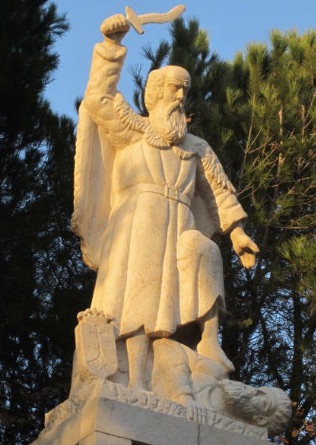
The powerful sculpture of the Prophet Elijah with sword in hand stands on Mount Carmel in northern Israel, where he defeated the false prophets of Ahab –today’s reading, (1 Kings 18:20-39) We will be reading about him this week.

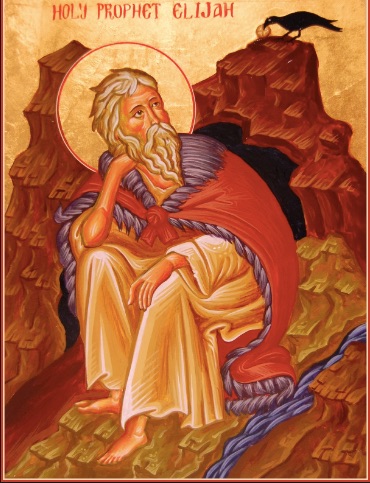
I must confess I like better his picture below where Elijah is huddled in his cloak facing death while a raven behind him offers God’s food. He’s a prophet on a lonely journey. Yes, the powerful prophet forbade the rain to fall and raised the dead, but according to the Book of Kings he spent most of his time on the run, hiding in caves and wadis, depending on someone like a poor widow for food and shelter. He had no support from other religious or political leaders. He was a lonely prophet.

The compilers of our lectionary knew what they were doing when they pared his story with the readings from Matthew’s Sermon on the Mount, also read this week. Some of Jesus’ listeners saw him as Elijah returned. He too had little support from the religious and political leaders of his day.

The Passionist community celebrates today Blessed Lorenzo Salvi, a Passionist priest who lived at the time of the Napoleonic Suppression of the church in 18th century Europe, when most of the religious communities in Italy where disbanded and their places taken over by the government. Lorenzo took part in rebuilding the church in Rome by his constant preaching. I think of him as a lonely prophet and I also see him as an example for the Passionists today. We have a role in rebuilding our church. You can read the story of Lorenzo Salvi here.

Elijah, the lonely prophet, makes me also think of a man who visited us from China about 40 years ago. He had been a seminarian in our seminary in China in the late 1940’s when the communists came to power and began the Cultural Revolution. John was sent for three years to a hard labor camp for “reeducation” because he was a Christian. But when they learned he knew English, government officials made him an English teacher in a Chinese high school.

I asked John what he taught. English literature, he told me. He taught Pearl Buck’s “The Good Earth” because the Chinese loved Pearl Buck. He also taught bible stories, particularly the Old Testament stories about Moses leading the Israelites out of Egypt and Elijah confronting the evil king Ahab and his wife Jezebel.

Bible stories I asked? Didn’t the officials question him? You can’t understand English literature without knowing the stories of the bible, he told them.

Whenever I hear the story of the lonely prophet Elijah in a country completely controlled by a powerful regime, yet still faithfully proclaiming the truth, I think of John. I also think of Lorenzo Salvi. Our society, held strongly now in the grip of a deaf secularism, needs lonely prophets to speak.

The Genealogy of Jesus

Advent began two weeks ago with Isaiah’s promise that all nations, along with his chosen people in exile, would hear God’s call to dwell in peace on God’s holy mountain. On December 17 our liturgy turns to Matthew’s gospel and the account of the genealogy of Jesus, “son of David, son of Abraham.” Matthew’s gospel traces his ancestry back to his Jewish beginnings. ( Matthew 1,1-17)

Whenever we read this gospel, filled with so many hard to pronounce names I am reminded of my mother.  She had a remarkable memory for relationships, whether her own family relations or others. Honestly, I often tuned out as she probed with delight family trees. After she died I realized I had lost my connection with countless relatives and people she had firmly in mind.  She would have appreciated the genealogy above.

This is not a superfluous project the evangelists are engaged in. They’re intent on describing the Incarnation of Jesus. He wasn’t isolated from humanity, above it all, but  he was part of the human family. And his family tree was not an army of saints; sinners are there for sure.

We will hear from some of his saintly forbears in the next few days, Mary, Joseph, Elizabeth and Zachariah. But let’s not forget the others.They are his family too. He loved them all.

In our family tree above Mary points to Joseph. Like her his ancestry goes back to David and Abraham. Appearing to him in a dream the angel says “Joseph, son of David, do not be afraid to take Mary your wife into your home. For it is through the holy Spirit that this child has been conceived in her.”

Advent Weekday Readings: 1st Week

The Old Testament readings for the 1st week of Advent– all from Isaiah–  are a message of universal salvation. Isaiah 2:1-5 (Monday) is the prophet’s classic announcement that all nations will stream to God’s mountain and listen for God’s instruction. “They will beat their swords into plowshares and their spears into pruning hooks.” Wars are over; the fragmentation destroying humanity comes to an end.  

For Isaiah, the mountain of the Lord– site of the Jewish temple in Jerusalem– has a central place in God’s promise. All nations will come there; they will be fed a rich banquet (Wednesday), there the poor will triumph (Thursday), the blind will see (Friday); it’s the rock where people dwell in safety, where children play around the cobra’s den, and the lion and the lamb lie down together (Tuesday). The prophet’s poetic imagery in the readings for the 1st week of Advent is strikingly beautiful. 

The gospels in the 1st week point to the Isaian prophecies fulfilled in Jesus Christ. The Roman centurion humbly approaching Jesus in Capernaum represents all the nations coming to him. Jesus feeds a multitude on the mountain. He gives sight to blind humanity, he affirms that his kingdom will be built on rock. He praises the childlike, who will enter the kingdom of heaven.

Matthew’s gospel, source of many of our Advent readings, portrays Jesus teaching on a mountain (Isaiah’s favorite symbol) and working great miracles there that benefit all who come.  He is also the new temple, the new Presence of God, Emmanuel, God with us.

Poor in Spirit

Christmas is a time of poverty. The Spirit of Bethlehem is one of smallness, of tiny new beginnings that open our minds to the infinite largeness of Incarnate Wisdom. The Christ Child heals us of our presumption. The New Born shows us that we simply don’t know what God has in store. His impoverished delivery stops us in our tracks. We stand like beasts in a stable, our knowledge, our understanding, our science, our facts, our truths stripped of eternal value. All that remains, whether we’re shepherds or kings or someone in between, is for us to nod along with the tiny beat of the drummer boy offering his seemingly meaningless gift. Let’s welcome Christ Jesus, Innocence itself, by being poor with Him. Let’s let go of preconceived notions of having control. To stand before the Lord in our nothingness is worth more to Him than any amount of gold, frankincense or myrrh. Our humility before the bright light is pure praise and prayer to the One Who offers us everything.

—Howard Hain

Mary’s Mother

by Howard Hain

durer

Albrecht Durer, “Virgin and Child with Saint Anne”, ca. 1519 (The Met)

Christmas is a time for grandmothers.

They bake and cook and decorate. Their homes become mini North Poles, diplomatic outposts of Santa’s Castle.

At its core, Christmas is of course all about Jesus. All about Jesus, Mary, and Joseph. All about the Holy Family.

The Holy Family is an extended family though. And it doesn’t stop at grandmothers and grandfathers, aunts and uncles, or even cousins and distant cousins.

Just ask Saints Joachim and Anne, Zechariah and Elizabeth, or John the Baptist—not to mention all the unknown relatives whom the child Jesus surely encountered throughout His Galilean days. Ask any one of them about the far-reaching ripple effects of family grace.

Those touched by Jesus have a tendency to appear bigger than life.

Look at Santa Claus.

Most of us are aware that he is really Saint Nick.

But do we stop to wonder who Mrs. Claus really is?

I think she’s Saint Anne.

After all, Mrs. Claus is seen as everyone’s grandmother, especially when it comes to holiday cheer. But when it comes to truly celebrating the birth of Jesus, it is through Saint Anne that we approach the gates of Christ’s Nativity.

Mary’s Mother holds a special key. She is first among grandmas, first among those who pinch chubby cheeks, who pass along one more extra sugary treat.

———

Saint Anne help us. Speak to us. Show us how to be grand parents to all those around us, especially the little ones. Stir up the spirit of Advent. Bake away the holiday blues. Cook up a dish of Christmas love that only your hearth can serve.

———

Come one, come all, to the home of Saint Anne. Come with me to Grandma’s house for a holiday visit. Taste and see. Enter her kitchen, where the hot chocolate can always fit a little more whipped cream, where you hear the constant refrain: “eat…eat…eat…”

At Grandma’s your plate is never empty.

Her table is continually set.

She always sees Jesus as having just been born.

She is always wrapping Him up tightly in swaddling clothes.

It is simply grand.

To Grandma, Jesus is always an innocent child.

And she can’t help but see Him deep within both you and me.


(Dec/21/2017)

Howard Hain is a contemplative layman, husband, and father. He blogs at http://www.howardhain.com


Web Link: Metropolitan Museum of Art. Albrecht Durer, “Virgin and Child with Saint Anne”, ca. 1519