Tag Archives: God

Letter to the Ephesians

It’s so easy to see a world out of control these days, and to believe that nothing can be done. We’re going nowhere. 

The Letter to the Ephesians, read this week at Mass, says that’s not so. It’s written, not just to the  church at Ephesus, but to other churches as well, commentators says. So it’s written to our church too.

A great plan of God is at work from “the foundation of the world,” a plan for the “fulness of time,” a “mystery made known to us” in Christ Jesus, our Lord. We have this “word of truth” this gospel of our salvation, from Jesus himself. The Spirit he promised is the “first installment of our inheritance.”“First installment,” That’s what we working with now, It may not seem like much but it gets us where we’re going.

It promises more than we think or expect. “May the God of our Lord Jesus Christ, the Father of glory, give you a spirit of wisdom and revelation resulting in knowledge of him. May the eyes of [your] hearts be enlightened, that you may know what is the hope that belongs to his call, what are the riches of glory in his inheritance among the holy ones, and what is the surpassing greatness of his power for us who believe, in accord with the exercise of his great might, which he worked in Christ, raising him from the dead and seating him at his right hand in the heavens, (Ephesians 1)

Every Monday of the four week cycle of the Liturgy of the Hours we read Ephesians 1, 3-10 at evening prayer, a reminder to see the day, however small and confusing it may be, as part of the great unfolding plan of God in Christ, our Lord.

Paul, an Apostle of Christ Jesus by the will of God,
to the holy ones who are in Ephesus
and faithful in Christ Jesus:
grace to you and peace from God our Father and the Lord Jesus Christ.

Blessed be the God and Father of our Lord Jesus Christ,
who has blessed us in Christ
with every spiritual blessing in the heavens,
as he chose us in him, before the foundation of the world,
to be holy and without blemish before him.
In love he destined us for adoption to himself through Jesus Christ,
in accord with the favor of his will,
for the praise of the glory of his grace
that he granted us in the beloved.

In Christ we have redemption by his Blood,
the forgiveness of transgressions,
in accord with the riches of his grace that he lavished upon us.
In all wisdom and insight, he has made known to us
the mystery of his will in accord with his favor
that he set forth in him as a plan for the fullness of times,
to sum up all things in Christ, in heaven and on earth.

Guardian Angels

We usually associate Guardian Angels with children. In the gospel reading for the Feast of Guardian Angels, October 2, Jesus says we can’t get to heaven unless we become like little children whose “angels in heaven always look upon the face of my heavenly Father.”  (Matthew 18,1-5,10)

Artists, like the above, usually picture children with Guardian Angels, protecting and guiding them as they go on their way in a dangerous world.

Yet, the angels we read about  in the Bible are more than guardians of children; they’re signs of God’s guardianship of the whole world. They bring God’s message to Mary and Joseph and the prophets. They bring bread to Elijah in the desert and save Daniel in the lion’s den. Angels are part of God’s providential hand dealing with the world. They’re guardians and guides of nations, the human family and creation itself.  They’re everywhere instruments of God’s power and love and justice. 

This week’s news will be dominated, as usual,  by politics, wars, human tragedies and scandals, but here we are reading about guardian angels, who will never make the news of the day, yet are powerfully present in our world.  However smart or independent or grown-up we think are, God knows we’re still little children. We never outgrow God’s guidance and care: we have “loyal, prudent, powerful protectors and guides. They  keep us so our ways cannot be overpowered or led astray.” So that’s us in the picture above.

I think of the “principle of subsidiarity” on the feastday of the Guardian Angels. God spreads his  power around. I also remember that sometime ago I nearly hit a truck ahead of me but something suddenly stopped me. “Thanks.”

O God,
in your infinite providence you deign to send your holy angels to be our guardians. Grant to us who pray to you
that we may be defended by them in this life
and rejoice with them in the next.
Through our Lord Jesus Christ, your Son.

Lonely Prophets: Elijah

Elijah mcarmel
Elijah


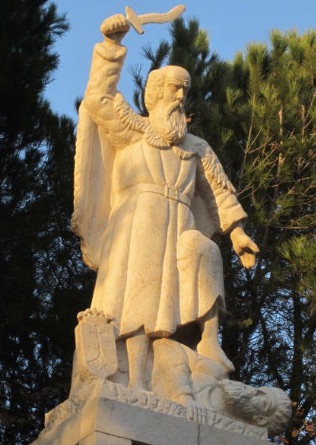
The powerful sculpture of the Prophet Elijah with sword in hand stands on Mount Carmel in northern Israel, where he defeated the false prophets of Ahab –today’s reading, (1 Kings 18:20-39) We will be reading about him this week.

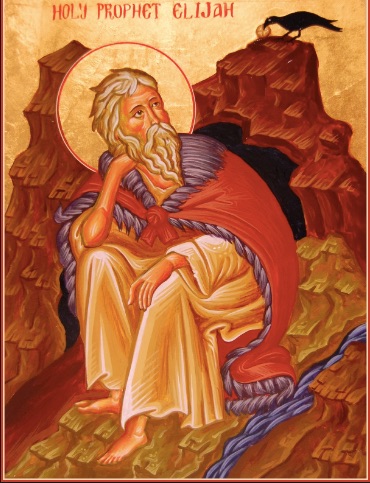
I must confess I like better his picture below where Elijah is huddled in his cloak facing death while a raven behind him offers God’s food. He’s a prophet on a lonely journey. Yes, the powerful prophet forbade the rain to fall and raised the dead, but according to the Book of Kings he spent most of his time on the run, hiding in caves and wadis, depending on someone like a poor widow for food and shelter. He had no support from other religious or political leaders. He was a lonely prophet.

The compilers of our lectionary knew what they were doing when they pared his story with the readings from Matthew’s Sermon on the Mount, also read this week. Some of Jesus’ listeners saw him as Elijah returned. He too had little support from the religious and political leaders of his day.

The Passionist community celebrates today Blessed Lorenzo Salvi, a Passionist priest who lived at the time of the Napoleonic Suppression of the church in 18th century Europe, when most of the religious communities in Italy where disbanded and their places taken over by the government. Lorenzo took part in rebuilding the church in Rome by his constant preaching. I think of him as a lonely prophet and I also see him as an example for the Passionists today. We have a role in rebuilding our church. You can read the story of Lorenzo Salvi here.

Elijah, the lonely prophet, makes me also think of a man who visited us from China about 40 years ago. He had been a seminarian in our seminary in China in the late 1940’s when the communists came to power and began the Cultural Revolution. John was sent for three years to a hard labor camp for “reeducation” because he was a Christian. But when they learned he knew English, government officials made him an English teacher in a Chinese high school.

I asked John what he taught. English literature, he told me. He taught Pearl Buck’s “The Good Earth” because the Chinese loved Pearl Buck. He also taught bible stories, particularly the Old Testament stories about Moses leading the Israelites out of Egypt and Elijah confronting the evil king Ahab and his wife Jezebel.

Bible stories I asked? Didn’t the officials question him? You can’t understand English literature without knowing the stories of the bible, he told them.

Whenever I hear the story of the lonely prophet Elijah in a country completely controlled by a powerful regime, yet still faithfully proclaiming the truth, I think of John. I also think of Lorenzo Salvi. Our society, held strongly now in the grip of a deaf secularism, needs lonely prophets to speak.

Earth Day: God So Loved the World

Today is Earth Day. As Christians we see the earth through eyes of faith. The earth is God’s creation

God created and cares for more than the human family. You are the “hope of all the earth and of far distant isles”, Psalm 65 says. “You uphold the mountains with your strength, you still the roaring of the seas…The ends of the earth stand in awe at the sight of your wonders. The lands of sunrise and sunset you fill with your joy.

“You care for the earth, give it water, you fill it with riches. Your river in heaven brims over to provide its grain. And thus you provide for the earth; you drench its furrows; you level it, soften it with showers; you bless its growth. You crown the year with your goodness. Abundance flows in your steps, in the pastures of the wilderness it flows. The hills are girded with joy, the meadows covered with flocks, the valleys are decked with wheat. They shout for joy, yes they sing.” (Psalm 65, Tuesday. Morning Prayer, week 2)

Along with the human family, the earth praises God, its creator,. The natural world, as a vital part of God’s creation, shouts for joy and sings. There’s even surprise in the psalms that God, the Almighty, creator of heaven and earth, could have a special care for the human family. “When I see the heavens, the work of your hands, the moon and the stars which you arranged, what is man that you should keep him in mind, mortal man that you care for him?”  ( Psalm 8, Saturday Morning, week 2, 4 )

The view of God’s close engagement with the natural world proclaimed by the psalms and the scriptures fell into disfavor when science became the primary way of looking at the natural world with the age of the Enlightenment. Science became our guide and the human world became the center that controls everything. God’s engagement with the natural world and the human world came into question. The scriptural accounts were just poetry.

But poetry can also be true.  

As we hear the Risen Jesus in the Easter season using the great images of bread from heaven, the shepherd, the vine, we shouldn’t miss their cosmic import. Images point out many things. Certainly “bread from heaven” points to the sacrament of the Eucharist; the shepherd and vine point to the life of the church and the intimacy we enjoy as branches grafted into the vine that is Jesus Christ.

But let’s not forget God’s rule over the whole world. We know so much more about it now. We also know how endangered it has become because of human neglect. More than ever, we need to acknowledge its dignity before God, who still covers the meadows with flocks, “the valleys are decked with wheat.” The natural world shouts for joy and sings during the Easter season. Its Shepherd guides it; it receives daily bread.  It shares in the promise of the Risen Christ.  

The Genealogy of Jesus

Advent began two weeks ago with Isaiah’s promise that all nations, along with his chosen people in exile, would hear God’s call to dwell in peace on God’s holy mountain. On December 17 our liturgy turns to Matthew’s gospel and the account of the genealogy of Jesus, “son of David, son of Abraham.” Matthew’s gospel traces his ancestry back to his Jewish beginnings. ( Matthew 1,1-17)

Whenever we read this gospel, filled with so many hard to pronounce names I am reminded of my mother.  She had a remarkable memory for relationships, whether her own family relations or others. Honestly, I often tuned out as she probed with delight family trees. After she died I realized I had lost my connection with countless relatives and people she had firmly in mind.  She would have appreciated the genealogy above.

This is not a superfluous project the evangelists are engaged in. They’re intent on describing the Incarnation of Jesus. He wasn’t isolated from humanity, above it all, but  he was part of the human family. And his family tree was not an army of saints; sinners are there for sure.

We will hear from some of his saintly forbears in the next few days, Mary, Joseph, Elizabeth and Zachariah. But let’s not forget the others.They are his family too. He loved them all.

In our family tree above Mary points to Joseph. Like her his ancestry goes back to David and Abraham. Appearing to him in a dream the angel says “Joseph, son of David, do not be afraid to take Mary your wife into your home. For it is through the holy Spirit that this child has been conceived in her.”

Advent Weekday Readings: 1st Week

The Old Testament readings for the 1st week of Advent– all from Isaiah–  are a message of universal salvation. Isaiah 2:1-5 (Monday) is the prophet’s classic announcement that all nations will stream to God’s mountain and listen for God’s instruction. “They will beat their swords into plowshares and their spears into pruning hooks.” Wars are over; the fragmentation destroying humanity comes to an end.  

For Isaiah, the mountain of the Lord– site of the Jewish temple in Jerusalem– has a central place in God’s promise. All nations will come there; they will be fed a rich banquet (Wednesday), there the poor will triumph (Thursday), the blind will see (Friday); it’s the rock where people dwell in safety, where children play around the cobra’s den, and the lion and the lamb lie down together (Tuesday). The prophet’s poetic imagery in the readings for the 1st week of Advent is strikingly beautiful. 

The gospels in the 1st week point to the Isaian prophecies fulfilled in Jesus Christ. The Roman centurion humbly approaching Jesus in Capernaum represents all the nations coming to him. Jesus feeds a multitude on the mountain. He gives sight to blind humanity, he affirms that his kingdom will be built on rock. He praises the childlike, who will enter the kingdom of heaven.

Matthew’s gospel, source of many of our Advent readings, portrays Jesus teaching on a mountain (Isaiah’s favorite symbol) and working great miracles there that benefit all who come.  He is also the new temple, the new Presence of God, Emmanuel, God with us.

Mary’s Mother

by Howard Hain

durer

Albrecht Durer, “Virgin and Child with Saint Anne”, ca. 1519 (The Met)

Christmas is a time for grandmothers.

They bake and cook and decorate. Their homes become mini North Poles, diplomatic outposts of Santa’s Castle.

At its core, Christmas is of course all about Jesus. All about Jesus, Mary, and Joseph. All about the Holy Family.

The Holy Family is an extended family though. And it doesn’t stop at grandmothers and grandfathers, aunts and uncles, or even cousins and distant cousins.

Just ask Saints Joachim and Anne, Zechariah and Elizabeth, or John the Baptist—not to mention all the unknown relatives whom the child Jesus surely encountered throughout His Galilean days. Ask any one of them about the far-reaching ripple effects of family grace.

Those touched by Jesus have a tendency to appear bigger than life.

Look at Santa Claus.

Most of us are aware that he is really Saint Nick.

But do we stop to wonder who Mrs. Claus really is?

I think she’s Saint Anne.

After all, Mrs. Claus is seen as everyone’s grandmother, especially when it comes to holiday cheer. But when it comes to truly celebrating the birth of Jesus, it is through Saint Anne that we approach the gates of Christ’s Nativity.

Mary’s Mother holds a special key. She is first among grandmas, first among those who pinch chubby cheeks, who pass along one more extra sugary treat.

———

Saint Anne help us. Speak to us. Show us how to be grand parents to all those around us, especially the little ones. Stir up the spirit of Advent. Bake away the holiday blues. Cook up a dish of Christmas love that only your hearth can serve.

———

Come one, come all, to the home of Saint Anne. Come with me to Grandma’s house for a holiday visit. Taste and see. Enter her kitchen, where the hot chocolate can always fit a little more whipped cream, where you hear the constant refrain: “eat…eat…eat…”

At Grandma’s your plate is never empty.

Her table is continually set.

She always sees Jesus as having just been born.

She is always wrapping Him up tightly in swaddling clothes.

It is simply grand.

To Grandma, Jesus is always an innocent child.

And she can’t help but see Him deep within both you and me.


(Dec/21/2017)

Howard Hain is a contemplative layman, husband, and father. He blogs at http://www.howardhain.com


Web Link: Metropolitan Museum of Art. Albrecht Durer, “Virgin and Child with Saint Anne”, ca. 1519


Morning Thoughts: Little Drummer Boys and Girls

by Howard Hain

Yesterday I witnessed a “dress” rehearsal for a live nativity. The cast was made up of first and second graders, and the audience was mostly composed of residents of a retirement home for religious sisters, Franciscans. It was spectacular.

Last week I was at Radio City Music Hall to watch the Rockettes in their “Christmas Spectacular”. It was quite a production.

Sitting in the dark this morning I cannot help but contrast the two.

I also cannot help but relate to the seven-year old who played the part of The Little Drummer Boy.

As that child walked so slowly toward the foot of the altar, where the rehearsal was being staged, I saw my vocation in an entirely different light.

The children were all singing their hearts out, and many of the eighty and ninety year-old sisters were mouthing the words. The boy with the drum didn’t utter a sound. He just kept walking, slowly, extremely slowly toward the altar, every once in a while ever so slightly pretending to tap two tiny sticks upon a toy drum. He was beautifully awkward.

There was no greater spectacle on earth at that very moment. Shall I dare to say, no greater event that heaven or earth has ever known?

For a child was born. We were all being born.


Come they told me, pa rum pum pum pum
A new born King to see, pa rum pum pum pum
Our finest gifts we bring, pa rum pum pum pum
To lay before the King, pa rum pum pum pum,
rum pum pum pum, rum pum pum pum,

So to honor Him, pa rum pum pum pum,
When we come.

Little Baby, pa rum pum pum pum
I am a poor boy too, pa rum pum pum pum
I have no gift to bring, pa rum pum pum pum
That’s fit to give the King, pa rum pum pum pum,
rum pum pum pum, rum pum pum pum,

Shall I play for you, pa rum pum pum pum,
On my drum?

Mary nodded, pa rum pum pum pum
The ox and lamb kept time, pa rum pum pum pum
I played my drum for Him, pa rum pum pum pum
I played my best for Him, pa rum pum pum pum,
rum pum pum pum, rum pum pum pum,

Then He smiled at me, pa rum pum pum pum
Me and my drum.*


.

.*(Little Drummer Boy was composed by Katherine K. Davis, Henry Onorati and Harry Simeone in 1958.)


Broken Baby Jesus

by Howard Hain

(Note: This post was originally published on December 24, 2011.)
broken-baby-christ-2-1


We have not put up a tree in years.

For nearly a decade we have been moving—no longer than two years in any one house and no less than ten different not-so-humble abodes. Between and during the moves we were very much engaged with the world. A seemingly endless movable beast.

This December marks one year in our current house. I am happy to say it is our home. The Lord has blessed us with great peace. And with that peace comes a tree. A simple, well-shaped tree. Fittingly, a dear friend offered it to us as a gift.

Francesca could not be more ready to be initiated into the act of trimming. Before the tree arrived, her two-year-old fingers pointed out every tree, artificial or real, that graced the pages of a holiday flyer or the commercial floor of a Rite Aid or Dollar Store.

Up the stairs came the evergreen, into the old stand that has been in storage since my father last used it several decades ago. I cut off the mesh and out popped the branches.

We hung the lights and old glass ornaments that my mother-in-law washed a few days before.

The main attraction for Francesca was the Nativity.

Not since St. Francis of Assisi assembled the first Nativity in Greccio in 1223, has there been such admiration for each and every witness who Our Lord assembled to adore His Son that first Christmas two millennia ago. Francesca kissed and hugged every shepherd, sheep, donkey, angel, and king. Most of all she adored the Holy family, calling Mary and Joseph, Ma-ma and Da-da, respectively. And Jesus, He was simply called: “ba-be.”

She carried them around the apartment. I did not want to ruin her fun, but they are ceramic. I explained a few times to be very careful.

“Gentle, Francesca…gentle…”, I harked a host of times.

Boom. To the wood floor went the shepherd. Amazing, grace held him intact. I took that as a great sign to put an end to her carrying the animals, angels and representatives of mankind.

I was fixing my coffee when I turned to see Francesca with Baby Jesus in her tiny hands. But He is so small, so tiny, what harm could come from holding Him? So I let her get away with carrying the Savior.

As I stirred my spoon Christ crashed to the floor, the tile floor. Francesca immediately looked at me, as if expecting all hell to break loose. I think I sighed but that was about all. It is Christmas, right? And it is, after all, only a ceramic figure purchased at Target.

After assuring Francesca not to worry and guiding her toward a few coloring books in the living room, I bent down to retrieve the broken Christ.

———

St. Francis was told by a Crucifix in an old abandoned chapel: “Restore my Church.”

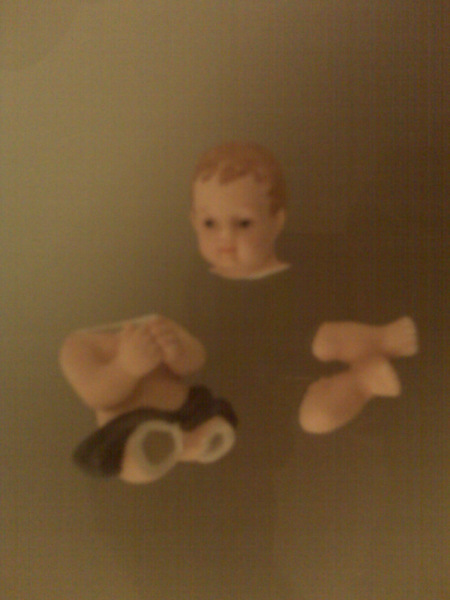
In my small one-bedroom apartment, I found Baby Christ, broken into exactly three: The Head, the Torso, and the Crossed Legs.

“Restore the Trinity,” was spoken to me.

———

For half of my forty years I can honestly say I have tried to pursue Truth, wherever it lie. In philosophy, in scripture, in literature, in art, in nature, in history…

Now, the entire Gospel of Christ lie naked on my kitchen floor.

We separate, we distinguish, we categorize, we breakdown. The Fall of Adam was a fall into denomination.

Christ’s body is One. His Church cannot be broken. Only mere men can get things so wrong.

I think of the great “Angelic Doctor” of the Church, St. Thomas Aquinas, who after spending a lifetime in unparalleled pursuit of human understanding, said after glimpsing a vision of what Our Lord has in store for those who love God:

“All that I have written seems like straw compared to what has now been revealed to me.”

Yes… “straw”…my brother Thomas…merely straw. Straw that lines the manger within which Our Savior is laid bare.

———

It is tradition to leave the crib empty until Christmas morning. Only then do we place the figurative baby Jesus into the scene, after all until that moment he was not yet brought forth from Mother Mary’s womb.

This Christmas morning I will glue together a Broken Baby Christ. The Head, the Torso, and the Crossed Legs will again be One.

Like the world after the birth of Christ, I will never be the same.

For what has now been revealed to me, no fall can break apart.


Howard Hain is a contemplative layman, husband, and father. He blogs at http://www.howardhain.com

 

The Yet Empty Stable

by Howard Hain

There’s a little stable not too far from here.

It sits in a church that has seen better days.

The parish is poor and the people seem to disappear.

But a few persistent peasants won’t stay away.

I love it there.

The priest is wonderfully uncertain.

He is afraid of God.

He instinctively bows his head at the mention of the name.

He knows how little he is in front of the great star.

I imagine he was involved in setting the stable.

It is a good size, on the relative little-stable scale.

It is surrounded by ever-green branches.

Probably snipped from the few Douglas Firs placed around the altar and yet to be trimmed.

The stable itself is composed of wood.

A little wooden railing crosses half the front.

A single string of clear lights threads through the branches laid upon the miniature roof.

They are yet to be lit.

I love it there.

I kneel before the empty scene.

For as of yet, not a creature or prop is present.

Not an ox or a goat, not a piece of hay or plank of fencing.

Not even a feeding trough that is to be turned into a crib.

No visible sign of Joseph and Mary, nor a distant “hee-haw” of a very tired donkey.

I wonder if I could get involved.

Perhaps I could slip into the scene.

There’s a darkened corner on the lower left.

In the back, against the wall.

I could hide myself within the stable.

Before anyone else arrives.

I don’t think they would mind.

I’d only be there to adore.

To pay homage to the new born king.

I might even help keep the animals in line.

Yes, a stagehand, that’s what I can be!

I know there’s no curtain to pull.

That’s to be torn in a much later scene.

But to watch the Incarnation unfold from within!

That’s what I dream.

To see each player take his and her place.

To see the great light locate the babe.

To watch the kings and shepherds stumble onto the scene.

Hark! To hear the herald angels sing!

O the joy of being a simple farmhand.

Of being in the right place at always the right time.

Of course though I wouldn’t be alone.

In that darkened corner, also awaiting the entire affair, there are many others.

Most I don’t know by name.

Too many in fact to even count.

But a few I know for sure.

For certain, present are those few persistent peasants who won’t stay away.

And of course there’s that wonderful anonymous parish priest.

The one who helped set into place this yet empty but very expectant stable.

The one whose fear of God is so clearly the beginning of wisdom.


(Dec/16/2016)

Howard Hain is a contemplative layman, husband, and father. He blogs at http://www.howardhain.com