Tag Archives: God

Friday Thoughts: On the Cutting Edge of Boredom

vincent-van-gogh-the-stone-bench-in-the-garden-at-saint-paul-hospital-1889

Vincent van Gogh, “The Stone Bench in the Garden of Saint-Paul Hospital” (1889)

.

There is so much “excitement” in the world.

Politics. Sports. Entertainment.

Even in the simple act of kids going back to school there is so much hoopla.

We can’t just do things simply. Everything has to be planned, announced, delved into, broadcast into something “grand”, “life-changing”, “utterly profound.”

But the more we need to insist that something is the case, the less in reality it usually is. For excitement, like authority, is something that by its very nature announces itself—and it decreases in direct proportion to the need to have it proclaimed.

In other words, just because we make “a big deal” about everything doesn’t mean it is. In fact, it is normally quite the opposite.

———

I remember when a child’s birthday party was composed of eight or ten kids sitting around a kitchen table, wearing silly pointy hats, and eating a Duncan Hines cake made the day before by a stay-home mom.

Even catechism lessons seemed a whole lot more straight forward, and effective. For me they took place around that same kitchen table, with those same neighborhood friends, and were taught by that same mom who baked the birthday cake. Now, catechists are expected to act like game-show hosts. And preachers? We’ll they’re expected to be downright celebrities.

Well, there is an answer to all this triviality: The Bench. Whether it’s in the park, in front of your house, or even under one of those little bus-stop canopies on the side of the road.

Sit. Listen. Do nothing. Especially when you are tempted by “boredom”. For that’s exactly what boredom is, a temptation. A temptation to deny the existence of God. For if we are conscious of God’s presence we can never be bored. Every nook and cranny of every “meaningless” daily act and encounter has profound, truly profound significance, if we are conscious of God’s omnipresence and His perfect will.

Sit there peacefully, resting quietly on the cutting edge of boredom. You never know how much good God might do through you: what poor widow you may accompany, what orphan you might help find a home, what angel you may entertain, what authentic prayer you might offer up—now that God and not self-image is in control.

———

Truth flips things on their head. I think it is Saint Bernard who says something along these lines: If we really think about how radical a call the Christian life is, as compared to the way the rest of the world lives, we realize it’s almost the equivalent of us walking down the street on our hands.

If it isn’t Saint Bernard that I’m paraphrasing, well then it is one of God’s other saints, and that is all that matters. For in God’s Kingdom the only credit that is given comes from and returns to God, and God alone. All wisdom is His.

And there it is, there is the crux of it: We have become obsessed with being “original”, with being “special”, with being “one-of-a-kind”—which of course we all are, tremendously so in fact—that is until we stop and think about it, or even worse, try to achieve it through our own means.

Trying to be “original” is the end of all originality. Wanting to be “special” is the death of a truly special purpose.

Pure existence on the other hand can only result in true originality—and it is always special, no matter what Tom, Dick, or Harry it is taking place within.

———

When a human being is existing as God wills, the result is dynamic, truly exciting. And God never wills for us to believe and act as if we are God and He is not.

Put to death once and for all the need to self-promote, to self-proclaim, to self-worship.

Sit on a bench instead. Be still. Exist. You just may be surprised how cool you really are.


.

—Howard Hain

.

Friday Thoughts: Playing Around

Bruegel, Children's Games, 1560

Bruegel, “Children’s Games”, (1560)


…and a little child will lead them.

—Isaiah 11:6

———

It’s the simple moments. It’s playing hide-and-seek. It’s pretending that what isn’t is.

Like a game made-up as we go, with only a single rule: It has to make us laugh.

But not the kind of laughter that hurts anyone or anything. No, it has to be true laughter, the kind that comes from and through kindness, through truly wanting to be with one another—so much so that we’ll make up just about any old game, just as long as we wont have to go our separate ways.

“Life” then becomes one big beautiful “excuse” to stay together, and our “actions” take on a tremendously meaningful fashion. They become like soft pieces of colorful clothing gently placed upon our joy-filled affections.

Little children know this through and through. They’re constantly changing and tailoring their “clothes”, adapting and accessorizing as they go, with only one goal in mind: for the “fun” to continue. But the fun they seek is not the kind that you and I normally desire—for little children know what few adults remember. They’re not so easily tricked. They know that fun, true fun, has very little to do with the actual game being played, in and of itself. For little children it’s all about what the game, as a mere instrument, allows them to experience—the freedom to let out love.

That’s why the type of game they play can turn on a dime. It just doesn’t matter.

Rules? Scores? Time-limits?

Who cares about stuff like that?

Are we “laughing”? Are we having “fun”? Are we still “with each other”?

Are we still in love?

These are the only questions that matter to a small child!

And with prayer it is much the same. Saints make up all kinds of “games” in order to “excuse” the time that they want so desperately to spend with God. They play all kinds of little games. They slide beads, they sing little songs, they pretend to be statues while playing hide-and-seek with the Lord, and some—the ones that the world most often calls crazy—even dream up little tales and fanciful stories, imagining along with God what could be if only everyone in the world would join in and play together.

But this is no big secret. All saints in one way or another come to say the same thing: Every technique, every approach, every means of entering into prayer…each and every one…they’re all part of one giant “excuse”, one seemingly never-ending “game”. For at the end of the day, techniques and approaches are at best a mere prelude to divine laughter—that infant-like sound composed of pure joy, that only the Love of God can bring into being.

———

He said to them, “Let the little children come to me, and do not hinder them, for the kingdom of God belongs to such as these. Truly I tell you, anyone who will not receive the kingdom of God like a little child will never enter it.” And he took the children in his arms, placed his hands on them and blessed them.

—Mark 10: 14-16

.

—Howard Hain

.

Friday Thoughts: To All Gathered in Thought and Prayer

by Howard Hain

.

Jesus Christ is Real.

.

He is not made of wood or ink or paint. He is not a distant figure from a distant past. He is here. We gather in His name—He is here. He is as real as each one of us. He is what makes each one of us real.

The message is simple:

He is the Son of God. He is the Way, and the Truth, and the Life. He is Love. He is Forgiveness. He is Humility. He is Boldness and Obedience.

He is Lord. He is God. He is Jesus Christ, crucified and risen.

He is Christ Jesus, and He is Real.

I see Him now in each of you. I say to Him, I say to you: “I love You, my Lord and my God.”

.

Now, let us go and tell others…

.

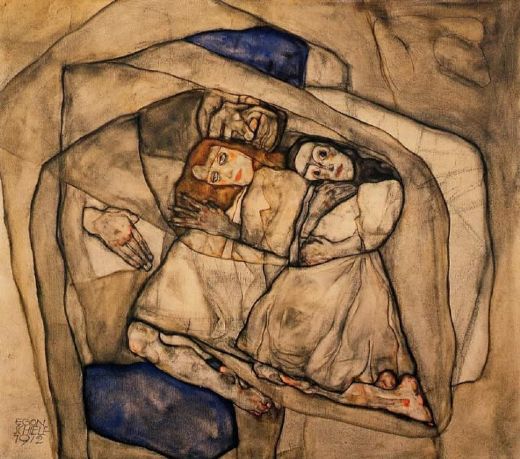
egon-schiele-conversion-78198

Egon Schiele, “Conversion” (1912)

.

And behold, I am with you always, until the end of the age.”

— Matthew 28:20

.

The Visitation

Today is the  feast of the Visitation,  and in the readings Venerable Bede recalls Mary’s prayer in which she says, “My spirit rejoices in God my savior.” Like other great teachers of prayer, Bede likes to reflect on the  great prayers found in the scriptures.

“Above all other saints, she alone could truly rejoice in Jesus, her savior, for she knew that he who was the source of eternal salvation would be born in time in her body, in one person both her own son and her Lord.”

He would be born “in time” Bede says. We learn from Mary to believe in the One who “fills with greatness and strength the small and the weak who believe in him.” She calls on God, her savior who acts “in time.”

As he comments on the Magnificat, Bede offers a simple explanation for one of the night prayers of the church:  the Salve Regina.

“Hail Holy Queen,

mother of mercy, our life, our sweetness and our hope….”

“It’s an excellent and fruitful custom of holy Church to sing Mary’s hymn at the time of evening prayer. By meditating upon the incarnation, our devotion is kindled, and by remembering the example of God’s Mother, we are encouraged to lead a life of virtue, which needs strengthening in the evening. We’re weary after the day’s work and worn out by our distractions. The time for rest is near, and our minds look for contemplation.”

Seeing God

St. Gregory of Nyssa has a beautiful reflection in today’s readings on the beatitude, “Blessed are the pure of heart, for they shall see God.”

He begins by saying that “It does not say that it is blessed to know something about the Lord God, but that it is blessed to have God within oneself. Blessed are the pure in heart, for they shall see God.

“I do not think that this is simply intended to promise a direct vision of God if one purifies one’s soul. On the other hand, perhaps the magnificence of this saying is hinting at the same thing that is said more clearly elsewhere: The kingdom of God is within you. That is, we are to understand that by purging our souls of every illusion and every disordered affection, we will see our own beauty as an image of the divine nature.

“Our own beauty as an image of the divine nature,”

We are sharers in the divine nature. We’re not God, who is transcendent, inaccessible, beyond our minds and knowing, but we can “see” God in ourselves, our own image, as we are purified from our illusions, our sins, our disordered love. Like many early eastern theologians, Gregory appreciates the basic goodness of human nature restored by the grace of the Redeeming Christ. No demeaning of humanity here.

The saints goes on:

“And those pure in heart are blessed because, seeing their own purity, they see the archetype reflected in the image. If you see the sun in a mirror then you are not looking directly at the sky, but still you are seeing the sun just as much as someone who looks directly at it. In the same way, the Lord is saying, although you do not have the strength to withstand the direct sight of the great and inaccessible light of God, if you look within yourselves once you have returned to the grace of the image that was placed in you from the beginning, you will find in yourselves all that you seek… the sight of God.”

Going a step further, can the saint’s words apply also to creation itself? If our created world as well as our human world mirrors God, aren’t we meant to see God there too? If it is marred and disfigured by human greed and loses its place as a sacrament of God’s presence, does the beatitude about purifying the human heart also extend to renewing and purifying creation?

Desiring God

Here’s a wonderful reflection from St. Augustine on desiring God, from today’s Office of Readings:

“The entire life of a good Christian is in fact an exercise of holy desire. You do not yet see what you long for, but the very act of desiring prepares you, so that when he comes you may see and be utterly satisfied.
“Suppose you are going to fill some holder or container, and you know you will be given a large amount. Then you set about stretching your sack or wineskin or whatever it is. Why? Because you know the quantity you will have to put in it and your eyes tell you there is not enough room. By stretching it, therefore, you increase the capacity of the sack, and this is how God deals with us. Simply by making us wait he increases our desire, which in turn enlarges the capacity of our soul, making it able to receive what is to be given to us.
“So, my brethren, let us continue to desire, for we shall be filled. Take note of Saint Paul stretching as it were his ability to receive what is to come: Not that I have already obtained this, he said, or am made perfect. Brethren, I do not consider that I have already obtained it. We might ask him, “If you have not yet obtained it, what are you doing in this life?” This one thing I do, answers Paul, forgetting what lies behind, and stretching forward to what lies ahead, I press on toward the prize to which I am called in the life above. Not only did Paul say he stretched forward, but he also declared that he pressed on toward a chosen goal. He realised in fact that he was still short of receiving what no eye has seen, nor ear heard, nor the heart of man conceived.”
I’m reading “The Education of Henry Adams”  now, by one of the great observers of our time. Adams was overwhelmed by the complexity of life brought about by the machine and rapid industrialization he experienced in the latter part of the 19th century. Though seen as progress, the changes caused a loss of a unified vision of life. There were too many things going on; too many facts to evaluate, too much happening to look ahead to the future. The world was entering a dizzying stage. 

We are still in that stage.

How does our time affect the way we desire God? In a more settled time, God had a recognized place. Not so now. Augustine speaks of desire as a container, a sack that we must enlarge to be filled. We might  use the image today of a shopping cart that’s filled to the brim with stuff, and there’s still more to come.

How can we make room for desiring God?

Seeing God

Here’s why I like St. Ireneaus:

“The prophets foretold that God would be seen by us; as indeed the Lord himself confirmed: Blessed are the pure in heart, for they shall see God.

But at the same time God is great and unspeakably glorious, so that no one shall see God and live, for God can never be completely understood. But God is loving and kind and omnipotent, and so he gives the sight of God, the greatest gift of all, to those who love him. Even this was foretold by the prophets: For those things that are humanly impossible, are possible with God.

We don’t see God by our own powers; but we see God when it pleases him that this should be so. God decides who should see him, and when, for God is powerful in all things. He was seen in the past prophetically, through the Spirit, and now by adoption through the Son; and in the kingdom of heaven he will be seen as a true father. The Spirit prepares humanity for the Son of God, the Son leads it to God, and the God gives it the gift of incorruptible eternal life, a life that everyone receives who sees God.”