Tag Archives: God

Morning Thoughts: The Prayer of Milk and Honey


.

Then the LORD brought us out of Egypt with a strong hand and outstretched arm, with terrifying power, with signs and wonders, and brought us to this place, and gave us this land, a land flowing with milk and honey.

—Deuteronomy 26:8-9


.

Last fall we went apple picking. We were a small party, composed of immediate family. It was a beautiful crisp day, just the kind you would order for such an excursion.

On our rounds we passed an old wood wagon, behind it and off a bit in the distance lay the remains of an abandoned stone farmhouse—roofless, hollowed out, its fireplaces and chimneys still the main draw. But is was a tiny hand-painted sign on the wagon right before me that most caught my attention:

“Honey is the only food that includes all the substances necessary to sustain life, including enzymes, vitamins, minerals, and water.”

I don’t know if it’s true or not, and I’m not going to spend much time investigating. I like the thought. That’s what matters. So I’m going to keep it, well not keep it, but steward it. Yes, ‘steward’ is a much better word:

Thus should one regard us: as servants of Christ and stewards of the mysteries of God.

(1 Corinthians 4:1)

So often an internet search can do quite the opposite. It can make us into investigators, examiners, maybe even mean-spirited inquisitors. It can turn us into lots of things, other than stewards.

Such an investigative approach also often opens the door to outright skepticism. It may even lead us into intellectual scrupulosity. And all scrupulosity, no matter its form or make up, steals joy. And that we just cannot allow.

On the other hand, we also have to be responsible. We can’t just “believe everything we hear and read”, right?

So what is one to do with such a pickle?

Well, a good steward should look to his master for advice, after all it’s his property we are called to steward on his behalf:

Now it is of course required of stewards that they be found trustworthy.

(1 Corinthians 4:2)

So there we have it. We must be stewards of God’s mysteries, and as stewards we must be found trustworthy.

Sounds straight forward enough. Tough to do though.

Perhaps this can help.

Let’s go step by step, at our Savior’s command:

———

First, let us become more aware of the very mystery that is put into our care:

Our Father, who art in heaven…

Let us next adore what we do not understand:

hallowed be thy name;

Let us then accept the great gift of responsibility, handed over to each one of us daily:

thy kingdom come,

thy will be done

on earth as it is in heaven.

What happens next seems logical enough, we have to ask for help:

Give us this day our daily bread,

And with that, we address the inevitable—for even if we possess only a morsel of humility—we all know that disobedience on our part is bound to occur:

and forgive us our trespasses,

as we forgive those who trespass against us;

Now, having about all we need to proceed, it’s a very good idea to remind ourselves of an eternal reality: That the master is ultimately in control and oversees us closely—rooting us on to accomplish what he wills for us to achieve, all in his very name:

and lead us not into temptation,

But just in case we fail to avoid the snares and traps hidden in plain and disordered sight—especially from falling into the false belief that the “possessions” placed into our care are actually our own—we plead with great desperation, like Saint Peter and all true disciples who think they’ve become lost, that we don’t completely sink into the waters of darkness when our faith begins to falter:

but deliver us from evil.

And together we say:

Yes. I accept. I believe. I agree.

So be it.

(or in other words:)

AMEN.

.

Now, if I can only find some raw milk for breakfast…


.

Look down, then, from heaven, your holy abode, and bless your people Israel and the fields you have given us, as you promised on oath to our ancestors, a land flowing with milk and honey.

—Deuteronomy 26:15


.

—Howard Hain

.
Friday Thoughts: The Best Coinage The World Has Ever Known

.

You can run but you can’t hide. An apple a day keeps the doctor away.

What a world it would be if we only spoke in clichés.

Is it the kind of world you and I live in?

Do we retreat into beaten-down meadows, like deer who lay where others have already flattened the grass?

There’s less work I suppose. And the grass may still be warm.

But it’s also kind of like Goldilocks and the Three Bears.

You can enter a home that isn’t yours, you can search for a bed that fits just right, but at the end of the day your cover will be blown.

You can run but you can’t hide.

After all, you’ve made your bed, now lie in it.

Perhaps it is such lying that is really the apple.

For picking fruit from someone else’s tree has never been a good idea.

Those kind of apples certainly keep the good doctor away.

But I guess we also have to be careful to not overcorrect.

We must not out of pride be unwilling to enter where others have already been.

No, that is wisdom. We should go where others have gone before. It just depends on who they were and where they went.

And no matter what, we shouldn’t hide within those spaces, pretend that they are our own, and perhaps worst of all, act as if we are the first to ever have entered—delusion of this kind leads us to the belief that we create anything at all.

We don’t.

Think of Adam in the Garden. God is busy whipping up the entire universe from out of nothing. Creating and sculpting, adding and adapting, breathing life into His new world. And Adam, well, he’s one of the building blocks. Yes, certainly a favorite. A favorite that God does not want to be alone.

And something spectacular takes place:

The LORD God said: It is not good for the man to be alone. I will make a helper suited to him. So the LORD God formed out of the ground all the wild animals and all the birds of the air, and he brought them to the man to see what he would call them; whatever the man called each living creature was then its name. The man gave names to all the tame animals, all the birds of the air, and all the wild animals… (Genesis 18-20)

God created, Adam named.

It is simply amazing. And humbling.

What an honor. And what a clear indicator of who is truly in charge.

We create nothing. That’s the bad news for those who want to be God.

We do though participate in the ongoing unfolding of God’s perfect and eternal world. We even seem to share the leading role. That’s the Good News for those who believe.

For our work is not to create. We simply cant. Only God can. And even if we “build” with what is already in existence, if we seemingly “create” something “new” with the building blocks we find already laying around, that “pseudo-creation” still isn’t our primary job.

Then what is?

Well, the original disciples of Jesus had a similar wonder:

So they said to him, “What can we do to accomplish the works of God?” Jesus answered and said to them, “This is the work of God, that you believe in the one he sent.” (John 6:28-29)

And there’s the crux of it, if you will.

Adam, we must remember, when in the supremely honorable position of naming God’s creatures was still naked, and he felt “no shame.” He hadn’t yet eaten what wasn’t his. He was not yet hiding “among the trees of the garden.” He still believed in the One Who Sends.

Adam was faithful. Adam was original. Adam knew he was God’s creation. And Adam was free to roam.

But Adam used his freedom to choose to become a slave.

Adam’s fall was a fall into self. A fall into creation, the creation of a great lie, that man creates on the same level as God.

It was a great fall. So steep was the cliff off which he went that no other story could ever bring more meaning to the most hackneyed line: “Once upon a time…”

Adam’s fall is a fall into denomination.

A fall into the church of self.

A fall into complete and utter cliché.

And it brought death to the great privilege of cooperating with God, of naming and stewarding on His behalf His created world.

But thanks be to God.

For someone truly original, and creative, finally came round.

He put the apple back up upon the tree and told the snake to take a hike.

His name is Jesus.

He is also called The Son of Man.

But of course we are free to just call Him God.

For about Jesus, nothing is cliché.

It is very clear, there’s absolutely no running or hiding when it comes to the Cross.

And when it comes to His love for us, there’s no apple that can keep the Divine Physician away.


.

—Howard Hain

.

Morning Thoughts: Love Your Proud Papa

Today, This Moment, The Year of Your Lord

My Child,

I thought I should write you this morning. To put down a few words. To speak into creation my ongoing love for you.

There are times when I watch you, somewhat at a distance. I leave that space so that my watching doesn’t impede your playing. But there is really no space at all. Because by not being “right with you” I get to see you as you truly are. My “distance” allows me to see you within the full scope of your existence. And never forget, my child, not for a second, I create your existence. It is not an event of the past. I am active. Always. I am always creating you, and I am always enjoying my creation. That is why I watch.

I watch you unfold. I watch frowns and frustrations unfold into smirks and full-blown smiles. I watch you evolve and grow. I watch you transform. I watch you fight then make up. I watch you get hurt then heal. I watch you hoard then share. Of course there are many times, my dear child, always in fact, that I want to jump in and save the day, to stop the fight, the hurt, the misunderstanding before it evens begins. But I love you too much to always deny you such good food and such nutritious drink.

I will your existence moment by moment, and my will is love. I know exactly how much you need to digest in order to provide for your perfect growth. I also know when too much of one nutrient or the denial of another is not part of my overall plan.

Perhaps that is the hardest thing about being a father, knowing that your maximum freedom within the ever-expanding bounds of my love is what you most need. Such liberty leads you into the divine individuality that I ultimately will to be achieved. And it’s also what makes you most valuable to our one, united, and very common family.

True liberty is what makes you most like me.

Please enjoy my gift this new day.

That’s what I will.

Enjoy my love. Enjoy your freedom. Enjoy the play of keeping it all within bounds. For you should also know, your freedom without my love is a very dangerous game. A game that as much as it grieves me to see any of my children play, I must allow, if the freedom I gift to you is to be of any value at all.

I am always with you. And know this—and know it for sure—if at any one moment, you choose to use your liberty to call out my name, I will scoop you up before you can even utter “the smallest letter or the smallest part of a letter” of my most hallowed name.

For the distance between us isn’t real at all.

It’s love. It’s everywhere. And it lasts for eternity.

I seal this with a kiss. I place it upon the palm of my hand.

I hold it out and gently blow it your way.

I love you…my dear child.


Always smiling at you,

.

Your Proud Papa

.


.

.

—Howard Hain

.

Sunday Vespers: A Chip off the Old Block

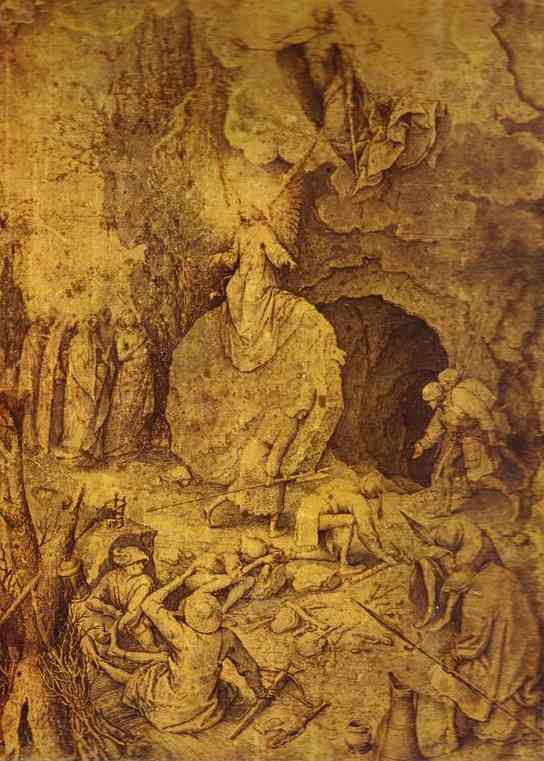
pieter-bruegel-the-resurrection-of-christ-ca-1562


You are my rock

Upon the rock You built Your Church

At Your death the rock was split in two

They laid You lifeless in the rocky tomb

And rolled the rock to seal the light of day

I am Your rock

Upon me You build Your Church

At Your death I split in two

You lay lifeless in my lifeless tomb

My rocky heart seals the light of day

In secret to Father we do pray

Our stillness knows that He is God

No longer statues we arise

And throw aside what we once wore

Total darkness and yet we see

Clearly only one way to go

Your promise lights the way

To restore what You foretold

Same as in the beginning

God and in His image

His creation

His masterpiece

His Son and His brother

The One known as The Word and the one called man

We both enter the garden

As the rock is rolled away


.

—Howard Hain

.

* Pieter Bruegel the Elder, “The Resurrection of Christ”, ca. 1562

.

Friday Thoughts: Heroic Virtue, The Holy Face of Jesus


.

He had no majestic bearing to catch our eye,

no beauty to draw us to him.

.

—Isaiah 53:2


.

There is a great hero alive this very moment.

He’s running into a burning building to rescue a small child.

He’s chasing down a thief who nabbed a pocketbook from a helpless old lady.

He’s performing CPR on a middle-aged man in the midst of a heart attack.

He’s keeping diligent watch over the safety of a nation.

But there is no “burning building”, no “thief”, no “heart attack.” And the “nation” he watches over is his own home.

Oh, but there is crisis, there are certainly trials.

There are countless situations and scenarios that require heroic virtue.

For the child he rescues lives in a foreclosing home, the helpless old lady he aides is robbed by dementia, the middle-aged man he resuscitates is his own brother who desperately needs a sober ride home.

And “he”, our hero, is not just one man. He is several, and numerous, and he wears all kinds of different clothes.

And like that ultimate superhero, the one our childhood comic books ceaselessly proclaim, he spends most of his other waking hours in a job that appears rather mundane.

His “telephone booth”—where he quickly straps on his boots, belt, and cape—is often a tiny bathroom—into which he quietly enters and calmly closes the door, only to clasp his face and let out a silent cry. He sometimes even falls to his knees, begging God for strength. But he only has a minute.

He cant help but look in the mirror as he regains his composure and dries his face, preparing to head back into the arena. What he sees looks old and unfamiliar. That’s not the face of adolescent dreams.

And the door is opened and out walks our hero to save the scene.


.

Yet it was our pain that he bore,

our sufferings he endured.

We thought of him as stricken,

struck down by God and afflicted…

.

—Isaiah 53:4-5


.

—Howard Hain

.

Morning Thoughts: The Sovereignty of Good


The Lord be with you.

—And with your spirit.

Lift up your hearts.

—We lift them up to the Lord.

Let us give thanks to the Lord our God.

—It is right and just.

(The beginning of the Eucharistic Prayer, The Order of Mass)

.

The next right thing.

Sometimes it is just that simple.

In fact, it is always that simple.

But to silly people like us, simple is not good enough.

It’s not complex enough.

Not sophisticated enough.

Not civilized enough.

Not cultured enough.

Not smart enough.

“Simple” lacks “nuance” and “subtlety”.

“Simple” contains nothing of the triune god of highly-refined society: arrogance, ambition, and ambiguity.

“Simple” is simply not good enough for you and me.

But it is for God.

He is simply great.

He is “right and just.”

Let’s simply be like Him.

Believe the next right thing.

Hope the next right thing.

Love the next right thing.

For the next right “thing” is God Himself.

For God is Good.

And He is Love.

Let us love then.

One step at a time.

One breath at a time.

One charitable conception, thought, and decision at a time.

Let us be like God.

Let us be amazingly simple.

Let us be simply amazing.

— “It is right and just.”


.

It is truly right and just, our duty and our salvation, always and everywhere to give you thanks, Lord, holy Father, almighty and eternal God, through Christ our Lord.

(Common Preface I, Eucharistic Prayer, The Order of Mass)

.

—Howard Hain

.

Morning Thoughts: New Year, New Love


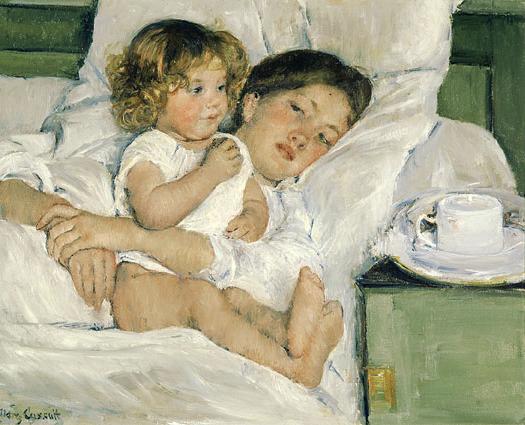
mary-cassatt-breakfast-in-bed-1897

Mary Cassatt, “Breakfast in Bed”, 1897

.

Lord, a new year is upon us.

Help us.

Help us to be grateful.

Gracious and grateful.

Gracious, grateful, and giving.

You give and you take away.

Nothing but Your love is truly ours.

For love You give and love You never take away.

Love only love.

Love just love.

What is it, Lord? What is Your love?

A million answers.

Each of us could probably come up with a thousand.

It’s times such as these that You are not silent, although You don’t seem to say a word.

You answer. You have and will always continue to do so.

You gave Your Only Begotten Son.

A tiny babe. A beautiful child. A strong young man. A fearless leader. A lamb to be slaughtered.

You gave the Tree of Life.

You threw it into the River.

You made all that is bitter sweet.

You gave the Sign of the Cross.

You wrote Your name upon our foreheads.

You gave us a mother, and common brothers and sisters, and holy angels and saints, all of whom we are free to call friends.

Yes, You gave us love.

But what is it, Lord?

We know love exits and we know it does not come from ourselves.

Even for those who say You don’t exist.

To them we could point at the ocean, or the sky—the sun, the moon, and the stars—or even a simple common everyday tree—a single leaf of grass.

“Who made them?”, we can ask.

“Who but God alone?”

Who but You, Lord God, Who willed not to be alone?

You willed love.

You willed Yourself.

Proof of Your existence is You don’t need it.

For nothing will prove You, for nothing can disprove You.

For the love You send is not only born, crucified, and risen, it also ascends.

Above all knowledge.

Into Heaven.

Pure and simple.

Knowledge.

Knowledge that You love us.

You truly love us.

Little old us.

That is what You love.

The object of Your love.

The product of Your love.

We are Your love.

Thank You, Lord.


.

—Howard Hain

.

Friday Thoughts: Portrait of the Catholic as a Middle-Aged Man


george-seurat-aman-jean-portrait-of-edmond-francois-amna-jean-1882-83

Georges Seurat, “Aman-Jean (Portrait of Edmond Francois Aman-Jean)”, 1882-83, (The Met)

.

So much is not seen.

What is heard hardly tells the story.

The hairline leaves little to gaze upon.

A good sergeant, he worries little about appearances.

He often feels what he believes is slipping away beneath his feet.

The commands barked from above seem detached from the situation on the ground.

He follows orders anyway.

To many he is somewhat of a joke.

A puppet. A man who cant think for himself.

Some may even use the word ‘coward’.

But none of this is accurate of course.

No, he is a man of honor.

A noble-man.

He takes his vows and commitments seriously.

He will protect his wife. He will raise his children.

He will stand when others hide.

He will walk forward when others turn away.

Firm and steadfast.

He lives out daily the faith of his fathers.

Quietly and efficiently as possible.

No, he’s certainly not perfect.

And of this he is very conscious.

So much so he wonders often if God has chosen the wrong man.

And this is saving grace.

Humility is purgatorial.

It burns away the dross.

It polishes the trophy.

It propels him to love to heroic measures.

It keeps him around, in the game, engaged, alive, an active participant.

As much as it hurts, he knows it’s true, and he carries on, toward the goal.

Toward what he cannot see, toward what he certainly does not understand.

This man is a hero of faith.

And at the same time he is just another Joe.

Another Tom, Dick or Harry.

But in heaven, when all is said and done, he shall receive a crown.

His cross finally laid down, he shall finally see it as a walking stick.

A beautifully-crafted staff in the hand of a just and upright man.

A righteous upholder of God’s eternal law.

Then he shall take his place, very close to the King and Queen, right beside that other unknown man named Joe.

That common nobody led by angels and mocked by men.

The one chosen by God to raise the Messiah.

For where you find the anonymous man of whom I speak, you too shall discover the Holy Family.

Jesus, Mary, and Joseph

Joseph, Mary, and Jesus.

On earth as it is in heaven.

A little humble home in the middle of nowhere.

An eternal kingdom emanating all that is good.


.

—Howard Hain

.

http://www.metmuseum.org/art/collection/search/339751.

.

* Dedicated to my good friend, who I greatly admire.

.

Morning Thoughts: Wise as Doves

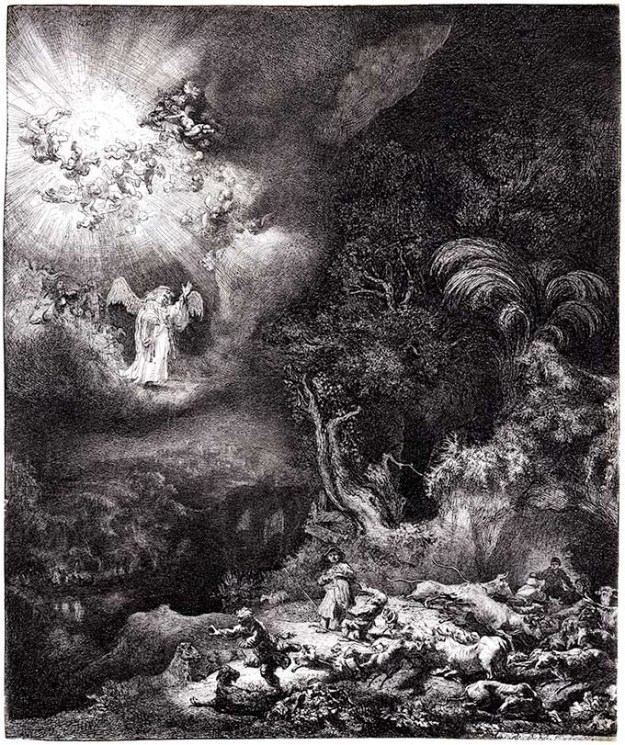
rembrandt-angel-appearing-to-the-shepherds-1634

Rembrandt, “The Angel Appearing to the Shepherds”, 1634

 .

Now there were shepherds in that region living in the fields and keeping the night watch over their flock. The angel of the Lord appeared to them and the glory of the Lord shone around them, and they were struck with great fear.

—Luke 2:8-9


.

Perhaps the scariest thing to those of us who cling tightly to the things of the world is to accept the job that the Lord assigns us.

Oh, how so many of us are so quick to long for greater adventure!

Yet, when it comes to those humble, little shepherds to whom the angel of the Lord appeared, we are perhaps even quicker to long to be one of them—sitting quietly upon a gentle hillside, effortlessly tending to a passive flock, while the always-full moon provides a soft, ever-so-appropriate illumination from above.

But we are liars. For there’s nothing less romantic in each one of our daily lives, or more mundane. We simply have to be honest, or at least consistent. It all depends on how we look at it. If we see the shepherds in such a delicate light then we also need to see ourselves in the same. For before the angel appears, the shepherds were hardly posing for picturesque landscapes. Perhaps it is for this very reason—their realness, their authenticity, their holy simplicity—that the Lord chose them to be present when He revealed His glory.

It is exciting. We have a wonderful choice, then. Either our “boring” lives make us just the kind of people to whom God prefers to reveal Himself, or our lives are a lot more “exciting” than we ever imagined. Either way, what is vital to making such a decision is true sincerity and genuine gratitude. We need to thank God for who He has made us, for where He has placed us, and for what type of task He has assigned us.

A faithful, humble heart dreams and believes and sees great things among the most ordinary circumstances. Just look at the young virgin and the upright carpenter to whom the shepherds “went in haste” to find in a stable, adoring a child born within the company of the “lowest” of men.

If we spend our time dreaming of being someone else, living somewhere else, and doing something else, we miss the opportunity of being exactly who God intends us to be—and when that happens—we are always in the wrong place, at the wrong time, and most tragically, doing that which matters very little.

For to be the first on the scene, the first to “lay hold”, the first to adore the New Born King, is as good as it gets—even for those whose “normal existence” isn’t standing around all alone—day after day in the scorching sun or biting cold, while picking fleas from matted-down fleece or scaring off hungry wolves.


.

The angel said to them, “Do not be afraid; for behold, I proclaim to you good news of great joy that will be for all the people…”

So they went in haste and found Mary and Joseph, and the infant lying in the manger. When they saw this, they made known the message that had been told them about this child. All who heard it were amazed by what had been told them by the shepherds.

Then the shepherds returned, glorifying and praising God for all they had heard and seen, just as it had been told to them.

—Luke, Chapter 2:10,16-18,20


.

—Howard Hain

.

Friday Thoughts: The Yet Empty Stable

.

There’s a little stable not too far from here.

It sits in a church that has seen better days.

The parish is poor and the people seem to disappear.

But a few persistent peasants wont stay away.

I love it there.

The priest is wonderfully uncertain.

He is afraid of God.

He instinctively bows his head at the mention of the name.

He knows how little he is in front of the great star.

I imagine he was involved in setting the stable.

It is a good size, on the relative little-stable scale.

It is surrounded by ever-green branches.

Probably snipped from the few Douglas Firs placed around the altar and yet to be trimmed.

The stable itself is composed of wood.

A little wooden railing crosses half the front.

A single string of clear lights threads through the branches laid upon the miniature roof.

They are yet to be lit.

I love it there.

I kneel before the empty scene.

For as of yet, not a creature or prop is present.

Not an ox or a goat, not a piece of hay or plank of fencing.

Not even a feeding trough that is to be turned into a crib.

No visible sign of Joseph and Mary, nor a distant “hee-haw” of a very tired donkey.

I wonder if I could get involved.

Perhaps I could slip into the scene.

There’s a darkened corner on the lower left.

In the back, against the wall.

I could hide myself within the stable.

Before anyone else arrives.

I don’t think they would mind.

I’d only be there to adore.

To pay homage to the new born king.

I might even help keep the animals in line.

Yes, a stagehand, that’s what I can be!

I know there’s no curtain to pull.

That’s to be torn in a much later scene.

But to watch the Incarnation unfold from within!

That’s what I dream.

To see each player take his and her place.

To see the great light locate the babe.

To watch the kings and shepherds stumble onto the scene.

Hark! To hear the herald angels sing!

O the joy of being a simple farmhand.

Of being in the right place at always the right time.

Of course though I wouldn’t be alone.

In that darkened corner, also awaiting the entire affair, there are many others.

Most I don’t know by name.

Too many in fact to even count.

But a few I know for sure.

For certain, present are those few persistent peasants who wont stay away.

And of course there’s that wonderful anonymous parish priest.

The one who helped set into place this yet empty but very expectant stable.

The one whose fear of God is so clearly the beginning of wisdom.


.

—Howard Hain

.