Tag Archives: Christmas

The Whole World Comes to a Manger

A large painting of the Christmas mystery in the gathering space of St.Mary’s Church in Colts Neck, New Jersey, is worth a visit before its taken down soon. The artist commissioned to make the work evidently wants to expand the way we look at this mystery in the three panels he created. 
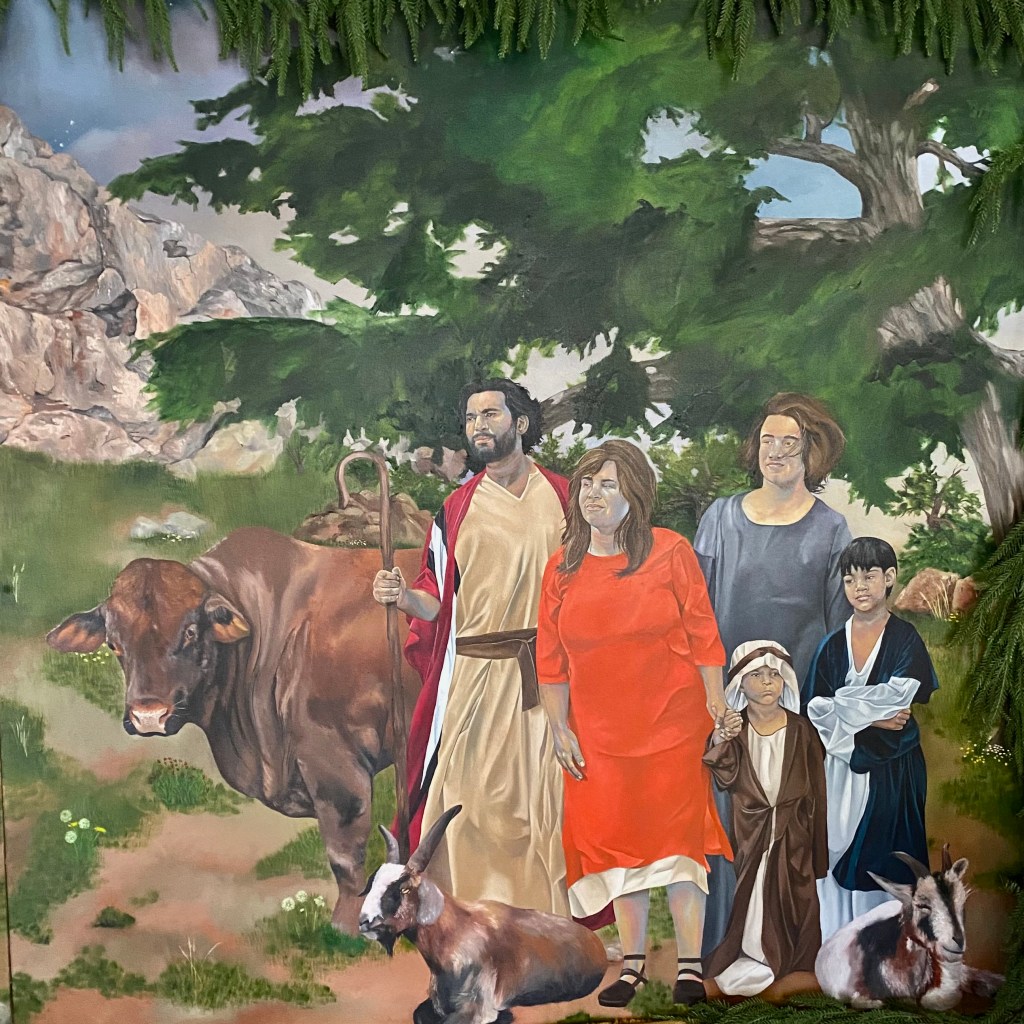
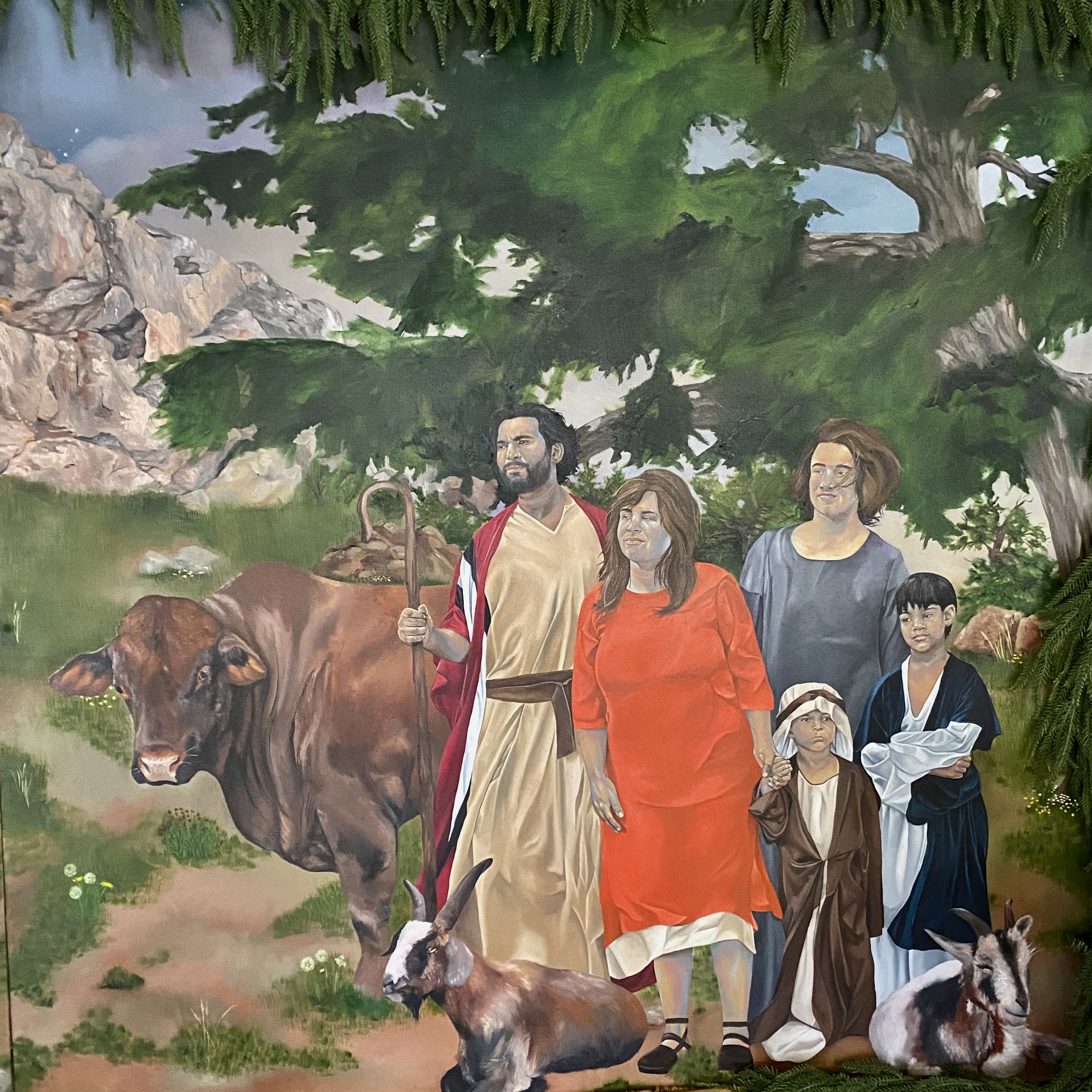
In the right panel the shepherds coming to the Child are not the usual band of men followed by their sheep. There’s one shepherd and two women and two children and a water buffalo and two other animals who look like they may be wild mountain goats. No sheep. 

Who are the women? The shepherd’s wife and maybe his sister? The women look like they’ve been summoned quickly from their homes. Did the shepherd call them to come  see what the angels proclaimed in the fields? Don’t worry how you look, and bring the kids. Come and see.

Are the animals representatives of the animal world waiting , like the human world, for the angels’ message?
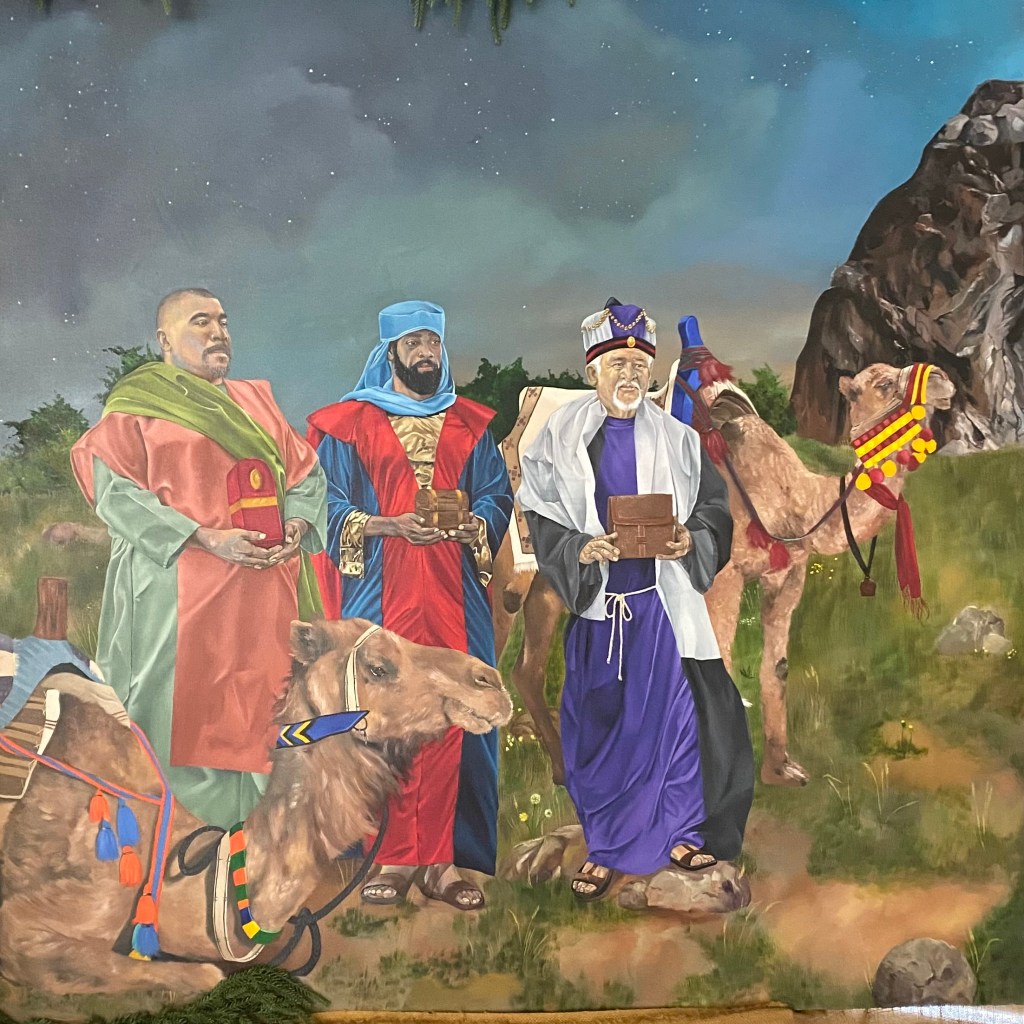
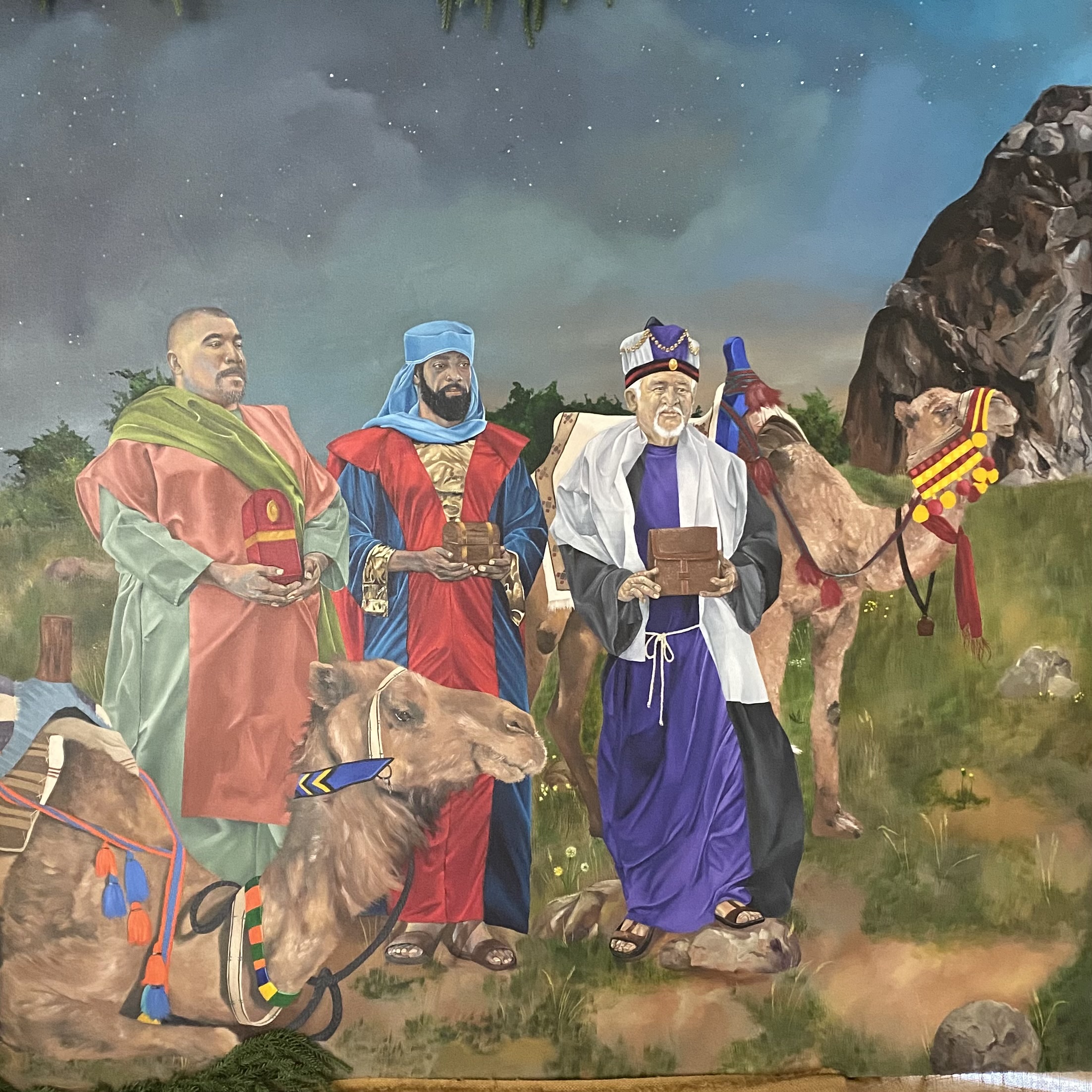
In the left panel, the Magi, elegantly dressed, hold their gifts for the Child as they come from a star-filled sky. Their camels finally rest from the long journey. The three represent the young and the old, and the different races called by the star. 
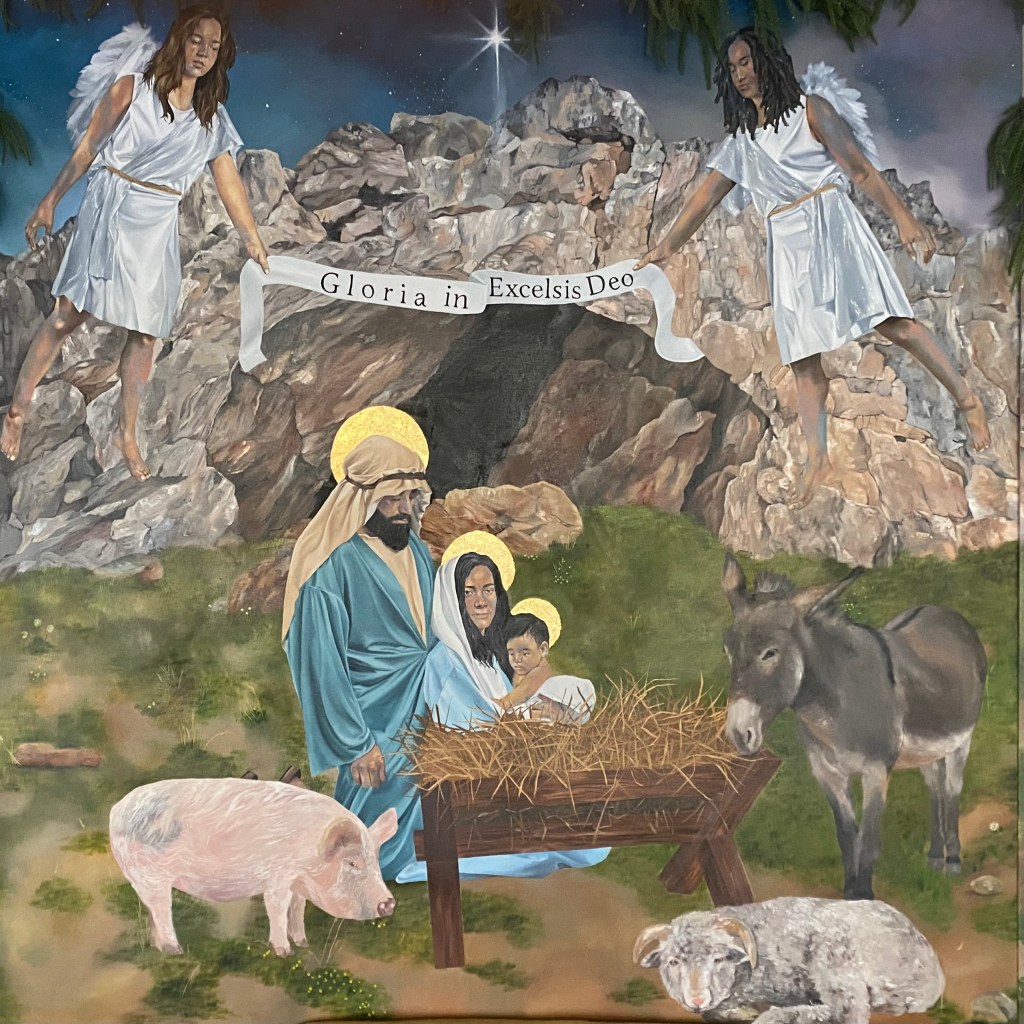
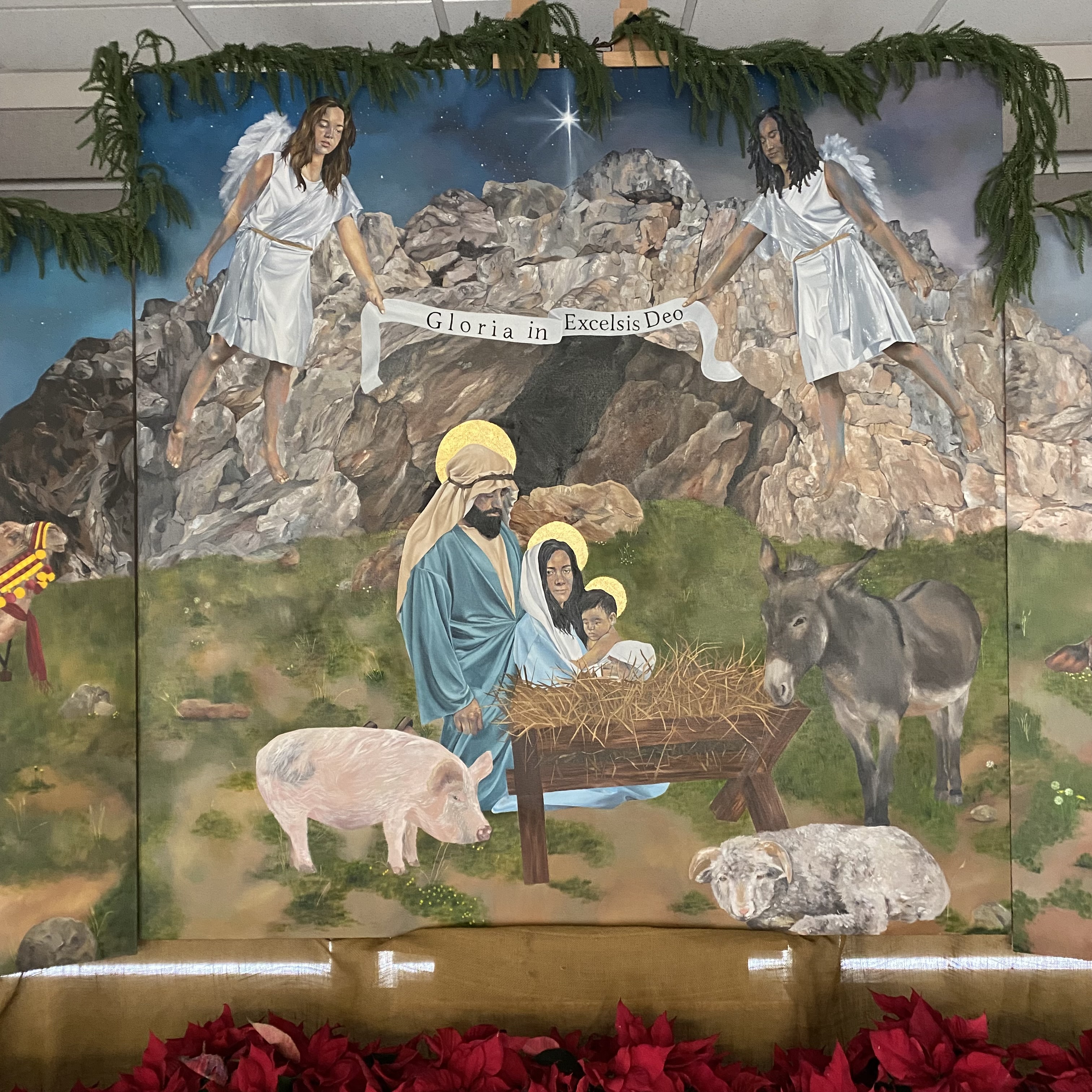
In the central panel, Mary seated holds in her arms the Child whom she wrapped in swaddling clothes and laid in a manger after she gave him birth.  Joseph stands protectingly over them. They’re dark skinned and dark haired, yet it’s hard to tell what race they belong to. 

Two angels above them announce “Glory to God” and a star shines brightly over the cave dug into the mountain. 

A donkey eats the straw from the manger, and a sheep lays on the ground beneath the manger. Right at Joseph’s feet there a large pig. Why is  he there, so close to the Child?  

In those days pigs were unclean animals. The Jews refused to eat them. On a journey to Joppa, Peter had a dream in which God commanded him to eat all kinds of food. There’s no fool that’s unclean, God said. All creation is  made clean through the saving power of his Son.

The whole world is welcome to the Manger. 

Artists remind us we can never exhaust the mysteries of life and the mysteries of God. There’s always more. 

READINGS: DECEMBER 17 TILL CHRISTMAS

The Gospel of Luke is our principal guide through the final days of Advent till the feast of  Christmas. These days are our “novena” preparing for the mystery of Christmas.

 December 17th and December 18th we read Matthew’s genealogy of Jesus and his account of Jesus’ birth.

December 19 The angel’s announcement to Zechariah the priest about the birth of John the Baptist. (Luke 1: 5-26)

December 20. The angel announces to Mary that she will bring “the Son of God” into the world. (Luke 26-38) 

December 21. Mary visits her cousin Elizabeth to share this Good News. ( Luke 1:39-45 )

December 22. The 4th Sunday of Advent. The gospel account of Mary’s visit to Elizabeth is repeated. ( Luke 1:46-56) 

December 23. Elizabeth gives birth to John, who will announce the coming of Jesus: (Luke 1:57-66)

December 24. Zechariah praises God’s compassion towards those who “dwell in darkness and the shadow of death.” (Luke 1:67-79.)

December 25 Christmas. The evening readings for Christmas are:  

Isaiah 9: 1-6

Timothy 2:11-14

Luke 2:1-14, The story of the Birth of Jesus Christ

Old Testament readings add their voice to the gospel accounts.  A number of stories, like the unpredictable births of Sampson and Samuel accompany the story of the birth of John the Baptist and Jesus. They remind us that “nothing is impossible with God.” The prayers in Advent speak too of the gentle rain that makes the earth fertile and the numerous “miracles” found in the ordinary course of nature. From the created world we can gain a sense of wonder for this great wonder of God.

Our readings are stories of belief and doubt. Isaiah offers King Ahaz, the consummate doubter and cold calculator on December 20. He was mentioned on Wednesday mornings at morning prayer each week of Advent. Ahaz stands in contrast to Mary, who believes and accepts the angel’s promise. She wonders “how can this be?” before this mystery of God, but she believes. 

The Christmas Tree

Since1931 there’s been a Christmas Tree in Rockefeller Center in New York City. It started when some workers pooled their money and decorated a tree with simple home decorations. Last year’s tree had 50,000 LED lights.

People line up to see it every year. They say that during the pandemic a few years ago people wanted live trees for the holidays and busily bought them out..They were “seeking comfort in the conifers.” We are busily putting up trees ourselves now, They bring comfort as the days get darker.

When the Laurentine Glacier receded from our land here in Queens, NY, about 12,000 years ago, the first trees to grow were the evergreens. Are the evergreens a sign of hope? Is that why we treasure them?  Certainly Christians from northern Europe saw them that way when they gave us the Christmas Tree centuries ago. The tree is a sign of Christ our hope, a sign of life.

I find myself visiting these two evergreens in our garden these days. The other trees are leafless, asleep. These still stand, signs that life can go in the cold.

Bless the tree in your house for the season. Here’s a blessing prayer.


Saving Advent and Christmas

Wikipedia’s article on Advent offers a description about how Christian denominations– Catholic, Anglican, Lutheran, Presbyterian, Methodist– approach the feast of Christmas, through devotional prayers and practices like the Advent wreath, the Christmas tree, musical performances like the Nine Lessons of Carols and Handel’s Messiah. Purple is the color of the season in most of these churches, blue in the Scandinavian countries.

The Wikipedia article features the devotions of Advent. Little is said ofGreek church’s Nativity Fast or the Roman Catholic liturgy of Advent. The Catholic liturgy of Advent “remained unchanged until the Second Vatican Council introduced minor changes,” it says.

That’s not accurate. The Roman Catholic Advent liturgy underwent a major change after the Second Vatican Council. A better schedule of readings and new Eucharistic prefaces were introduced to the liturgy; morning and evening prayers and other parts of its liturgy were enhanced. The Catholic Advent liturgy is a ringing affirmation of hope.

Advent hope is nourished by the first coming of Jesus Christ, but also by the promise of his second coming. It’s hope defying human calculation or human logic – an impossible hope. A hope spelled out in the devotions like the Advent wreath and the Christmas tree, but above all proclaimed in the Advent scriptures and liturgy.

Isaiah’s oracles from 8th century Judea are heard in the first few week of Advent, They proclaim that kind of hope.  Even as Assyrian armies capture and destroy his land, Isaiah sees a sign, the root of Jesse, set up before the nations. 

“His dwelling shall be glorious. The wolf shall be a guest of the lamb, and the leopard shall lie down with the kid; The calf and the young lion shall browse together, with a little child to guide them. The cow and the bear shall be neighbors, together their young shall rest; the lion shall eat hay like the ox. The baby shall play by the cobra’s den, and the child lay his hand on the adder’s lair. There shall be no harm or ruin on all my holy mountain; for the earth shall be filled with knowledge of the LORD, as water covers the sea.”

Wolves and lambs, leopards and kid goats, calves and lions lie down together on God’s holy mountain. The impossible becomes possible. That’s the  kind of hope we need today. 

Our Christian holidays and seasons are suffering more and more from secularization and commercialization. Like Santa Claus they need to be saved. They celebrate a greater hope than human imagination dares – hope in God and the promises God offers in Jesus Christ.

Let’s celebrate that hope in our liturgy.

Saving Santa Claus

Santa came to town for Macy’s annual Thanksgiving Parade. From the parade he went into the store for Black Friday and he will be there for the rest of the days till Christmas.

More than a salesman, Santa’s a saint– Saint Nicholas– and he reminds us Christmas is for giving rather than getting. His quiet giving mirrors God’s love shown in Jesus Christ.

Telling his story is one of the ways we can save Santa Claus from being captured by Macys and Walmart and all the rest. First, take a look at our version for little children, which has over 200,000 views on YouTube. How about telling that story to a real little kid you know? Wouldn’t you rather they know someone like him than the guy in the store in a red suit?

Then, you might want to go on to our  modest contribution for bigger children– like us:

Belief and Unbelief

Mark’s gospel today describes the arrival of Mary his mother and some of his relatives from Nazareth. (Mark 3: 32-35) They’re outside a house crowded with people gathered around Jesus, some looking to be cured, some to listen to what he has to say. Jesus and his disciples don’t even have time to eat, Mark says.

His family come because they want to take him home; some think he is out of his mind . (Mark 3:20-21) When people tell him ‘Your mother and your brothers and your sisters are outside asking for you.’ Jesus said to them in reply, ‘Who are my mother and my brothers?’ And looking around at those seated in the circle he said, ‘Here are my mother and my brothers. For whoever does the will of God is my brother and sister and mother.’” (Mark 3: 32-35)

Jesus sees people of faith as his family, his mother, brother and sister. He considers us who believe in him his family. 

But we continue to ask: Why does his own family think he is out of his mind?

His mother Mary is with them. What does she think? 

The gospels, Matthew 13:54-58, Mark 6: 1-6, Luke 4:16-30 all point to Nazareth as a place where Jesus is rejected.  Luke’s gospel sees the rejection of Jesus at Nazareth in the harshest terms. They are ready to hurl him from the hill after the claims he makes in their synagogue. His visit to Nazareth is headed for violence, but a violence postponed, and no one takes his part. ( Luke 4:16-36 )

Mary lived there. What was it like for her?  What was it like to be with family members who thought her son was mad? What was it like to be day after day with people who didn’t believe in her son? No one from Nazareth is among the 12 disciples Jesus chooses. The rejection of Jesus by the people of his own town, his own family and relatives, was a sword that pierced her heart.

We might say Mary’s faith was strong and kept her secure, but was it a faith that knew everything? Did it save her from questioning?

I wonder if we can see Mary’s appearance at Lourdes and Fatima in some way related to her own experience at Nazareth. She appears in places when the faith of ordinary people is severely challenged by a world increasingly hostile to belief. 

She knows how to believe when everyone else does not. We welcome her today to be with us.

CHRISTMAS Eve

The Advent season closes today December 24th. The Christmas season begins with the vigil Mass this evening. 

Advent is a season rich in the scriptures. Isaiah speaks strongly throughout the season, calling Jewish exiles and all nations to the holy mountain and God’s banquet with his people and all creation. “Swords will be turned into plowshares and spears will be turned into pruning hooks and they will not train for war again.” 

John the Baptist and his parents Zachariah and Elizabeth have important roles in the coming of the Child born of Mary.  Of course, Mary and Joseph are key figures responding to the messengers of God. 

Faith and hope do not come easily, the Advent season tells us. Political unbelief appears in Ahaz who “will not tempt the Lord.” Zachariah, a priest, is struck dumb for his unbelief. John the Baptist asks if Jesus is really “the one who is to come.” Mary wonders “how can this be?”

The gospel reading today, Zachariah’s song of belief, seems to promise faith and hope conquers in the end. 

“Blessed be the Lord God of Israel, he has come to his people and set them free.

Christmas carols, more than the scriptures seem to dominate the Christmas season. They bring the shepherds from the dark hills and magi from the east  to the Child. They also speak of those who not believe, like Herod who goes in search of the Child. But people of faith, like Simeon and Anna, welcome the Child in the temple and take him into their arms. 

Advent and Christmas are seasons rich in the wisdom of faith. A faith that leads to great truths, as the feast of John the Apostle reminds us. A faith one should  die for, as we are reminded by the feasts of the Holy Innocents and Stephen the first of many martyrs.  

MERRY CHRISTMAS

Hanukkah and Christmas

Hanukkah, an eight day Jewish celebration, which can occur in late November to late December, and Christmas, the Christian celebration on December 25th, are celebrated close together in time. Are they connected beyond that?

The quick answer usually given is no, but think about it a little. Hanukkah celebrates the rededication of the temple in Jerusalem after its desecration by Antiochus Epiphanes IV in 167 BC. After conquering Judea, the Syrian leader plundered the temple, ended Jewish services and erected an altar to Zeus in it.

Leading a Jewish revolt, Judas Maccabeus reconquered the city, cleansed the temple and initiated an eight day celebration in memory of the event. Eight lights lit successively call people to God’s holy place.

Christmas celebrates the birth of Jesus Christ approximately 167 years later.

Both of these feasts are about the Presence of God. For the Jews God was in the temple as Creator and Savior. For Christians God reveals his presence in Jesus Christ, who proclaimed himself God’s Son, “the light of the world” as he celebrated the Jewish feasts in the temple. (John 7-10)

All the gospels report that Jesus cleansed the temple  and spoke of himself replacing it. Luke’s gospel  begins in the temple with the promise to Zechariah of the birth of John the Baptist and ends as the Child Jesus enters his “Father’s house.” (Luke 1-2) Our readings today link the restoration of the temple by Judas Maccabeus and the Jesus cleansing the temple: 1 Mc 4:36-37, 52-59/Lk 19:45-48

Far from being separate, Hanukkah and Christmas are connected in their celebration of God’s presence. Hanukkah reminds us of the temple, the place of God’s provisional presence. The Christmas mystery reminds us of the abiding presence of God with us in Jesus Christ, Emmanuel, the Light that never fails, who gives life to all nations.

Why December 25th?

Why do we celebrate December 25th as the day of Jesus’ birth? A popular theory  says December 25th was a Christian attempt to replace a pagan festival honoring the Unconquerable Sun. More likely, December 25 was chosen because it was tied to March 25th, the day some early Christian sources say Jesus was conceived and crucified.

Andrew McGowan advocates that theory in Biblical Archeology.

“ There is another way to account for the origins of Christmas on December 25: Strange as it may seem, the key to dating Jesus’ birth may lie in the dating of Jesus’ death at Passover. This view was first suggested to the modern world by French scholar Louis Duchesne in the early 20th century and fully developed by American Thomas Talley in more recent years. But they were certainly not the first to note a connection between the traditional date of Jesus’ death and his birth.

“Around 200 C.E. Tertullian of Carthage reported the calculation that the 14th of Nisan (the day of the crucifixion according to the Gospel of John) in the year Jesus died was equivalent to March 25 in the Roman (solar) calendar. March 25 is, of course, nine months before December 25; it was later recognized as the Feast of the Annunciation—the commemoration of Jesus’ conception. Thus, Jesus was believed to have been conceived and crucified on the same day of the year. Exactly nine months later, Jesus was born, on December 25.

The mysteries of Christ are joined together. We celebrate his birth, but we also keep in mind his death and resurrection– mysteries  never far apart, in Jesus and in us.

Poor in Spirit

Christmas is a time of poverty. The Spirit of Bethlehem is one of smallness, of tiny new beginnings that open our minds to the infinite largeness of Incarnate Wisdom. The Christ Child heals us of our presumption. The New Born shows us that we simply don’t know what God has in store. His impoverished delivery stops us in our tracks. We stand like beasts in a stable, our knowledge, our understanding, our science, our facts, our truths stripped of eternal value. All that remains, whether we’re shepherds or kings or someone in between, is for us to nod along with the tiny beat of the drummer boy offering his seemingly meaningless gift. Let’s welcome Christ Jesus, Innocence itself, by being poor with Him. Let’s let go of preconceived notions of having control. To stand before the Lord in our nothingness is worth more to Him than any amount of gold, frankincense or myrrh. Our humility before the bright light is pure praise and prayer to the One Who offers us everything.

—Howard Hain