Commentators find it hard to establish the time and place the Epistle to the Hebrews was written. Most say it was written for early Jewish Christians trying to figure out their relationship to the religion of their ancestors.
I wonder if Jewish Christians in Rome would be especially among those for whom the letter was written. Rome is one of the places commentators say it might have originated..
The Jewish Christian community of Rome was a large community attached to Jerusalem and the temple, even Jews who had embraced a new faith. They would have been onlookers as Titus marched triumphantly into the Rome carting the spoils and slaves in chains from the Jewish wars and the destruction of the temple in 70. Afterwards, they would have watched the Colosseum bring built with the gold from the temple. Less than 5 years before some were singled out as renegade Jews and blamed by Nero for the great fired that had destroyed the city.
As we read the words from the Epistle to the Hebrews today I wonder if we hear words written especially for them.
“Let us hold unwaveringly to our confession that gives us hope, for he who made the promise is trustworthy.We must consider how to rouse one another to love and good works. We should not stay away from our assembly, as is the custom of some, but encourage one another, and this all the more as you see the day drawing near.” Hebrews 10:19-25
It would be a hard time then for Jewish Christians in Rome “to put your light on a lamp stand,” as we read in today’s gospel . It was a time for laying low, “staying away from our assembly.”
Faith has to be professed in season and out of season. It’s never to be hid under a bushel.
The Advent wreath and its four candles, for the four Advent weeks, is a traditional devotion for this season. It originated in the folk practices of the pre-Christian Germanic peoples who gathered wreaths of evergreen and lit fires during the cold December darkness as a sign of hope for spring and new light.
Christians kept these popular traditions. By the 16th century Catholics and Protestants throughout Germany used these symbols to celebrate their Advent hope in Christ, the everlasting Light. From there, the Advent wreath spread to other parts of the Christian world.
Traditionally, the wreath consists of four candles in a circle of evergreens. Each day at home, the candles are lighted, perhaps before the evening meal– one candle the first week, and then another each succeeding week until December 25th. A short prayer may accompany the lighting.
Prayers for an Advent Wreath
The day the wreath is lit the leader may say:
Our nights grow longer and our days grow shorter. We look at this candle and green branches– and remember God’s promise to our world: Christ, our Light and our Hope, will come.
Here are the words of Isaiah the prophet:
The people that walked in darkness have seen a great light; on those who lived in a land as dark as deatha light has dawned. You have increased their joy and given them gladness; We rejoice in your presence.
Let us pray:
O God, we rejoice as we remember the promise of your Son,
Jesus Christ,
His light shines on us,
brightening our way, guiding us by his truth.
May Christ our Savior bring light into the darkness of our world,
It’s good to be reminded in these days following our contentious election on Tuesday that “ our citizenship is in heaven.” Paul tells that to the Philippians in today’s reading, but we should hear it too.
But our citizenship is in heaven, and from it we also await a savior, the Lord Jesus Christ. He will change our lowly body to conform with his glorified Body by the power that enables him also to bring all things into subjection to himself.
Therefore, my brothers and sisters, whom I love and long for, my joy and crown, in this way stand firm in the Lord, beloved.
We ‘re citizens of heaven; we belong somewhere else. We’re temporary, not permanent residents here. In that place “ the Lord Jesus Christ will change our lowly bodies to conform to his glorified Body by the power that enables him also to bring all things into subjection to himself.” (Philippians 3:17-4:1)
The responsorial psalm today tells us that even now we’re standing within the gates of a heavenly Jerusalem, the destiny of the tribes of the Lord. Our destiny.
St. Augustine wrote “The City of God” as barbarian armies sacked Rome and were invading North Africa. The world is coming to an end, some were saying, and they blamed Christianity for the critical times. But God is at work beyond human time and events, Augustine wrote.
Go rejoicing to the city of God and the house of the Lord, we hear today. There is something beyond the politics of today at work.
It’s so easy to see a world out of control these days, and to believe that nothing can be done. We’re going nowhere.
The Letter to the Ephesians, read this week at Mass, says that’s not so. It’s written, not just to the church at Ephesus, but to other churches as well, commentators says. So it’s written to our church too.
A great plan of God is at work from “the foundation of the world,” a plan for the “fulness of time,” a “mystery made known to us” in Christ Jesus, our Lord. We have this “word of truth” this gospel of our salvation, from Jesus himself. The Spirit he promised is the “first installment of our inheritance.”“First installment,” That’s what we working with now, It may not seem like much but it gets us where we’re going.
It promises more than we think or expect. “May the God of our Lord Jesus Christ, the Father of glory, give you a spirit of wisdom and revelation resulting in knowledge of him. May the eyes of [your] hearts be enlightened, that you may know what is the hope that belongs to his call, what are the riches of glory in his inheritance among the holy ones, and what is the surpassing greatness of his power for us who believe, in accord with the exercise of his great might, which he worked in Christ, raising him from the dead and seating him at his right hand in the heavens, (Ephesians 1)
Every Monday of the four week cycle of the Liturgy of the Hours we read Ephesians 1, 3-10 at evening prayer, a reminder to see the day, however small and confusing it may be, as part of the great unfolding plan of God in Christ, our Lord.
Paul, an Apostle of Christ Jesus by the will of God, to the holy ones who are in Ephesus and faithful in Christ Jesus: grace to you and peace from God our Father and the Lord Jesus Christ.
Blessed be the God and Father of our Lord Jesus Christ, who has blessed us in Christ with every spiritual blessing in the heavens, as he chose us in him, before the foundation of the world, to be holy and without blemish before him. In love he destined us for adoption to himself through Jesus Christ, in accord with the favor of his will, for the praise of the glory of his grace that he granted us in the beloved.
In Christ we have redemption by his Blood, the forgiveness of transgressions, in accord with the riches of his grace that he lavished upon us. In all wisdom and insight, he has made known to us the mystery of his will in accord with his favor that he set forth in him as a plan for the fullness of times, to sum up all things in Christ, in heaven and on earth.
As the Synod on Synodality proceeds in Rome, we can all participate as the listening Church, the Bride of Christ, sitting at Jesus’ feet like Mary of Bethany (Luke 10:38). Enveloped in his peace, we can attune our hearts and minds to the Spirit of truth sent to us from the Father by the Son (John 15:26).
In a world of distracting noise, the Lord invites us to listen to his voice in Sacred Scripture, the Holy Mass, the Liturgy of the Hours, and personal prayer. Heard in the silence of the Spirit, the ancient words resonating from centuries past speak to the present generation with striking relevance. May the Lord grant us “ears to hear” his voice amid the din of the latest buzz (Matthew 11:14).
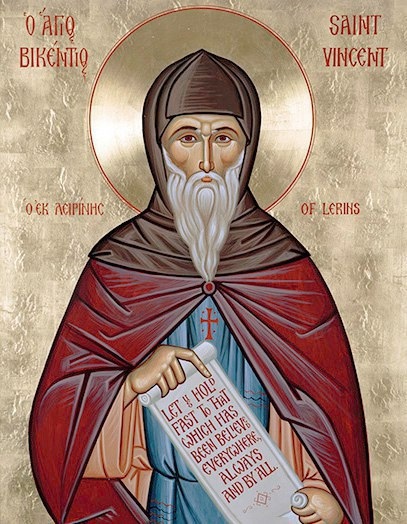
In a recent passage from the Office of Readings (October 11, 2024), St. Vincent of Lerins, a fifth-century French monk, seemed to jump out of the pages to address the Synod in Rome during its second week. In his vision, the organism of the Church grows and matures like a child to an adult, but preserves her essential form. Human skeletal structure, facial features, limbs, and organs develop with maturity but do not evolve into another species. The Body of Christ, the Church, in its heavenward journey also grows in the Holy Spirit into the perfect image of the Incarnate Son of God and not a distortion (2 Corinthians 3:18). May the Blessed Virgin Mary, Mother of the Church, guide her sons and daughters in the Spirit to her Son, who is the Way, the Truth, and the Life.
From the first instruction by Saint Vincent of Lerins, priest
The development of doctrine
Is there to be no development of religion in the Church of Christ? Certainly, there is to be development and on the largest scale.
Who can be so grudging to men, so full of hate for God, as to try to prevent it? But it must truly be development of the faith, not alteration of the faith. Development means that each thing expands to be itself, while alteration means that a thing is changed from one thing into another.
The understanding, knowledge and wisdom of one and all, of individuals as well as of the whole Church, ought then to make great and vigorous progress with the passing of the ages and the centuries, but only along its own line of development, that is, with the same doctrine, the same meaning and the same import.
The religion of souls should follow the law of development of bodies. Though bodies develop and unfold their component parts with the passing of the years, they always remain what they were. There is a great difference between the flower of childhood and the maturity of age, but those who become old are the very same people who were once young. Though the condition and appearance of one and the same individual may change, it is one and the same nature, one and the same person.
The tiny members of unweaned children and the grown members of young men are still the same members. Men have the same number of limbs as children. Whatever develops at a later age was already present in seminal form; there is nothing new in old age that was not already latent in childhood.
There is no doubt, then, that the legitimate and correct rule of development, the established and wonderful order of growth, is this: in older people the fullness of years always brings to completion those members and forms that the wisdom of the Creator fashioned beforehand in their earlier years.
If, however, the human form were to turn into some shape that did not belong to its own nature, or even if something were added to the sum of its members or subtracted from it, the whole body would necessarily perish or become grotesque or at least be enfeebled. In the same way, the doctrine of the Christian religion should properly follow these laws of development, that is, by becoming firmer over the years, more ample in the course of time, more exalted as it advances in age.
In ancient times our ancestors sowed the good seed in the harvest field of the Church. It would be very wrong and unfitting if we, their descendants, were to reap, not the genuine wheat of truth but the intrusive growth of error.
On the contrary, what is right and fitting is this: there should be no inconsistency between first and last, but we should reap true doctrine from the growth of true teaching, so that when, in the course of time, those first sowings yield an increase it may flourish and be tended in our day also.
Reference
The passage from St. Vincent of Lerins can be found in the Office of Readings for Friday of the 27th Week in Ordinary Time.
This week we’re coming to the end of the Easter season and the time devoted especially to Mystagogic Catechesis. Mystagogic Catechesis is an old term inspired by the time that Jesus after his resurrection began to wean his followers away from knowing him physically to knowing him through signs, like water, bread and wine, like gathering together to remember him in the scriptures, like seeing him in the poor and suffering who are wounded like him, also seeing his plan in the signs of the times they were living in. Mystagogic Catechesis is a catechesis for recognizing Jesus Christ in signs.
Even though “they rejoiced at the sight of the Lord” the disciples of Jesus found this new way hard to understand. They saw Jesus physically less and less. We see their uneasiness, their questioning, in the gospel narratives read in the Easter season. He taught the patiently, but still they found it hard to see him in another way, through signs.
The Old Testament scriptures were important signs Jesus offered his disciples after rising from the dead. (Luke24L13-27) During the Easter season the scriptures are important signs offered to us. The resurrection appearances of Jesus from the four gospels, especially from the Gospel of John, are gospels we read in the early weeks of Easter. The meeting of Jesus with Nicodemus, the miracle of the loaves and fish, and the Last Supper Discourse of Jesus– all from John’s Gospel– are read on the following weeks. The Acts of the Apostles, describing the surprising growth of the church after the resurrection, is read all through the Easter season.
Those who follow Jesus share the experience of his disciples as they face the mystery of his death and resurrection.
In their catechetical sermons after easter, saints like Ambrose and Cyril of Jerusalem saw the unease in the newly baptized they taught. “Is this it?” St. Ambrose begins one his catechetical sermons to newly baptized Christians. “Is this it? You’re saying to yourself.” The Christian life is not Paradise, the saint reminds them. The Christian life here on earth is not seeing completely or knowing everything clearly. The Christian life is a life of signs, signs that come with the sign of the cross.
Following the Second Vatican Council, the church gives Mystagogic Catechesis a more prominent place in her liturgy. In the past, Mystagogic Catechesis took place in the one week after Easter and was focused on the newly baptized. In the church’s liturgy now Mystagogic Catechesis takes place, not for just one week, but for all the Easter season, and beyond the Easter season to every Sunday celebration. It is meant, not just for the newly baptized, but for the whole Christian community.
Mystagogic Catechesis is not limited to the seven sacraments, but is sacramental in the broad sense the early church understood the term. For example, it sees the church as a sacrament. That’s why we read the Acts of the Apostles all through the Easter season, to understand the mystery of the church.
The church’s promotion of Mystagogic Catechesis also brings a shift in catechesis and preaching. Mystagogic Catechesis is based on the scriptures, rites and prayers of the liturgy, not the catechism. It moves us into another way of teaching and praying. Not a new way, but a way found in the early church and in the church up to the Council of Trent.
Mystagogic Catechesis puts an emphasis on the liturgy, its prayers, readings and signs, as the preeminent place where we learn and pray. “Christ is always present in His Church, especially in her liturgical celebrations…The liturgy is the summit toward which the activity of the Church is directed; at the same time it is the font from which all her power flows. (SC 7, 10)
Advent began two weeks ago with Isaiah’s promise that all nations, along with his chosen people in exile, would hear God’s call to dwell in peace on God’s holy mountain. On December 17 our liturgy turns to Matthew’s gospel and the account of the genealogy of Jesus, “son of David, son of Abraham.” Matthew’s gospel traces his ancestry back to his Jewish beginnings. ( Matthew 1,1-17)
Whenever we read this gospel, filled with so many hard to pronounce names I am reminded of my mother. She had a remarkable memory for relationships, whether her own family relations or others. Honestly, I often tuned out as she probed with delight family trees. After she died I realized I had lost my connection with countless relatives and people she had firmly in mind. She would have appreciated the genealogy above.
This is not a superfluous project the evangelists are engaged in. They’re intent on describing the Incarnation of Jesus. He wasn’t isolated from humanity, above it all, but he was part of the human family. And his family tree was not an army of saints; sinners are there for sure.
We will hear from some of his saintly forbears in the next few days, Mary, Joseph, Elizabeth and Zachariah. But let’s not forget the others.They are his family too. He loved them all.
In our family tree above Mary points to Joseph. Like her his ancestry goes back to David and Abraham. Appearing to him in a dream the angel says “Joseph, son of David, do not be afraid to take Mary your wife into your home. For it is through the holy Spirit that this child has been conceived in her.”
The Old Testament readings for the 1st week of Advent– all from Isaiah– are a message of universal salvation. Isaiah 2:1-5 (Monday) is the prophet’s classic announcement that all nations will stream to God’s mountain and listen for God’s instruction. “They will beat their swords into plowshares and their spears into pruning hooks.” Wars are over; the fragmentation destroying humanity comes to an end.
For Isaiah, the mountain of the Lord– site of the Jewish temple in Jerusalem– has a central place in God’s promise. All nations will come there; they will be fed a rich banquet (Wednesday), there the poor will triumph (Thursday), the blind will see (Friday); it’s the rock where people dwell in safety, where children play around the cobra’s den, and the lion and the lamb lie down together (Tuesday). The prophet’s poetic imagery in the readings for the 1st week of Advent is strikingly beautiful.
The gospels in the 1st week point to the Isaian prophecies fulfilled in Jesus Christ. The Roman centurion humbly approaching Jesus in Capernaum represents all the nations coming to him. Jesus feeds a multitude on the mountain. He gives sight to blind humanity, he affirms that his kingdom will be built on rock. He praises the childlike, who will enter the kingdom of heaven.
Matthew’s gospel, source of many of our Advent readings, portrays Jesus teaching on a mountain (Isaiah’s favorite symbol) and working great miracles there that benefit all who come. He is also the new temple, the new Presence of God, Emmanuel, God with us.
Albrecht Durer, “Virgin and Child with Saint Anne”, ca. 1519 (The Met)
Christmas is a time for grandmothers.
They bake and cook and decorate. Their homes become mini North Poles, diplomatic outposts of Santa’s Castle.
At its core, Christmas is of course all about Jesus. All about Jesus, Mary, and Joseph. All about the Holy Family.
The Holy Family is an extended family though. And it doesn’t stop at grandmothers and grandfathers, aunts and uncles, or even cousins and distant cousins.
Just ask Saints Joachim and Anne, Zechariah and Elizabeth, or John the Baptist—not to mention all the unknown relatives whom the child Jesus surely encountered throughout His Galilean days. Ask any one of them about the far-reaching ripple effects of family grace.
Those touched by Jesus have a tendency to appear bigger than life.
Look at Santa Claus.
Most of us are aware that he is really Saint Nick.
But do we stop to wonder who Mrs. Claus really is?
I think she’s Saint Anne.
After all, Mrs. Claus is seen as everyone’s grandmother, especially when it comes to holiday cheer. But when it comes to truly celebrating the birth of Jesus, it is through Saint Anne that we approach the gates of Christ’s Nativity.
Mary’s Mother holds a special key. She is first among grandmas, first among those who pinch chubby cheeks, who pass along one more extra sugary treat.
———
Saint Anne help us. Speak to us. Show us how to be grand parents to all those around us, especially the little ones. Stir up the spirit of Advent. Bake away the holiday blues. Cook up a dish of Christmas love that only your hearth can serve.
———
Come one, come all, to the home of Saint Anne. Come with me to Grandma’s house for a holiday visit. Taste and see. Enter her kitchen, where the hot chocolate can always fit a little more whipped cream, where you hear the constant refrain: “eat…eat…eat…”
At Grandma’s your plate is never empty.
Her table is continually set.
She always sees Jesus as having just been born.
She is always wrapping Him up tightly in swaddling clothes.
It is simply grand.
To Grandma, Jesus is always an innocent child.
And she can’t help but see Him deep within both you and me.
Yesterday I witnessed a “dress” rehearsal for a live nativity. The cast was made up of first and second graders, and the audience was mostly composed of residents of a retirement home for religious sisters, Franciscans. It was spectacular.
Last week I was at Radio City Music Hall to watch the Rockettes in their “Christmas Spectacular”. It was quite a production.
Sitting in the dark this morning I cannot help but contrast the two.
I also cannot help but relate to the seven-year old who played the part of The Little Drummer Boy.
As that child walked so slowly toward the foot of the altar, where the rehearsal was being staged, I saw my vocation in an entirely different light.
The children were all singing their hearts out, and many of the eighty and ninety year-old sisters were mouthing the words. The boy with the drum didn’t utter a sound. He just kept walking, slowly, extremely slowly toward the altar, every once in a while ever so slightly pretending to tap two tiny sticks upon a toy drum. He was beautifully awkward.
There was no greater spectacle on earth at that very moment. Shall I dare to say, no greater event that heaven or earth has ever known?
For a child was born. We were all being born.
Come they told me, pa rum pum pum pum
A new born King to see, pa rum pum pum pum
Our finest gifts we bring, pa rum pum pum pum
To lay before the King, pa rum pum pum pum,
rum pum pum pum, rum pum pum pum,
So to honor Him, pa rum pum pum pum, When we come.
Little Baby, pa rum pum pum pum I am a poor boy too, pa rum pum pum pum I have no gift to bring, pa rum pum pum pum That’s fit to give the King, pa rum pum pum pum, rum pum pum pum, rum pum pum pum,
Shall I play for you, pa rum pum pum pum, On my drum?
Mary nodded, pa rum pum pum pum The ox and lamb kept time, pa rum pum pum pum I played my drum for Him, pa rum pum pum pum I played my best for Him, pa rum pum pum pum, rum pum pum pum, rum pum pum pum,
Then He smiled at me, pa rum pum pum pum Me and my drum.*
.
.*(Little Drummer Boy was composed by Katherine K. Davis, Henry Onorati and Harry Simeone in 1958.)



 The Victor's Place