A World of Talking Trees: Mark 8:22-26

“Do you still not understand?” Jesus said this to his disciples in Mark’s gospel right after curing a blind man who only gradually gains his sight. He has to lay his hands on the man’s eyes a second time before he sees clearly. Is that the way we see and understand, gradually?

The cross Jesus says we all must bear takes many forms and I wonder if one form it takes in our time is the cross of confusion. We like clear sight for ourselves and everyone else, but in times of great change confusion is inevitable. Like the man in the gospel we’re living in a world of “talking trees” and that’s hard to take, reasonable, resourceful people that we are.  It’s humbling to live in confusing times like ours..

It makes us angry. There’s a lot of anger around us today, the anger that boils over and lashes out, or the anger that retreats into a fortress of resistence and isolation.

Pope Francis often speaks of patience. He said patience keeps the church going. It keeps the world going too. He spoke once of the music of patience, a patience that hears and waits, like the patient blind man who waits for the hand of Jesus to reach out again.

That’s one of the lasting teachings of the Gospel of Mark. We’re human, we think as humans do, and that means we learn gradually, by patience.

“When Jesus and his disciples arrived at Bethsaida,
people brought to him a blind man and begged Jesus to touch him.
He took the blind man by the hand and led him outside the village.
Putting spittle on his eyes he laid his hands on the man and asked,
“Do you see anything?”
Looking up the man replied, “I see people looking like trees and walking.”
Then he laid hands on the man’s eyes a second time and he saw clearly;
his sight was restored and he could see everything distinctly.
Then he sent him home and said, “Do not even go into the village.”
(Mark 8,22-26)

Noah and the Ark: Genesis 6-7

Where did the story come from?

A few years ago Nova on PBS featured a program called“The Secrets of Noah’s Ark.” In early times, floods were common in the “Fertile Crescent,” the area in Mesopotamia {modern Iraq} where the Tigris and Euphrates Rivers and the ancient city of Babylon were located. Floods, sometimes great floods, occurred, so the people had to be ready. You had to keep your boats handy, and a big boat also– you never knew..

But people then, as now, had short memories. “As it was in the days of Noah, so it will be at the coming of the Son of Man. In those days before the flood, they were eating and drinking, marrying and giving in marriage, up to the day that Noah entered the ark. They did not know until the flood came and carried them all away.” (Matthew 24, 37-38)

I suspect some Babylonian priests then– meteorologists and story tellers of the age– came up with a flood story thousands of years before the Noah story in Genesis, to keep people on their toes – and maybe challenge some early climate change deniers too. It reinforced important advice: “ Keep your boats in shape and make sure a big boat’s around for ‘the big one.’”

Jewish priests and scribes in 6th century Babylon saw the story a perfect fit for the story of human origins they were telling their people. For them the take-away from the story was not to keep a big boat handy, but to be faithful to God like Noah and Abraham and their families. If they were faithful, God would save them from the flood and bring them  to the Promised Land.

The Nova program showed evidence from today of those big boats there “just in case.”

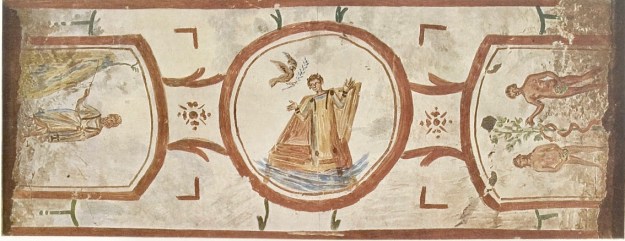
The story gave hope to the Jews driven from Jerusalem to exile in Babylon where, “By the rivers of Bablyon, we sat ad wept, remembering Zion.” (Psalm 137)  Christians– the pictures in the catacombs remind us (above)– saw Noah as a sign that the waters of baptism saved them from death and brought them the promise of paradise lost by Adam and Eve.

So the story of Noah and the ark is more than a myth.

Building a City: Genesis 11: 1-9

babel
Tower of Babel. Pieter Bruegel the Elder. 16th century

After the deluge, God renews a covenant with creation, and the descendants of Noah begin to fulfill God’s command “to increase and multiply and fill the earth.”

But then something else happens: human beings want to be together, so they build a city. A common origin and language draws them together, not just as families or clans, but in a larger society. They look for human flourishing in a city. (Genesis 11,1-9)

Unfortunately, they overreach. They want to get their heads into the heavens and so they plan a tower into the sky. Like Adam and Eve reaching for the Tree of the Knowledge of Good and Evil, they want to be like gods, “presuming to do whatever they want,” Their tower becomes a Tower of Babel. It collapses and they’re scattered over the world, leaving their city unfinished.

It’s important to recognize that the Genesis story does not claim God’s against human beings building a city. The bible, in fact, often sees the city as a place favoring human flourishing. In the Book of Jonah, God values the great city of Nineveh. Jesus sees Jerusalem, the Holy City, cherished by the Lord, the place where he dwells. The Spirit descends on his church in the city. The Genesis story sees the city as good, but it can be destroyed by sin and human pride..

The picture at the beginning of this blog is a painting of the Tower of Babel by the 16th century Dutch artist, Pieter Bruegel the Elder. It’s situates Babel in Antwerp, one of the key seaports of the time. Its shaky structure suggests it’s too ambitiously built. Still incomplete, it may not last. So the painter offers a warning against ambition and not caring for people, especially the needy.

It’s interesting to note that Pope Francis encourages mayors from cities to plan well. Commentators say the pope, conscious of a rising isolationism that’s affecting nations and international bodies today, sees cities to be agents for unifying peoples. They’re important places for humans to flourish. The United Nations also sees cities as key resources in the challenge that comes with climate change.

The picture at the end? You don’t have to be told. A great city. Still, its greatness will be judged, not by its big buildings or businesses, but how it encourages human flourishing.

img_1960

The Prayer of Abel: Genesis 4: 1-15

Cain and Abel. James Tissot. Brooklyn Museum

God was pleased with the sacrifice of Abel, rather than that of Cain. St. Ambrose explains why:

“Jesus told us to pray urgently and often, so that our prayers should not be long and tedious but short, earnest and frequent. Long elaborate prayers overflow with pointless phrases, and long gaps between prayers eventually stretch out into complete neglect.

Next he advises that when you ask forgiveness for yourself then you must take special care to grant it also to others. In that way your action can add its voice to yours as you pray. The apostle also teaches that when you pray you must be free from anger and from disagreement with anyone, so that your prayer is not disturbed or broken into.

The apostle teaches us to pray anywhere, and the Saviour says ‘Go into your room’ – but you must understand that this “room” is not the room with four walls that confines your body when you are in it, but the secret space within you in which your thoughts are enclosed and where your sensations arrive. That is your prayer-room, always with you wherever you are, always secret wherever you are, with your only witness being God.

Above all, you must pray for the whole people: that is, for the whole body, for every part of your mother the Church, whose distinguishing feature is mutual love. If you ask for something for yourself then you will be praying for yourself only – and you must remember that more grace comes to one who prays for others than to any ordinary sinner. If each person prays for all people, then all people are effectively praying for each.

In conclusion, if you ask for something for yourself alone, you will be the only one asking for it; but if you ask for benefits for all, all in their turn will be asking for them for you. For you are in fact one of the “all.” Thus it is a great reward, as each person’s prayers acquire the weight of the prayers of everyone. There is nothing presumptuous about thinking like this: on the contrary, it is a sign of greater humility and more abundant fruitfulness.”

6th Sunday c: Who Do We Trust

For this week’s homily please watch the video below.

Where Are You? Genesis 3: 9-24

“Where are you?” A question that can take many forms.

“Where are you in this world of yours?”

“Where are you in this church of yours?

“Where are you in this life of yours?

“Where are you?” God asks Adam, hiding and fearful in his nakedness. It’s a question asked, not from judgment or in anger, but from love and concern. A merciful God speaks.  

When God asks Adam and Eve “Where are you?” the sentence of death for eating the forbidden fruit was already being being carried out. The two do not die physically immediately. The scriptures say they live on for hundreds of years. But now they’re uneasy, hiding in the garden where they experienced such full life and moved so freely before. 

The healthy relationship with the created world the garden symbolizes is no more. Their relationship with each other has changed. They blame each other. “The woman made me do it.” Their relationship with the animal world is broken; they’re betrayed by the wisest of animals, the snake. 

The earth itself that gave them abundant food and drink and offered its delightful beauty, becomes hard and unyielding. The first physical death recorded in Genesis is the murder of Abel by his brother Cain. 

When God asks “Where are you?” death has already entered the world. God is not carrying out a sentence. God comes with love and kindness to the creatures made in his image.

God fashions garments of skin for Adam and Eve as they are driven out of the garden. God promises a woman, a new Eve, a mother of all the living. As the Jewish scribes fashioned the ancient creation stories into the Book of Genesis, they end it with God’s call and promise to Abraham. A new people will bring life to the world. A merciful God does not abandon the world he made.  

“Where are we in this world of ours?” The question asked in Genesis is still asked of us today.

The Fall: Genesis 3:1-8

Humanity falls in our reading from Genesis today. (Genesis 3, 1-8)

“Now the serpent was the most cunning of all the animals
that the LORD God had made.
The serpent asked the woman,
‘Did God really tell you not to eat
from any of the trees in the garden?’”

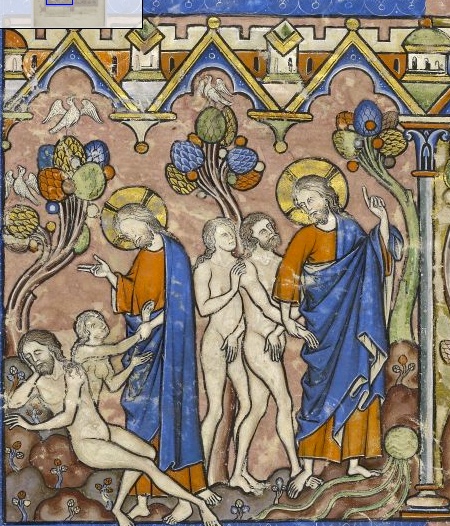
Adam and Eve, given life, are instructed by God about the forbidden tree in the garden. (above) Behind them stands the Tree of Life, mentioned only once in the Genesis account. Did they forget to eat enough of that tree?

A serpent, “the most cunning of all the animals,” initiates their fall. The authors of Genesis do not want to give equal power to the Evil One. Satan’s not God’s equal. So a serpent brings down humanity. Satan’s there, but other things as well.

In Mark’s gospel Jesus says to Peter, who wishes to change Jesus’ acceptance of his Father’s will: “Get behind me Satan; you’re not thinking like God, but like human beings do.” Peter’s speaking for Satan, but he’s speaking “reasonably” like human beings do.

In the Book of Job, Satan tempts Job, not directly, but through his friends, who also speak the way human beings do, “with a serpent’s tongue.”

The serpent, “the most cunning of all the animals,” represents the wisdom of a world that challenges God, the Creator. “Did God really tell you not to eat from any of the trees in the garden?” he asks the woman, demeaning God.

Some see eating from the tree of the knowledge of good and evil as a decision for moral autonomy made by humans, a claim to know it all, to say what’s right or wrong, rejecting the limits and finite freedom they have as creatures of God.

It can also be seen as trusting only in the experience and knowledge we gain as we live– like children distancing themselves from parents. We’re meant to grow in self-sufficiency and wisdom of our own, but without distancing ourselves from the God of wisdom and life who created us and wishes us always to be his children.

Two things to remember:

The Book of Genesis and other books of the Bible, never see the world – or us –belonging to Satan. God is king, always present, master of this world as the days go on, day and night, in light and darkness. The plans of his heart stand from age to age. The serpent doesn’t win.

Tomorrow’s reading ends promising a return to the land we lost and the Tree of Life. God is merciful.

We’re Not Alone: Genesis 2: 18-25

genesis man alone copy 2
The LORD God said:
“It is not good for the man to be alone.
I will make a suitable partner for him.”
(Genesis 2,18)

We usually rush on when we hear these words to the creation of Eve, who becomes “bone of my bone, flesh of my flesh” for Adam, and the human story begins.

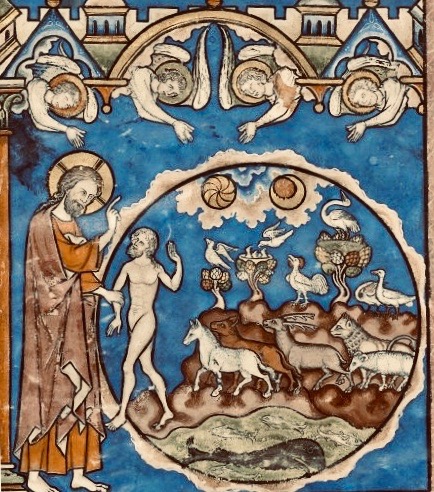
But the Genesis account  we read today and the medieval artist above remind us that God first “formed out the ground various wild animals and various birds of the air, and he brought them to the man… but none proved to be the suitable partner for the man.” (Genesis 2,19 ff)

Adam signals to God these new creatures are not enough, but does he dismiss them altogether for Eve?

Whether we realize it or not, we are not meant to be isolated individuals on this planet. We look for human companionship and friendship. But are human beings our only relationship. Besides caring for each other, we have destiny to care for all the creatures Adam names. They’re our partners too and we share this common home with them.

“A Vision Thing”


Here’s a favorite picture of mine from the Staten Island Ferry. You say it’s a picture of the New York skyline? I say it’s a picture of water that gave birth to the city. True, isn’t it? The water was here first. The city came to be because water brought the world here, making the city a capitol of world trade and drawing millions of human beings to this place

Now look at it. The man who built the new World Trade Center claims it’s the tallest building in the country, challenging the heavens–like Babel.

Be careful, though, about challenging the heavens and forgetting about the earth. Be careful about the waters that brought you where you are. No fish or oysters here to eat now. Little space for the waters to go when they rise. And they will.

Don’t forget– the water was here first. It’s a “vision thing.” That’s what Pope Francis says in “Laudato si”.

This week’s readings from Genesis are good readings for improving our vision. In the weeks before we read from the Letter to the Hebrews, so you might say that from the heavens we’re now reflecting on the earth.  

It’s good to reflect on creation, Genesis reminds us. God looks on what has been made and finds it good. Our account from Genesis today describes the creation of man (“man” here is a term for man and woman). Man is not immediately placed on the bare earth. No, he is placed in a garden where “various trees grow that were delightful to look at and good for food, with the tree of life in the middle of the garden and the tree of the knowledge of good and evil. “

Human beings, created by God, are called like God to find creation good. iThe Genesis account singles our the various trees that are delightful to look at and good for food, but all creation, from the sun and the stars to the simplest organisms, is to be looked at with delight.  

We’ll read for two weeks in our lectionary from the Book of Genesis and then we’ll be reading from the Book of Sirach which continues the Genesis message. Learn the Lord’s wisdom from the sands on the seashore, from heaven’s heights and earth’s depths, Sirach teaches.  Like the Book of Genesis, it tells us to learn from the world we live in. 

The scriptures in our lectionary are not assigned arbitrarily. The compilers of our lectionary after Vatican II carefully planned the way our lectionary unfolds.

What’s Inside? Mark 7:14-23


In Wednesday’s Gospel reading (Mk 7: 14-23), Jesus says: ” Nothing that enters one from outside can defile that person; but the things that come out from within are what defile.”

    Later on, He tells His disciples: ” Do you not realize that everything that goes into a person from outside cannot defile, since it enters not the heart but the stomach and passes out into the latrine (thus He declared all foods clean). But what comes out of the man, is what defiles him. From within the man, from his heart, come evil thoughts, unchastity, theft, murder, adultery, greed, malice, deceit, licentiousness, envy, blasphemy, arrogance, folly. All these evils come from within and they defile.”

    Our Lord is once again talking about the pettiness and superficiality of so many of the rules and regulations that the scribes and Pharisees were always harping on. He asks us to focus rather on that “beam” in our eyes, the sinful, destructive tendencies that exist within us, and that we try to cover up.

    But this passage leads me to ask so many questions. In many of the Psychology courses that I took, the issue of ” nature vs. nurture” would come up, and makes me think of this Gospel. So many disturbing, horrible things can ” enter from the outside ” and damage or ” defile ” a child so that he or she grows up and displays many of these sinful behaviors listed by the Lord. Do we learn these evils, or did they already come within us at birth? How extensive is the power of our “original sin?”  Why do some people turn out ” nicer” than others?

    No matter what the answers to these questions, our Lord certainly wants people to be cleansed of ” all their evils” . Can we do it by following a set of rules and prescribed behaviors that our Church so lovingly provides? ….. Follow the Commandments, participate in the Eucharist, celebrate the Sacrament of Reconciliation,  fast, avoid the sinful influence of the media for us and our children, control our “dirty language” and “dirty pictures” in our minds, practice tolerance and forgiveness, and so on?

    Many, many people, like me, who received Catholic upbringing and instruction when young, failed to follow these rules. Others, by the Grace of God, gave these rules a good try and are still trying. Why? Was it God’s arbitrary choice?

    I really cannot answer these questions either. All I know is that after 43 years in the wilderness, after hurting God, myself, and others so many times, my Lord Jesus Christ came my way and struck me with his Love and Mercy. The gift of His Light helped me to see His Light in me, along with the many dark, dirty spots that would cloud my vision of Him.

    So I no longer try to analyze what harmful events in my life led me to so much sin, nor how my “inside”  got filled with so much darkness (although I try to spot those bad influences when they threaten my grandchildren, and carefully talk about it with their parents!). All I know is that God loves me so much, that I can’t help but try to be”better”, because I love Him. There is this beautiful sentence that I read in the magazine THE WORD AMONG US: ” It’s the relationship, not the formula that matters.”

    In his book, FALLING UPWARD, Fr Richard Rohr, talks about the importance of “shadow work” in the spiritual journey. It is a matter of careful ” seeing through ” our self-deception, as well as through all of those inner things that “defile” us: ” You come to expect various forms of halfheartedness, deceit, vanity, or illusions from yourself. But now you see through them, which destroys most of their game and power.” What are you looking at as you see through them? Rohr believes that you are looking into your innermost self at  the One who loves you.

   ” This self cannot die and always lives, and is your True Self.”

Orlando Hernandez