Origen, On Genesis

Caesarea Maritime

In his poem “Conversion” Billy Collins dreams about reflecting for months on “a parable about a lost sheep or a blighted vineyard.” Our lectionary gives us a couple of weeks to reflect on the Book of Genesis..

The early theologian, Origen, taught catechumens in Caesarea Maritime on the coast of Palestine in the middle of the 3rd century. He’s not a learned scholar readying a book for publication. He’s teaching catechism to ordinary people who want to know something about the faith they’re drawn to.

“In the beginning God made heaven and earth. What is the beginning of all things except our Lord and Savior of all, Jesus Christ.” It’s not a beginning in time, Origen says, the beginning is Jesus Christ, through whom all things were made. The Word who became flesh, according to St. John.

We prefer today to look for the beginning science points out, without the Word. But the people Origen speaks to know nothing of modern science, yet they want to know what this world and their lives are all about. 

God made heaven and earth and you too, the Christian teacher says. You interact with heaven and earth, darkness and light, the waters above the earth and the waters that make the dry land fruitful. You came from chaotic darkness to your present home, the world you know. Don’t return to chaotic darkness. Follow the light that is Jesus Christ. You were made in his image and he calls you on to a heavenly world.

We belong to the earth, which is no longer dry land. We’re to bring forth fruits from the earth, not thorns and thistles, but fruits for the glory of God and for his blessing. We’re to bring forth fruits that are seed bearing, providing for a good future. “The earth in each of us is called to bear fruit according to our potential, some a hundredfold, some sixty, some thirty.” Our lives are meant to be seed-bearing. 

Sun and moon shine in our world. They also shine in us– Christ and his church. Stars are alight in our sky– saints are stars that light up our worlds. Stars differ, star from star, and so do we, one from another. This world is meant to be alight, so Jesus tells us, his disciples, to be light in our world.

All of us are called to approach God who made us. We don’t come the same, but each one comes “ according to one’s ability.” “Those who approach God receive much more of his life.” Martha and Mary approached Jesus in different ways. His apostles received light from him that was not given to the crowds listening at a distance. Those who share in his trials receive a special blessing. All of us, though, must approach God who made us.

Yes, the world God created is good, Origen tells his hearers, but good as it is, it can try us and tempt us.  Caesarea Maritime was a major seaport north of Joppa, where Jonah began his perilous encounter with a whale. For Origen’s hearers the sea was mostly a dangerous place, but it had to be travelled. From the story of creation he offers the birds and the creeping animals from the waters as symbols of the drives to good and evil in us all.

The birds are heavenly creatures, good graces and thoughts, that lift us to the heavens. Follow them.The creeping animals from the waters, especially the whales, are the evil inclinations– gigantic pride, hidden lust, unpredictable anger– that can drown us in the sea, where Satan dwells. Beware of them.

Not a view science or biblical exegetes would offer, is it? But Origen’s hearers in Caesarea Maritime would likely remember his teaching as they looked at the heavens, waited for the harvest and ventured out to sea. He was a good catechist.

He reads Genesis as a catechist would. We are made in the image of God. “ What image are we made in but the image of our Savior, who ‘is the firstborn of every creature,” (Colossians 1:15) “I am in the Father, and the Father is in me.”  “He who sees me sees the Father.” Jesus says about himself (John 14) . “Father, grant that just as you and I are one, they may be one in us.” he prays (John 17). We are called into the mystery of the Trinity.

Out of compassion the Word became flesh to restore the image of God in us, which we put aside. Now we need to draw near to Jesus Christ, who helps us grow in his image.

Like many of the ancient Christian writers, Origen can lose you at times in thought patterns we’re not used to. But there’s a reason great teachers and theologians like him still make sense. Truth is not confined to the last 20 minutes.
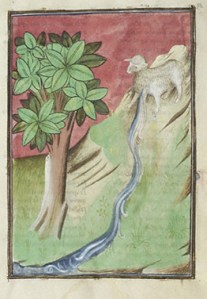
Learning from Genesis

tree-of-life-2


Pope Francis, in his encyclical Laudato Si, , invites Christians to turn to the Book of Genesis to understand how they’re related to the earth.

Genesis makes clear in its first chapter that the earth, “our common home,” is God’s work. God works for 5 days to create the world; only on the 6th day does God create man, whom he gives dominion over creation– but not absolute dominion. God made this world, not us, and every created thing enjoys a distinct relationship to its creator.

The dominion we have from God is a gift and is not absolute. We’re to help, respect, understand, tend, care for creation: creation isn’t ours to do what we want with it.

eden-2

The 2nd chapter of Genesis describes the creation of man. The earth is dry dust, but water wells up making a soft wet clay from the dust. God, like a potter, fashions man from the clay, breathing the breath of life into him and making him a living being.

We’re creatures of the earth, the story says.  As we’re reminded on Ash Wednesday, “You are dust and to dust you shall return.”

After creating man, God places him in a garden filled with all kinds of plants and trees. Two trees are singled out, the tree of life, and the tree of the knowledge of good and evil. Man is forbidden to eat from that tree.

What’s the tree of the knowledge of good and evil? Why is it forbidden to eat its fruit?  There are different interpretations. Some interpret eating from the tree as a decision of moral autonomy. By eating its fruit, I claim a knowledge of good and evil; I say what’s right or wrong.

Not unusual to hear that today, is it? Some believe they’re in absolute control of their lives. They choose what’s right or wrong, good and evil, rejecting the limits of the human condition and the finite freedom God gives human beings.

Another interpretation sees eating from the tree as a decision to trust only in human experience and human knowledge that we gain as we grow and progress individually and as a people. Like children distancing themselves from their parents, we must be self sufficient, gaining a wisdom on our own. The danger is that human experience and human wisdom become absolute.  We distance ourselves from God.

Can we see both these approaches harmful to our environment? The first leads to a possessiveness of created things;  they belong to us alone and we can do anything we want with them.

The second way also leads to harming our environment. Pope Francis speaks of the danger of “anthropocentrism,” putting human beings at the center of everything, a trend he traces back to the beginnings of the Enlightenment in the 16th century. Trusting human knowledge and human creativity, some are convinced that science and technology alone can bring about a perfect world.

Technology isn’t enough to meet our present environmental crisis, the pope says, we humans need to change. We need to humbly accept our place in creation, as God meant it to be.

What about the tree of life in the Genesis narrative? In the garden the tree was a promise of continuing life. Once banished from the garden,  human beings face death.

tree-of-life

When Christ came in the fullness of time, he brought life to the world, Christians believe. In his death on the cross, the sign of death was replaced by a sign of life. His cross is a tree of life.

Here’s Pope Francis from Laudato si:

“The creation accounts in the book of Genesis contain, in their own symbolic and narrative language, profound teachings about human existence and its historical reality. They suggest that human life is grounded in three fundamental and closely intertwined relationships: with God, with our neighbour and with the earth itself. According to the Bible, these three vital relationships have been broken, both outwardly and within us. This rupture is sin. The harmony between the Creator, humanity and creation as a whole was disrupted by our presuming to take the place of God and refusing to acknowledge our creaturely limitations. This in turn distorted our mandate to “have dominion” over the earth (cf. Gen 1:28), to “till it and keep it” (Gen 2:15). As a result, the originally harmonious relationship between human beings and nature became conflictual (cf. Gen 3:17-19).

It is significant that the harmony which Saint Francis of Assisi experienced with all creatures was seen as a healing of that rupture. Saint Bonaventure held that, through universal reconciliation with every creature, Saint Francis in some way returned to the state of original innocence.[40] This is a far cry from our situation today, where sin is manifest in all its destructive power in wars, the various forms of violence and abuse, the abandonment of the most vulnerable, and attacks on nature.”

Pope Francis, Laudato SI  66

“AND GOD SAID: LET THERE BE LIGHT” Genesis 1

Most mornings I sit out on our back porch facing east and watch for the morning light. Many mornings now it comes through the bare trees. In the dead of winter it’s still dark around 6 am, but soon the light will touch everything.  

“And God said: ‘Let there be light.’” “The voice of the Lord is full of power,” a morning psalm says. Light, darkness, sun and moon, water, earth, plants and flowers that fill the earth, birds of the air, fish of the sea, animals that roam the earth and  humans like us are brought into being by God’s voice. In our readings today and tomorrow we have the creation account from the Book of Genesis today and tomorrow..

We didn’t bring this all about and certainly it didn’t just happen. 

God’s voice, God’s power, God’s wisdom brings it all about. To see things right we need to have a worldview that sees things this way.The Book of Genesiss, which we begin in our lectionary today, tells us what we need to know. Each day is a Genesis day. God is at work, the morning light reminds us. 

In the beginning, when God created the heavens and the earth,
the earth was a formless wasteland, and darkness covered the abyss,
while a mighty wind swept over the waters.

Then God said,
“Let there be light,” and there was light.
God saw how good the light was.
God then separated the light from the darkness.
God called the light “day,” and the darkness he called “night.”
Thus evening came, and morning followed–the first day.

Then God said,
“Let there be a dome in the middle of the waters,
to separate one body of water from the other.”
And so it happened:
God made the dome,
and it separated the water above the dome from the water below it.
God called the dome “the sky.”
Evening came, and morning followed–the second day.

Then God said,
“Let the water under the sky be gathered into a single basin,
so that the dry land may appear.” 
And so it happened:
the water under the sky was gathered into its basin,
and the dry land appeared.
God called the dry land “the earth,”
and the basin of the water he called “the sea.”
God saw how good it was.
Then God said,
“Let the earth bring forth vegetation:
every kind of plant that bears seed
and every kind of fruit tree on earth
that bears fruit with its seed in it.”
And so it happened:
the earth brought forth every kind of plant that bears seed
and every kind of fruit tree on earth that
bears fruit with its seed in it.
God saw how good it was.
Evening came, and morning followed–the third day.

Then God said:
“Let there be lights in the dome of the sky,
to separate day from night.
Let them mark the fixed times, the days and the years,

and serve as luminaries in the dome of the sky,
to shed light upon the earth.”
And so it happened:
God made the two great lights,
the greater one to govern the day,
and the lesser one to govern the night;
and he made the stars.
God set them in the dome of the sky,
to shed light upon the earth,
to govern the day and the night,
and to separate the light from the darkness.
God saw how good it was.
Evening came, and morning followed–the fourth day. (Genesis 1:1-19)

5th Sunday c: Trust in God

For this week’s homily, please watch the video below.

Letter to the Hebrews and the Gospel of Mark

Commentators find it hard to identify when and where the Letter to the Hebrews was written and who wrote it. The early theologian Origen said “only God knows.”

Most say the Letter to the Hebrews was written for early Jewish Christians at a time of persecution who are trying to figure out how their new faith is related to the religion of their ancestors. There’s a strong opinion the letter was written for Jewish Christians in Rome and it originated there. 

The Christians in Rome early on were predominantly Jewish Christians. Nero blamed them for the fire that occurred in Rome in 64 and destroyed the city. Many of them, including Peter and Paul, were put to death in the late 60s. It was the first great persecution of the early church. 

Then, only a few years later the Jewish wars began.Titus and his armies destroyed Jerusalem and its temple in the year 70.  Roman Christians, the majority converted Jews, saw him return triumphantly to Rome carting spoils and slaves from Jerusalem.

They would have to wonder what was coming next and whether their faith was worth it. 

We can hear in our lectionary readings for Monday the author of Hebrews appealing to their Jewish tradition, calling them to hang on, to be brave, reminding them of Jewish heroes who braved death and every kind of persecution. 

A few days before we heard in this letter: “Let us hold unwaveringly to our confession that gives us hope, for he who made the promise is trustworthy.We must consider how to rouse one another to love and good works. We should not stay away from our assembly, as is the custom of some, but encourage one another, and this all the more as you see the day drawing near.”  Hebrews  10:19-25  

This isn’t a time for laying low and hiding your faith, the letter says.This a time to profess your faith. 

Today, the author of Hebrews reminds his readers, including us, that besides this great cloud of witnesses, to keep our eyes fixed on the great witness, Jesus, “the leader and perfecter of faith. For the sake of the joy that lay before him Jesus endured the cross, despising its shame, and has taken his seat at the right of the throne of God. Consider how he endured such opposition from sinners, in order that you may not grow weary and lose heart. In your struggle against sin you have not yet resisted to the point of shedding blood.” ( Hebrews 12:1-4)

Along with the Letter to the Hebrews the Gospel of Mark was written at the same time in Rome for the same audience, some commentators believe. It portrays the witness of Jesus  who, after being acclaimed in Galilee, goes to Jerusalem to endure death on a cross. 

I admire the compilers of our lectionary who paired the Letter to the. Hebrews with the Gospel of Mark. As will as providing more readings from scripture, they have helped us have insight into the history of the early church. Those who compiled our calendar of saints taken from every time and place have also provided us with an historical sense for understanding our church. 

The liturgy is a way of prayer, but it’s also a book of theology and history. It’s our catechism. All we have to do is read it.

At the Caves: Mark 5:1-20

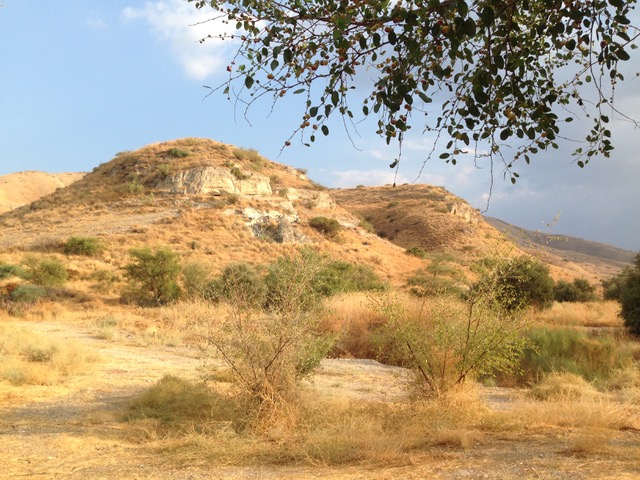
Caves along the Sea of Galilee

By Orlando Hernández

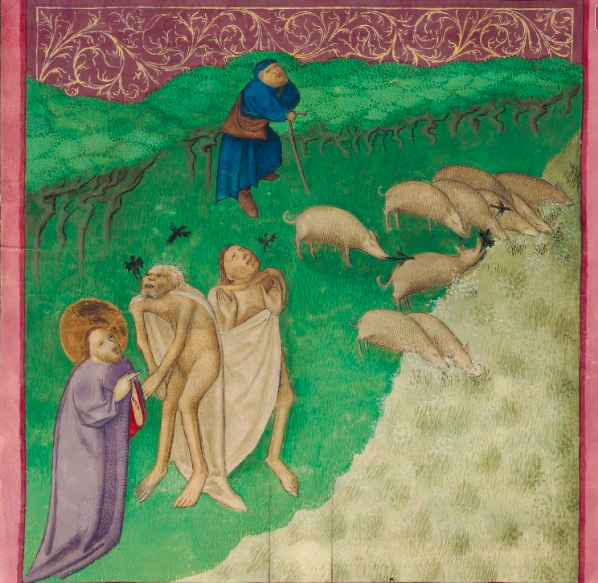
The Gospel for Monday of the fourth week in Ordinary Time (Mk 5: 1-20) follows the story from the end of Chapter 4. The disciples, after the terrifying experience of the storm in the Sea of Galilee, “came to the other side of the sea to the territory of the Gerasenes”. They were about to undergo another scary experience. From the caves in the mountainside, a naked, wild-eyed, scarred, bleeding man, strong enough to break chains, crying out in a terrifying voice, runs right up to them! (I have often wondered if any of the disciples stepped up in front of Jesus to defend Him, or if they stayed behind Him!) To what must have been everyone’s relief, the man prostrates himself before Jesus. It turns out, a host of demons have possessed this man, and Jesus drives them out of him. At the end, the man is “sitting there, clothed and in his right mind.”

     This story has always had a special, if disturbing, meaning to me. I don’t think I have ever been possessed by demons, but I must confess that, even after all these years with Jesus, I still have all these fears, prejudices, resentments, and hatreds (of myself and others) in my mind and soul, which come out of nowhere and torture me in a way that makes me think of the Gerasene demoniac.

     On the Pilgrimage to Israel this was one of the places that I most wished to visit. There, I wanted to kneel by those cave-tombs on the mountainside and beg Jesus to finally rid me of these personal flaws. The site is neatly kept by the Israeli government as a national park, next to the highway that goes around the Lake. One can visit the ruins of an ancient Orthodox Church and Monastery that commemorates the miracle by Jesus. I was not interested in seeing this place, so I detached myself from the group and climbed up the trail to the steep hills that were dotted with caves. A winding steel staircase led up to the caves but I knew that I did not have enough time, so I stood there at the bottom. I was all alone, surrounded by this arid, lonely landscape. I could imagine the screams of the possessed man echoing all around, and within me. I felt the urgency. If not here and now, when? I threw myself upon the ground and started to beg Jesus, whose presence I felt so strongly, to deliver me from all these things that torment my soul. I moaned. I cried. I yelled. Then, a quiet attitude came within me, not peace, but acceptance. Somehow I felt that the calm, quiet message that my Lord was giving me was this:

     “I will not release you of these ‘demons’. They will be with you until the day you die. They are part of your cross. What I will do is be with you always, and help you to control them. I will never stop teaching you to love yourself and others. You can count on me.” I felt with certainty that this was Jesus’ message. 

     I stayed there for a while, until my wife came to tell me that the group was leaving. I did not say a word during the bus ride back to the hotel in Tiberias. That night I dined and laughed with my fellow Pilgrims. But that moment at the hillside was always in the back of my mind. That night my sleep was troubled, and I kept on dreaming that I was going in and out of those dark caves. To this day this memory haunts me.

     To this day I fight with these elements of negativity within me. Of course, I am not alone. Wonderful people of God surround me, helping me to be a better person. Occasionally , I meditate and pray in Ignatian fashion and visit those caves with my Lord at my side. The Holy Spirit of God fortifies me with the Sacrament of Reconciliation. The Eucharistic Christ comes within this old, crumbling temple of my soul, and boy, does He clean up! I realize that there is nothing I can do without Him. Without Him there is no meaning in life. 

     The healed Gerasene man wanted to stay with Jesus, but the Lord gave him the mission to stay and give His message to his people. The message, after all, is Love. Lord, You hold me up me with such an awesome Love! Thank You. Let me be an instrument of that Love.

The Possessed Man: Ottheinrich Bible. Library of Congress.

Passion Exhibit 1; Guides to the Mystery of Christ

Crucifix: St. Michael’s Monastery, Union City, New Jersey

St. Thomas Aquinas

St. Bernard of Clairvaux

St. Paul of the Cross

St. Gabriel of the Sorrowful Mother

Artist: Mother Mary of the Compassion, Dominican Chapel, Union City, NJ

Four saints face the great crucifix that was once above the altar in the monastery chapel of St. Michael’s Passionist Monastery, Union City, New Jersey. St. Paul of the Cross, St. Gabriel of Our Lady of Sorrows, St. Thomas Aquinas and St. Bernard of Clairvaux.  Mother Mary of the Compassion, a renowned artist from the Dominican Convent in Union City, painted the saints. 

Thomas and Bernard represent the guides the Passionists follow in their search into the mystery of Christ. Bernard represents their search through devotional prayer and preaching. Aquinas represents those who guide them into the mystery of the Cross through theological study and the search for truth.

St. Michael’s Monastery in Union City was formerly the headquarters of the Passionists in the United States and a place for formation of their young religious.  The Passionists left Union City on June 1, 2012.

For more on St. Michael’s, Union City: https://vhoagland.com/2012/05/18/st-michaels-union-city/  

Storms at Sea:Mark 4:35-41

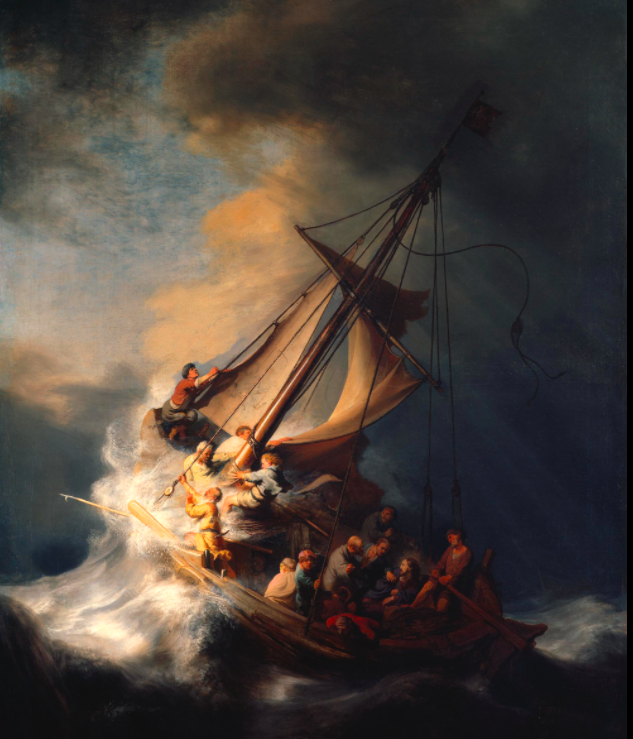
Rembrandt, Storm at Sea, Gardner Museum,

Earlier in the day, Jesus taught the crowds and his disciples gathered at the lakeshore, Mark’s Gospel says. His words were wise and reassuring, words to set the course of your life on. Then, as evening drew on, he said to them ‘Let us cross to the other side.’”  (Mark 4:35-41) He and his disciples sail onto the Sea of Galilee and “ a violent squall came up, waves breaking over the boat so that it was already filling up. “Jesus was in the stern asleep on a cushion.” They were afraid they were going to drown, and Jesus in the stern of the boat seemed asleep, unaware of their fears. It’s hard to make him out in Rembrandt’s dramatic picture of the storm.

A good image of how life can turn out, isn’t it? Words of faith bring such strength and assurance. “Peace be with you.” “I am the vine, you are the branches.” “I’m with you all days.” “I am the way, the truth and the life.”

Then, the storms come; unexpectedly, powerfully, with frightening suddenness sometimes, turning our lives upside down. Overwhelmed by life’s quick tragedies and doubts, we forget God’s assurances. Like Jesus in the boat, God seems asleep, unaware of our experience.

Mark’s gospel is good to reflect on today, isn’t it? Wars, political and economic storms, the planet endangered by wild seas and changing weather. “The winds and the sea obey him,” our gospel today reminds us. God is for stormy times as well as fair. He doesn’t want us to perish. “Have faith,” he says, “I’m with you.” God’s with us in storms. 

Still, like the disciples we say “Teacher, do you not care that we are perishing?” ( Mark 4:37)

Today’s reading from the Letter to the Hebrews offers another dimension to our story. Abraham and his wife Sarah are past child-bearing age. Where are the promises of God, they wonder? Like so many older people they can’t see a promise in the future. Their dreams of children or what they have given their life to, unfulfilled.

“Have faith, I am with you,” God says. God fulfills his promises.