Where Are You? Genesis 3: 9-24

“Where are you?” A question that can take many forms.

“Where are you in this world of yours?”

“Where are you in this church of yours?

“Where are you in this life of yours?

“Where are you?” God asks Adam, hiding and fearful in his nakedness. It’s a question asked, not from judgment or in anger, but from love and concern. A merciful God speaks.  

When God asks Adam and Eve “Where are you?” the sentence of death for eating the forbidden fruit was already being being carried out. The two do not die physically immediately. The scriptures say they live on for hundreds of years. But now they’re uneasy, hiding in the garden where they experienced such full life and moved so freely before. 

The healthy relationship with the created world the garden symbolizes is no more. Their relationship with each other has changed. They blame each other. “The woman made me do it.” Their relationship with the animal world is broken; they’re betrayed by the wisest of animals, the snake. 

The earth itself that gave them abundant food and drink and offered its delightful beauty, becomes hard and unyielding. The first physical death recorded in Genesis is the murder of Abel by his brother Cain. 

When God asks “Where are you?” death has already entered the world. God is not carrying out a sentence. God comes with love and kindness to the creatures made in his image.

God fashions garments of skin for Adam and Eve as they are driven out of the garden. God promises a woman, a new Eve, a mother of all the living. As the Jewish scribes fashioned the ancient creation stories into the Book of Genesis, they end it with God’s call and promise to Abraham. A new people will bring life to the world. A merciful God does not abandon the world he made.  

“Where are we in this world of ours?” The question asked in Genesis is still asked of us today.

The Fall: Genesis 3:1-8

Humanity falls in our reading from Genesis today. (Genesis 3, 1-8)

“Now the serpent was the most cunning of all the animals
that the LORD God had made.
The serpent asked the woman,
‘Did God really tell you not to eat
from any of the trees in the garden?’”

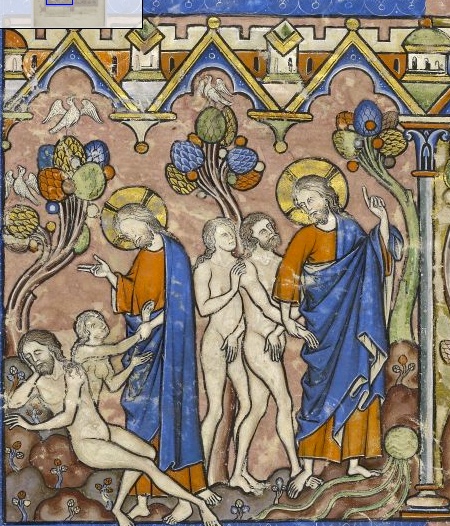
Adam and Eve, given life, are instructed by God about the forbidden tree in the garden. (above) Behind them stands the Tree of Life, mentioned only once in the Genesis account. Did they forget to eat enough of that tree?

A serpent, “the most cunning of all the animals,” initiates their fall. The authors of Genesis do not want to give equal power to the Evil One. Satan’s not God’s equal. So a serpent brings down humanity. Satan’s there, but other things as well.

In Mark’s gospel Jesus says to Peter, who wishes to change Jesus’ acceptance of his Father’s will: “Get behind me Satan; you’re not thinking like God, but like human beings do.” Peter’s speaking for Satan, but he’s speaking “reasonably” like human beings do.

In the Book of Job, Satan tempts Job, not directly, but through his friends, who also speak the way human beings do, “with a serpent’s tongue.”

The serpent, “the most cunning of all the animals,” represents the wisdom of a world that challenges God, the Creator. “Did God really tell you not to eat from any of the trees in the garden?” he asks the woman, demeaning God.

Some see eating from the tree of the knowledge of good and evil as a decision for moral autonomy made by humans, a claim to know it all, to say what’s right or wrong, rejecting the limits and finite freedom they have as creatures of God.

It can also be seen as trusting only in the experience and knowledge we gain as we live– like children distancing themselves from parents. We’re meant to grow in self-sufficiency and wisdom of our own, but without distancing ourselves from the God of wisdom and life who created us and wishes us always to be his children.

Two things to remember:

The Book of Genesis and other books of the Bible, never see the world – or us –belonging to Satan. God is king, always present, master of this world as the days go on, day and night, in light and darkness. The plans of his heart stand from age to age. The serpent doesn’t win.

Tomorrow’s reading ends promising a return to the land we lost and the Tree of Life. God is merciful.

We’re Not Alone: Genesis 2: 18-25

genesis man alone copy 2
The LORD God said:
“It is not good for the man to be alone.
I will make a suitable partner for him.”
(Genesis 2,18)

We usually rush on when we hear these words to the creation of Eve, who becomes “bone of my bone, flesh of my flesh” for Adam, and the human story begins.

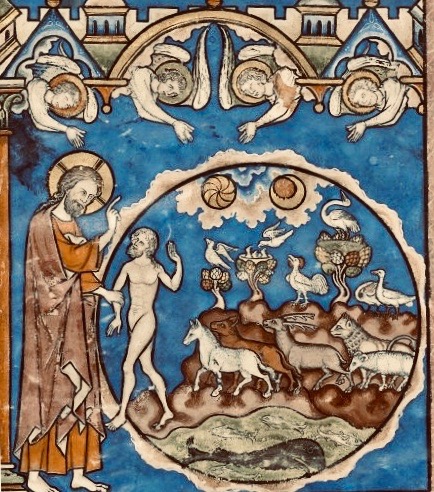
But the Genesis account  we read today and the medieval artist above remind us that God first “formed out the ground various wild animals and various birds of the air, and he brought them to the man… but none proved to be the suitable partner for the man.” (Genesis 2,19 ff)

Adam signals to God these new creatures are not enough, but does he dismiss them altogether for Eve?

Whether we realize it or not, we are not meant to be isolated individuals on this planet. We look for human companionship and friendship. But are human beings our only relationship. Besides caring for each other, we have destiny to care for all the creatures Adam names. They’re our partners too and we share this common home with them.

“A Vision Thing”


Here’s a favorite picture of mine from the Staten Island Ferry. You say it’s a picture of the New York skyline? I say it’s a picture of water that gave birth to the city. True, isn’t it? The water was here first. The city came to be because water brought the world here, making the city a capitol of world trade and drawing millions of human beings to this place

Now look at it. The man who built the new World Trade Center claims it’s the tallest building in the country, challenging the heavens–like Babel.

Be careful, though, about challenging the heavens and forgetting about the earth. Be careful about the waters that brought you where you are. No fish or oysters here to eat now. Little space for the waters to go when they rise. And they will.

Don’t forget– the water was here first. It’s a “vision thing.” That’s what Pope Francis says in “Laudato si”.

This week’s readings from Genesis are good readings for improving our vision. In the weeks before we read from the Letter to the Hebrews, so you might say that from the heavens we’re now reflecting on the earth.  

It’s good to reflect on creation, Genesis reminds us. God looks on what has been made and finds it good. Our account from Genesis today describes the creation of man (“man” here is a term for man and woman). Man is not immediately placed on the bare earth. No, he is placed in a garden where “various trees grow that were delightful to look at and good for food, with the tree of life in the middle of the garden and the tree of the knowledge of good and evil. “

Human beings, created by God, are called like God to find creation good. iThe Genesis account singles our the various trees that are delightful to look at and good for food, but all creation, from the sun and the stars to the simplest organisms, is to be looked at with delight.  

We’ll read for two weeks in our lectionary from the Book of Genesis and then we’ll be reading from the Book of Sirach which continues the Genesis message. Learn the Lord’s wisdom from the sands on the seashore, from heaven’s heights and earth’s depths, Sirach teaches.  Like the Book of Genesis, it tells us to learn from the world we live in. 

The scriptures in our lectionary are not assigned arbitrarily. The compilers of our lectionary after Vatican II carefully planned the way our lectionary unfolds.

What’s Inside? Mark 7:14-23


In Wednesday’s Gospel reading (Mk 7: 14-23), Jesus says: ” Nothing that enters one from outside can defile that person; but the things that come out from within are what defile.”

    Later on, He tells His disciples: ” Do you not realize that everything that goes into a person from outside cannot defile, since it enters not the heart but the stomach and passes out into the latrine (thus He declared all foods clean). But what comes out of the man, is what defiles him. From within the man, from his heart, come evil thoughts, unchastity, theft, murder, adultery, greed, malice, deceit, licentiousness, envy, blasphemy, arrogance, folly. All these evils come from within and they defile.”

    Our Lord is once again talking about the pettiness and superficiality of so many of the rules and regulations that the scribes and Pharisees were always harping on. He asks us to focus rather on that “beam” in our eyes, the sinful, destructive tendencies that exist within us, and that we try to cover up.

    But this passage leads me to ask so many questions. In many of the Psychology courses that I took, the issue of ” nature vs. nurture” would come up, and makes me think of this Gospel. So many disturbing, horrible things can ” enter from the outside ” and damage or ” defile ” a child so that he or she grows up and displays many of these sinful behaviors listed by the Lord. Do we learn these evils, or did they already come within us at birth? How extensive is the power of our “original sin?”  Why do some people turn out ” nicer” than others?

    No matter what the answers to these questions, our Lord certainly wants people to be cleansed of ” all their evils” . Can we do it by following a set of rules and prescribed behaviors that our Church so lovingly provides? ….. Follow the Commandments, participate in the Eucharist, celebrate the Sacrament of Reconciliation,  fast, avoid the sinful influence of the media for us and our children, control our “dirty language” and “dirty pictures” in our minds, practice tolerance and forgiveness, and so on?

    Many, many people, like me, who received Catholic upbringing and instruction when young, failed to follow these rules. Others, by the Grace of God, gave these rules a good try and are still trying. Why? Was it God’s arbitrary choice?

    I really cannot answer these questions either. All I know is that after 43 years in the wilderness, after hurting God, myself, and others so many times, my Lord Jesus Christ came my way and struck me with his Love and Mercy. The gift of His Light helped me to see His Light in me, along with the many dark, dirty spots that would cloud my vision of Him.

    So I no longer try to analyze what harmful events in my life led me to so much sin, nor how my “inside”  got filled with so much darkness (although I try to spot those bad influences when they threaten my grandchildren, and carefully talk about it with their parents!). All I know is that God loves me so much, that I can’t help but try to be”better”, because I love Him. There is this beautiful sentence that I read in the magazine THE WORD AMONG US: ” It’s the relationship, not the formula that matters.”

    In his book, FALLING UPWARD, Fr Richard Rohr, talks about the importance of “shadow work” in the spiritual journey. It is a matter of careful ” seeing through ” our self-deception, as well as through all of those inner things that “defile” us: ” You come to expect various forms of halfheartedness, deceit, vanity, or illusions from yourself. But now you see through them, which destroys most of their game and power.” What are you looking at as you see through them? Rohr believes that you are looking into your innermost self at  the One who loves you.

   ” This self cannot die and always lives, and is your True Self.”

Orlando Hernandez   

Origen, On Genesis

Caesarea Maritime

In his poem “Conversion” Billy Collins dreams about reflecting for months on “a parable about a lost sheep or a blighted vineyard.” Our lectionary gives us a couple of weeks to reflect on the Book of Genesis..

The early theologian, Origen, taught catechumens in Caesarea Maritime on the coast of Palestine in the middle of the 3rd century. He’s not a learned scholar readying a book for publication. He’s teaching catechism to ordinary people who want to know something about the faith they’re drawn to.

“In the beginning God made heaven and earth. What is the beginning of all things except our Lord and Savior of all, Jesus Christ.” It’s not a beginning in time, Origen says, the beginning is Jesus Christ, through whom all things were made. The Word who became flesh, according to St. John.

We prefer today to look for the beginning science points out, without the Word. But the people Origen speaks to know nothing of modern science, yet they want to know what this world and their lives are all about. 

God made heaven and earth and you too, the Christian teacher says. You interact with heaven and earth, darkness and light, the waters above the earth and the waters that make the dry land fruitful. You came from chaotic darkness to your present home, the world you know. Don’t return to chaotic darkness. Follow the light that is Jesus Christ. You were made in his image and he calls you on to a heavenly world.

We belong to the earth, which is no longer dry land. We’re to bring forth fruits from the earth, not thorns and thistles, but fruits for the glory of God and for his blessing. We’re to bring forth fruits that are seed bearing, providing for a good future. “The earth in each of us is called to bear fruit according to our potential, some a hundredfold, some sixty, some thirty.” Our lives are meant to be seed-bearing. 

Sun and moon shine in our world. They also shine in us– Christ and his church. Stars are alight in our sky– saints are stars that light up our worlds. Stars differ, star from star, and so do we, one from another. This world is meant to be alight, so Jesus tells us, his disciples, to be light in our world.

All of us are called to approach God who made us. We don’t come the same, but each one comes “ according to one’s ability.” “Those who approach God receive much more of his life.” Martha and Mary approached Jesus in different ways. His apostles received light from him that was not given to the crowds listening at a distance. Those who share in his trials receive a special blessing. All of us, though, must approach God who made us.

Yes, the world God created is good, Origen tells his hearers, but good as it is, it can try us and tempt us.  Caesarea Maritime was a major seaport north of Joppa, where Jonah began his perilous encounter with a whale. For Origen’s hearers the sea was mostly a dangerous place, but it had to be travelled. From the story of creation he offers the birds and the creeping animals from the waters as symbols of the drives to good and evil in us all.

The birds are heavenly creatures, good graces and thoughts, that lift us to the heavens. Follow them.The creeping animals from the waters, especially the whales, are the evil inclinations– gigantic pride, hidden lust, unpredictable anger– that can drown us in the sea, where Satan dwells. Beware of them.

Not a view science or biblical exegetes would offer, is it? But Origen’s hearers in Caesarea Maritime would likely remember his teaching as they looked at the heavens, waited for the harvest and ventured out to sea. He was a good catechist.

He reads Genesis as a catechist would. We are made in the image of God. “ What image are we made in but the image of our Savior, who ‘is the firstborn of every creature,” (Colossians 1:15) “I am in the Father, and the Father is in me.”  “He who sees me sees the Father.” Jesus says about himself (John 14) . “Father, grant that just as you and I are one, they may be one in us.” he prays (John 17). We are called into the mystery of the Trinity.

Out of compassion the Word became flesh to restore the image of God in us, which we put aside. Now we need to draw near to Jesus Christ, who helps us grow in his image.

Like many of the ancient Christian writers, Origen can lose you at times in thought patterns we’re not used to. But there’s a reason great teachers and theologians like him still make sense. Truth is not confined to the last 20 minutes.

Learning from Genesis

tree-of-life-2


Pope Francis, in his encyclical Laudato Si, , invites Christians to turn to the Book of Genesis to understand how they’re related to the earth.

Genesis makes clear in its first chapter that the earth, “our common home,” is God’s work. God works for 5 days to create the world; only on the 6th day does God create man, whom he gives dominion over creation– but not absolute dominion. God made this world, not us, and every created thing enjoys a distinct relationship to its creator.

The dominion we have from God is a gift and is not absolute. We’re to help, respect, understand, tend, care for creation: creation isn’t ours to do what we want with it.

eden-2

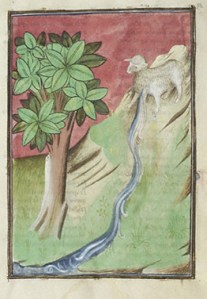
The 2nd chapter of Genesis describes the creation of man. The earth is dry dust, but water wells up making a soft wet clay from the dust. God, like a potter, fashions man from the clay, breathing the breath of life into him and making him a living being.

We’re creatures of the earth, the story says.  As we’re reminded on Ash Wednesday, “You are dust and to dust you shall return.”

After creating man, God places him in a garden filled with all kinds of plants and trees. Two trees are singled out, the tree of life, and the tree of the knowledge of good and evil. Man is forbidden to eat from that tree.

What’s the tree of the knowledge of good and evil? Why is it forbidden to eat its fruit?  There are different interpretations. Some interpret eating from the tree as a decision of moral autonomy. By eating its fruit, I claim a knowledge of good and evil; I say what’s right or wrong.

Not unusual to hear that today, is it? Some believe they’re in absolute control of their lives. They choose what’s right or wrong, good and evil, rejecting the limits of the human condition and the finite freedom God gives human beings.

Another interpretation sees eating from the tree as a decision to trust only in human experience and human knowledge that we gain as we grow and progress individually and as a people. Like children distancing themselves from their parents, we must be self sufficient, gaining a wisdom on our own. The danger is that human experience and human wisdom become absolute.  We distance ourselves from God.

Can we see both these approaches harmful to our environment? The first leads to a possessiveness of created things;  they belong to us alone and we can do anything we want with them.

The second way also leads to harming our environment. Pope Francis speaks of the danger of “anthropocentrism,” putting human beings at the center of everything, a trend he traces back to the beginnings of the Enlightenment in the 16th century. Trusting human knowledge and human creativity, some are convinced that science and technology alone can bring about a perfect world.

Technology isn’t enough to meet our present environmental crisis, the pope says, we humans need to change. We need to humbly accept our place in creation, as God meant it to be.

What about the tree of life in the Genesis narrative? In the garden the tree was a promise of continuing life. Once banished from the garden,  human beings face death.

tree-of-life

When Christ came in the fullness of time, he brought life to the world, Christians believe. In his death on the cross, the sign of death was replaced by a sign of life. His cross is a tree of life.

Here’s Pope Francis from Laudato si:

“The creation accounts in the book of Genesis contain, in their own symbolic and narrative language, profound teachings about human existence and its historical reality. They suggest that human life is grounded in three fundamental and closely intertwined relationships: with God, with our neighbour and with the earth itself. According to the Bible, these three vital relationships have been broken, both outwardly and within us. This rupture is sin. The harmony between the Creator, humanity and creation as a whole was disrupted by our presuming to take the place of God and refusing to acknowledge our creaturely limitations. This in turn distorted our mandate to “have dominion” over the earth (cf. Gen 1:28), to “till it and keep it” (Gen 2:15). As a result, the originally harmonious relationship between human beings and nature became conflictual (cf. Gen 3:17-19).

It is significant that the harmony which Saint Francis of Assisi experienced with all creatures was seen as a healing of that rupture. Saint Bonaventure held that, through universal reconciliation with every creature, Saint Francis in some way returned to the state of original innocence.[40] This is a far cry from our situation today, where sin is manifest in all its destructive power in wars, the various forms of violence and abuse, the abandonment of the most vulnerable, and attacks on nature.”

Pope Francis, Laudato SI  66

“AND GOD SAID: LET THERE BE LIGHT” Genesis 1

Most mornings I sit out on our back porch facing east and watch for the morning light. Many mornings now it comes through the bare trees. In the dead of winter it’s still dark around 6 am, but soon the light will touch everything.  

“And God said: ‘Let there be light.’” “The voice of the Lord is full of power,” a morning psalm says. Light, darkness, sun and moon, water, earth, plants and flowers that fill the earth, birds of the air, fish of the sea, animals that roam the earth and  humans like us are brought into being by God’s voice. In our readings today and tomorrow we have the creation account from the Book of Genesis today and tomorrow..

We didn’t bring this all about and certainly it didn’t just happen. 

God’s voice, God’s power, God’s wisdom brings it all about. To see things right we need to have a worldview that sees things this way.The Book of Genesiss, which we begin in our lectionary today, tells us what we need to know. Each day is a Genesis day. God is at work, the morning light reminds us. 

In the beginning, when God created the heavens and the earth,
the earth was a formless wasteland, and darkness covered the abyss,
while a mighty wind swept over the waters.

Then God said,
“Let there be light,” and there was light.
God saw how good the light was.
God then separated the light from the darkness.
God called the light “day,” and the darkness he called “night.”
Thus evening came, and morning followed–the first day.

Then God said,
“Let there be a dome in the middle of the waters,
to separate one body of water from the other.”
And so it happened:
God made the dome,
and it separated the water above the dome from the water below it.
God called the dome “the sky.”
Evening came, and morning followed–the second day.

Then God said,
“Let the water under the sky be gathered into a single basin,
so that the dry land may appear.” 
And so it happened:
the water under the sky was gathered into its basin,
and the dry land appeared.
God called the dry land “the earth,”
and the basin of the water he called “the sea.”
God saw how good it was.
Then God said,
“Let the earth bring forth vegetation:
every kind of plant that bears seed
and every kind of fruit tree on earth
that bears fruit with its seed in it.”
And so it happened:
the earth brought forth every kind of plant that bears seed
and every kind of fruit tree on earth that
bears fruit with its seed in it.
God saw how good it was.
Evening came, and morning followed–the third day.

Then God said:
“Let there be lights in the dome of the sky,
to separate day from night.
Let them mark the fixed times, the days and the years,

and serve as luminaries in the dome of the sky,
to shed light upon the earth.”
And so it happened:
God made the two great lights,
the greater one to govern the day,
and the lesser one to govern the night;
and he made the stars.
God set them in the dome of the sky,
to shed light upon the earth,
to govern the day and the night,
and to separate the light from the darkness.
God saw how good it was.
Evening came, and morning followed–the fourth day. (Genesis 1:1-19)

5th Sunday c: Trust in God

For this week’s homily, please watch the video below.

Letter to the Hebrews and the Gospel of Mark

Commentators find it hard to identify when and where the Letter to the Hebrews was written and who wrote it. The early theologian Origen said “only God knows.”

Most say the Letter to the Hebrews was written for early Jewish Christians at a time of persecution who are trying to figure out how their new faith is related to the religion of their ancestors. There’s a strong opinion the letter was written for Jewish Christians in Rome and it originated there. 

The Christians in Rome early on were predominantly Jewish Christians. Nero blamed them for the fire that occurred in Rome in 64 and destroyed the city. Many of them, including Peter and Paul, were put to death in the late 60s. It was the first great persecution of the early church. 

Then, only a few years later the Jewish wars began.Titus and his armies destroyed Jerusalem and its temple in the year 70.  Roman Christians, the majority converted Jews, saw him return triumphantly to Rome carting spoils and slaves from Jerusalem.

They would have to wonder what was coming next and whether their faith was worth it. 

We can hear in our lectionary readings for Monday the author of Hebrews appealing to their Jewish tradition, calling them to hang on, to be brave, reminding them of Jewish heroes who braved death and every kind of persecution. 

A few days before we heard in this letter: “Let us hold unwaveringly to our confession that gives us hope, for he who made the promise is trustworthy.We must consider how to rouse one another to love and good works. We should not stay away from our assembly, as is the custom of some, but encourage one another, and this all the more as you see the day drawing near.”  Hebrews  10:19-25  

This isn’t a time for laying low and hiding your faith, the letter says.This a time to profess your faith. 

Today, the author of Hebrews reminds his readers, including us, that besides this great cloud of witnesses, to keep our eyes fixed on the great witness, Jesus, “the leader and perfecter of faith. For the sake of the joy that lay before him Jesus endured the cross, despising its shame, and has taken his seat at the right of the throne of God. Consider how he endured such opposition from sinners, in order that you may not grow weary and lose heart. In your struggle against sin you have not yet resisted to the point of shedding blood.” ( Hebrews 12:1-4)

Along with the Letter to the Hebrews the Gospel of Mark was written at the same time in Rome for the same audience, some commentators believe. It portrays the witness of Jesus  who, after being acclaimed in Galilee, goes to Jerusalem to endure death on a cross. 

I admire the compilers of our lectionary who paired the Letter to the. Hebrews with the Gospel of Mark. As will as providing more readings from scripture, they have helped us have insight into the history of the early church. Those who compiled our calendar of saints taken from every time and place have also provided us with an historical sense for understanding our church. 

The liturgy is a way of prayer, but it’s also a book of theology and history. It’s our catechism. All we have to do is read it.