2nd Sunday of Lent: Transfiguration of Jesus

For this week’s homily please watch the video below.

The glorious transfiguration of Jesus before his disciples on the mountain came after he predicted his suffering and death. He told them then that they must follow him.
” If anyone wishes to come after me he must renounce self, take up his cross and follow me.”

They found those words hard to hear, as we do. Peter, reacting for the others, protested “Heaven forbid! No, Lord, this shall never happen to you.” Most likely he was also thinking: “Nor should it happen to me, either.”

In answer to their fears, Jesus took Peter, James and John up a high mountain and was transfigured before them. They saw his face shining like the sun and his garments brilliant white. Moses and Elijah. were at his side. A voice from heaven confirmed that “He is my chosen Son.”

Luke notes in his gospel that the disciples Jesus took up the mountain with him were at first unaware of the vision. They were asleep and had to be awakened, but even awake they can hardly take it in. They were filled with awe.

How hard it is to realize the promise made in the mystery of the Transfiguration, a promise we hear in Paul’s Letter to the Philippians.

Our citizenship is in heaven,
and from it we also await a savior, the Lord Jesus Christ.
He will change our lowly body
to conform with his glorified body
by the power that enables him also
to bring all things into subjection to himself.

The glorious promises of God are as hard to understand as the mystery of the Cross.

Thursday, 1st Week of Lent

Lent 1

Matthew 7,7-12

Does God answer prayers? A question often asked. Some say God–if there is a God-doesn’t pay attention to us at all. We’re on our own. No one’s listening and no one cares.

Jesus certainly believed his Father listens and cares. He trusted God and asked God for things. He taught us to pray as he did. His prayer in the Garden of Gethsemane reveals a trust that’s unfailing. Over and over he asks that his life be spared. “Father, let this cup pass from me.” He knocked and the door opened; the answer came, yet not as he willed, but as His Father willed. “An angel came to strengthen him,” to accept that answer.

His experience is a model for us. Yes, God gives good gifts to his children, but according to his will. He knows what we need. He gave his only Son the gift of new life, yet he had to first pass through death.

St. Paul of the Cross recognized the mystery surrounding petitionary prayer. Ultimately our prayer is answered, but often enough in mysterious ways that’s hard to understand. Our faith is tested when we pray for things.

“I thank the Father of Mercies that you are improved in health, and you say well that the Lord seems to be playing games. That’s what Scripture says: “God plays on the earth,” and “My delights are to be with the children of men.” How fortunate is the soul that silently in faith allows the games of love the Sovereign Good plays and abandons itself to his good pleasure, whether in health or sickness, in life or in death!”
(Letter 920)

The first reading today from the Book of Esther is an example of someone who comes late to praying. We might call Esther a non-practicing Jew, who prays when things get worse. Is Lent a time for non-practicing Christians to consider praying again? Faith grows through prayer.

“God of Abraham, God of Isaac, and God of Jacob, blessed are you. 
Help me, who am alone and have no help but you,
for I am taking my life in my hand.
As a child I used to hear from the books of my forefathers
that you, O LORD, always free those who are pleasing to you.
Now help me, who am alone and have no one but you,
O LORD, my God. And now, come to help me, an orphan.” (Esther 12:14-16)

Lord,
I ask, I seek, I knock.
Let me never tire of prayer.
“In the day I called you answered me.”                                                                                 So attentive, so quickly you turn when I call.                                                                   Hear me
and let it be done
according to your will.

For more: http://www.PassiionistPray.org

1st Week of Lent: What to Look for.

Our readings for the 1st week of Lent are wonderful teachings on prayer. .Prayer is a conversation with God, who made heaven and earth. We can come into God’s presence. Monday’s readings this week remind us of God’s care for everything in heaven and earth. As his children, we’re to share his care for all things.

.In Matthew’s Gospel , Tuesday, Jesus tells us God is “Our Father”.We can come to God as his children. He gives us daily bread, what we need each day. He gives us forgiveness and strength to come to him, no matter what trials we meet. God gives us the gift of prayer to know him. Like the snow and rain that falls constantly on the earth, that gift always falls on us. We can pray to him.

Wednesday’s readings tells us that prayer is about more than ourselves and our own needs. The story of Jonah says we’re part of a world bigger than our own. Like Jonah in Nineveh, we belong to a larger world we must care for, God’s world.

Never lose confidence in prayer and what it makes possible, Jesus tells us in Thursday’s readings. “Ask and you will receive, seek and you will find. Knock and the door with open” .

In Friday’s readings Jesus says we must approach the altar of God’s presence with hearts free from resentment, harsh judgment and anger. Otherwise, our prayer become weak and blind. We cannot see.  (Friday)

We must pray even for our enemies, we hear on Saturday, this week, for our Father in heaven makes the sun shine on the just and the unjust and the rain to fall on saints and sinners.

Lent is an important time to appreciate the gift of prayer. It’s a time for all of us, young or old, even those who don’t pray, to grow in prayer,

1st Sunday of Lent c: Temptation

For this week’s homily please play the video below.

The Works of Mercy are Many

Here’s a sermon from, St. Leo the Great about prayer, fasting and almsgiving, the three usual recommendations for our lenten season.. Leo guided the Roman church early in the 5th century in troubled times, maybe like ours.

Barbarian tribes poured through Rome’s defenses along the Rhine River on its northern frontier, threatening the Italian peninsula. Many of Rome’s elite left for the safety of Constantinople, the empire’s new center. Rome was left with an army incapable of defending the city. The Romans barricaded themselves in their homes with everything they had, convinced the world was ending.

Leo’s sermon focuses on the most important lenten recommendation for his time – almsgiving.  As governments today give up a role of support for the needy and turn to builiding their armies and their economy, Leo”s word might well be directed to us today. He puts it in more elegant language than mine, but he tells his people “Stick together.”    

“There is no more profitable practice as a companion to holy and spiritual fasting than that of almsgiving. The works of mercy are innumerable. Their very variety brings this advantage to those who are true Christians. In the matter of almsgiving not only the rich and affluent but also those of average means and the poor are able to play their part. Those who are unequal in their capacity to give can be equal in the love within their hearts.”

“The works of mercy are innumerable.” Rich or poor can show mercy, according to what you can do. . Forget yourself and think of someone  else and do something, Leo says. “The works of mercy are innumerable.” Love makes them all equal. 

Pope Francis talks like that too.  What can we do for others?

Mark 10:17-24: The Rich Young Man

As Jesus was setting out on a journey, a man ran up,
knelt down before him, and asked him,
“Good teacher, what must I do to inherit eternal life?”
Jesus answered him, “Why do you call me good?
No one is good but God alone.
You know the commandments: You shall not kill;
you shall not commit adultery;
you shall not steal;
you shall not bear false witness;
you shall not defraud;
honor your father and your mother.”

He replied and said to him,
“Teacher, all of these I have observed from my youth.” 
Jesus, looking at him, loved him and said to him,
“You are lacking in one thing.
Go, sell what you have, and give to the poor
and you will have treasure in heaven; then come, follow me.”
At that statement, his face fell,
and he went away sad, for he had many possessions.

Jesus looked around and said to his disciples,
“How hard it is for those who have wealth
to enter the Kingdom of God!”
The disciples were amazed at his words.
So Jesus again said to them in reply,
“Children, how hard it is to enter the Kingdom of God!
It is easier for a camel to pass through the eye of a needle
than for one who is rich to enter the Kingdom of God.”
They were exceedingly astonished and said among themselves,
“Then who can be saved?”
Jesus looked at them and said,
“For men it is impossible, but not for God.
All things are possible for God.”

Rembrandt, Christ Preaching

8th Sunday c: Advice for Young People

For this week’s homily please watch the video below.

On weekdays this year we’ve been reading from the Book of Sirach at Mass, and today, the 8th Sunday C, we read it along with the Gospel of Luke.  

The early church used the Book of Sirach for teaching people, especially young people, about the Christian faith. The Book of Sirach was once called the Book of Ecclesiastes, a book for the church. I think Sirach is a Jewish contribution to the church’s catechesis.

Who was Sirach? He was probably a devout Jewish father or grandfather who lived in Jerusalem about 200 years before Jesus, and was writing for younger people, his son or grandson likely among them. 

They were facing changing times. Alexander the Great had conquered the Middle East and Jerusalem. Their world was not going to be the same as their fathers’ and grandfathers’. A different  world.

What does Sirach tell them, this new generation? He doesn’t say “You’re on your own. Brush your teeth, stay healthy and I hope you get a good job.” He has more important advice.

 “Fear of the Lord,” he says over and over.  He’s not telling them to be afraid of God, No. He tells them to keep God, all powerful and wise, before them always. Don’t get lost in yourself or a slave to the times you live in. 

God is present everywhere. God’s wisdom is in the world you will live in and in your experience of daily life. Learn from your life. 

Fear of the Lord is like fear of the sea. We may gain new knowledge and build larger vessels to go on its waters, but we still must fear the sea. It has its own laws. We must accept them, if we don’t want to drown.

God’s not only God of the past, God’s with us always, Sirach says. Follow the Creator’s laws. Don’t forget your religious tradition and its heroes. They can help you. God’s with you on your journey into the future, leading you on.

Always know who you are, Sirach says to the young in today’s reading. Listen to what you say and how you think “one’s speech discloses the bent of one’s mind.” Listen to yourself and watch yourself; you’re responsible for your own life. 

“As the test of what the potter molds is in the furnace, so in tribulation is the test of the just.” Sirach also knows life can be hard and doesn’t always play out the way we’d like. How we meet disappointments and suffering is one of life’s greatest tests. You’re going to be challenged and mocked and made fun of. Hold on to your faith, Sirach says. Don’t give up. God is with you.

Sirach’s teaching resembles the teaching of Jesus in today’s gospel. 

Keep an eye on yourself. If you only pay attention to others and criticize everyone else. Blind, you will fall into a pit.

 A rotten tree doesn’t bear good fruit. Listen to what you say and how you think. That will tell you what your heart is like. What you’re like.

We need this kind of wisdom today, don’t we? The wisdom of Sirach and of Jesus. A wisdom to be passed on from one generation to the next.

The Days Since Genesis

It’ s a long way from the creation of the world to sitting on the porch in the morning. How many years before did God, the Creator of all things, bring light and water paving the way for a host of new things, non-living and living. Then, we humans enter the picture. A complex, changing world I belong to, sitting on the porch in the morning, looking eastward at the world before me.

.

Jessica Powers, a Carmelite nun and poet, wrote about our experience of that world– “Song At Daybreak”

This morning on the way,

that yawns with light across the eastern sky

and lifts its bright arms high –

It may bring hours disconsolate or gay,

I do not know, but this much I can say:

It will be unlike any other day.

God lives in his surprise and variation.

No leaf is matched, no star is shaped to star.

No soul is like my soul in all creation

though I may search afar.

There is something -anquish or elation-

that is peculiar to this day alone.

I rise from sleep and say: Hail to the morning!

Come down to me, my beautiful unknown.

“My Beautiful unknown”. Our world is beautiful, but unknown, surprising, with variations that bring “anguish or elation.” People of faith know this, since they believe in God who lives “in his surprise and variation”, but unfortunately we can make God too small. We “think like humans do.”

The Genesis account, which we just finished reading recently and the rest of the Bible, deserve a search for their wisdom. I know there’s a new story that science tells, but the scriptures were there first. We should listen to their special wisdom..

St. Ephrem the Syrian:Wisdom Enough?

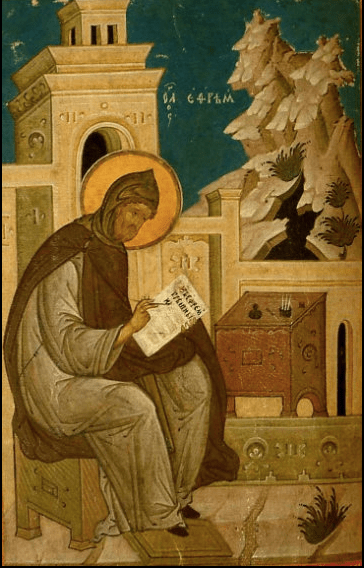
St. Ephrem the Syrian…..16th century Russian Ms.

St. Ephem the Syrian, an important teacher of the eastern Christian churches, was made a doctor of the Catholic Church in 1920 by Pope …Scholars today are growing in appreciation of his poetic understanding of the sacraments and his understanding of the church. A gem from St. Ephrem the Syrian, whose feast is June 9th.

Do we have enough wisdom to make our way in life? St.  Ephrem says we have more than enough. Christ, the Wisdom and Power of God, has come.

The trouble is that often we want more wisdom than we need or can take in. We want to know it all.  Drawing on God’s wisdom, St. Ephrem says, is like drinking from a great spring of water. You can only drink one mouthful at a time. The spring is never exhausted, but you can’t drink it all. That’s not the way we’re built.

But we want to know it all, and so we become dissatisfied with the wisdom we have at the moment, or we think there is nothing more to draw on.

This is not just a problem for us as individuals; we see it in our world today with all of its needs and challenges. One temptation is to throw in the towel and say we can do nothing; another is to think we can solve our problems with one sweeping action.

Keep drinking from the spring,
“What you could not take at one time because of your weakness, you will be able to take in at another if only you persevere. So do not foolishly try to drain in one draught what cannot be consumed all at once, and do not cease out of faintheartedness from what you will be able to absorb as time goes on.”