Posture of Prayer

by Howard Hain
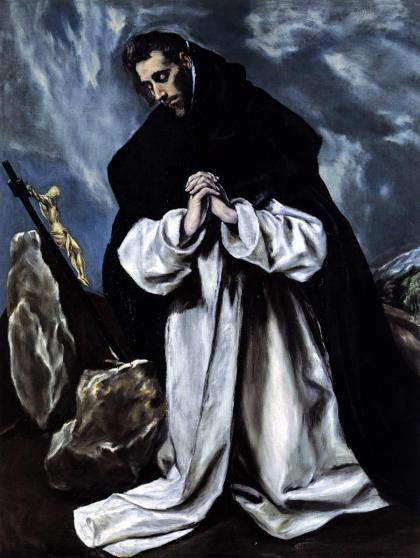
el_greco_st_dominic_in_prayer-1595

El Greco, “St. Dominic Praying”, c. 1588

Sometimes just showing up is all we can do.

To put ourselves in position to pray and worship—at least physically, even if we just cannot seem to get there spiritually—is an act of prayer and worship in itself. And quite often, it is the best we have to offer.

By confessing our aridity through physical obedience alone, we approach God’s altar with humility, for we come to God in our “nothingness”.

The bowing of head, the placement of knees, and the closing of eyes return us to the dark warmth of the womb. It is no coincidence that the posture of prayer and the fetal position bear great semblance.

It is in the womb that we are closest to God, furthest from the corruption of the world, and possess the least of what our “flesh” considers of value—our “brilliant” ideas, our “magnificent” plans, our “heroic” acts—our self-aggrandizement.

It is in the womb that we find ourselves in complete dependence. We receive all we need without knowing, without speaking, without cost.

In that sense, being in the womb is much the same as being in the world—for in the world we are still completely dependent—it is just that without the obvious reminder of the umbilical cord, we so easily forget our total and complete dependence on God, our Creator, our Sustainer, and our Ultimate End.

Hence we find ourselves “knowing,” “telling,” and “paying a price.” When in reality, the only thing that we can somewhat even come close to taking credit for is being physically present to receive His Word, His Wisdom, and His Will. All of which come free of charge, His Son having already paid the price.

———

“Lord, let me place my knees to the earth. Let me feel the foot of the cross against the caps of my knees. Let me close my eyes and bow my head. Let my brow lay upon your bloodied feet. Let me humbly raise my eyes to gaze upon your battered body. Oh my Lord and my God, let your blood and water rain down upon me.”

Amen.


Howard Hain is a contemplative layman, husband, and father. He blogs at http://www.howardhain.com

Follow Howard on Twitter @HowardDHain

twitter.com/HowardDHain

If you enjoyed this post, please consider “liking” it, adding a comment, becoming an email subscriber, or passing it along via the social-media links below. Your support is greatly appreciated. Step by step. All for God’s glory.

High Places

by Orlando Hernandez

The readings for this Wednesday’s Mass are so precious. They illustrate our faith, our Church, and our ministries in such wonderful ways. Most of all, of course, they display the love and compassion that the All-Mighty God feels for us, and acts upon.
Today I will focus on the first reading from Isaiah. The prophet fills our hearts with hope:

“ On this mountain the Lord of hosts will provide for all peoples a feast of rich food and choice wines, juicy, rich food and pure, choice wines.”
(Is 25:6)

This “mountain” can mean so many things for us Christian Catholics. It certainly makes me think of the heights to which the Liturgy of the Mass can take us. I pray every day that more and more Catholics may give the Eucharist a second chance. The Lord of Hosts lovingly waits there for all of us, no matter how long we have been away from Him. On that blessed day when my life changed after so many sinful years, even after confession, I looked fearfully upon that risen Host. He beckoned me with such love! He is the one who gives us the chance! He provides a solemn but joyful feast. He feeds us individually with His very self, “rich food,” indeed.
For me the mountain can also be the place where we celebrate God’s love for us with family and friends, on Easter Sunday and Christmas Day
(which is right around the corner, bless God!), a festive, joyous time, with lots of food, laughter, and love. This is certainly true for many of us in our beautiful country, thank You Lord. But in so many places here and throughout the world, where loneliness, hopelessness, and hunger reigns, it is another story. Yet even in those places the compassion of God reaches many through the charitable work of so many good people who even risk their lives to feed and shelter the homeless, the displaced, the lost and lonely.

What about those for whom any kind of help is impossible? Where is their mountain? Isaiah goes on to say:

“On this mountain He will destroy the veil that veils all peoples, the web that is woven over all nations. He will destroy death forever. The Lord will wipe away the tears from all faces.” (Is 25: 7-8a)

This mountain is, in the end, found in a realm beyond our physical world. Do you believe? Do you believe in such a place? I do, and I know that I am not alone. So many of us have felt, so many times, such powerful waves of Divine Love, that no-one can convince us otherwise. There is hope, hope in a life of Eternal Bliss in the arms of our God: no more hunger, no more tears, no more bondage, no more death. He promised us.
Do we deserve this? I ask myself this question every day. And then I think of another mountain, a sad place, and yet the place of God’s Glory. On the crag of Golgotha Love itself was tortured and murdered by our human race. But this Love has resurrected and reigns from the Throne of Heaven. This Love is forever, and it is all-powerful in Its mercy and forgiveness. I trust in His Love, and, in repentance and humility, I worship Him, Jesus, my Lord and Savior, my Hero, my Friend, my Guide, my Spouse, the Word of God, Who “has spoken”.
The passage from Isaiah ends like this:

“The reproach of His people He will remove from the whole earth; for the Lord has spoken. On that day it will be said : ‘Behold our God, to whom we looked to save us! This is the Lord for whom we looked; let us rejoice and be glad that He has saved us!’ For the hand of the Lord will rest on this mountain.” (Is 25: 8b-9)

In action and prayer, may I strive, hand after hand, step by step, only with His help, to climb this Holy Mountain, so that His loving hand may also rest upon my heart.

Orlando Hernández

I’m Pro-Art

by Howard Hain
DT1554

Paul Cézanne, “Bathers”, 1874-75, (The Met)

I’m Pro Art

In other words:

I’m Pro Truth

In other words:

I’m Pro Beauty

In other words:

I’m Pro Love

In other words:

I’m Pro Creation

In other words:

I’m Pro Life

(Oops, how’d that happen…funny how logic can lead you to such “un-expecting” places.)

(Words do seem to matter—or at least carry some weight—maybe even 7 pounds 8 ounces worth.)

(Before you panic, give it a little, teeny-weeny, infant-sized bit of thought…)

Conclusion:

ProArt (pro-creates) ProLife

ProLife (pre-conceives) ProArt

ProArt (equ=als) ProLife


Howard Hain is a contemplative layman, husband, and father. He blogs at http://www.howardhain.com

Follow Howard on Twitter @HowardDHain

twitter.com/HowardDHain

If you enjoyed this post, please consider “liking” it, adding a comment, becoming an email subscriber, or passing it along via the social-media links below. Your support is greatly appreciated. Step by step. All for God’s glory.

Web Link: The Metropolitan Museum of Art. Paul Cézanne, “Bathers”, 1874–75

Monday: 1st Week of Advent

Readings:

Isaiah 2,1-5  All nations will come to this mountain

Matthew 8:5-11:  The Roman centurion at Capernaum.

In 8th century Jerusalem Isaiah makes glowing promises about the holy mountain, Jerusalem– all people will come there. At the same time,  Assyrian armies rumble into Palestine. “What are you talking about?” people say, “Can’t you see what’s at the door?”. But the prophet insists they will beat their swords into plowshares, their spears into pruning hooks and there will be no wars any more.

The prophet continues making outrageous promises. There will be a cloud by day and a fire by night over this holy mountain. The mountain’s moving, on an exodus of its own. Wonderful imagery for solid institutions, like churches and nations, that have been around for centuries. You’re still on the move, and God will guide you.

The Assyrians must have had the equivalent of the Roman centurions as the backbone of their armies. If you can get to them, you’ve got the army, military analysts would say. Powerful men, loyal soldiers. They could  tell their troops: “Lay down your swords and spears,” and it would be done.

The Roman centurion in today’s gospel comes humbly before Jesus. “Lord, I am not worthy that you come under my roof, but say the word and my servant will be healed.” He comes with a faith not found in Israel.

The Messiah will touch the proud and the strong. The centurion is one of them.


Mary Gardens

Andrea Oliva Florenda, a professor at St. John’s University in Queens, New York, offered a day of reflection on Mary Gardens, December 1 at Bishop Molloy Retreat Center, Jamaica, New York. Professor Florenda teaches in the department of theology and religious studies at St. John’s, specializing in Marian theology. She’s also the designer and curator of the Marian Garden at the university.

Mary Gardens, dedicated to Mary, the Mother of Jesus, appeared in Europe following the Black Death, a pandemic that caused millions of deaths in that part of the world in the 14th century. The gardens, usually found in monasteries and religious shrines, brought hope to people walking “in the shadow of death.”

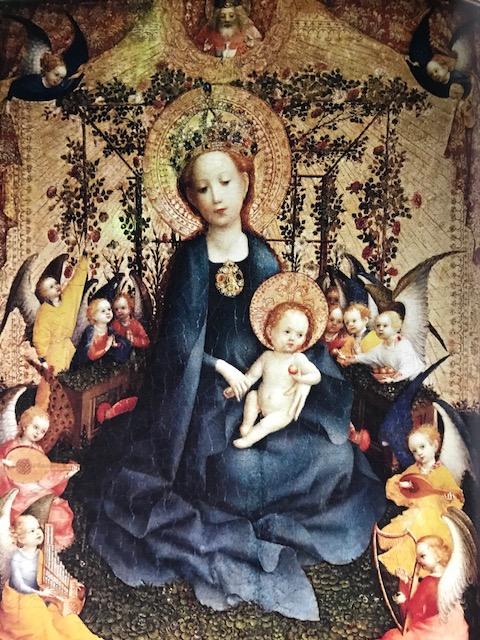
God placed Adam and Eve in a garden, Christian tradition says. (Genesis 2, 8-28) Rising from the dead, Jesus proclaimed eternal life in a garden. (John 20,11-18) For early and medieval Christians, Mary appeared as a garden enclosed, flowers, plants and trees surrounded her, “our life, our sweetness and our hope.” The Mary Garden, which became a favorite inspiration for medieval and renaissance artists, brought the promise of life to the “poor banished children of Eve.”

Does the Mary Garden have a role today in a world facing climate change and environmental degradation? Professor Florenda thinks it does. Besides the mysteries of faith, it teaches reverence for creation, for the soil, for plants that feed us and bring healing, for flowers that nourish our sense of beauty.

Certainly science and technology have a large part to play in the current environmental movement, but Professor Florenda notes the number of young people, from various religious tradition drawn to her Mary Garden at St. John’s, where the mysteries of seed and soil unfold, where pharmacy students study medicinal herbs and seasonal vegetables feed the poor.

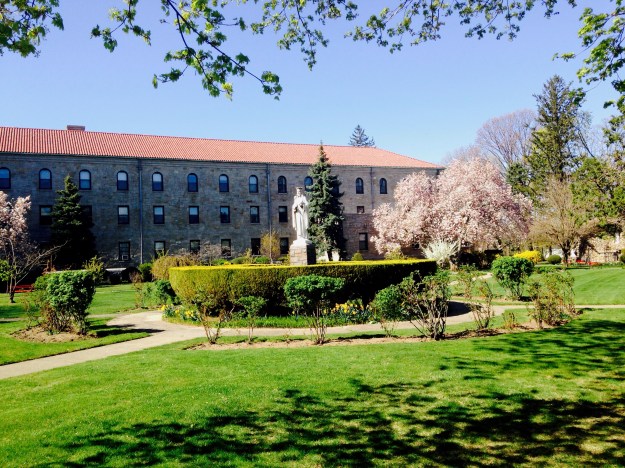
The day of reflection on Mary Gardens ended at the grotto honoring Mary in the garden of Immaculate Conception Monastery in Jamaica. There, Professor Florenda spoke about the meaning of the grotto, its structure and the plants and trees surrounding it.

“There is a language in each flower,
that opens to the eye,
A voiceless but a magic power.
A prayer in earth’s blossoms lie.” Anonymous

1st Sunday of Advent: Wake Up!

For this week’s homily, please play the video file below:

Walking Into Heaven

by Howard Hain
Rembrandt_-_The_Philosopher_in_Meditation

Rembrandt, “Philosopher in Meditation”, 1632, (Musée du Louvre)


Dream big.

Think small.

Step by step.

Real growth is incremental.

Reaching toward a glory beyond our reckoning.


Sure and Steady

by Howard Hain
jusepe-josc3a9-de-ribera-tightrope-walkers-1634

Jusepe (Jose) de Ribera, “Tightrope Walkers”, 1634


The brighter the light the more we squint.

The closer we get the less we see.

And if we stare we go blind.

Now what?

You have to trust.

In what?

Not in yourselves.

In total darkness the answer is clear.

All other ways disappear.

Close your eyes.

Shutter your ears.

Forget the past.

Ignore what is below.

Chin slightly elevated.

Now walk.

No need to go too slow.

Sure and steady.

Heart on the goal.

And if we slip?

Don’t worry.

I made the rope.

I hold it tight.

My Son is “the way and the truth and the life”.

In Him you never fall.

In Him you know.

In Him you live.

He walks before you.

You may not see Him but He is there.

Follow close behind.

It is a tight walk.

That’s why I gave Him a pole.

I gave you one too.

And because it can get very dark.

I made them easy to identify.

They are made of thick dead wood.

Your hands know their splinters and knots.

Hold tight.

Say thank You.

Kiss in the dark what you cannot see.

For that old piece of wood.

Will get you across the gorge.

Where on the other side.

It will be planted.

Grafted into the Tree of Life.


Howard Hain is a contemplative layman, husband, and father. He blogs at http://www.howardhain.com

Follow Howard on Twitter @HowardDHain

twitter.com/HowardDHain

If you enjoyed this post, please consider “liking” it, adding a comment, becoming an email subscriber, or passing it along via the social-media links below. Your support is greatly appreciated. Step by step. All for God’s glory.