4th Sunday of Advent: Mary, Woman of Faith

King David wonders, in our first reading today of the 4th Sunday of Advent, what he can do for God after all God has done for him. David had built himself a palace of cedar wood in Jerusalem, while the ark of the covenant, the sign of God’s presence, is in a tent. Should I build God a temple, a place of beauty where God would dwell and be honored,” the king asks?
The prophet Nathan tells the king: instead a building, God wants to dwell with you and your people.

In today’s gospel, God goes further. God will dwell in Mary’s womb, to take flesh from her and be cared by her. 
Our gospel begins:
The angel Gabriel was sent from God
to a town of Galilee called Nazareth,
to a virgin betrothed to a man named Joseph,
of the house of David,
and the virgin’s name was Mary.
And coming to her, he said,
Hail, full of grace! The Lord is with you.

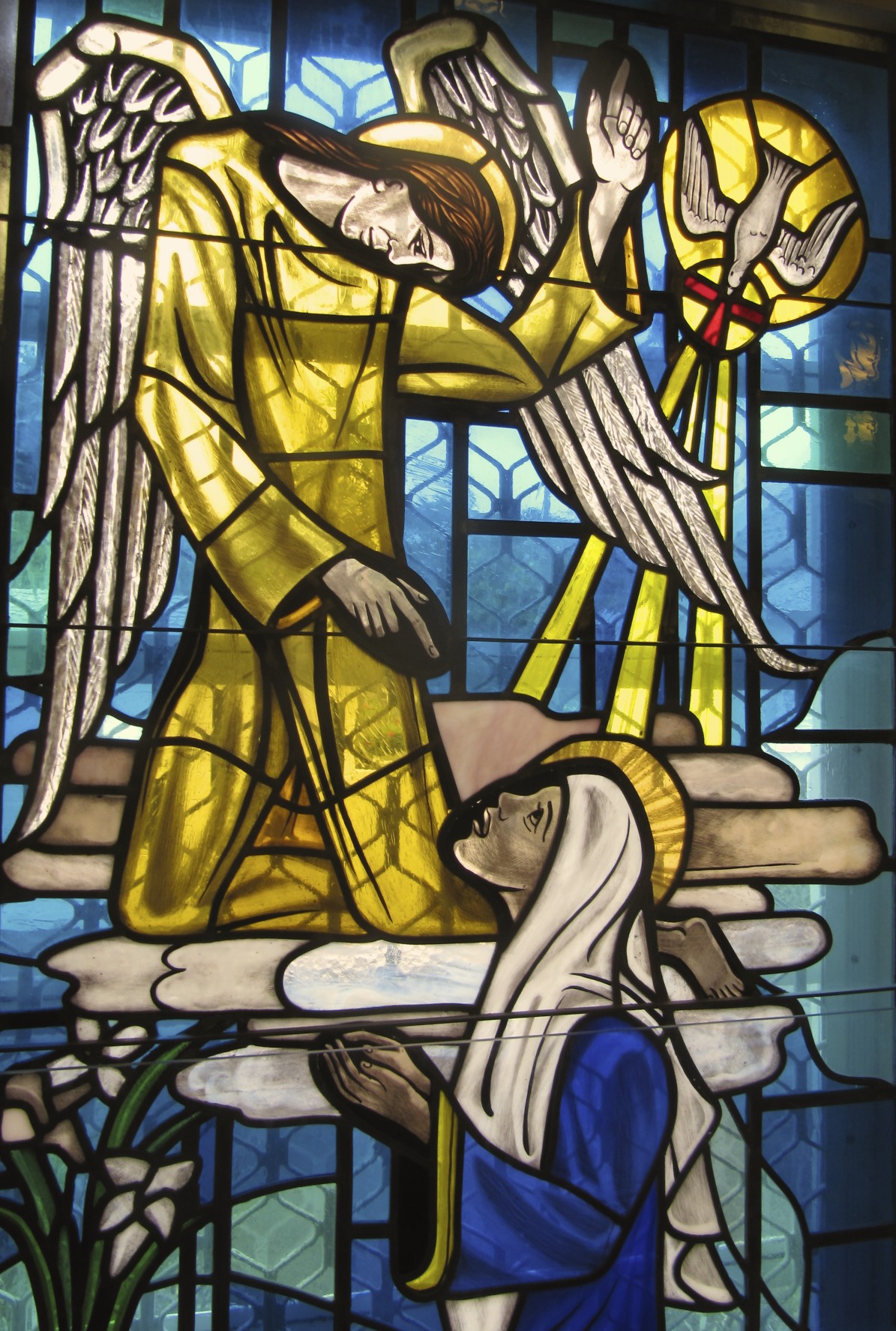
This gospel says so much about Mary. God showered graces upon her: “Hail, full of grace! The Lord is with you.” Just a young girl of 15 or 16, Mary answers: “Be it done to me according to your word. She accepts God’ s call, but she has her questions: “How can this be?”
The power of God will overshadow you, the angel tells her. The only sign she’s given is that her cousin, Elizabeth, “has also conceived a son in her old age, and this is the sixth month for her who was called barren; for nothing will be impossible for God.”
“Nothing will be impossible for God.”

Then, the angel leaves, and never returns, as far as we know. Mary meets the days as they come with faith, gathering her experiences and treasuring them in her heart.
At Christmas, we’ll see Mary in Bethlehem, humbly, silently holding the Infant, her Child, God with us. At Easter, we’ll see her standing beneath the cross of Jesus.
She’s his mother, a woman of faith. We learn from her and ask her to pray for us: “Pray for us, O holy Mother of God, that we may be made worth of the promises of Christ. 

Communion with Saints

by Howard Hain


A man named Paul lives in my home.

He’s an excellent house guest.

He never imposes.

He’s never and always alone.

My daughter and I talk of him often.

He brings wisdom to our kitchen table.

I’m not exactly sure when he moved in.

But it wasn’t so long ago.

Before and with him there are others.

Theresa, Francis, Bruno, John…just to name a few.

But Paul for some reason never seems to leave.

The others, they kind of come and go.

Paul on the other hand always hangs around.

But then again, I could say the same about the rest.

Is it cliché to say it’s a mystery?


Wednesday, 3rd week of Advent


Sacred Heart Church


The angel came to Mary in Nazareth, the last place we might expect an angel’s message. In this little known place, Jesus became flesh. In this young unknown woman, he came to dwell among us.

It wasn’t in Jerusalem, in the temple where God’s Presence was proclaimed. It was in Nazareth, in the quiet hills of Galilee, on a routine day, that He came.

We celebrate the mystery of the Incarnation and pray, “Pray for us, O holy mother of God, that we may be made worthy of the promises of Christ.”

Little Drummer Boys and Girls

by Howard Hain

Yesterday I witnessed a “dress” rehearsal for a live nativity. The cast was made up of first and second graders, and the audience was mostly composed of residents of a retirement home for religious sisters, Franciscans. It was spectacular.

Last week I was at Radio City Music Hall to watch the Rockettes in their “Christmas Spectacular”. It was quite a production.

Sitting in the dark this morning I cannot help but contrast the two.

I also cannot help but relate to the seven-year old who played the part of The Little Drummer Boy.

As that child walked so slowly toward the foot of the altar, where the rehearsal was being staged, I saw my vocation in an entirely different light.

The children were all singing their hearts out, and many of the eighty and ninety year-old sisters were mouthing the words. The boy with the drum didn’t utter a sound. He just kept walking, slowly, extremely slowly toward the altar, every once in a while ever so slightly pretending to tap two tiny sticks upon a toy drum. He was beautifully awkward.

There was no greater spectacle on earth at that very moment. Shall I dare to say, no greater event that heaven or earth has ever known?

For a child was born. We were all being born.

———

Come they told me, pa rum pum pum pum
A new born King to see, pa rum pum pum pum
Our finest gifts we bring, pa rum pum pum pum
To lay before the King, pa rum pum pum pum,
rum pum pum pum, rum pum pum pum,

So to honor Him, pa rum pum pum pum,
When we come.

Little Baby, pa rum pum pum pum
I am a poor boy too, pa rum pum pum pum
I have no gift to bring, pa rum pum pum pum
That’s fit to give the King, pa rum pum pum pum,
rum pum pum pum, rum pum pum pum,

Shall I play for you, pa rum pum pum pum,
On my drum?

Mary nodded, pa rum pum pum pum
The ox and lamb kept time, pa rum pum pum pum
I played my drum for Him, pa rum pum pum pum
I played my best for Him, pa rum pum pum pum,
rum pum pum pum, rum pum pum pum,

Then He smiled at me, pa rum pum pum pum
Me and my drum.*


Little Drummer Boy was composed by Katherine K. Davis, Henry Onorati and Harry Simeone in 1958.


Howard Hain is a contemplative layman, husband, and father. He blogs at http://www.howardhain.com

 

A Man Named John

by Howard Hain

A Man Named John

There is a man named John. He was born and raised to be good. He believes that if he is a good person when he dies he will enter heaven. So while here on earth he prepares for death. The result is John lives a simple life. His home is simple. His occupation is not one many would find out of the ordinary. Yet John spends much of his time quietly bettering himself. In short, John is a good man.

It has been a long process. And John knows that his time is coming to an end. He also knows well that the end of his life is not in his own hands. He tells himself again and again “all one can do is prepare.” And prepare is what John has done since birth: He spent his youth lassoing his passions, his middle years harnessing his ego and pride, and his later years in private reflection upon the afterlife—an afterlife in which he hopes and prays he will be permitted to share. But it is his recent days that have been the most difficult. He battles to stop himself from thinking that he has been good and is one of the few who deserves to enter paradise. So each morning, before he rises and meets the day, John prays in bed. He prays in these final days, the days that matter most, for humility. He asks God for nothing but to remain within His glorious will.

Morning after morning John continues to pray. With each day he senses that his preparation is coming closer to an end. He feels his body slipping away and his spirit being freed. He senses he is on the verge of being born into salvation.

One morning as John is praying in bed the door is thrust open. A man and a woman walk into the room. The woman immediately applies a large metal clamp to John’s head. She holds John in place while the man begins to rip John’s body apart. Piece by piece, limb by limb, the man cuts away. The man and woman chat about their weekends as if John were never alive. Piece by piece John is pulled apart. Oblivious to John’s screams, indifferent to his fear, ignorant of his pain, in denial of his life, the man continues to tear away, as if John never breathed nor was ever born—as if dismantling an unwanted couch that won’t fit through the door.

Now what if I told you that John was never born, never lived, never prepared for the afterlife, never ripped into pieces and pulled from his bed. What if I told you that instead of being born John was conceived, instead of living he developed, instead of preparing for the afterlife he prepared for this life? What if I told you that instead of being ripped into pieces and pulled from his bed he was ripped into pieces and torn from the womb?


Howard Hain is a contemplative layman, husband, and father. He blogs at http://www.howardhain.com
3rd Sunday of Advent: Be who you are! Witness to the Light.

For this week’s homily please play the video file below:

Come to Me

by Orlando Hernandez

“Come to me, all you who labor and are burdened, and I will give you rest. Take my yoke upon you and learn from me, for I am meek and humble of heart; and you will find rest for yourself. For my yoke is easy and my burden light.”

This Gospel leads me straight into the very heart of Jesus. It leads me to prayer. It leads me to seek Him deep within me. I hear Him call me. He is calling me softly, saying “Come to me, come to me. I am right here within your very soul. Be with me. I am reaching out to you. You are the lost sheep that I was seeking. I can feel your pain, your guilt, sorrow and fear in each one of my wounds. Come lay your burdens on my Cross.”
Then I realize that I am not alone, because He says, “come to me all of you”. I am one of many, so many tired, wounded followers and apostles throughout the centuries. I think of my Parish community. I remember all the people in the prayer groups that I belong to. All the many pleas that are made to Him. And I know that He is big enough to take into His heart every one of us, because He is our Lord and God.
There, in that Holy place we come into His rest. He embraces us. He soothes us. He heals us, as we stay with Him in the peace that intimate prayer can bring. But then He offers us a new burden. He offers us His yoke. A yoke is an implement that is placed over the shoulders of two bulls so that they can pull a burden, like a plow or a wagon, together, as a team. When I tie myself to that yoke I see Him next to me pulling with me, inviting me to be like Him, to learn from Him. What is He teaching me?
He teaches me that He is the meek and humble one. Do I want to be like Him? He is unresisting one, the non-violent one, allowing Himself to be crucified so that I may place all my burdens, all my sins, my fears, my doubts upon His Cross. He unburdens my heart. I feel the relief that comes from His touch. I rest.
Then, again I feel the yoke He places upon me, the burden of love. It can be so easy to fall in love, so unexpected. You can feel as light as a feather in the presence of your beloved, your husband, your wife, your child, your mother, your father, your dear friends, those you come to help and you fall in love with. Sometimes it can feel like such a heavy burden. Sometimes we fail at it. Sometimes we lose the ones we love. And yet the greatest gift that was given to us along with life was this opportunity to love. And so, when we don’t resist, when we let ourselves be swept by this love we feel ready to do anything for the beloved, to be Simon of Cyrene for them, to help them carry their cross, or even carry it for them.
Our hearts feel lighter, life feels easier when we are practicing good. Our God, who is the Eternal Good enables us to do this in our best moments. Please, don’t let me go.  Come Jesus, rest in me so that I may rest in you, as I strive to give my life to You and to Your people.

Orlando Hernandez

An Honest Environment

by Howard Hain
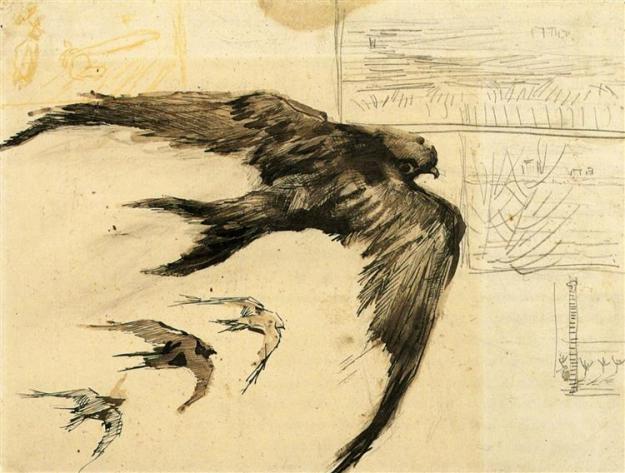
four-swifts-with-landscape-sketches-1887(1).jpg!Large

Vincent van Gogh, “Four Swifts With Landscape Sketches”, 1887


If a child is wasteful, what should the parents do?

Give them more?

More toys?

More snacks?

More disposable goodies?

Should they inflate the number and insignificance of what the child already has?

If the child’s room or backyard is full of waste, scattered remnants of “grown-bored-with” toys and doodads, what’s the answer?

Should the parents implement specific and tedious rules detailing what the child should do and not do in order to preserve the cleanliness and neatness of the home and outdoor space?

Should the parents provide the child with even greater means to continue to live so wastefully, with such little appreciation?

Or maybe, just maybe, the answer begins with the child possessing less, less toys, less privilege—especially when the family budget doesn’t allow for them in the first place—wouldn’t that be more beneficial to all involved?

Maybe if the child had only a few but well-loved toys, the child would be less wasteful, less likely to discard them and negatively affect the family environment?

Isn’t it the same with the overall environment? With the care of the earth and its resources?

If we are really serious about the environment, is the answer really man-made laws from “up high” limiting the freedom of individuals and localities? Or would it be better to begin with embracing a liberating reality that would help foster a more natural and organic conservancy?

Put it this way, if the government actually had to balance the budget, I mean really balance it on an annual basis—spending only what it brings in—and they didn’t continue to print more money (especially when the new “currency” is not based on any real asset, but instead out of “thin-air”) don’t you think that spending on the national level would change?

It would have to, period.

And don’t you think that the debate over what we do spend on would tighten up, become quite serious, efficient, and effective? And don’t you think that on the local level it would be the most freeing? For it would create an environment where individuals wouldn’t be handed false paper to purchase false products (designed to be disposable), and then maybe we’d have a commercial reality that is truly sustainable—where we have perhaps fewer items but items we cherish, are grateful to possess, and protect and care for—goods we wouldn’t just throw away.

Would that perhaps change the pollution problem?

Would it perhaps address our reckless use of natural resources?

In short, no “environmentalist” is serious about the environment (and values individual rights and freedom of local choice) if they do not deal with the biggest polluter of all: runaway debt, rising inflation (with concurrent deflation of valued consumer-driven product), and false and perpetually self-emptying currency.

Because without the false means of consumerism, consumerism would have to return whence it came: nonreality.

For imbalanced budgets, large deficit spending, and reckless printing of currency are the most non-organic, the least natural, and most non-locally-supporting factors concerning the health of our rivers, soil, trees, and, quite frankly, ourselves.

So let’s be real. Real as dirt. Let go of the hidden influences, agendas, and political prejudices, and be serious about what is truly causing waste and environmental destruction.

The truthful alternative is certainly refreshing: an unwavering allegiance to God’s most natural law of truth, beauty, and divine efficiency. For while God is certainly exuberant in His abundance and provision, He is never wasteful. He never lies. He never “cooks the books”.

The Creator of the Universe is honesty to the utmost degree. Pure harmony. Pure integrity. Pure accountability. Not a trace of fallacy or fiction.

If you doubt me, well then just ask the local bird. Ask him if he can borrow against bad credit, if he can feed his babes with worms that are printed merely on paper, and if he ever worries about his offspring buying and buying and throwing out and throwing out—or is it precisely his non-inflated natural resources that actually keep his local environment in harmonious check?

It is as long as some bureaucratic bird, puffed up with unrealistic good intentions (and other people’s money) doesn’t come along promising freebies and handing out nests that he and his other fine-feathered friends pay for with bad credit or currency based on a non-existent reality.

In their bird-brained world, thank goodness, that doesn’t happen. No, birds build their nests in reality. And continue to fly high because of it.

We on the other hand have many among us who try to sell us such false narratives and papier-mâché mansions. They also ironically tend to be the ones who “support” the “environment” the most.

For to discuss global warming, sustainability, and carbon credits without discussing the need for balanced budgets and disciplined currency policy is to be either a fool or a liar—both cases are unsustainable.


Howard Hain is a contemplative layman, husband, and father. He blogs at http://www.howardhain.com

Advent Readings: Week 2

Advent_heading copy 2To reach God’s holy mountain there’s a journey to make, Isaiah says, but guides will show the way. “Behold, I send my messenger ahead of you, to prepare your way.” Mark 1, 1. John the Baptist appears in the desert promising forgiveness  to those washing in the waters of the Jordan River. We have been baptized in the waters of baptism.

The Old Testament readings this Advent week, mostly from Isaiah, describe a desert journey,  but the desert will bloom and a highway will be there, the prophet promises. (Monday) God will speak tender, comforting words to his people on the way. (Tuesday) Those who hope in him will renew their strength, soaring on eagle’s wings. (Wednesday) Though we are as insignificant as a worm, God holds us in his hands and says:“Fear not; I am with you.” (Thursday) God is our teacher and shows us the way  to go. (Friday) On the way, prophets like Elijah accompany us. (Saturday)

Jesus is our way, the gospel readings say. He healed and forgave the paralyzed man– symbol of a paralyzed humanity– who was lowered through the roof into the house in Capernaum. (Monday) Like a good shepherd he searches for and finds the stray sheep. (Tuesday) “Come to me all who are weary, ” he says. (Wednesday) He sends us prophets and guides like John the Baptist and Elijah.( Thursday) Though rejected like John the Baptist, Jesus still teaches. (Friday)

He will save us, even though unrecognized like John and Elijah. (Saturday)

List of Readings

Monday: Isaiah 30, 1-10 The desert will bloom and a highway will be there, a holy way.Luke 5,17-26 The paralyzed man, lowered through the roof, is healed and forgiven.

Tuesday: Isaiah 40,1-11 The desert is a way to the Lord. Comfort my people. Mattthew 18, 12-14 The shepherd searches for the stray sheep.

Wednesday: Isaiah 30,25-31 God is the strength of his people. Matthew 11,28-30   “Come to me all who are weary…”

Thursday: Isaiah 41,13-20   God says, “I will grasp you by the hand. Fear not.”Matthew 11,11-15   John the Baptist is sent like Elijah.

Friday: Isaiah 48-17-19 I teach you what’s for your good and lead you on the way to go. Matthew 11,1-19   John and Jesus rejected as teachers.

Saturday: Sirach 48,1-4; 9-11 Elijah, precursor of John. Matthew 17, 9-13   Elijah and John not recognized.