60 years

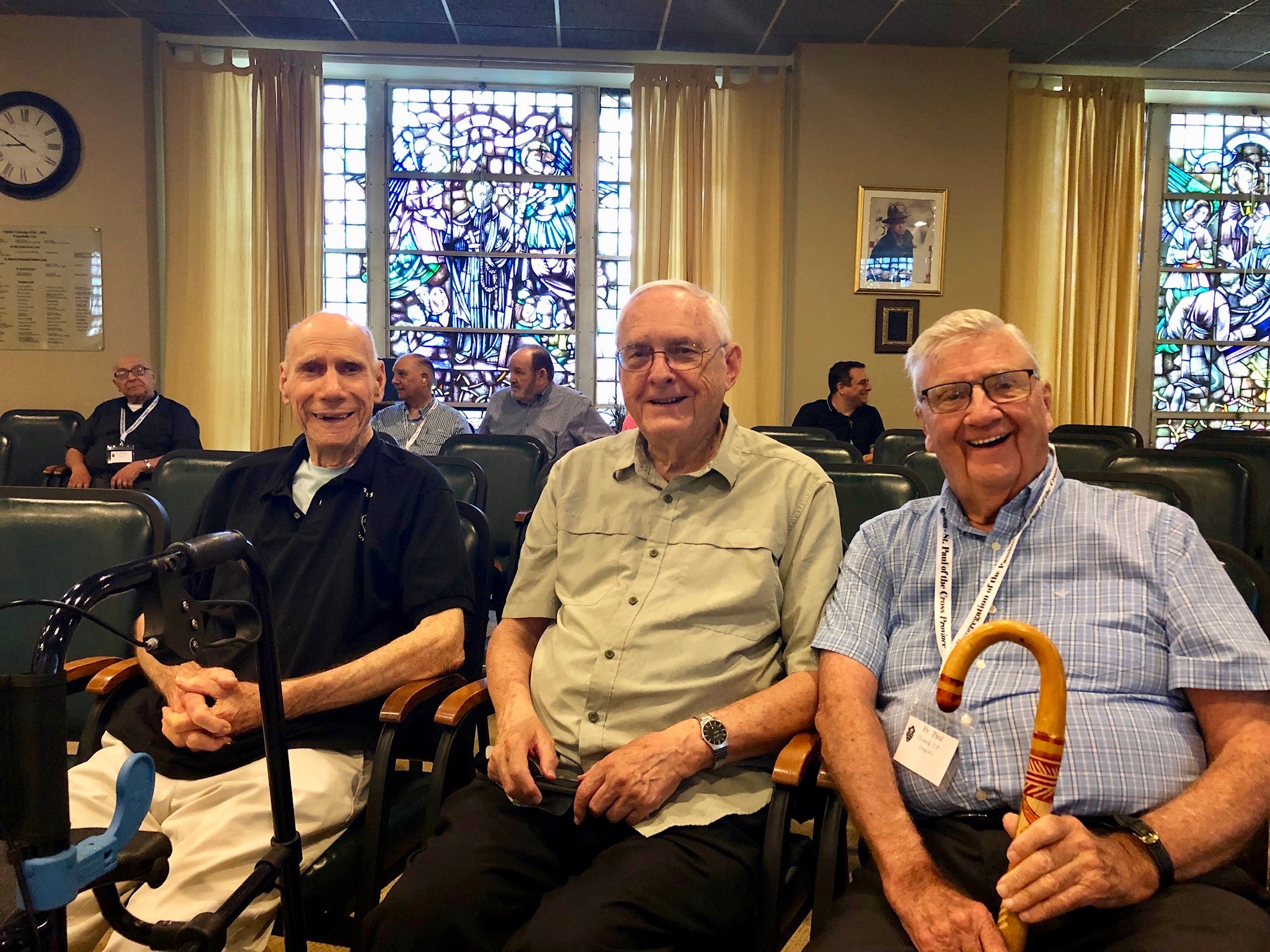
I’m celebrating 60 years of priesthood today, among my own community, the Passionists, gathered here in Jamaica, NY,  for an assembly. There are three of us left. Fr. Theodore Walsh, Fr. Paul Cusack, and myself. 

The first reading today is from Genesis 15, 1-12,17-18; Abraham complains to God he is childless, without an heir, and God takes him out into the night and shows him the stars: 

“Look up at the sky and count the stars, if you can.

Just so,” he added, “shall your descendants be.”

Abram put his faith in the LORD,

who credited it to him as an act of righteousness.” 

The responsorial psalm goes on:

“You descendants of Abraham, his servants,

sons of Jacob, his chosen ones!

He, the LORD, is our God;

throughout the earth his judgments prevail. 

R. The Lord remembers his covenant for ever.

He remembers forever his covenant

which he made binding for a thousand generations—

Which he entered into with Abraham

and by his oath to Isaac.

R. The Lord remembers his covenant for ever.

Remain in me, as I remain in you, says the Lord;

whoever remains in me will bear much fruit.”

And so may it be. Amen.

The Birth of John the Baptist

For this week’s homily, please play the video below:

READINGS FOR THE 12TH WEEK OF THE YEAR

JUNE 24 Mon THE NATIVITY OF SAINT JOHN THE BAPTIST

Solemnity

 Is 49:1-6/Acts 13:22-26/Lk 1:57-66, 80 

25 Tue Weekday (Twelfth Week in Ordinary Time)

Gn 13:2, 5-18/Mt 7:6, 12-14 (372) 

26 Wed Weekday

Gn 15:1-12, 17-18/Mt 7:15-20 

27 Thu Weekday

[Saint Cyril of Alexandria, Bishop and Doctor of the Church]

Gn 16:1-12, 15-16 or 16:6b-12, 15-16/Mt 7:21-29 

28 Fri THE MOST SACRED HEART OF JESUS

Solemnity

Ez 34:11-16/Rom 5:5b-11/Lk 15:3-7 

29 Sat SAINTS PETER AND PAUL, APOSTLES

Solemnity

Day: Acts 12:1-11/2 Tm 4:6-8, 17-18/Mt 16:13-19 

30 SUN THIRTEENTH SUNDAY IN ORDINARY TIME

1 Kgs 19:16b, 19-21/Gal 5:1, 13-18/Lk 9:51-62 (99) Pss I

This week we’re reading some stories from Genesis, chapters 12-50, about Abraham, Isaac, Jacob and Joseph who represent “a forward step in the divine plan to bring about recognition of the divine blessing promised to the world, if only humanity would obey and honor God.”   BG 66. Catholic Study Bible,   

The stories are puzzling (the sacrifice of Isaac), sometimes unjust by our standards (Sarah and Hagar). Hard for us to see “a forward step”,  but as we read them we’re to realize that “the overall purpose of Genesis 12-50 is to carry forward God’s promise “despite all obstacles.”” (BG 70)

That’s how we should look at our times too, isn’t it? Hard to see a forward step going on now too.

Whom Shall We Send?

At the recent meeting of US Bishops in Baltimore, Bishop Robert Barron offered some alarming statistics about the US Catholic Church today. For every I person who joins 6 leave, and these are often young people. As early as 13 young people give up believing in the church and what it teaches. Barron urged the  bishops to take action and they agreed we need to take action.

What will the action be and who will take it? Barron advocates a stronger presence in the social media, which makes sense. But who will bring the word, who will we send? If we look at the past, God usually sends someone young, like the prophet Jeremiah, who initially say they can’t do it.

Today, June 21, is the Feast of Saint Aloysius Gonzaga, who belonged to a powerful Italian aristocratic family. They were shocked when the young man announced, after hearing stories of Jesuit missionaries in China, that he was entering the Jesuits. His family did everything to stop him, but the young man wouldn’t listen. 

He entered the Jesuits and when, in 1591, a fierce plague broke out in Rome where he was studying, Aloysius took care of the victims, despite his own bad health. He died from the plague, convinced that God called him to this dangerous ministry. Today he’s celebrated as a patron of those who care for victims of AIDS.

Whom shall we send? Look around for the young. That’s what God does.

Morning Prayer: A Genesis Prayer

img_0325

We may think morning prayer is a few mumbled words or the Sign of the Cross quickly made, but morning prayer is meant to be an important part of our experience as we wake from darkness and sleep.

“Let there be light and there was light; and God said it was good.” (Genesis 1, 3-4) Light was the first thing God made. True Light, which enlightens everyone, came into our world, John’s gospel says. ( John 1, 9)

I sit on the porch for a few minutes in the early morning and watch the sun come through the tall trees lining our garden to the east. In winter it takes awhile. In summer, the sparrows and the doves and sometimes a pair of cardinals gather at the bird feeder to begin the day. Before I do a thing, the world gradually is bathed in light and comes awake.

Before I do a thing.

Morning prayer is a Genesis Prayer, an assurance we shouldn’t miss. Light comes to our world today, True Light, as it was from the beginning. Darkness is a sign of the world that’s chaotic. The psalms and hymns of morning prayer say light comes, and we pray our eyes be open to see.

The images in morning prayer are important. In the beginning God created a garden, a symbol of the world ordered and in harmony, beautiful and fruitful. God is the great Gardener, a king enthroned over creation, and all is God’s garden, the morning psalms say.

“Shout to the Lord all the earth, ring out your joy…Let the sea and all within it thunder praise, the world and all its peoples. Let the rivers clap their hands, and the hills ring out their joy. Rejoice at the presence of the Lord, for he comes to rule the earth.” (Psalm 98, Wednesday Morning 111)

The world, however chaotic it seems, is cared for by the One who made it.

Sometimes God is a Shepherd, a Great Shepherd bestriding the world: “Here comes with power the Lord God…Like a shepherd he feeds his flock, in his arms he gathers his lambs, carrying them in his bosom and leading the ewes with care.” (Isaiah 40, Thursday Morning 111)

Sometimes we’re asked to see the world as a city, God’s holy city. “On the holy mountain is his city, cherished by the Lord…a holy city.” (Psalm 87 Thursday Morning III) We’re asked to see our world as holy, yet still to be built.

“Sing a new song to the Lord; sing to the Lord, all the earth; sing to the Lord and bless his name.” we’re told as we begin the day. (Psalm 96. Monday Morning, 111)

“Serve the Lord with gladness, come into his presence singing for joy.”
READINGS FOR THE 11th WEEK OF THE YEAR

June 17 Mon Weekday 

2 Cor 6:1-10/Mt 5:38-42 

18 Tue Weekday

2 Cor 8:1-9/Mt 5:43-48 

19 Wed Weekday [Saint Romuald, Abbot]

2 Cor 9:6-11/Mt 6:1-6, 16-18 

20 Thu Weekday

2 Cor 11:1-11/Mt 6:7-15

21 Fri Saint Aloysius Gonzaga, Religious Memorial

2 Cor 11:18, 21-30/Mt 6:19-23 

22 Sat Weekday[Saint Paulinus of Nola, Bishop; Saints John Fisher, Bishop, and Thomas More, Martyrs;] 2 Cor 12:1-10/Mt 6:24-34 

23 SUN THE MOST HOLY BODY AND BLOOD OF CHRIST (Corpus Christi) Solemnity

Gn 14:18-20/1 Cor 11:23-26/Lk 9:11b-17 

Our gospel readings, from Matthew’s gospel, the Sermon on the Mount. (Matthew 5, 1-7,29) are meant for all of us, ordinary or extraordinary saints. They also indicate how Jesus lived his life and ministry. He lives what he teaches.

The readings from the letters to the Corinthians offer a picture of church life then and now.

The saints this week come from different times, Romuald, 11th century Italy, Paulinus of Nola, 5th century Italy, Aloysius Gonzaga, 16th century Italy, Thomas More and John Fisher, 16th century England. Holiness is found in every age and social condition.

The Church of England also honors Thomas More and John Fisher for their holiness.

Leaders Disagree

If there were a Catholic version of Jeopardy there might be some questions we could ask about the Feast of St. Barnabas today, June 11. Did he die on this day? No. Were his relics brought to some church on this day? No. We celebrate his feast today because he’s a key figure in the Post Pentecostal church. He tells us something about the leadership of that church, especially, and also about church leaders today.

Leaders can disagree. 

Barnabas and Paul were missionaries together, but a sharp disagreement occurred between them and they went their separate ways. (Acts 15, 36-41)  Will disagreement always occur among Christian leaders?

Today the US Catholic bishops meet in Baltimore to deal with the crisis of sex abuse in our church. They agree the issue has to be strongly addressed, but they seem divided about how to address it. There are strong personalities involved; men holding on to positions they’re committed to. 

We might like it to be different, but it was that way from the beginning. The Spirit leads the church, not human beings. “While they were worshiping the Lord and fasting, the Holy Spirit said, “Set apart for me Barnabas and Saul for the work to which I have called them.”Then, completing their fasting and prayer, they laid hands on them and sent them off.” (Acts 13, 1-3)

From the beginning the Spirit brought human beings to lead who are different and will disagree. 

Why? So that no one can boast?

The Spirit is our guide. Lord, send out your Spirit and renew the face of the earth.

How about political leaders? Another story, or the same?

My guess is it’s the same. Beware of the one who knows it all.

Readings for the 10 Week in Ordinary Time

JUNE 10 Mon The Blessed Virgin Mary, Mother of the Church (Tenth Week in Ordinary Time) Memorial

Gn 3:9-15, 20 or Acts 1:12-14/Jn 19:25-34 

11 Tue Saint Barnabas, Apostle, Memorial

Acts 11:21b-26; 13:1-3 (580)/Mt 5:13-16 

12 Wed Weekday

2 Cor 3:4-11/Mt 5:17-19 

13 Thu Saint Anthony of Padua, Priest and Doctor of the Church Memorial 2 Cor 3:15—4:1, 3-6/Mt 5:20-26

14 Fri Weekday

2 Cor 4:7-15/Mt 5:27-32 

15 Sat Weekday

2 Cor 5:14-21/Mt 5:33-37

16 SUN THE MOST HOLY TRINITY Solemnity

Prv 8:22-31/Rom 5:1-5/Jn 16:12-15

Mary, the Mother of the Church (Monday after Pentecost) is a new feast added to the calendar in 2018. The feast is inspired by the conviction of the participants of the Second Vatican Council that Mary is the Mother of the Church. It’s  celebrated the Monday after Pentecost as the days of ordinary time, the season of the Holy Spirit, begin. 

Mary stood by the Cross as her Son gave birth to the church. She’s a tender mother and caring guide standing with the people he redeemed, as they live the mystery of redemption day by day.


We’ll be reading from Paul’s 2nd Letter to the Corinthians for the next two weeks at Mass. A good way to go into Ordinary Time. The Corinthian church, diverse and contentious,  is a favorite for historians seeking to know the early church. It’s a good way for us to understand our own church too.