“I sing of arms and a man” , words the Latin poet Virgil used to describe Aeneas, a founder of Rome. His fate was to take up arms and after much struggle found a great city. The words could also describe our generation. For most of the last hundred years, we have taken up the arms of war to achieve our various purposes.
Tomorrow is the 75th anniversary of one of the great battles of all time–the sea born invasion of Normandy by175,000 Allied troops, which led to the liberation of Western Europe from Nazi Germany’s control. The Second World War, which began in 1939 and ended in 1945 was followed by the Korean War (1950-51}, the War in Vietnam (1965-73) and the War in Iraq (2003-present). Other wars besides these have raged world wide.
Will the day come to lay down our arms? Not soon, it seems, and the arms in our hands become still deadlier. We don’t live in a peaceful world.
War over the years, with all its consequences, affects us in many ways. I’m wondering about the way it affects our theological imagination. Has it weakened our sense of hope in life and in God? Have the long years of war brought doubt about human life flourishing here on earth? Is personal flourishing now the only way to go? So let’s survive the best we can on our own, in a house or country surrounded by walls.
We take up arms to control land and resources. Has chronic war also affected the way we see our planet? Should we abandon our fragile and unsteady earth, and make heaven our goal? Or maybe survive the best we can on our own, here and now, without a thought of it?
The Feast of the Ascension points to heaven and tells us that’s our goal. But what about the world God created? Doesn’t it yearn for something new and needs our care? The Feast of the Ascension is linked to Pentecost and the promise of the Spirit who teaches us all things.
Come, Holy Spirit, fill the hearts of the faithful and renew the face of the earth.
I was on the F train coming in from Penn Stations late yesterday morning. The cars were moderately crowded, empty seats here and there. The usual mix of quiet mid-day travelers going or coming. Where? Always hard to tell, you can only guess.
Then suddenly at 5th Avenue two classes of chattering kids got on. City kids, for sure; not wide-eyed strangers to the underground world. They grabbed the empty seats and kept chattering away, filling the car with children’s voices. Some adventure in the city had stirred their sense of wonder. Their voices were bubbling over with excitement. I judged they were 5th or 6th graders, maybe 40 of them.
I noticed one of their teachers standing near me, a young woman. One, two or three kids turned to her like a magnet for some quick exchange. She had that pleased look that comes when something’s well done. She had just led these kids to unknown worlds by subway.
The first stop in Queens the door opened and they quickly flowed out, still chattering, kids, chaperones, teachers, in well attended lines, going back to school, then home.
Thomas Berry, a Biography by Mary Evelyn Tucker John Grim and Andrew Angyal, Columbia University Press, 2019 is available.
I was one of Fr. Thomas Berry’s first students. It was at Holy Cross Preparatory Seminary in Dunkirk, NY in 1950. Tom taught history to seminarians that year and I was in his class.
I remember the first day he came into class with a stack of booklets in his hands. “We have to know what’s going on today in the world,” he said, “and so we’re going to study The Communist Manifesto.”
Now remember, this was 1950. Senator Joe McCarthy had begun a witch-hunt to root out Communist sympathizers and The Communist Manifesto was on the church’s list of forbidden books. We studied it.
Tom never mentioned Joe Mc Carthy or the threats of a Communist takeover in Europe or what was happening then in China. No, he was interested in where the Communist Manifesto came from. Beyond Karl Marx and Lenin, he traced it back to the Jewish prophets and their demands for justice for the poor and human rights. The long view of history was what interested him.
After the Communist Manifesto, we studied St. Augustine’s City of God. Two loves are building two cities, Augustine said. Again, Tom didn’t dwell much on the historical events used by Augustine to illustrate his theory of history. It was the overall dynamic of the two loves in conflict over time that interested him.
From Augustine, we studied Christopher Dawson and his book The Making of Europe. Dawson, one of the 20th century’s “meta-historians,” wasn’t interested only in Europe; he was interested in the whole panorama of civilizations that came before it. That was Tom’s interest too.
As far as I remember, Tom didn’t speak of the universe and its evolution, his focus in later years, yet you could see him heading that way. He had a mind for the long view of things.
Pope Francis in Laudato Si also has a mind for the long view of things. The pope doesn’t quote from The Communist Manifesto, but he insists, more strongly than the manifesto, on the rights of the poor, to which he joins a strong insistence on the rights of the earth.
Can we also hear echoes of Augustine’s City of God in Laudato Si? I think so. The pope speaks of two loves in conflict. There’s the love that builds the city of man. How describe it today? How about blind consumerism; we love things too much. We love our vision of material progress too much. We love our technology too much. We love our control over the earth too much. We love ourselves too much. The result is “global indifference” to an environment falling apart. (Laudato Si, 9,14)
Opposing that love is a love the pope sees in Francis of Assisi, “who was particularly concerned for God’s creation, for the poor and the outcast…he would call all creatures, no matter how small, by the name of ‘brother’ or ‘sister’… If we approach nature and the environment without this openness to awe and wonder, if we no longer speak the language of fraternity and beauty in our relationship with the world, our attitude will be that of masters, consumers, ruthless exploiters, unable to set limits on their immediate needs.” (LS, 13)
Berry, like the pope in Laudato Si, accepted science’s view of our environment, yet also like the pope he distanced himself from a major trait of the era of the Enlightenment which unfortunately causes us in the western world “to see ourselves as lords and masters of our environment, entitled to plunder her at will.” (LS, 2)
Science teaches us a lot about our environment and its perilous condition today, but knowledge is one thing and love is another. Two loves are at work. Love doesn’t always follow what we know, especially if our hearts are fixed on something else. Love is hard to change.
The evironment doesn’t seem to be a big issue in our churches, in the media or in the political world. We seem to be avoiding what the pope calls “an ecological conversion.”
It’s not going to happen overnight through some quick fix. We need to get ready for the long haul. And what does that mean? We need wise teachers and leaders to guide us, like Thomas Berry and Pope Francis.
“The present time is not a time for desperation, but for hopeful activity.” Thomas Berry, CP
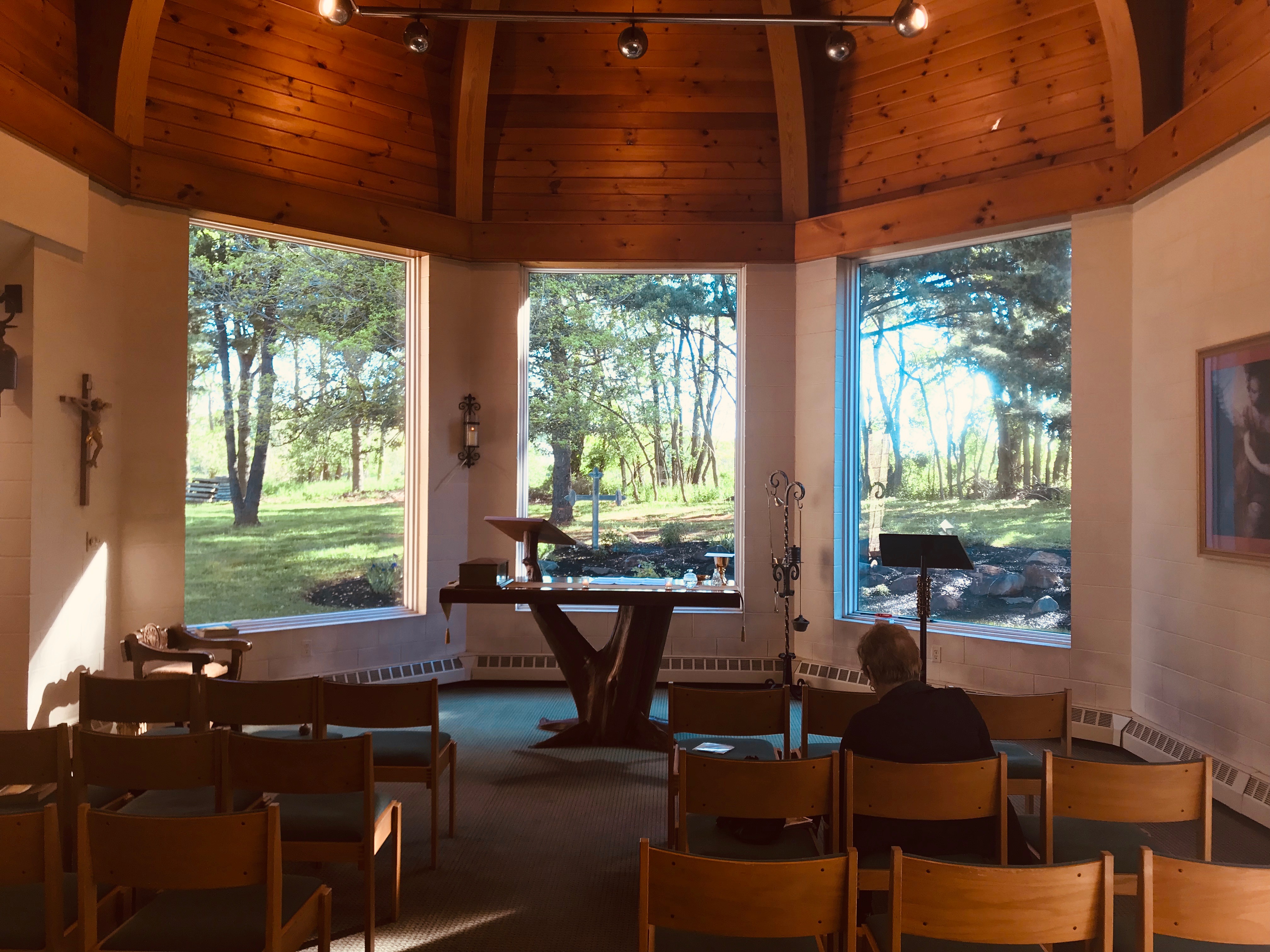
I’m celebrating Mass all this week in the chapel in the spiritual center at St.Mary’s Parish, Colts Neck, NJ. The chapel was designed by Fr. William Bausch, pastor of St. Mary’s for many years, a prolific author, superb homilist and a priest beloved by his people. He recently published a book, at 90 years old!
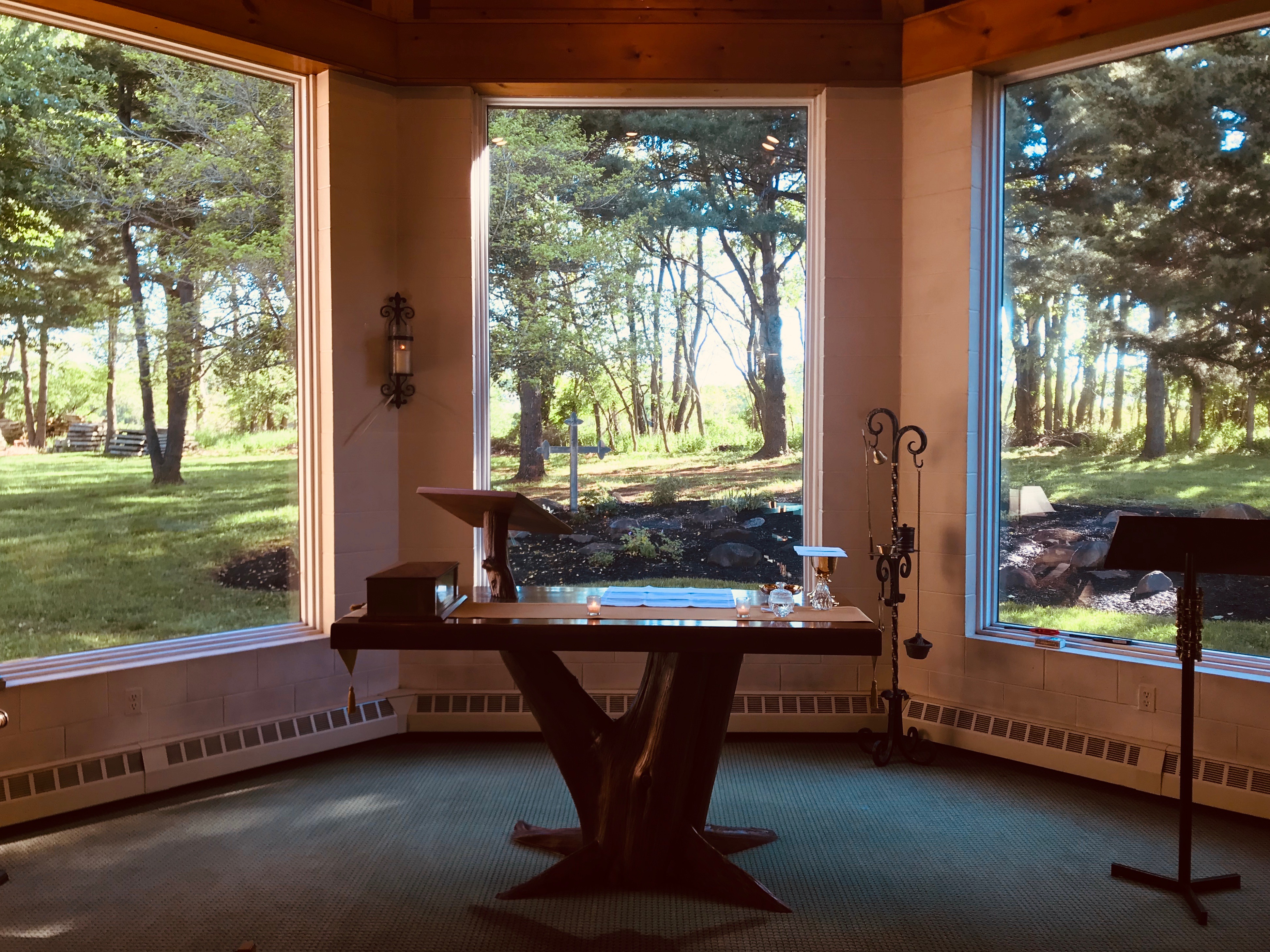
The chapel windows behind the altar face a garden and a distant row of trees. A weathered cross from the first parish church stands in the garden. The natural world, which has given us bread and wine, and the parish of the past join us as we give thanks at Mass to God the Creator, through Jesus Christ, God’s Son.
The chapel altar is carved from a tree, one of its branches providing a stand for the book of the altar. So the trees of the forest are here too.
The altar stands under an octagonal roof. Here we have the mystery of the eight day, the day that never ends, the place Jesus prepares for us, as he says in the gospel of John today.
“Master, we do not know where we are going,” Thomas says in today’s gospel. Here in signs the place is pointed out. The Cross of Jesus ends in a garden.
The daily Mass readings for Eastertime, from the Acts of the Apostles and the Gospel of John, are so different in tone. The Acts of the Apostles is a fast-moving account of a developing church spreading rapidly through the world through people like Paul of Tarsus and his companions. Blazing new trails and visiting new places, they’d be frequent flyers today, always on the go.
The supper-room discourse of Jesus from the Gospel of John, on the other hand, seem to move slowly, repeating, lingering over the words of Jesus to his disciples. Listen, be quiet, sit still, they say. Don’t go anywhere at all.
St. Paul of the Cross, the founder of the Passionists, was inspired by St. Paul, the Apostle, to preach and to teach. Many of his letters end telling readers he has to go, he’s off to preach somewhere. He was a “frequent flyer.”
But the Gospel of John also inspired him; it was the basis for his teaching on prayer. Keep in God’s presence, in pure faith, he often said. Enter that inner room and remain there. Don’t go anywhere.
“It’s not important for you to feel the Divine Presence, but very important to continue in pure faith, without comfort, loving God who satisfies our longings. Remain like a child resting on the bosom of God in faithful silence and holy love. Remain there in the higher part of your soul paying no attention to the noise of the enemy outside. Stay in that room with your Divine Spouse…Be what Saint John Chrysostom says to be: silent clay offered to the potter. Give yourself to your Maker. What a beautiful saying! What the clay gives to the potter, give to your Creator. The clay is silent; the potter does with it what he wills. If he breaks it or throws away, it is silent and content, because it knows it’s in the king’s royal gallery.” (Letter 1515)


 The Victor's Place