What Does the Risen Christ Look LIke?

Many of us  learned our faith from catechisms and sermons and pictures on the windows and walls of our churches. Xavier Leon-Dufour begins his classic work (Resurrection and the Message of Easter, New York, 1971) remembering trying to reconcile images he saw on the church windows of his youth with the gospel accounts he studied later. In art Jesus often appears as a revived corpse, his body and clothing brighter than before..

The church window above, based on Matthew’s Gospel, changes the way the gospel tells the resurrection story. Similar images appear often, especially in the Easter season.  Jesus risen from the dead appears like Lazarus raised from the tomb. But resurrection is different from resuscitation.

“After the sabbath, as the first day of the week was dawning, Mary Magdalene and the other Mary came to see the tomb. And behold, there was a great earthquake; for an angel of the Lord descended from heaven, approached, rolled back the stone, and sat upon it. His appearance was like lightning and his clothing was white as snow. The guards were shaken with fear of him and became like dead men.” Mt 28,1-5

According to Matthew, an angel descends from heaven, rolls back the stone and strikes fear in the guards at the tomb. Our stained glass window depicts Jesus Christ stepping from the tomb striking fear into the guards. The angel becomes an onlooker wearing green, the color of hope. Jesus looks rather like he did before he died and he would be recognized immediately.

The gospels, however, indicate he was changed. Mary Magdalene and the others have difficulty recognizing him– he’s changed. The disciples on the way to Emmaus recognize him after he quotes the scriptures and, finally,  breaks bread with them. The disciples at the lakeshore in Galilee are not sure who is he, until they eat with him.

The Risen Lord has entered another realm of existence. He is risen.  He remains with us mysteriously.  He does not blind us with  light, as he did Paul the Apostle. He does not appear in bodily form, as he was before his death. He  comes to us risen, risen indeed. Now, we meet him in the scriptures and the “breaking of the bread.” Also, just as mysteriously, we see him in the least. “When did we see you?”  is the question raised at judgment.

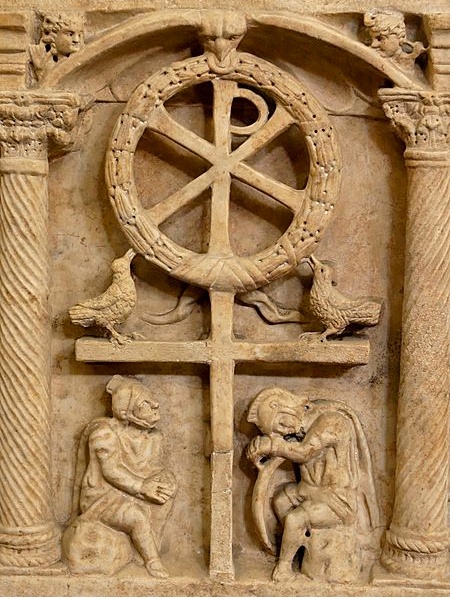
Early Christian art as seen in the 4th century portrayal from catacombs below, recognizing the mystery of the Resurrection, used symbolism to represent the Risen Christ. Jesus entered a new existence in his resurrection. It’s hard for artists and for us to depict that existence.

I mentioned Xavier Leon-Dufour earlier. Here’s what he said about the Risen Jesus:

“To speak of the resurrection of Jesus is to affirm that death has been conquered in one man at least: and to say that he lives forever is boldly to locate oneself at the end of time. It is a challenge for the unbeliever to revise his idea of life: for if one man is alive forever after his death, why not should the same be so for all men at the end of time? Why should there not be after death an existence called heaven?”  In that existence “life is changed, not ended.”
Resurrection

Weekday Readings: Third Week of Easter


Monday Acts 6,8-15; John 6,22-29
Tuesday Acts 7,58-8,1; John 6,30=35
Wednesday Acts 8,1-8; John 6,35-40
Thursday Acts 8,26-40; John 6,44-51
Friday Acts 9,1-20; John 6,52-59
Saturday Acts 9,31-42; John 6,60-69

The Mass readings this week continue from the Acts of the Apostles with the story of the Greek-speaking deacon Stephen. His fiery preaching against temple worship and “stiff-necked” Jewish opposition to Jesus results in his death and a persecution that drives Hellenist Christians out of Jerusalem. (Monday and Tuesday) But Stephen’s death, like the death of Jesus, brings new life. The church grows. “The death of Christians is the seed of Christianity.” (Tertullian )

Philip the Deacon, one of those displaced, preaches to the Samaritans north of Jerusalem. Then, led by the Spirit, he converts the Ethiopian eunuch returning home after his pilgrimage to Jerusalem. (Wednesday and Thursday} Following Philip’s activity, Paul, the persecutor, is converted by Jesus himself. (Friday)

Before Paul’s ministry begins, Peter leaves Jerusalem to bless the new Christian communities near the coast; at Joppa he’s told by God to meet the Roman centurion in Caesarea Maritima. The mission to the gentile world begins with that meeting. (Saturday)

Stephen, Philip, Peter and Paul serve God’s mysterious plan. It’s not human planning. The Holy Spirit is at work.

The gospel readings this week are from St.John’s gospel– segments of Jesus’ long discourse on the Bread of Life to the crowd at Capernaum after the miracle of the loaves. (John 6) In the Eucharist we meet the Risen Christ.  He not only feeds us personally, but a growing church is fed.

Light in Darkness

IMG_5910

The Easter readings tell us  Jesus Christ is the light of the world, who shines in our darkness. Mary comes to the tomb while it’s still dark. The dark of evening comes as the disciples hide in the Upper Room. The disciples fish all night, in the dark, and catch nothing. Then, Light comes.

Listen to Maximus of Turin’s reflections on Jesus Christ, “Light from Light.”

“Yes, we have the light of Christ, but it is a light that shines in darkness.  The light of Christ is an endless day that knows no night. Christ is this day, says the Apostle; such is the meaning of his words: Night is almost over; day is at hand. He tells us that night is almost over, not that it is about to fall… This is why John the evangelist says: The light shines in the darkness, and the darkness has never been able to overpower it.

And so, my brothers and sisters, each of us ought surely to rejoice on this holy day. Let no one, conscious of his sinfulness, withdraw from our common celebration, nor let anyone be kept away from our public prayer by the burden of his guilt. Sinner he may indeed be, but he must not despair of pardon on this day which is so highly privileged; for if a thief could receive the grace of paradise, how could a Christian be refused forgiveness?”

I like sitting on the porch this morning watching the light come in the morning. It always comes, sometimes muted, sometimes bright and clear, but it always comes.

Today, the feast of St. Athanasius, I was thinking of the Word proclaimed by the heavens and the earth.

“When I see your heavens, the work of your fingers,

…O LORD, our Lord,

how awesome is your name through all the earth!”

I l

The Easter Season: a School of Faith

Nicodemus

Nicodemus reminds us that faith doesn’t depend on how sharp our minds are or how many books we’ve read. Faith is God’s gift to us. We are all still in the school of faith.

On Friday of the Second Week of Easter we begin reading from John’s gospel about Jesus multiplying the loaves and fish near the Sea of Galilee. (John 6) There’s a lot of unbelief in the crowd that Jesus feeds, according to John. “Many of his disciples drew back and no longer went about with him,” . Besides those who radically reject Jesus’ claim to be the bread come down from heaven,  others appear to have little appreciation for this great sign. Commentators suspect this this section of John’s gospel may indicate there were troubles over the Eucharist and over the identity of Jesus in the churches John is writing for.

Most of the gospel readings for the last weeks of the Easter season are taken from the Farewell Discourse in John’s gospel. There too the disciples seem far from perfect. They’re fearful, they seem to understand Jesus so little. He calls them “little children,”  not far removed from the children making their Communion this season.

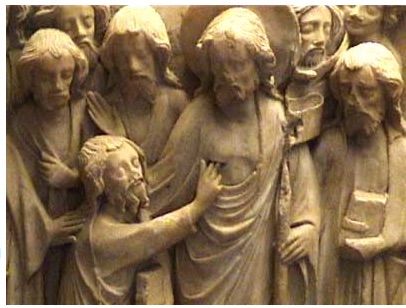
There are no perfect believers  in the gospels of our Easter season. Plenty of imperfect believers, like us, which tells us that faith is something to pray and struggle for. More importantly, they reveal the goodness of Jesus, who showed the wounds in his hands and his side to Thomas, who never dismissed Nicodemus to the night, who came to table with his disciples and fed them again, who called them “his own” and prayed that they would not fail.

We’re in a school of faith in the Easter season where the Risen Christ speaks to us in signs like water, bread and wine, words that promise a world beyond ours and teach us how to live in our world today.  He is our Teacher and Lord.

At Peace

 One of my favorite expressions is “Shalom Aleichem” : “Peace be with you,” or “Peace be on to you.” Even as I pronounce the Hebrew words, a strange tranquility comes over me. The word “Shalom” itself has so many rich meanings: peace, prosperity, welfare, tranquility, harmony, wholeness, completeness. It seems almost like an invitation to taste the wholeness and completeness of God Himself, a wishing of the good for the other person.    

 This expression has become more of a casual “Hi, how are you” in modern Israeli society. Saying “ Shalom” has become similar to saying “Aloha”: “Hi, bye.” And yet, I find such power in these words. A few years ago, after our interfaith Thanksgiving service at my parish in Bayside, NY,  I found myself talking over cookies with the wise and gentle Rabbi Weitz. I told him about my upcoming trip to Israel the following week, and he told me that he was also going there then. We were both very excited about it. As we were leaving I dared to try out my little Hebrew and told him, “Shalom Aleichem”. In the holy environment of my church the expression seemed to have so much meaning. My eyes met his shining eyes, and it felt like we shared something beyond ourselves. When he smiled and answered “Aleichem Shalom (Unto you peace),”I felt I was truly being blessed by this man of God. 

     Every year I spend the Easter Triduum in retreat at the Passionist Spiritual Center in Jamaica, NY. I usually go there without any expectations. I always know it’s going to be great. But from the beginning of Holy Week I had been asking the Lord for much-needed peace. The Morning Prayer that I recite begins by asking the Lord for peace, wisdom, and strength. I usually get stuck at “peace,” trying to measure on a 1 to 10 scale how my state of peace is.

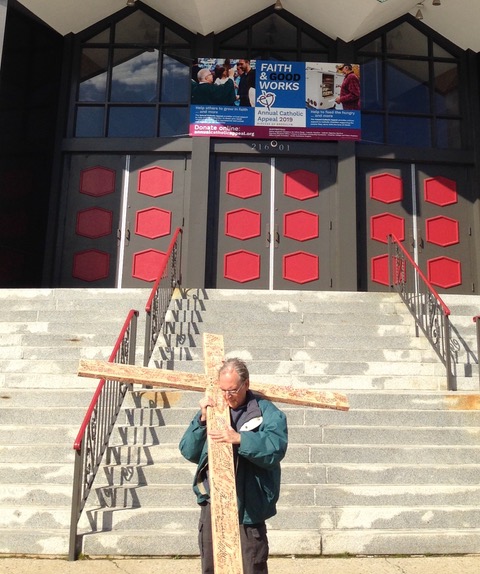
This week I was at a 4-5 level ! I was worried about all the jobs I had to do to help out during the retreat, especially with regard to this big cross that I had built. When would there be time to have the retreatants write their prayers on it? Would it be an imposition? Was there any room left on the cross to write on? Would anyone be interested in carrying it outside to pray the Stations of the Cross? Would anyone get splinters on their hands? Would it fall on somebody’s foot?   

 My lack of peace went a lot deeper than that. I was going through a senseless feeling of unworthiness. I had become a little worn out by the people I serve in my different ministries. There was a heaviness in my heart that I could not explain.     And then, as soon as I had figured out where to put the big cross, and I was able to sit before the Lord at chapel, the most blissful sense of peace descended on me. Talk about a quick answer to a prayer!

Throughout the four days I just never worried about anything. All the retreat events unfolded before me in mysterious, delightful ways. Nothing and nobody bothered me. There was no need to assess whether my prayers, or the experiences, or presentations, were devout, inspiring, or spiritual enough. Everything just was. I usually had a smile on my face. My fellow retreatants were not like strangers; they were beloved children of God, good and gracious company. The peace of God enveloped us.     

Dear readers, why am I writing about this? I guess I really want to share this peace with you. I want to sort of wish it, pray it upon you! Shalom Aleichem!     In the Gospel (John 20: 19-31) for the Octave Sunday of Easter (also adequately named Divine Mercy Sunday), our Resurrected Lord appears before His fearful disciples (that’s us!), and tells them, “Shalom Aleichem.”

This is much more than just a “Hi, what’s up.” The Living God blesses us with the power of His love. The soothing breeze of His Holy Spirit is breathed upon us. We relish in His love. As we touch His wounds our wounds are touched and relieved. We are home. Our guilt over the times we have deserted Him is calmed. He invites us to stop retaining our sins, and through His power,  to forgive ourselves for all those sins that He has already forgiven. And then He puts us back to work. He tells us, “so I send you!”

I hope that peace of His holds out within me. And even if it goes down to a 4 or 5 again, there is a bountiful storehouse of it in His heart within our hearts, just for the taking! We are His ministers, His agents in this troubled world.     Like the psalm says: “Lord send down Your Spirit and renew the face of the Earth.”     Shalom Aleichem!

By Orlando Hernandez

Signs That Lead Us On

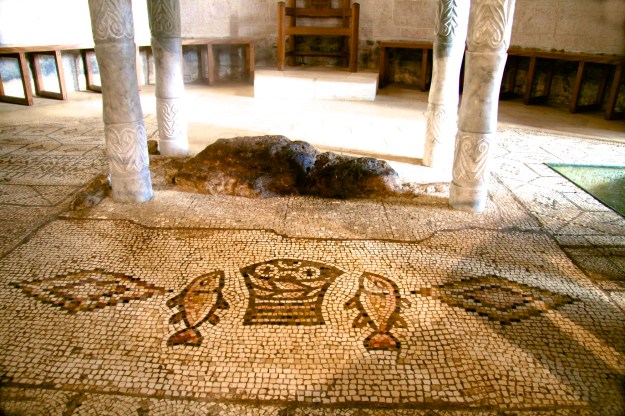
After his resurrection Jesus appeared to his disciples, but his appearances are occasional and fleeting. None of the resurrection accounts say he stayed long with them. He appears to verify he is risen. “Do not cling to me,” he says to Mary Magdalene, who hears him call her name.Thomas puts his finger in the nail marks and his hand in his wounded side; then he is gone. The disciples eat with him, but he doesn’t stay with them. The words of scripture remind them of him.The two at Emmaus know him mainly in the breaking of the bread.

Now they will see him in another way–through signs, like bread and wine, water, in gatherings where they remember him, in reading the scriptures which speak of him, in the poor and suffering, wounded like him. It’s as if he were weaning them away from seeing him bodily. That will be the way he remains with them–through signs– and that’s the way he remains with us now.

Christian teachers like Cyril of Jerusalem emphasize this way of knowing Jesus, through signs. We are told not to miss their importance:

“When we were baptized into Christ and clothed in him, we were transformed into the likeness of the Son of God…we are rightly called ‘the anointed ones.’”

God’s Spirit rested on him and sent him forth. Now God’s Spirit dwells in us and sends us on a mission. We don’t have a mission that weighs us down. The oil that anointed us at baptism is an “ oil of gladness,” raising us up.

These Easter days offer a world of signs that lead us to Jesus Christ; they also make us one with him.

What about the “signs of the times?” Don’t forget them.They lead us on too. I like what Sister Elizabeth Johnson, CSJ, says about them. “The signs of our time propel the living tradition forward.”

Jesus Abandoned

In the gospels for Monday to Thursday in Holy Week Jesus is not with the crowds in the temple area, sometimes hostile, sometimes friendly. He is with “his own” at a meal.  In Bethany six days before Passover he eats with those he loved: Martha, Mary and Lazarus, whom he raised from the dead. In Jerusalem before he dies he eats with the twelve who followed him. “His own.”

During the meal in Bethany, Mary anoints his feet with precious oil in a beautiful outpouring of her love. At the meal in Jerusalem, on Thursday, he meets betrayal. The gospel readings for Tuesday and Wednesday offer a harsh picture. Judas betrays him for thirty pieces of silver and goes out into the night; Peter will deny him three times; the others flee. Jesus faces suffering and death alone. Friends that followed him abandon him.

The gospels are not just about long ago; they’re also about now. We are “his own” to whom he gives his life on a cross, in the waters of baptism and in the Bread at the table.  Are we unlike the others?  Are we sure we will not go away?

We think saints exaggerate when they say they are great sinners and question themselves, but they know the truth. That’s the way St. Paul of the Cross described himself in his account of his forty day retreat as a young man:

“I rejoiced that our great God should wish to use so great a sinner, and on the other hand, I knew not where to cast myself, knowing myself so wretched. Enough! I know I shall tell my beloved Jesus that all creatures shall sing of his mercies.”  (Letter 2)

Be my rock of refuge

a stronghold to give me safety.

For you are my rock and my fortress,

O God, rescue me from the hand of the wicked.  Ps 71

LET’S CELEBRATE HOLY WEEK

APRIL 15  Monday of Holy Week

Is 42:1-7/Jn 12:1-11 (257) Pss II

16 Tuesday of Holy Week

Is 49:1-6/Jn 13:21-33, 36-38 (258)

17 Wednesday of Holy Week

Is 50:4-9a/Mt 26:14-25 (259)

18 Thursday of Holy Week (Holy Thursday)

Chrism Mass: Is 61:1-3a, 6a, 8b-9/Rv 1:5-8/Lk 4:16-21 (260)

Evening Mass of the Lord’s Supper: Ex 12:1-8, 11-14/1 Cor 11:23-26/Jn 13:1-15 (39) Pss Prop

19 Friday of the Passion of the Lord (Good Friday)

Is 52:13—53:12/Heb 4:14-16; 5:7-9/Jn 18:1—19:42 (40) Pss Prop

20  Holy Saturday

Vigil: Gn 1:1—2:2 or 1:1, 26-31a/Gn 22:1-18 or 22:1-2, 9a, 10-13, 15-18/

Ex 14:15—15:1/Is 54:5-14/Is 55:1-11/Bar 3:9-15, 32—4:4/Ez 36:16-17a, 18-28/ Rom 6:3-11/Lk 24:1-12 (41)

21 EASTER SUNDAY OF THE RESURRECTION OF THE LORD

Solemnity

Acts 10:34a, 37-43/Col 3:1-4 or 1 Cor 5:6b-8/Jn 20:1-9 (42) or Lk 24:1-12 (41) or, at an afternoon or evening Mass, Lk 24:13-35 (46) Pss Prop

Most of us are home, no place to go. Why not celebrate Holy Week? There are no church services, but we have the church readings each day. How about celebrating Holy Week looking at them? .

The gospel readings for Holy Week are mostly from the Gospel of John, the gospel least like Mel Gibson’s movie “The Passion of the Christ.” We may want to know exactly what happened to Jesus on the days of Holy Week, but the evangelists, who knew the basic facts, wanted to know more. What was behind it all? Why did Jesus, the Son of God, suffer and die. They turned to the Jewish scriptures, the Old Testament, because that was how Jesus explained what happened after he rose from the dead.

On Monday we’re in Bethany. where Martha, Mary and Lazarus who was raised from the dead.

Tuesday and Wednesday, his betrayal by Judas is recalled but, as our readings indicate, all his disciples abandon him. 

On Thursday, Jesus brings his disciples to the table and as a servant washes their feet. We continue reading from this part of John’s Gospel, which explores the mystery of our union with Jesus Christ, throughout the Easter season.  Our second reading from Paul’s First Letter to the Corinthians, recalls that on this night he was betrayed, Jesus took bread and wine and gave them to his disciples as his body and blood. The Eucharist is an enduring gift by which Jesus remains with his church.

The Good Friday readings from Isaiah tell of the Suffering Servant who gives his life for others, and Psalm 22 which recalls his suffering. Jesus is our High Priest in Jesus who always intercedes for us, the Epistle to the Hebrews says. The Gospel of John sees Jesus as a King who conquers as he suffers and dies. For a commentary on the Passion Narrative of John by Fr. Donald Senior, see here.

On Holy Saturday evening parts of the scripture are read, from Genesis on, that speak of Jesus and his mission to save us. On Easter the various gospels, beginning with John announce his resurrection. He has risen! And the waters of baptism are honored as a sign that we shall rise too.

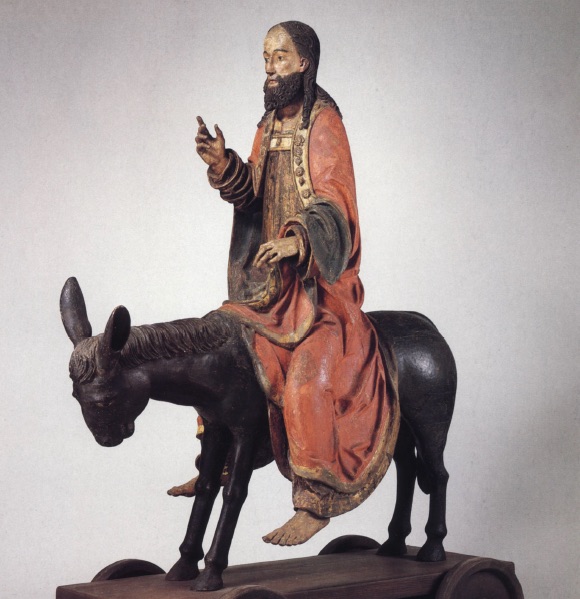
Palm Sunday: A Triumphal Journey

Jesus was troubled as he entered Jerusalem on Palm Sunday, the gospels say. And why not? The fear he felt so intensely in the garden was already seeping into his soul. 

He disturbed Jerusalem’s religious establishment by his words and actions; they noticed the people flocking to him and worried it would threaten the delicate balance they negotiated with the Romans who occupied their land. He had just raised Lazarus to life; his popularity was growing–one more reason for stopping him.

Entering the city, Jesus could see patrols of Roman soldiers brought in to keep peace during the Passover feast; he knew how harshly the Romans treated those who threatened their peace.

Yet, as he entered the city’s gates, crowds of people, ordinary people, greeted him with shouts of joy: “Hosanna, blessed is he who comes in the name of the Lord.” They scattered palm branches before him as he rode in on a donkey, carrying their hopes that God’s kingdom was coming.

Holy Week begins with this triumphal procession and it will take us into days of suffering and sorrow, when Jesus will be arrested, judged unjustly, scourged and beaten, made to carry a cross, and then die on a hill outside the city gates. 

But the journey will go on. Those who welcomed him on Palm Sunday were right. Death will not claim him. Rising from the dead, Jesus promises life to the world.