Category Archives: spirituality

Morning Thoughts: She Planted The Sun


.

There once was a little girl who loved to write “love”.

Over and over she wrote the lovely word.

Straight. Crooked. Curved. Upside down.

“Love”, “Love”, “Love”…

She drew hearts and placed all around.

And in a corner she planted the sun.

Day after day she pecked away.

A little hen marking the ground where she play.

All kinds of chicks came to stay.

She lined her dolls in pretty little rows.

A beauty pageant, all kinds of hair.

Straight. Curly. Blond. Brown.

She loved them all.

Did she favor?

She rotated each day.

She knew who needed extra care.

Though all to be happy.

That the only rule.

No room in her garden for overcast days.

And how her family grew.

She had, my God, so many to attend!

Amazing she could even keep track.

Yet each tiny doll held a special place.

She simply made room.

A little girl who loved to write “love”.

Over and over she wrote the lovely word.

Straight. Crooked. Curved. Upside down.

“Love”, “Love”, “Love”…

She drew hearts and placed all around.

And in a corner she planted the sun.

———

Miriam…Marie…Maria…

Mary…

I guess it depends on the day.

Accent. Pronunciation. Spelling.

Even eye color may change.

But it’s always the same little girl.

Age to age.

Place to place.

The same little girl

Helping save the human race.

The same little girl

In the fullness of time

Forever known:

Full of Grace


.

—Howard Hain

.

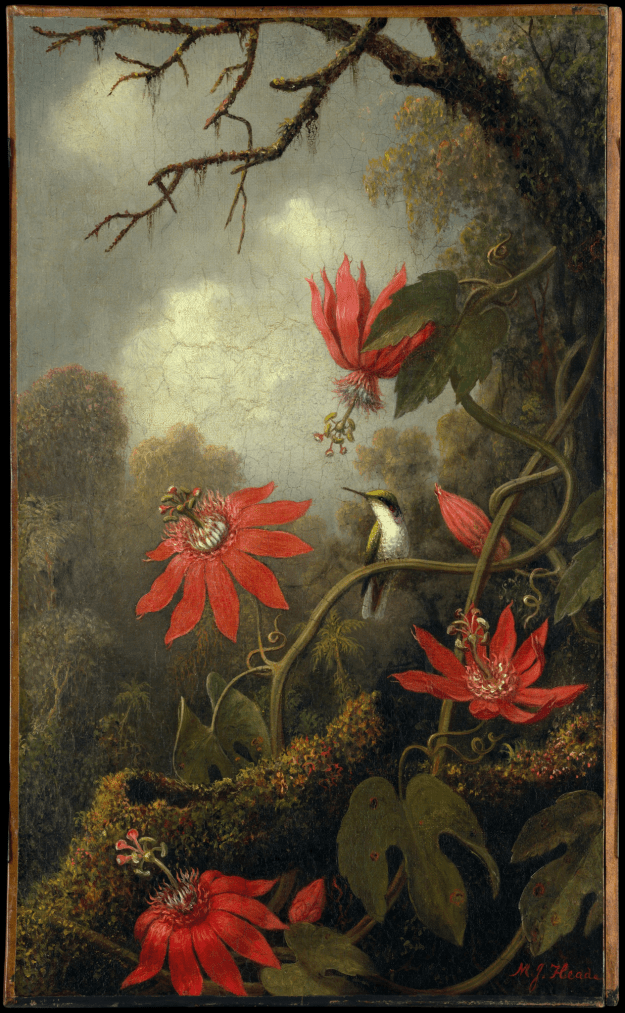
Hummingbird and Passionflowers

by Howard Hain
1509123983639705942327.jpg

Martin Johnson Heade, “Hummingbird and Passionflowers” (ca. 1875-85) (The Met)

The delicate little bird that resides within each of us.

It hops to and fro. It stands startlingly still.

Very often we are the very ones who chase it away.

But it doesn’t fly far.

Just to the closest branch, that’s just beyond our reach.

And it looks back at us, as if to ask, “Why are you afraid?”

The tiny head of a tiny bird, slightly cocked to the side—a question mark floats from its beak.

It longs to return, to live within us, to build a nest, to raise its young.

But it doesn’t rush back.

No, it waits.

It waits for us to ask for it to return.

It’s a patient creature, that tiny bird.

One may be tempted to say it’s not very smart, but that’s not it at all.

It’s simple. It’s holy. It knows who it is. It’s not afraid of the fall.


Howard Hain is a contemplative layman, husband, and father.


Web Link: The Met Museum. Martin Johnson Heade, “Hummingbird and Passionflowers” (ca. 1875-85)

Accounts of Jesus’ Resurrection

A Book for Lent

St. Paul Cross

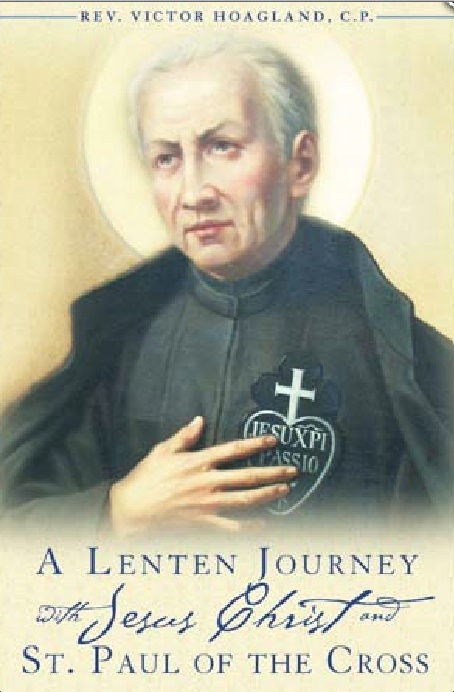
Lent begins next Wednesday, February 14th. Some years ago a publisher asked me to write a book entitled A Lenten Journey with Jesus Christ and St. Paul of the Cross, to be part of a series of reflections on the daily lenten gospels that included thoughts of saints of different religious orders. The book has just been translated into Japanese.

I was initially skeptical about the project. From early on I’ve seen lent as a time to give up something and take up some devotional practice like the Stations of the Cross. Yes, Lent was a journey with Jesus, and I appreciate the daily scriptures that take us through the season with him, but where does a saint come in, even a saint important to me, like St. Paul of the Cross, the 18th century founder of my community the Passionists ?

Working on the book made me see lent differently. First, for St. Paul of the Cross lent was a time to leave the quiet mountain at the edge of the Mediterranean Sea where he lived and prayed and go to work in the Tuscan Maremma, then a swampy, malaria infested region of Italy, overrun with robbers and desperately poor. All through lent, carrying a cross and a bible Paul went from village to village preaching God’s love to people whose lives were often on edge with fear and lost hope.

Lent isn’t a time for turning inward, away from world you live in, Paul reminds me. Lent is a time to go out to the wounded world before you.

Secondly, Paul engaged his world, the world of the Tuscan Maremma, in the light of the gospel, especially the Passion of Jesus Christ. For him that mystery was not limited to a time long ago, when Jesus suffered on a Cross; it was there in the people before him. From village to village, he held up a Cross to anyone who would hear as a mirror of their reality and a pledge of the great mercy of God. Jesus died and rose again.

The Passionists celebrate two feasts immediately before Ash Wednesday to prepare for Lent. Last Friday we celebrated the Commemoration of the Passion of Jesus Christ. Tomorrow, Tuesday before Ash Wednesday, we celebrate the Prayer of Jesus in the Garden. Both feasts come from our missionary founder.

I can see him packing his bags for his lenten journey down the quiet mountain for the villages and towns of the Tuscan Maremma. He must remind himself what he will see. He must pray so he doesn’t forget.

“May the Passion of Jesus Christ be always in our hearts.”

3rd Sunday of Easter


The Art and Imagination of Duk Soon Fwang

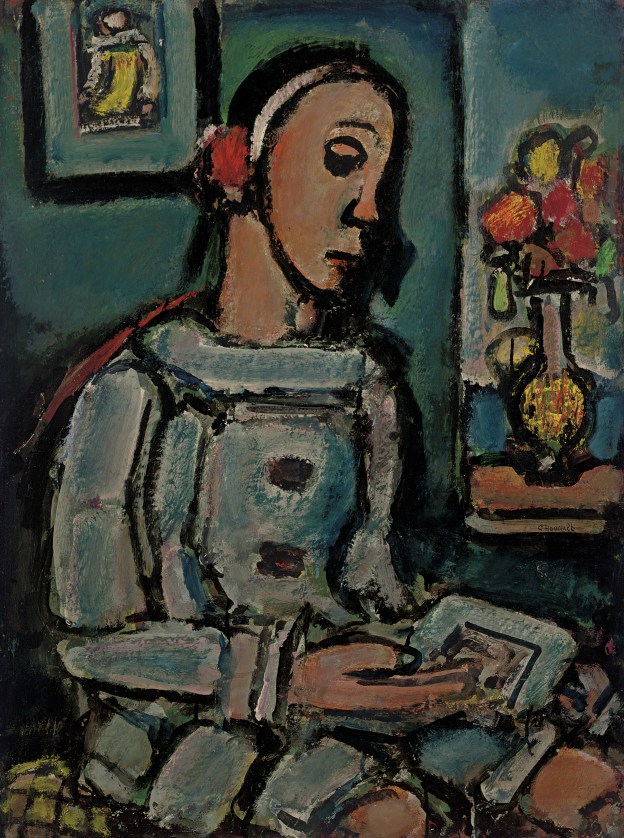
The Wise Pierrot, by Georges Rouault

Is this clown wise because he is reading a book? Are the illiterate necessarily stupid? Are books the best source of truth? Not at all. 

In this life, the true medium of the best message has been, is and always will be—sorrow. Carl Jung and Rollo May are emphatic on this point. Add St. John of the Cross, and Melville too: ‘The truest of men was the Man of Sorrows.’

So don’t pity this sad clown. He is learning, and Shakespeare put it well: ‘Knowledge has a bloody entrance.’

Painless learning is a delusion—especially that learning which must begin with self. ‘Lord,’ cried St. Augustine, ‘May I know myself, may I know Thee.’ A courageous prayer and a necessary one, for anyone who would really know God.

For, to look into one’s heart and search out one’s true motives; to face, as in a mirror, the real blotches, wrinkles and wastes of one’s spirit is not a discipline for a fool. And only he is truly wise who sees himself as nearly as he is, and accepts his gifts without smugness, his handicaps without regret.

Yes, indeed, wisdom is what’s left, when all your courses and readings are forgotten.

From Meditations on Some Art I Have Loved

By Fr. Hilary Sweeney, C.P.

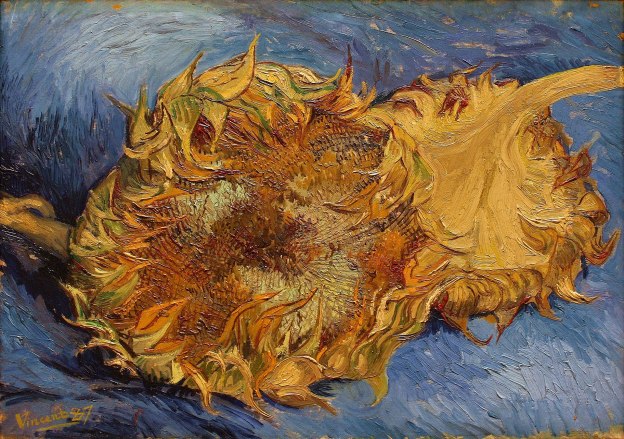
Sunflowers, by Vincent van Gogh

It has always fascinated me that when the giant sunflower plant bursts out to its glorious flower head, it is not long before it droops down (heavy with seed), upon the neck of its thick trunk. So intimately, even in nature, is humility joined to exaltation. “Whoever humbles himself shall be exalted.”

Vincent made many attempts to picture the wondrous sunflower, and here he gives us the plant’s apotheosis and its declension side-by-side. This tells us that the seeds within the flower head do not reach maturity until the plant bows low.

How exalted we’ve all felt, at times, in our youth and in our burgeoning years—to have accomplished something really good. And yet it was only when the weight of that glory (Augustine’s pondus gloriae) made us bow down before God in adoration—that our work was indeed well done. 

I honor the Chinese tradition that finds in the chrysanthemum (the last of summer’s flowers) a symbol of old age. But here in the West, the sunflower serves us even more tellingly.

It is only when life seems to have ended that it really begins. Whoever loses his life keeps it. So, when we are beset with discouragement over the goods we lose or that are taken from us, it is important to remember that Jesus never did so much for this world as when He seemed to be doing nothing—on the Cross.

There is great feeling in this painting. The flowers seem to elicit the reach of your hand, the feel of your fingertips upon their surfaces—those marvelous double helix packages.

From Meditations on Some Art I Have Loved

By Fr. Hilary Sweeney, C.P.

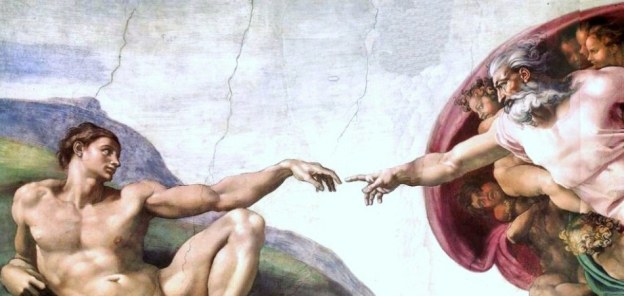
The Creation of Man, by Michelangelo

It was a stroke of genius to have left a space between Adam’s reach and His Maker’s. For, if it is man’s innate need to reach for God, it is in God’s power alone to satisfy that need.

Man, at his best, strives. He is most truly himself when he reaches beyond himself—to God. And yet the space between man and God is never so little that it is not infinite.

Man lives upon spaces, pauses. He can breathe and speak in no other way. And no matter how earnestly he strives, he must learn that waiting is the only way to meet God. For God comes to us, not we to Him.

Before completing His work of creating Mankind, God put Adam to sleep. In a sense, then, rest is the Creator’s visible signature upon our flesh. For sleep, or rest is an interval between nothing and something. And no truer description of man’s way to God was ever made than the Psalmist’s cry—“Wait for the Lord.” Nor did anything more truly describe our Lord’s humanity than the need He felt to wait for ‘the hour’ appointed by the Father—a waiting which Jesus described as an ordeal. (Luke 12:52)

It is very human to think: ‘If only there were something to hope for, I could be patient.’ But Paul reveals how far God’s ways are from ours, when he writes, ‘We wait for hope with patience.’ (Romans 8:25) So—patience first, then hope!

Let’s not put limits on God, Whose designs are beyond our measuring, while our own were limited before they began. (Psalm 139)

Be patient, then, when your situation seems hopeless—even as, in Faith, you believe what you do not see, and in Charity, you love what is naturally unlovable. Such is the nature of any virtue worthy to be called ‘theological’, that is, a virtue whose object is God Himself.

From Meditations on Some Art I Have Loved

By Fr. Hilary Sweeney, C.P.

6th Sunday A: Commandments about Love

Please watch today’s homily by selecting the video below: