Category Archives: spirituality

An Honest Environment

by Howard Hain
four-swifts-with-landscape-sketches-1887(1).jpg!Large

Vincent van Gogh, “Four Swifts With Landscape Sketches”, 1887


If a child is wasteful, what should the parents do?

Give them more?

More toys?

More snacks?

More disposable goodies?

Should they inflate the number and insignificance of what the child already has?

If the child’s room or backyard is full of waste, scattered remnants of “grown-bored-with” toys and doodads, what’s the answer?

Should the parents implement specific and tedious rules detailing what the child should do and not do in order to preserve the cleanliness and neatness of the home and outdoor space?

Should the parents provide the child with even greater means to continue to live so wastefully, with such little appreciation?

Or maybe, just maybe, the answer begins with the child possessing less, less toys, less privilege—especially when the family budget doesn’t allow for them in the first place—wouldn’t that be more beneficial to all involved?

Maybe if the child had only a few but well-loved toys, the child would be less wasteful, less likely to discard them and negatively affect the family environment?

Isn’t it the same with the overall environment? With the care of the earth and its resources?

If we are really serious about the environment, is the answer really man-made laws from “up high” limiting the freedom of individuals and localities? Or would it be better to begin with embracing a liberating reality that would help foster a more natural and organic conservancy?

Put it this way, if the government actually had to balance the budget, I mean really balance it on an annual basis—spending only what it brings in—and they didn’t continue to print more money (especially when the new “currency” is not based on any real asset, but instead out of “thin-air”) don’t you think that spending on the national level would change?

It would have to, period.

And don’t you think that the debate over what we do spend on would tighten up, become quite serious, efficient, and effective? And don’t you think that on the local level it would be the most freeing? For it would create an environment where individuals wouldn’t be handed false paper to purchase false products (designed to be disposable), and then maybe we’d have a commercial reality that is truly sustainable—where we have perhaps fewer items but items we cherish, are grateful to possess, and protect and care for—goods we wouldn’t just throw away.

Would that perhaps change the pollution problem?

Would it perhaps address our reckless use of natural resources?

In short, no “environmentalist” is serious about the environment (and values individual rights and freedom of local choice) if they do not deal with the biggest polluter of all: runaway debt, rising inflation (with concurrent deflation of valued consumer-driven product), and false and perpetually self-emptying currency.

Because without the false means of consumerism, consumerism would have to return whence it came: nonreality.

For imbalanced budgets, large deficit spending, and reckless printing of currency are the most non-organic, the least natural, and most non-locally-supporting factors concerning the health of our rivers, soil, trees, and, quite frankly, ourselves.

So let’s be real. Real as dirt. Let go of the hidden influences, agendas, and political prejudices, and be serious about what is truly causing waste and environmental destruction.

The truthful alternative is certainly refreshing: an unwavering allegiance to God’s most natural law of truth, beauty, and divine efficiency. For while God is certainly exuberant in His abundance and provision, He is never wasteful. He never lies. He never “cooks the books”.

The Creator of the Universe is honesty to the utmost degree. Pure harmony. Pure integrity. Pure accountability. Not a trace of fallacy or fiction.

If you doubt me, well then just ask the local bird. Ask him if he can borrow against bad credit, if he can feed his babes with worms that are printed merely on paper, and if he ever worries about his offspring buying and buying and throwing out and throwing out—or is it precisely his non-inflated natural resources that actually keep his local environment in harmonious check?

It is as long as some bureaucratic bird, puffed up with unrealistic good intentions (and other people’s money) doesn’t come along promising freebies and handing out nests that he and his other fine-feathered friends pay for with bad credit or currency based on a non-existent reality.

In their bird-brained world, thank goodness, that doesn’t happen. No, birds build their nests in reality. And continue to fly high because of it.

We on the other hand have many among us who try to sell us such false narratives and papier-mâché mansions. They also ironically tend to be the ones who “support” the “environment” the most.

For to discuss global warming, sustainability, and carbon credits without discussing the need for balanced budgets and disciplined currency policy is to be either a fool or a liar—both cases are unsustainable.


Howard Hain is a contemplative layman, husband, and father. He blogs at http://www.howardhain.com

Advent Readings: Week 2

Advent_heading copy 2To reach God’s holy mountain there’s a journey to make, Isaiah says, but guides will show the way. “Behold, I send my messenger ahead of you, to prepare your way.” Mark 1, 1. John the Baptist appears in the desert promising forgiveness  to those washing in the waters of the Jordan River. We have been baptized in the waters of baptism.

The Old Testament readings this Advent week, mostly from Isaiah, describe a desert journey,  but the desert will bloom and a highway will be there, the prophet promises. (Monday) God will speak tender, comforting words to his people on the way. (Tuesday) Those who hope in him will renew their strength, soaring on eagle’s wings. (Wednesday) Though we are as insignificant as a worm, God holds us in his hands and says:“Fear not; I am with you.” (Thursday) God is our teacher and shows us the way  to go. (Friday) On the way, prophets like Elijah accompany us. (Saturday)

Jesus is our way, the gospel readings say. He healed and forgave the paralyzed man– symbol of a paralyzed humanity– who was lowered through the roof into the house in Capernaum. (Monday) Like a good shepherd he searches for and finds the stray sheep. (Tuesday) “Come to me all who are weary, ” he says. (Wednesday) He sends us prophets and guides like John the Baptist and Elijah.( Thursday) Though rejected like John the Baptist, Jesus still teaches. (Friday)

He will save us, even though unrecognized like John and Elijah. (Saturday)

List of Readings

Monday: Isaiah 30, 1-10 The desert will bloom and a highway will be there, a holy way.Luke 5,17-26 The paralyzed man, lowered through the roof, is healed and forgiven.

Tuesday: Isaiah 40,1-11 The desert is a way to the Lord. Comfort my people. Mattthew 18, 12-14 The shepherd searches for the stray sheep.

Wednesday: Isaiah 30,25-31 God is the strength of his people. Matthew 11,28-30   “Come to me all who are weary…”

Thursday: Isaiah 41,13-20   God says, “I will grasp you by the hand. Fear not.”Matthew 11,11-15   John the Baptist is sent like Elijah.

Friday: Isaiah 48-17-19 I teach you what’s for your good and lead you on the way to go. Matthew 11,1-19   John and Jesus rejected as teachers.

Saturday: Sirach 48,1-4; 9-11 Elijah, precursor of John. Matthew 17, 9-13   Elijah and John not recognized.

Posture of Prayer

by Howard Hain
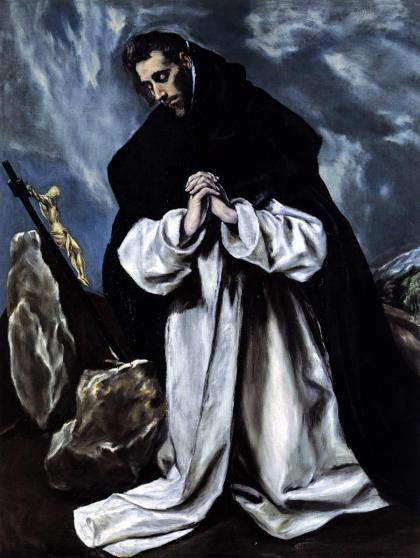
el_greco_st_dominic_in_prayer-1595

El Greco, “St. Dominic Praying”, c. 1588

Sometimes just showing up is all we can do.

To put ourselves in position to pray and worship—at least physically, even if we just cannot seem to get there spiritually—is an act of prayer and worship in itself. And quite often, it is the best we have to offer.

By confessing our aridity through physical obedience alone, we approach God’s altar with humility, for we come to God in our “nothingness”.

The bowing of head, the placement of knees, and the closing of eyes return us to the dark warmth of the womb. It is no coincidence that the posture of prayer and the fetal position bear great semblance.

It is in the womb that we are closest to God, furthest from the corruption of the world, and possess the least of what our “flesh” considers of value—our “brilliant” ideas, our “magnificent” plans, our “heroic” acts—our self-aggrandizement.

It is in the womb that we find ourselves in complete dependence. We receive all we need without knowing, without speaking, without cost.

In that sense, being in the womb is much the same as being in the world—for in the world we are still completely dependent—it is just that without the obvious reminder of the umbilical cord, we so easily forget our total and complete dependence on God, our Creator, our Sustainer, and our Ultimate End.

Hence we find ourselves “knowing,” “telling,” and “paying a price.” When in reality, the only thing that we can somewhat even come close to taking credit for is being physically present to receive His Word, His Wisdom, and His Will. All of which come free of charge, His Son having already paid the price.

———

“Lord, let me place my knees to the earth. Let me feel the foot of the cross against the caps of my knees. Let me close my eyes and bow my head. Let my brow lay upon your bloodied feet. Let me humbly raise my eyes to gaze upon your battered body. Oh my Lord and my God, let your blood and water rain down upon me.”

Amen.


Howard Hain is a contemplative layman, husband, and father. He blogs at http://www.howardhain.com

Follow Howard on Twitter @HowardDHain

twitter.com/HowardDHain

If you enjoyed this post, please consider “liking” it, adding a comment, becoming an email subscriber, or passing it along via the social-media links below. Your support is greatly appreciated. Step by step. All for God’s glory.

I’m Pro-Art

by Howard Hain
DT1554

Paul Cézanne, “Bathers”, 1874-75, (The Met)

I’m Pro Art

In other words:

I’m Pro Truth

In other words:

I’m Pro Beauty

In other words:

I’m Pro Love

In other words:

I’m Pro Creation

In other words:

I’m Pro Life

(Oops, how’d that happen…funny how logic can lead you to such “un-expecting” places.)

(Words do seem to matter—or at least carry some weight—maybe even 7 pounds 8 ounces worth.)

(Before you panic, give it a little, teeny-weeny, infant-sized bit of thought…)

Conclusion:

ProArt (pro-creates) ProLife

ProLife (pre-conceives) ProArt

ProArt (equ=als) ProLife


Howard Hain is a contemplative layman, husband, and father. He blogs at http://www.howardhain.com

Follow Howard on Twitter @HowardDHain

twitter.com/HowardDHain

If you enjoyed this post, please consider “liking” it, adding a comment, becoming an email subscriber, or passing it along via the social-media links below. Your support is greatly appreciated. Step by step. All for God’s glory.

Web Link: The Metropolitan Museum of Art. Paul Cézanne, “Bathers”, 1874–75

Mary Gardens

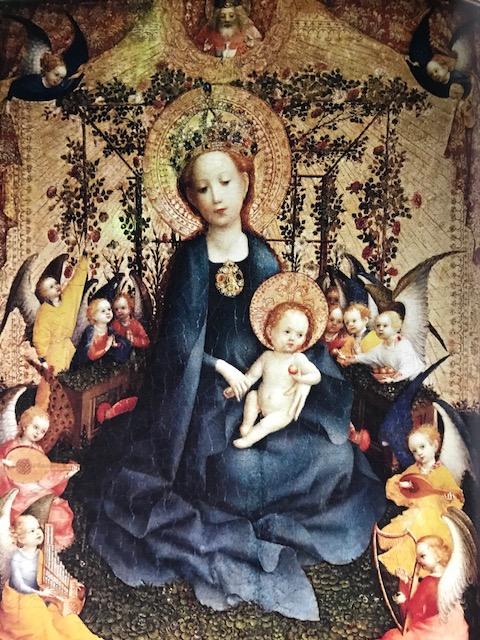
Andrea Oliva Florenda, a professor at St. John’s University in Queens, New York, offered a day of reflection on Mary Gardens, December 1 at Bishop Molloy Retreat Center, Jamaica, New York. Professor Florenda teaches in the department of theology and religious studies at St. John’s, specializing in Marian theology. She’s also the designer and curator of the Marian Garden at the university.

Mary Gardens, dedicated to Mary, the Mother of Jesus, appeared in Europe following the Black Death, a pandemic that caused millions of deaths in that part of the world in the 14th century. The gardens, usually found in monasteries and religious shrines, brought hope to people walking “in the shadow of death.”

God placed Adam and Eve in a garden, Christian tradition says. (Genesis 2, 8-28) Rising from the dead, Jesus proclaimed eternal life in a garden. (John 20,11-18) For early and medieval Christians, Mary appeared as a garden enclosed, flowers, plants and trees surrounded her, “our life, our sweetness and our hope.” The Mary Garden, which became a favorite inspiration for medieval and renaissance artists, brought the promise of life to the “poor banished children of Eve.”

Does the Mary Garden have a role today in a world facing climate change and environmental degradation? Professor Florenda thinks it does. Besides the mysteries of faith, it teaches reverence for creation, for the soil, for plants that feed us and bring healing, for flowers that nourish our sense of beauty.

Certainly science and technology have a large part to play in the current environmental movement, but Professor Florenda notes the number of young people, from various religious tradition drawn to her Mary Garden at St. John’s, where the mysteries of seed and soil unfold, where pharmacy students study medicinal herbs and seasonal vegetables feed the poor.

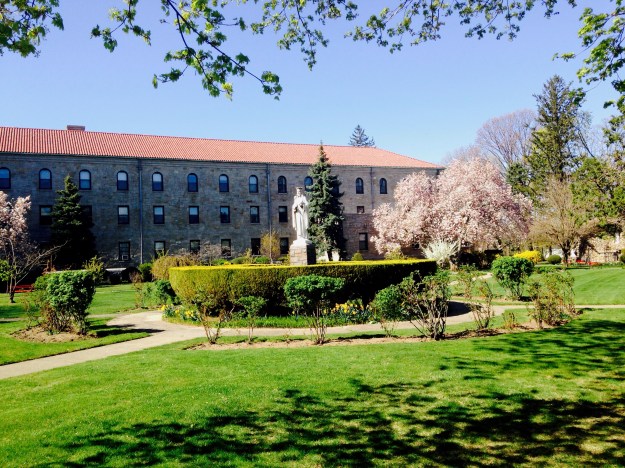
The day of reflection on Mary Gardens ended at the grotto honoring Mary in the garden of Immaculate Conception Monastery in Jamaica. There, Professor Florenda spoke about the meaning of the grotto, its structure and the plants and trees surrounding it.

“There is a language in each flower,
that opens to the eye,
A voiceless but a magic power.
A prayer in earth’s blossoms lie.” Anonymous

1st Sunday of Advent: Wake Up!

For this week’s homily, please play the video file below:

Walking Into Heaven

by Howard Hain
Rembrandt_-_The_Philosopher_in_Meditation

Rembrandt, “Philosopher in Meditation”, 1632, (Musée du Louvre)


Dream big.

Think small.

Step by step.

Real growth is incremental.

Reaching toward a glory beyond our reckoning.


Sure and Steady

by Howard Hain
jusepe-josc3a9-de-ribera-tightrope-walkers-1634

Jusepe (Jose) de Ribera, “Tightrope Walkers”, 1634


The brighter the light the more we squint.

The closer we get the less we see.

And if we stare we go blind.

Now what?

You have to trust.

In what?

Not in yourselves.

In total darkness the answer is clear.

All other ways disappear.

Close your eyes.

Shutter your ears.

Forget the past.

Ignore what is below.

Chin slightly elevated.

Now walk.

No need to go too slow.

Sure and steady.

Heart on the goal.

And if we slip?

Don’t worry.

I made the rope.

I hold it tight.

My Son is “the way and the truth and the life”.

In Him you never fall.

In Him you know.

In Him you live.

He walks before you.

You may not see Him but He is there.

Follow close behind.

It is a tight walk.

That’s why I gave Him a pole.

I gave you one too.

And because it can get very dark.

I made them easy to identify.

They are made of thick dead wood.

Your hands know their splinters and knots.

Hold tight.

Say thank You.

Kiss in the dark what you cannot see.

For that old piece of wood.

Will get you across the gorge.

Where on the other side.

It will be planted.

Grafted into the Tree of Life.


Howard Hain is a contemplative layman, husband, and father. He blogs at http://www.howardhain.com

Follow Howard on Twitter @HowardDHain

twitter.com/HowardDHain

If you enjoyed this post, please consider “liking” it, adding a comment, becoming an email subscriber, or passing it along via the social-media links below. Your support is greatly appreciated. Step by step. All for God’s glory.
Clean Enough To Care

by Howard Hain
DP801172.jpg

John Downman, “Child Holding a Doll”, 1780 (The Met)


What if someone handed you a child?

A small child.

A tiny child.

An infant.

A few hours…a few minutes old.

What if you were the only one that the child could be handed to?

Only you.

No one else around to help.

Would you receive that child into your arms?

There’s no sterilized room, no sanitary precautions, no sink, not even a bar of soap—just plain old you, a bunch of imperfect circumstances, and a poor tiny child that needs to be embraced.

You know what you would do.

Even if your hands were filthy, completely covered in soot and mud, you know what you would do.

You’d quickly rub your hands against your pants or shirt and wipe away the obvious dirt.

Then you’d hold out your hands.

Wouldn’t you?

Yes. You would.

We all would.

That’s what makes us human.

That’s what makes us children of God.

We’d do what we could with what we have to help an innocent child.

We know that “cleanliness” in such cases really doesn’t matter. For even if the circumstances were “perfect” we’d still have that uneasy feeling. That feeling that we’re not worthy to hold such innocence, to be entrusted with such treasure.

It’s a holy hesitancy that only true humility can bear.

Yet, it’s the necessity to help, the clear need for our assistance—the abundantly clear reality that we’re the only “hands” on deck—that drives us to overcome such holy and righteous fear—a fear that reveals just how poor we really are, much poorer in fact than even the helpless child we are about to embrace.

It is preciously this beautiful fear of God that propels us to love boldly—to boldly reach out beyond ourselves, to boldly become part of God’s mystical body, to become His very arms and hands—to embody Divine Love Itself—that perfect love of the eternal Father for each and every child ever created.

For it is the Father’s love that creates us, and sustains us, and longs to flow through us.

We just sometimes need extreme circumstances—ridiculously obvious situations—in order to tap the needed courage to let it to flow beyond our own borders and into those around us.

You are in such a situation. Right now.

We all are.

This very moment.

No matter where you are or what you’re doing.

Such a situation is at hand.

A child, a new born—cold, hungry, and without a home—desperately needs to be held.

Quick then, wipe your dirty hands, make due with what you’ve got—believe the Word of God, it’s good enough—now hold out your hands.

You’re clean enough to care.


Howard Hain is a contemplative layman, husband, and father. He blogs at http://www.howardhain.com

Follow Howard on Twitter @HowardDHain

twitter.com/HowardDHain

If you enjoyed this post, please consider “liking” it, adding a comment, becoming an email subscriber, or passing it along via the social-media links below. Your support is greatly appreciated. Step by step. All for God’s glory.


Web Link: The Metropolitan Museum of Art. John Downman, “Child Holding a Doll”, 1780

Bozza Imperfetta (imperfect sketch)

by Howard Hain


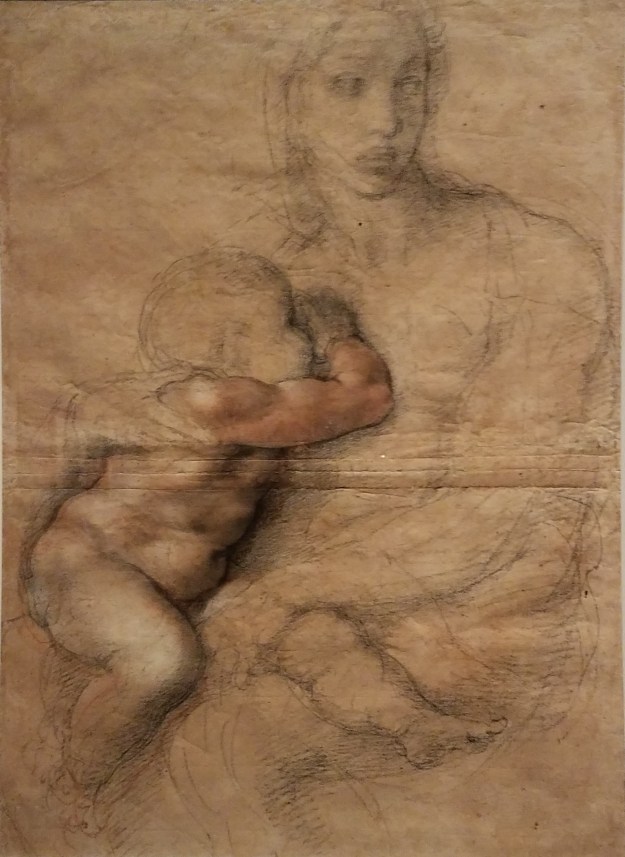
20171121_104929

Michelangelo Buonarroti (Italian, Caprese 1475–1564 Rome). “Unfinished cartoon for a Madonna and Child.” 1525–30. Drawing, black and red chalk, white gouache, brush and brown wash. Casa Buonarroti, Florence


I know almost nothing.

What I do know leads me up the ladder of not understanding.

To my perch upon the Cross.

Within the heart of my child Jesus.


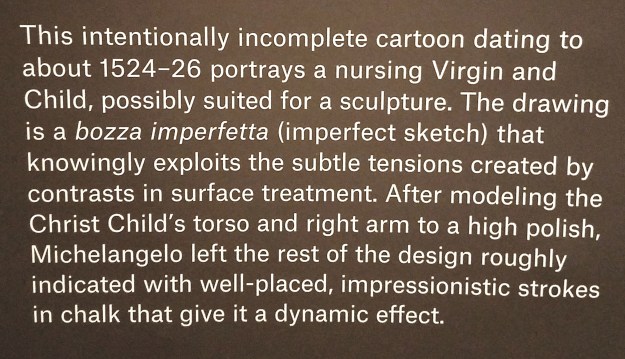
20171121_110016

Museum Wall Card for Work Above, from: Michelangelo: Divine Draftsman and Designer, on view at The Met Fifth Avenue from November 13, 2017 through February 12, 2018.