Category Archives: saints

John Neumann, January 5

Neumann
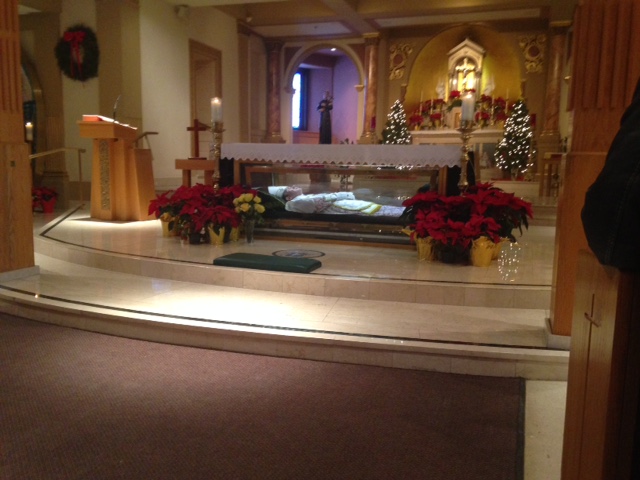
Shrine of St.John Neumann, St. Peter’s Church, Philadelphia

Today’s the feast of St. John Neumann,. “The sacrament of Holy Orders is at the service of the communion of the church.” (Catechism of the Catholic Church). John Neumann served the church in an heroic way as a priest and bishop. He’s one of the founding figures of the church in the United States.

Born in Bohemia in 1811, John Neumann was drawn to serve the church in the new world as a young seminarian. Arriving in New York City in 1835, he was immediately accepted for ordination by Bishop Dubois and ordained at Old St. Patrick’s Cathedral.

Canals and railroads were transforming the new nation then. The Eire Canal, completed in 1828, connected New York harbor and the Atlantic Ocean to the Great Lakes region, causing an explosive population growth in the cities and towns along its route. Bishop Dubois sent the newly-arrived priest to minister to the many Catholic immigrants settling there.

First as a diocesan priest and then as a Redemptorist religious, Neumann founded  numerous parishes and missions in the cities and towns along the canal and railroad lines in Pennsylvania, Ohio, Maryland and New York.

He spoke a number of languages and learned to speak others, even Gaelic, as he reached out to the diverse immigrant population, many poor Irish workers on the canal. He wore himself out in his tireless efforts and joined the Redemptorist Order looking for the support and stability that a religious order provided, yet as a Redemptorist he continued establishing churches and parishes through the northeastern United States as a preacher and catechist.

In 1852 Neumann was appointed bishop of Philadelphia, where the Catholic population was rapidly growing. He was a tireless shepherd, building over 100 new schools and 50 churches, until his death in 1860. Convinced that young people needed good formation in the faith, Neumann fostered Christian education and wrote two catechisms. He preached continuously, administered the sacraments and encouraged the Forty Hours Devotion and other devotional practices in his diocese.

John Neumann served the church as a zealous priest and bishop. He left his own homeland to work tirelessly to build the Catholic Church in the United States. He was a true missionary of Christ.

We need priests and missionaries like him today. Not only priests who leave their own homeland to minister in different countries, but priests who minister in an evolving church where the boundaries are not fixed.

O God, who called the Bishop Saint John Neumann, renowned for his charity and pastoral service, to shepherd your people in America, grant by his intercession that, as we foster the Christian education of youth and are strengthened by the witness of his brotherly love, we may constantly increase the family of your Church.                       Through Jesus Christ, our Lord. Amen.

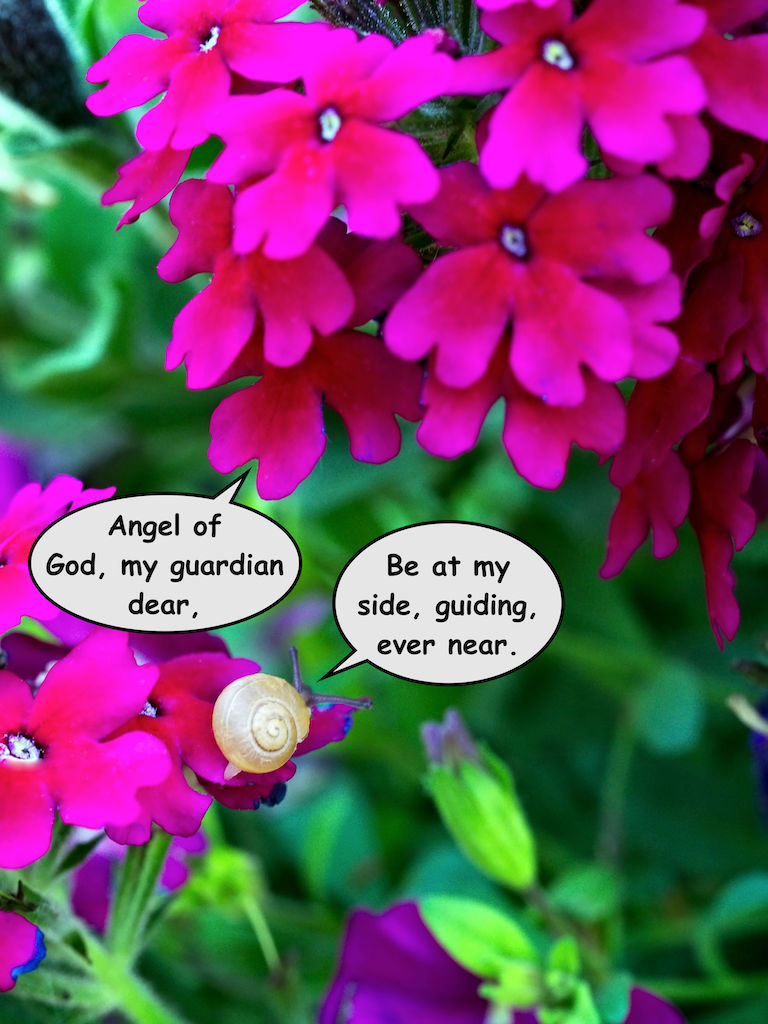
Prayer to My Guardian Angel

“Prayer to My Guardian Angel” (abridged)
Matthew 18:1-5, 10
Memorial of the Holy Guardian Angels
©️2021 Gloria M. Chang

At that time the disciples approached Jesus and said, “Who is the greatest in the kingdom of heaven?” He called a child over, placed it in their midst, and said, “Amen, I say to you, unless you turn and become like children, you will not enter the kingdom of heaven. Whoever humbles himself like this child is the greatest in the kingdom of heaven. And whoever receives one child such as this in my name receives me.

See that you do not despise one of these little ones, for I say to you that their angels in heaven always look upon the face of my heavenly Father.”

Matthew 18:1-5, 10

Guardian Angels Guide Us to the Father

God, the Father Almighty, maker of heaven and earth, of all things visible and invisible, placed Christ at the center of the angelic world. Every child made in the image of the Incarnate Son of God receives a guardian angel at conception to guide them in their journey home to the Father. As “their angels in heaven always look upon the face of my heavenly Father,” they intercede and light the way through Christ in the Spirit to the heart of the Father.

From its beginning until death, human life is surrounded by their watchful care and intercession. “Beside each believer stands an angel as protector and shepherd leading him to life.” Already here on earth the Christian life shares by faith in the blessed company of angels and men united in God.

Catechism of the Catholic Church 336

Prayer to My Guardian Angel

Angel of God, my guardian dear,
to whom God’s love commits me here,
ever this day be at my side,
to light and guard, to rule and guide. 
Amen.

Angel of God, my guardian dear,
Be at my side, guiding, ever near.


This content by Gloria M. Chang was originally published online at Shalom Snail: Journey to Wholeness.

The Wisdom of Thomas Aquinas

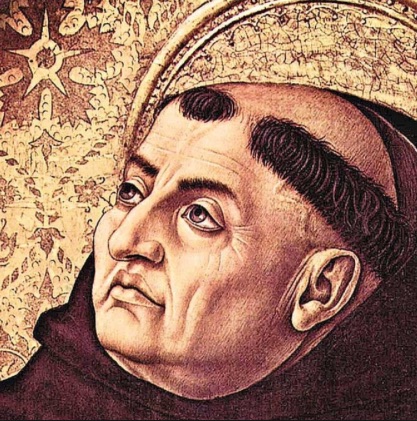
Thomas Acquinas

The feast of St. Thomas Aquinas, January 28th, in my student days was a day for presentations honoring the saint. The presentations were not about the saint’s life but his wisdom. Thomas Aquinas was a great theologian dedicated to the search for truth.

He was a man of faith, searching for understanding. That’s the definition of theology–faith seeking understanding, an understanding that draws us closer to God and helps us know God, the source of all truth.

He was a man of questions, who approached great mysteries through questions. That’s the way St. Thomas begins a sermon he once preached, found today in the Office of Readings for his feast:

 “Why did the Son of God have to suffer for us?” he asks as he looks at the Cross of Jesus. The passion of Jesus was necessary, the saint says, for two reasons. First, as a remedy for sin, and secondly, as an example of how to act.

Interestingly, the saint doesn’t spend much time asking why it’s a remedy for sin. He’s more interested in the passion of Jesus as an example for us. To live as we should, we need to look at Jesus on the cross, an example of every virtue:

“Do you want an example of love? ‘Greater love than this no one has, than to lay down one’s life for one’s friends.’ That’s what Jesus did on the cross. If he gave his life for us, then it should not be difficult to bear whatever hardships arise for his sake.

“If you want patience, you will find no better example than the cross. Great patience occurs in two ways: either when one patiently suffers much, or when one suffers things which one is able to avoid and yet does not avoid.

“Christ endured much on the cross, and did so patiently, because when he suffered he did not threaten; he was led like a sheep to the slaughter and he did not open his mouth. Therefore Christ’s patience on the cross was great. In patience let us run for the prize set before us, looking upon Jesus, the author and perfecter of our faith who, for the joy set before him, bore his cross and despised the shame.

“If you want an example of humility, look upon the crucified one, for God wished to be judged by Pontius Pilate and to die.

“If you want an example of obedience, follow him who became obedient to the Father even unto death. For just as by the disobedience of one man, namely, Adam, many were made sinners, so by the obedience of one man, many were made righteous.

“If you want an example of despising earthly things, follow him who is the King of kings and the Lord of lords, in whom are hidden all the treasures of wisdom and knowledge. Upon the cross he was stripped, mocked, spat upon, struck, crowned with thorns, and given only vinegar and gall to drink.

“Do not be attached, therefore, to clothing and riches, because they divided my garments among themselves. Nor to honours, for he experienced harsh words and scourgings. Nor to greatness of rank, for weaving a crown of thorns they placed it on my head. Nor to anything delightful, for in my thirst they gave me vinegar to drink.”

St. Thomas’ great theological work, the Summa Theologica can be found here.
Stars and Saints

Hubble Ultra Deep Field
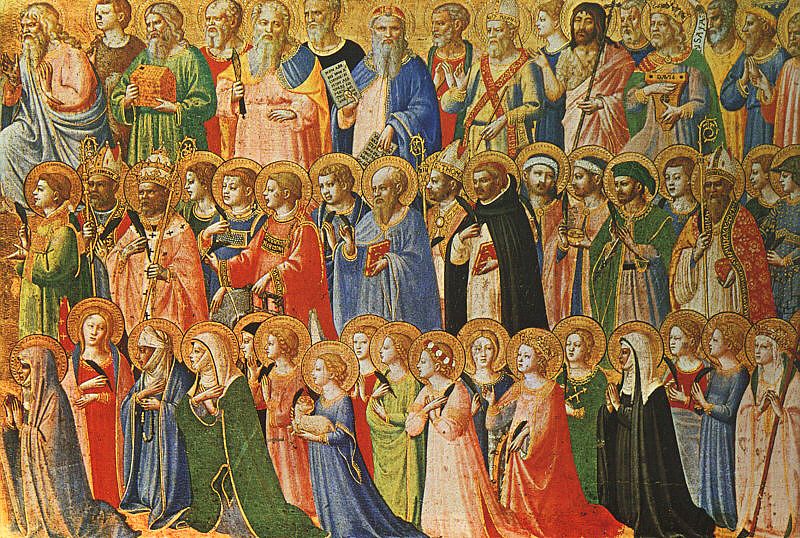
Fra Angelico, The Forerunners of Christ with Saints and Martyrs

By Gloria M. Chang

From eternity the Lord God designed humanity and the cosmos in his image, envisioning the constellation of saints bursting with Christic Light in the heavens. Formed from the dust of the earth, Adam evolves through the eons to completion in Jesus Christ, his descendant and Lord—the Potter’s masterpiece (Isaiah 64:8). 

Kindling the treasure of Christ’s flame in “jars of clay,” we grow day by day into the image of the Blessed Trinity as one Mystical Body (1 Corinthians 15:41). The dazzling kaleidoscope of saints, reflecting the unity and diversity of the Father, Son, and Holy Spirit radiates the infinite rays of divinity. Each saint refined in God’s furnace of Love emerges as an original from the hands of the Divine Artist, for “star differs from star in glory” (1 Corinthians 15:41).

Form me with your hands, Lord, day by day.
You are the Potter; I am the clay.
From soil you shaped sparkling saints like stars, 
Blazing your glory from earthen jars.

Just as we have borne the image of the man of dust, we shall also bear the image of the man of heaven.

1 Corinthians 15:49


This content by Gloria M. Chang was originally published online at Shalom Snail: Journey to Wholeness

The Lamp and the Lampstand

By Gloria M. Chang

You are the light of the world. A city set on a mountain cannot be hidden. Nor do they light a lamp and then put it under a bushel basket; it is set on a lampstand, where it gives light to all in the house.

Matthew 5:14-15

Jesus, the light of the world, purifies hearts and illuminates minds in the truth, restoring lost sons and daughters to the Father. Every child redeemed by the Lamb of God is a Christ-bearer and therefore, a light-bearer, but from where does the light shine? 

In a reading by St. Maximus the Confessor, he identifies the lamp of the parable with Jesus Christ and the lampstand as Holy Church. As the Head and the Body are inseparable, the lamp and the lampstand together illumine the “house, which is the world,” filling all people with divine knowledge. 

In an age of profound skepticism and disappointment in the institutional Church, St. Maximus’ vision challenges us to lift up our eyes to the mountain of the Lord (Zechariah 8:3), praying to become one with Christ collectively in the communion of saints. For it is by the virtuous lives of the saints that a world parched for mercy and truth is drawn to the Church as its Mother. 

In the old covenant, “the word was hidden under the bushel, that is, under the letter of the law,” veiling the eternal light. In the new covenant of grace in the Father, Son, and Holy Spirit, Christified saints become living letters of the law inscribed not on tablets of stone but on hearts of flesh, vivified by the Spirit (2 Corinthians 3:3).

Bereft of the lamp, the lampstand is dark and empty—a tomb of death and despair. Catholics experience the effects of the empty lampstand in the Church on Good Friday to Holy Saturday every year when the Blessed Sacrament is removed from the sanctuary. At dawn on Easter morning, with millions of candles piercing the darkness around the world, the Body of Christ rises with its Head from the empty tomb, joyfully singing “Alleluia! Christ is risen!”

From an inquiry addressed to Thalassius by Saint Maximus the Confessor, abbot

The light that illumines all men

The lamp set upon the lampstand is Jesus Christ, the true light from the Father, the light that enlightens every man who comes into the world. In taking our own flesh he has become, and is rightly called, a lamp, for he is the connatural wisdom and word of the Father. He is proclaimed in the Church of God in accordance with orthodox faith, and he is lifted up and resplendent among the nations through the lives of those who live virtuously in observance of the commandments. So he gives light to all in the house (that is, in this world), just as he himself, God the Word, says: No one lights a lamp and puts it under a bushel, but on a stand, and it gives light to all in the house. Clearly he is calling himself the lamp, he who was by nature God, and became flesh according to God’s saving purpose.

I think the great David understood this when he spoke of the Lord as a lamp, saying: Your word is a lamp to my feet and a light to my path. For God delivers us from the darkness of ignorance and sin, and hence he is greeted as a lamp in Scripture.

Lamp-like indeed, he alone dispelled the gloom of ignorance and the darkness of evil and became the way of salvation for all men. Through virtue and knowledge, he leads to the Father those who are resolved to walk by him, who is the way of righteousness, in obedience to the divine commandments. He has designated holy Church the lampstand, over which the word of God sheds light through preaching, and illumines with the rays of truth whoever is in this house which is the world, and fills the minds of all men with divine knowledge.

This word is most unwilling to be kept under a bushel; it wills to be set in a high place, upon the sublime beauty of the Church. For while the word was hidden under the bushel, that is, under the letter of the law, it deprived all men of eternal light. For then it could not give spiritual contemplation to men striving to strip themselves of a sensuality that is illusory, capable only of deceit, and able to perceive only decadent bodies like their own. But the word wills to be set upon a lampstand, the Church, where rational worship is offered in the spirit, that it may enlighten all men. For the letter, when it is not spiritually understood, bears a carnal sense only, which restricts its expression and does not allow the real force of what is written to reach the hearer’s mind.

Let us, then, not light the lamp by contemplation and action, only to put it under a bushel—that lamp, I mean, which is the enlightening word of knowledge—lest we be condemned for restricting by the letter the incomprehensible power of wisdom. Rather let us place it upon the lampstand of holy Church, on the heights of true contemplation, where it may kindle for all men the light of divine teaching.


Reference

The passage from St. Maximus the Confessor can be found in the Office of Readings for Wednesday of the 28th Week in Ordinary Time.

Praise God with St. Paul of the Cross

Statue of St. Paul of the Cross at the Passionist Monastery in Jamaica, NY

“Let everything in creation draw you to God. Refresh your mind with some innocent recreation and needful rest, if it were only to saunter through the garden or the fields, listening to the sermon preached by the flowers, the trees, the meadows, the sun, the sky, and the whole universe. You will find that they exhort you to love and praise God; that they excite you to extol the greatness of the Sovereign Architect who has given them their being.”

St. Paul of the Cross

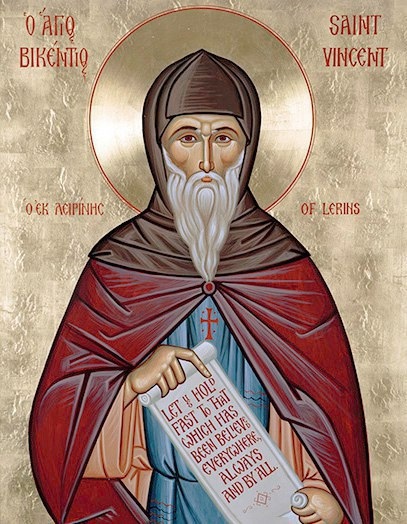
St. Vincent of Lerins Speaks to the Modern Church

By Gloria M. Chang

As the Synod on Synodality proceeds in Rome, we can all participate as the listening Church, the Bride of Christ, sitting at Jesus’ feet like Mary of Bethany (Luke 10:38). Enveloped in his peace, we can attune our hearts and minds to the Spirit of truth sent to us from the Father by the Son (John 15:26). 

In a world of distracting noise, the Lord invites us to listen to his voice in Sacred Scripture, the Holy Mass, the Liturgy of the Hours, and personal prayer. Heard in the silence of the Spirit, the ancient words resonating from centuries past speak to the present generation with striking relevance. May the Lord grant us “ears to hear” his voice amid the din of the latest buzz (Matthew 11:14).

In a recent passage from the Office of Readings (October 11, 2024), St. Vincent of Lerins, a fifth-century French monk, seemed to jump out of the pages to address the Synod in Rome during its second week. In his vision, the organism of the Church grows and matures like a child to an adult, but preserves her essential form. Human skeletal structure, facial features, limbs, and organs develop with maturity but do not evolve into another species. The Body of Christ, the Church, in its heavenward journey also grows in the Holy Spirit into the perfect image of the Incarnate Son of God and not a distortion (2 Corinthians 3:18). May the Blessed Virgin Mary, Mother of the Church, guide her sons and daughters in the Spirit to her Son, who is the Way, the Truth, and the Life.

From the first instruction by Saint Vincent of Lerins, priest

The development of doctrine

Is there to be no development of religion in the Church of Christ? Certainly, there is to be development and on the largest scale.

Who can be so grudging to men, so full of hate for God, as to try to prevent it? But it must truly be development of the faith, not alteration of the faith. Development means that each thing expands to be itself, while alteration means that a thing is changed from one thing into another.

The understanding, knowledge and wisdom of one and all, of individuals as well as of the whole Church, ought then to make great and vigorous progress with the passing of the ages and the centuries, but only along its own line of development, that is, with the same doctrine, the same meaning and the same import.

The religion of souls should follow the law of development of bodies. Though bodies develop and unfold their component parts with the passing of the years, they always remain what they were. There is a great difference between the flower of childhood and the maturity of age, but those who become old are the very same people who were once young. Though the condition and appearance of one and the same individual may change, it is one and the same nature, one and the same person.

The tiny members of unweaned children and the grown members of young men are still the same members. Men have the same number of limbs as children. Whatever develops at a later age was already present in seminal form; there is nothing new in old age that was not already latent in childhood.

There is no doubt, then, that the legitimate and correct rule of development, the established and wonderful order of growth, is this: in older people the fullness of years always brings to completion those members and forms that the wisdom of the Creator fashioned beforehand in their earlier years.

If, however, the human form were to turn into some shape that did not belong to its own nature, or even if something were added to the sum of its members or subtracted from it, the whole body would necessarily perish or become grotesque or at least be enfeebled. In the same way, the doctrine of the Christian religion should properly follow these laws of development, that is, by becoming firmer over the years, more ample in the course of time, more exalted as it advances in age.

In ancient times our ancestors sowed the good seed in the harvest field of the Church. It would be very wrong and unfitting if we, their descendants, were to reap, not the genuine wheat of truth but the intrusive growth of error.

On the contrary, what is right and fitting is this: there should be no inconsistency between first and last, but we should reap true doctrine from the growth of true teaching, so that when, in the course of time, those first sowings yield an increase it may flourish and be tended in our day also.


Reference

The passage from St. Vincent of Lerins can be found in the Office of Readings for Friday of the 27th Week in Ordinary Time.

Contemplating the Face of Christ With Mary

“Contemplating the Face of Christ With Mary”
Our Lady of the Rosary
A reflection on Rosarium Virginis Mariae, Apostolic Letter of St. Pope John Paul II
©️2024 Gloria M. Chang

The Rosary: A Christocentric Prayer

The Rosary of the Virgin Mary, which gradually took form in the second millennium under the guidance of the Spirit of God, is a prayer loved by countless Saints and encouraged by the Magisterium. Simple yet profound, it still remains, at the dawn of this third millennium, a prayer of great significance, destined to bring forth a harvest of holiness. It blends easily into the spiritual journey of the Christian life, which, after two thousand years, has lost none of the freshness of its beginnings and feels drawn by the Spirit of God to “set out into the deep” (duc in altum!) in order once more to proclaim, and even cry out, before the world that Jesus Christ is Lord and Saviour, “the way, and the truth and the life” (Jn 14:6), “the goal of human history and the point on which the desires of history and civilization turn.”

The Rosary, though clearly Marian in character, is at heart a Christocentric prayer. In the sobriety of its elements, it has all the depth of the Gospel message in its entirety, of which it can be said to be a compendium. It is an echo of the prayer of Mary, her perennial Magnificat for the work of the redemptive Incarnation which began in her virginal womb. With the Rosary, the Christian people sits at the school of Mary and is led to contemplate the beauty on the face of Christ and to experience the depths of his love. Through the Rosary the faithful receive abundant grace, as though from the very hands of the Mother of the Redeemer.”

Apostolic Letter, Rosarium Virginis Mariae of St. Pope John Paul II, 1

Our Lady of the Rosary with Saints, 18th century (Brooklyn Museum)

Saints who pray the Holy Rosary
Adore the face of Christ with Mary.


This content by Gloria M. Chang was originally published online at Shalom Snail: Journey to Wholeness

The Soldier Saints: Saint Sebastian

January 20th is the feast of Saint Sebastian, a young Christian from Milan who joined the Roman army in the 4th century as foreign armies began attacking Rome’s frontiers. Like others, he entered military service to save his country from invaders.

A good soldier, Sebastian rose quickly in the ranks. Diocletian, Rome’s finest general and then its unchallenged emperor, appreciated able, brave men. Above all, he wanted loyalty; Sebastian seemed to be everything he wanted.

Yet, he was a Christian. No one knows why, but the emperor, on good terms with Christians early on in his career, suddenly turned against them. In 301 he began purging his army, ordering Christian officers demoted and Christian soldiers dishonorably discharged. The emperor lost trust in them.

Then, Diocletian began persecuting the entire Christian population of the empire. It’s not known how many Christians were killed or imprisoned or forced into hard labor in the mines; it was so ferocious it was called the “Great Persecution.”

As the persecution was going on, sources place Sebastian, not yet dismissed from the army,  in Rome, then under the jurisdiction of Diocletian’s co-emperor Maximian. Here he faced the dangerous situation that caused his death.

Christians were being arrested and imprisoned, and Sebastian was among the soldiers arresting and guarding them. Rather than doing a soldier’s job,  Sebastian did what a Christian should do: he saw those imprisoned as Christ in chains. The whispered words, the small kindnesses, the human face he showed to those in the harsh grip of Roman justice was his answer to the call of Jesus: “I was a prisoner, and you visited me.”

How long he aided  prisoners we don’t know, but someone informed on him. The rest of his story– a favorite of artists through the centuries– says that Sebastian was ordered shot through with arrows by expert archers who pierced all the non-fatal parts of his body so that he would die slowly and painfully from loss of blood.

He was left for dead, but he didn’t die. Instead, he was nursed back to health by a Christian woman named Irene and, once recovered, went before the authorities to denounce their treatment of Christians.

They immediately had him beaten to death.

He was buried by a Christian woman, Lucina, in her family’ crypt along the Appian Way, where an ancient basilica and catacombs now bear the soldier saint’s name. You can visit that holy place today.

The early church revered soldier saints like Sebastian because they helped people in danger, even giving up their lives to do it. They used their strength for others. When soldiers asked John the Baptist what they should do, he answered simply “Don’t bully people.”  The temptation of the strong is to bully the weak.

The soldier saints did more than not dominate or bully others, however; they reached out to those in the grip of the powerful. Sebastian’s great virtue was not that he endured a hail of arrows, but that he cared for frightened, chained men and women in a Roman jail–a hellish place.

Soldier saints like Sebastian recall a kind of holiness we may forget these days. They remind us that it’s a holy task to stand in harm’s way on dangerous city streets, in unpopular wars and trouble-spots throughout the world so that others can be safe. It’s holy, but dangerous, to confront injustice and corruption in powerful political or social systems and take the side of the weak.

Christianity is not a religion that shies away from evil and injustice. Like Jesus, a Christians must not be afraid to take a stand against them. We pray to the Lord, then, for more soldier saints.