Category Archives: Passionists

The Disciple

By Orlando Hernandez

In this Wednesday’s Gospel (Lk 10: 1-9) it says:

The Lord Jesus appointed seventy-two disciples whom He sent ahead of Him in pairs to every town and place He intended to visit. He said to them, “ The harvest is abundant but the laborers are few; so ask the master of the harvest to send out laborers for his harvest. Go on your way; behold, I am sending you like lambs among wolves. Carry no money bag, no sack, no sandals; and greet no one along the way. Into whatever house you enter, first say, ‘ Peace to this household.’ If a peaceful person lives there, your peace will rest on him; but if not, it will return to you. Stay in the same house and eat and drink what is offered to you, for the laborer deserves payment. Do not move about from one house to another. Whatever town you enter and they welcome you, eat what is set before you, cure the sick in it and say to them, ‘ The Kingdom of God is at hand for you.’”

A friend of ours has been a member of our prayer group at the Passionist Monastery in Jamaica, Queens for the past two years. Through a series of unfortunate events, a few months ago, he lost the apartment that he had inherited from his parents. His Social Security check is not enough for him to get a place, and he has no family left, so he lives in a homeless shelter in Brooklyn. He is trying to get affordable housing through the social workers there. It has been a slow process.

Like the apostles that Jesus sent out he’s practically penniless and homeless, and lives out there like a “lamb among wolves.” He takes a series of trains so the he can come from Bedford-Stuyvesant to the Jamaica Monastery for Mass during the week, and to celebrate the Eucharist and praise the Lord with our prayer group on Sundays. We have raised a decent sum of money for him, but he prefers that we hold it until he can get a place of his own. One of the members of our group is dealing with the social workers to work something out so that he can rent an apartment in her house. We are waiting to see what happens.

He is lonely. He loves the company of our prayer group. He comes with an affable disposition and a positive attitude. He enters our chapel where he is indeed welcomed, and can “eat and drink” the best food in the world. He loves to praise and dance with our group, but sometimes he just sits there quietly and looks quite sad. People come and pray over him, and ask him how they can help him. He’s embarrassed and says he’s okey.

Sometimes he tells me that he thinks that God has put him in the doghouse and he doesn’t know why, but he keeps on coming, and praying, and participating. The other day I realized that he was like those 72 homeless disciples, coming to our House of God to bring his peace and brotherhood to all of us, to share his dignity, his patience and his faith —to represent our Lord. My spiritual director, Fr. John Powers,CP, says that being in need is one of the greatest ministries. It can inspire us to empathy, compassion, respect, and sacrifice for our hurting brothers and sisters. Jesus is there in so many ways. Our beautiful, humble, persevering friend is indeed coming to announce Jesus, to tell us by his very presence “The Kingdom of Heaven is at hand for you.”

Orlando Hernandez

24th Sunday: Forgiveness, Seventy-seven Times?


For this week’s homily, please play the video file below:

23rd Sunday a: Telling People They’re Wrong

For today’s homily, please play the video below:

Change and Automation


17. Theological and philosophical reflections on the situation of humanity and the world can sound tiresome and abstract, unless they are grounded in a fresh analysis of our present situation, which is in many ways unprecedented in the history of humanity. So, before considering how faith brings new incentives and requirements with regard to the world of which we are a part, I will briefly turn to what is happening to our common home.

18. The continued acceleration of changes affecting humanity and the planet is coupled today with a more intensified pace of life and work which might be called “rapidification”. Although change is part of the working of complex systems, the speed with which human activity has developed contrasts with the naturally slow pace of biological evolution. Moreover, the goals of this rapid and constant change are not necessarily geared to the common good or to integral and sustainable human development. Change is something desirable, yet it becomes a source of anxiety when it causes harm to the world and to the quality of life of much of humanity.

19. Following a period of irrational confidence in progress and human abilities, some sectors of society are now adopting a more critical approach. We see increasing sensitivity to the environment and the need to protect nature, along with a growing concern, both genuine and distressing, for what is happening to our planet.
Pope Francis, Laudato SI, 17-19

Avoiding an “irrational confidence in progress and human abilities”, we need to make “a fresh analysis of our present situation,” the pope says. He speaks of the “rapidification” of life– a fast changing world that cares little for nature or sustainable human development.

Like automation, smart cars, or whatever else puts people out of work and removes them from involvement in society or having a hand in the progress of our created world?

Crimes Against the Natural World


“Patriarch Bartholomew has spoken in particular of the need for each of us to repent of the ways we have harmed the planet, for “inasmuch as we all generate small ecological damage”, we are called to acknowledge “our contribution, smaller or greater, to the disfigurement and destruction of creation” He has repeatedly stated this firmly and persuasively, challenging us to acknowledge our sins against creation:

“’For human beings… to destroy the biological diversity of God’s creation; for human beings to degrade the integrity of the earth by causing changes in its climate, by stripping the earth of its natural forests or destroying its wetlands; for human beings to contaminate the earth’s waters, its land, its air, and its life – these are sins” For “to commit a crime against the natural world is a sin against ourselves and a sin against God.’

“At the same time, Bartholomew has drawn attention to the ethical and spiritual roots of environmental problems, which require that we look for solutions not only in technology but in a change of humanity; otherwise we would be dealing merely with symptoms. He asks us to replace consumption with sacrifice, greed with generosity, wastefulness with a spirit of sharing, an asceticism which “entails learning to give, and not simply to give up. It is a way of loving, of moving gradually away from what I want to what God’s world needs. It is liberation from fear, greed and compulsion” As Christians, we are also called “to accept the world as a sacrament of communion, as a way of sharing with God and our neighbours on a global scale. It is our humble conviction that the divine and the human meet in the slightest detail in the seamless garment of God’s creation, in the last speck of dust of our planet”.

Pope Francis ,Laudato SI, 8-9

St. Gregory the Great, September 3


Gregory the Great

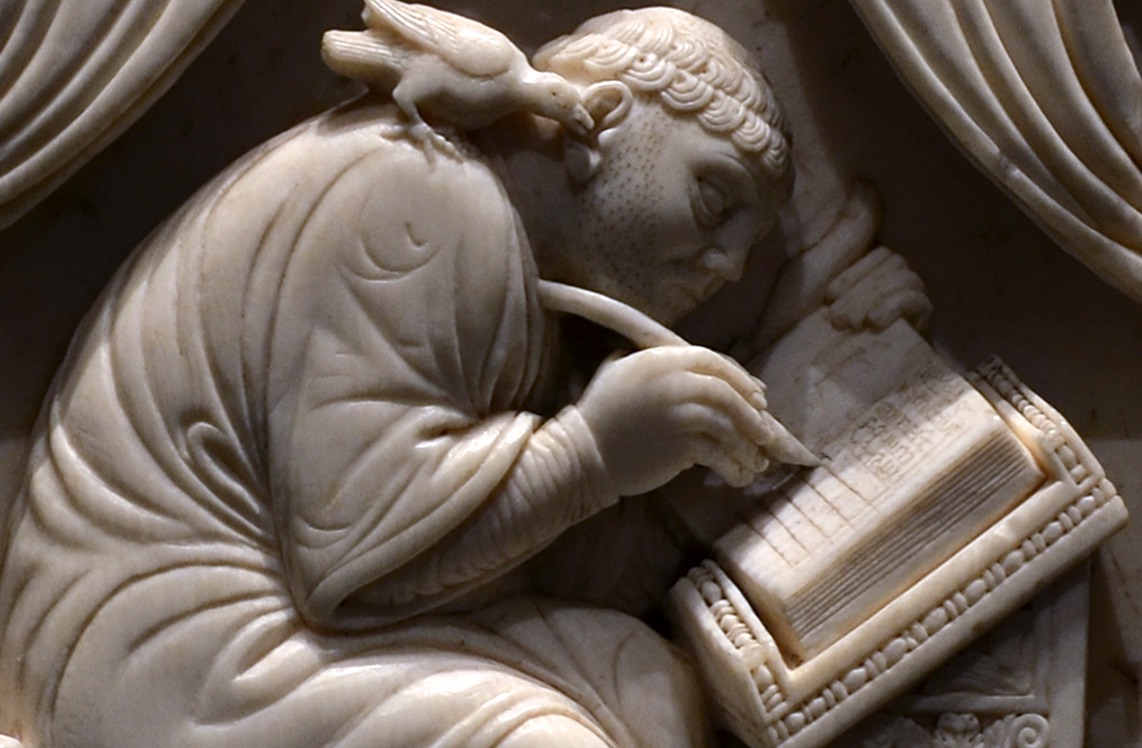
September 3rd is  the feast of St. Gregory the Great, many say the greatest of the popes. I’m sure he never thought of himself as great, he was too absorbed in the troubled times he lived in. Usually saints are recalled on the day of their death or martyrdom, but Gregory’s remembered the day he became pope, September 3, 590. That was a day of martyrdom for him.

Years ago, I lived across the street from Gregory’s home on the Celian Hill in Rome. On my way to school, I would peek through the ancient doors of the library of Pope Agapitus, a relative of Gregory’s, where archeologists were trying to learn about what was once the largest Christian library in Rome. Barbarian tribes later plundered the place on their regular sweeps through the city.

Those were bad times. Gregory was called from his monastery here on the Celian to become pope, but also to take charge of  a city under siege. He never was a healthy man and he never had much support. Most of Rome’s leading families fled to safer parts; the imperial government relocated in Milan. The burden of the city and the church fell on him.

Called to a job he didn’t want, Gregory drew wisdom and strength from the scriptures, especially from figures like Job and Paul the Apostle, who taught him that strength can come to weak “earthen vessels” like himself.

In his Commentary on Ezechiel, which we read in the Office of Readings, Gregory describes what he went through. Like Ezechiel, he was appointed a watchmen in the city, supposed to go up to the heights and see what’s coming, but “I’m not doing this very well, ” Gregory said.

“I do not preach as well as I should nor does my life follow the principles I preach so inadequately.
“I don’t deny my guilt, I get tired and negligent. Maybe by recognizing my failure I’ll win pardon from a sympathetic judge. When I lived in the monastery I was able to keep my tongue from idle topics and give my mind almost continually to prayer, but since taking on my shoulders the burden of pastoral care, I’m unable to keep recollected, with my mind on so many things.

“I have to consider questions affecting churches and monasteries and often I have to judge the lives and actions of individuals; I’m forced to take part in certain civil affairs, then I have to worry about barbarians attacking and wolves menacing the flock in my care; I have to do my political duty to support those who uphold the law; I have to put up patiently with thieves and then I have to confront them, in all charity.

“My mind is torn by all the things I have to think about. Then I have to put my mind on preaching. How can I do justice to this sacred ministry?

“Because of who I am I have to associate with all kinds of people and sometimes I say too much. But if I don’t talk to them the weaker kind of people wont come near me, and then we wont have them when we need them. So I have to listen to a lot of aimless chatter.

“But I’m also weak myself and I can get drawn into gossiping and then find myself saying the same things I didn’t care to listen to before.

“Who am I — what kind of watchman am I? I’m not standing on the heights, I’m in the depths of weakness. And yet the creator and redeemer of all can give me, unworthy though I am, the grace to see life as it is and power to speak effectively of it. It’s for love of him that I do not spare myself in preaching him.”

We have to admire Gregory, don’t we? He feels weak, but he’s a watchman looking out for his city and his church. Weakness doesn’t prevent him from serving or being far-sighted. From the Celian Hill Gregory sent monks to England, to the ends of the world, to found the church there. On his tomb in the Vatican is the simple inscription that describes him so well. “Servant of the servants of God.”

Today, Mother Theresa’s community lives on the land where Gregory’s home once was, on the Celian Hill, next to the ancient church of Saints John and Paul. They say Gregory took in 12 poor people for a meal almost every day. The poor are still taken care of where he once lived.

I hope to visit there in a few weeks.

22nd Sunday A: Thinking Like Human Beings Do


For today’s homily, please play the video below:


Why Read the Old Testament?

Some people complain about the selections from the Old Testament we’re reading at weekday Mass these past few weeks. Too long, they say, they don’t tell us anything. They’d rather hear what Jesus is saying and doing.

Why do we read from the Old Testament? Reading from the Old Testament is a lot like reading from the New York Times or the Daily News, or following David Muir on ABC each evening. You’re not going to hear much about Jesus there either. The media gives us the news of the day as it happens and, especially these days, it’s not encouraging.

Not much encouraging news in our Old Testament reading today from the Book of Numbers either. (Numbers 13-14) Giants are out there blocking the way to the promised land. Israel’s scouts face giants as they reconnoiter the world ahead. There’s no way ahead.

Our media tells us the same: giants are blocking our way– North Korea, the Middle East, storms from climate change, political giants who seem to get in the way of a world of justice and peace. And we don’t have answers what to do.

But the Old Testament tells us more than the media. It’s salvation history. More than the story of the Jews, the Old Testament is the story of the human race and all creation on a journey, from the beginning of time to its end. Human sinfulness, tragedies and delays are there, but the story begins and ends in hope. God is there.

That makes the Old Testament stories so different from the stories the media serves up everyday. God is there from the beginning. That’s the way our selection today from the Book of Numbers begins: “The LORD said to Moses [in the desert of Paran,]‘Send men to reconnoiter the land of Canaan,
which I am giving the children of Israel.’” And God is there as his people experience the consequences of their foolishness and lack of faith.

The columnist David Brooks in the Times yesterday said he has to think less about Donald Trump or he’s going to go crazy. He needs to think more about the deeper shifts taking place in society, he says.

I wonder if thinking about the deeper shifts is enough to stop you from going crazy these days. We need hope from another source. That’s where the Old Testament and the rest of the scriptures comes in. Some prefer calling it the “First Testament.” It testifies that the first thing to keep in mind about time is that God is there, from beginning to the end. God is our Savior.

17th Sunday a: Finding Life’s Treasures

For today’s homily, please play the video below:

The Martyrs of Daimiel


Wars, especially civil wars, can bring unspeakable violence. The Spanish Civil War in the 1930s is a good example. There were atrocities on both sides. Innocent people were among its victims, and suffered for no reason at all.

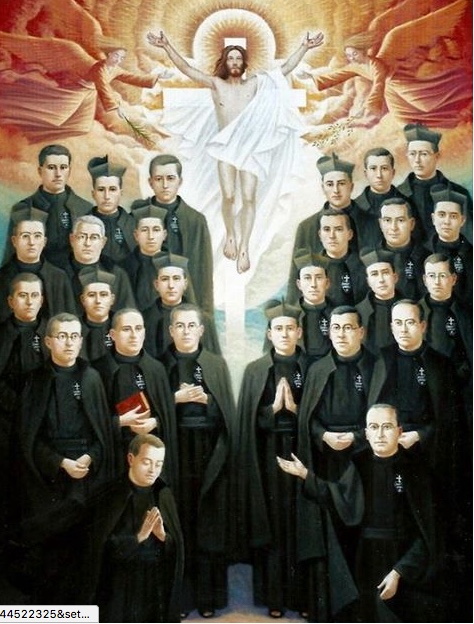
The Martyrs of Daimiel, Spanish Passionists from my own community, most of them young students for the priesthood preparing for missionary work in Cuba and Mexico, were killed in 1936. It’s a tragic story, but also a story of God’s grace shining through human evil..

Between July 22nd and October 24th, 1936, twenty-six religious from the Passionist house of studies, Christ of the Light, outside the city of Daimiel, about eighty miles south of Madrid, died at the hands of anti-religious militiamen at the outbreak of the Spanish Civil War. They were: Niceforo Diez Tejerina, 43, provincial superior, who previously served as a missionary in Mexico and Cuba after being ordained in Chicago, Illinois.; Ildefonso García Nozal, 38; Pedro Largo Redondo, 29; Justiniano Cuestra Redondo, 26; Eufrasio de Celis Santos, 21; Maurilio Macho Rodríguez, 21; Jose EstalayoGarcia, 21; Julio Mediavilla Concejero, 21; Fulgencio Calv Sánchez, 19; Honorino Carraced Ramos, 19; Laurino Proáno Cuestra, 20; Epifanio Sierra Conde, 20; Abilio Ramos Ramos, 19; Anacario Benito Nozal, 30; Felipe Ruiz Fraile, 21; Jose Osés Sainz, 21; Felix Ugalde Irurzun, 21; Jose Maria Ruiz Martinez, 20; Zacarias Fernández Crespo, 19; Pablo Maria Lopez Portillo, 54; Benito Solano Ruiz, 38; Tomas Cuartero Gascón, 21; Jose Maria Cuartero Gascón, 18; German Perez Jiménez, 38; Juan Pedro Bengoa Aranguren, 46; Felipe Valcobado Granado, 62.

Most of those killed were young religious studying for ordination and destined for missionary work in Mexico and Cuba. Others were priests who taught them and brothers who served in the community. Father Niceforo, the provincial, was visiting the community at the time. Militiamen entered the Passionist house on the night of July 21st and ordered the thirty-one religious to leave in one hour. Father Niceforo gathered them in the chapel, gave them absolution, opened the tabernacle and said: “We face our Gethsemane. . . all of us are weak and frightened,but Jesus is with us; he is the strength of the weak. In Gethsemane an angel comforted Jesus; now he himself comforts and strengthens us. . .Very soon we will be with him. . .To die for him is really to live. . . Have courage and help me by your example.”
He then distributed the sacramental hosts to them.

The militiamen ordered the group to the cemetery and told them to flee. At the same time, they alerted companions in the surrounding areas to shoot the religious on sight. The Passionists split into five groups. The first group of nine was captured and shot outside the train station of Carabanchel in Madrid on July 22, 1936 at 11pm. The second group of twelve, Father Niceforo among them, was taken at the station at Manzanares and shot by a firing squad. Father Niceforo and four others died immediately. Seven were taken to a hospital where one later died. Six of them recovered, only to be shot to death later on October 23, 1936.

Three other religious, traveling together, were executed at the train station of Urda (Toledo) on July 25th. Two gave their lives at Carrion de Calatrave on September 25th. Only five of the thirty-one religious were spared.

Numerous eye-witnesses testified afterwards to the brave faith and courage shown by the Daimiel Community in their final moments, especially the signs of forgiveness they gave their executioners. They were beatified by Pope John Paul II on October 1, 1989, who said of them: “None of the religious of the community of Daimiel was involved in political matters. Nonetheless, within the climate of the historical period in which they lived, they were arrested because of the tempest of religious persecution, generously shedding their blood, faithful to their religious way of life, and emulating, in the twentieth century, the heroism of the Church’s first martyrs.” (Homily: October 1, 1989) Today their bodies are interred in the Passionist house at Daimiel.

Their feastday is July 24th. They’re remembered still at their shrine in Daimiel, Spain.