I attended a beautiful Methodist funeral this week at a funeral home in Ocean Grove, New Jersey. I prayed and sang with the members of the family and their friends. Some years ago, before the Second Vatican Council, I would have been told “In no way is it permitted for the faithful to take part in any way in non-Catholic services.” (Canon 1258)
We have come a long way in our relations with other Christian churches and other religions. In the days of St. Francis de Sales in the 16th century, Christian churches were fighting each other over religion. Francis de Sales as the bishop of Geneva, Switzerland, chose to approach religious differences through dialogue and not arms. His approach anticipated the Vatican Council decrees on Ecumenism (Unitatis Redintegratia) and Non-Christian Religions (Nostra Aetate) which told Catholics to respect the religious beliefs of others and dialogue with them.
Dialogue means listening to the other and offering what you know in return. It’s an on-going process that ultimately, I think, has its roots in the created world we live in, which we know little by little. The word “respect”is a beautiful word, meaning “looking again,” Francis de Sales based his spirituality on respect for the variety of creation. We’re “living plants” in the garden of the world. We need to keep “looking again.”
And while we respect others, we need to “look again” at our own tradition to appreciate it and see it “ever ancient, ever new.”
We’re ending the Church Unity Octave on the Feast of the Conversion of St. Paul, the Apostle, January 25th. St Francis de Sales, St. Paul the Apostle, St. Paul of the Cross, pray for us.
This particular Gospel (Jn 1: 29-34) makes me think about the wonder and power of an encounter with the Living God, especially when it is so tangible or physical:
John the Baptist saw Jesus coming toward him and said, “Behold the Lamb of God, who takes away the sin of the world. He is the one of whom I said, ‘A man is coming after me who ranks ahead of me because He existed before me.’ I did not know Him, but the reason why I came baptizing with water was that He might be made known to Israel.” John testified further, saying, “I saw the Spirit come down like a dove from the sky and remain upon Him. I did not know Him, but the One who sent me to baptize with water told me, ‘On whomever you see the Spirit come down and remain, He is the One who will baptize with the Holy Spirit.’ Now I have seen and testified that He is the Son of God.”
The Baptist must have said these last words in such a state of joy. He certainly appreciated and needed a moment like this, after waiting and working for so long. All of us do. We who feel compelled to tell the world that God is real, loving, and present, need always to return to the source of this Light in order to find the strength to persist in what often seems like a hopeless task.
This passage makes me think of the blessed power of the Eucharist. Here we come as close as possible to the experience of the Baptist when he “saw Jesus coming up to him.” Through the light of God’s given faith we “see” the Holy Spirit of God hovering over our Beloved Jesus, when the priest prays: “ May this same Holy Spirit graciously sanctify these offerings that they may become the Body and Blood of our Lord Jesus Christ…”
This incredible infusion of grace can go a long way in enabling us to live the Christian example to the world, even as we endure so many challenges and sorrows that come our way.
One important lesson that we could learn is to approach all of this with humility. We will not save the world. It is too big a task. Perhaps a little contribution to Love is all we can give. I look at all the divine examples in this Gospel. Our Omnipotent Lord is compared to a lamb, a Suffering Servant coming as a sheep to the shearers. The Giver of Life, the Spirit of God, manifests Himself, not as a powerful Roman eagle, but as a gentle dove, like the doves that were the most that the poor could afford as sacrifices for the temple. This is the God of the impoverished and the powerless. In the Eucharist the Powerful One comes to us as a humble, little, thin wafer, tp give us the strength to do the little things that together add up to the salvation of the world.
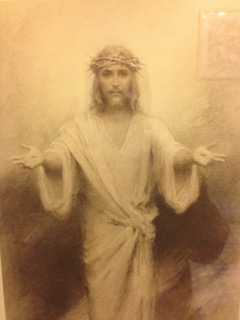
Just in case anyone reading this has not been to Mass in a while, come join us at the humble feast, even if the church is half-empty. Rather than just seeing, you might get the chance to behold. You just might be surprised to find our Savior, Jesus, walking right up to you! That’s what happened to me.
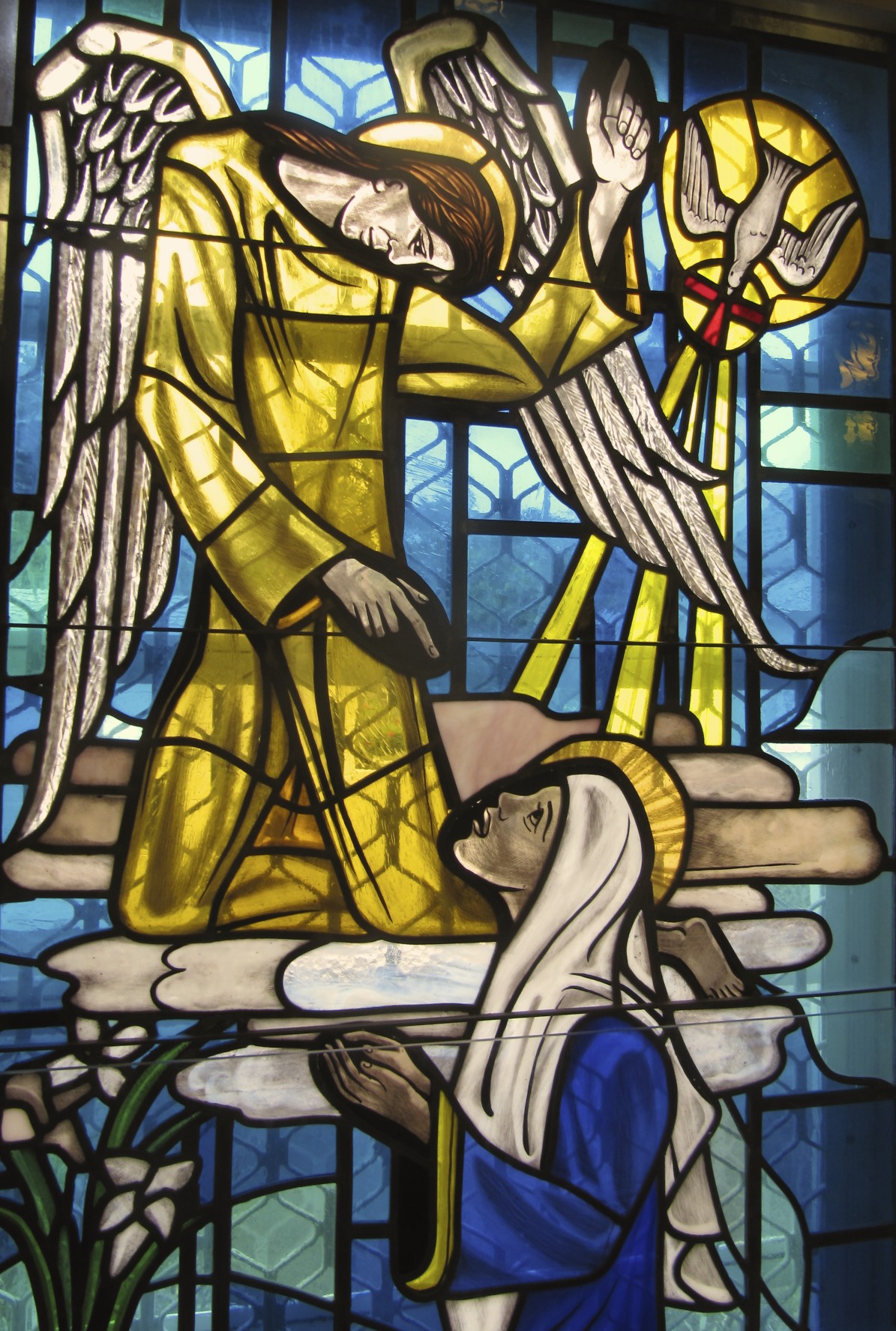
The angel came to Mary in Nazareth, the last place we might expect an angel’s message. In this little known place, Jesus became flesh. In this young unknown woman, he came to dwell among us.
It wasn’t in Jerusalem, in the temple where God’s Presence was proclaimed. It was in Nazareth, in the quiet hills of Galilee, on a routine day, that He came.
We celebrate the mystery of the Incarnation and pray, “Pray for us, O holy mother of God, that we may be made worthy of the promises of Christ.”
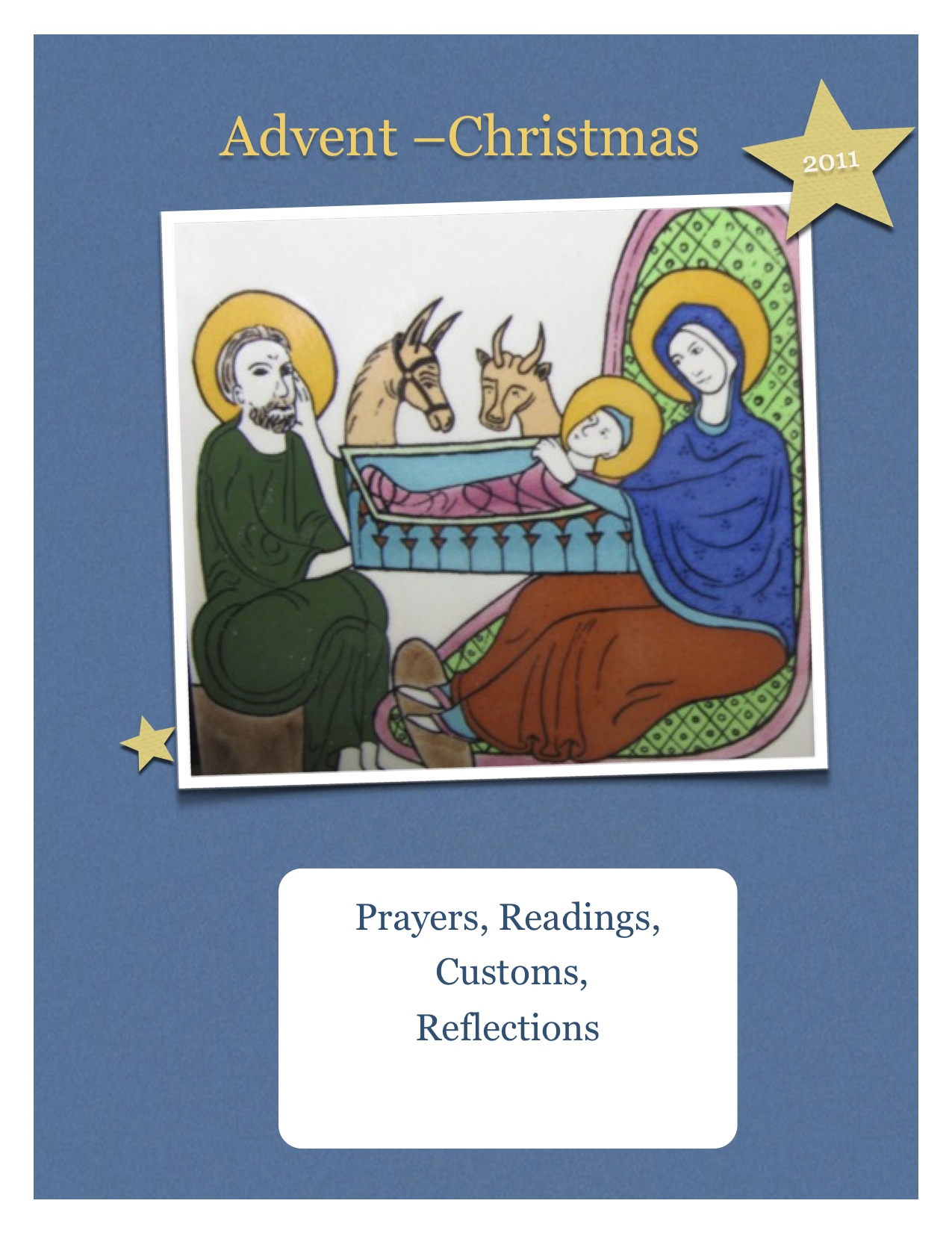
To reach God’s holy mountain there’s a journey to make, Isaiah says, but guides will show the way. “Behold, I send my messenger ahead of you, to prepare your way.” Mark 1, 1. John the Baptist appears in the desert promising forgiveness to those washing in the waters of the Jordan River. We have been baptized in the waters of baptism.
The Old Testament readings this Advent week, mostly from Isaiah, describe a desert journey, but the desert will bloom and a highway will be there, the prophet promises. (Monday) God will speak tender, comforting words to his people on the way. (Tuesday) Those who hope in him will renew their strength, soaring on eagle’s wings. (Wednesday) Though we are as insignificant as a worm, God holds us in his hands and says:“Fear not; I am with you.” (Thursday) God is our teacher and shows us the way to go. (Friday) On the way, prophets like Elijah accompany us. (Saturday)
Jesus is our way, the gospel readings say. He healed and forgave the paralyzed man– symbol of a paralyzed humanity– who was lowered through the roof into the house in Capernaum. (Monday) Like a good shepherd he searches for and finds the stray sheep. (Tuesday) “Come to me all who are weary, ” he says. (Wednesday) He sends us prophets and guides like John the Baptist and Elijah.( Thursday) Though rejected like John the Baptist, Jesus still teaches. (Friday)
He will save us, even though unrecognized like John and Elijah. (Saturday)
List of Readings
Monday: Isaiah 30, 1-10 The desert will bloom and a highway will be there, a holy way.Luke 5,17-26 The paralyzed man, lowered through the roof, is healed and forgiven.
Tuesday: Isaiah 40,1-11 The desert is a way to the Lord. Comfort my people. Mattthew 18, 12-14 The shepherd searches for the stray sheep.
Wednesday: Isaiah 30,25-31 God is the strength of his people. Matthew 11,28-30 “Come to me all who are weary…”
Thursday: Isaiah 41,13-20 God says, “I will grasp you by the hand. Fear not.”Matthew 11,11-15 John the Baptist is sent like Elijah.
Friday: Isaiah 48-17-19 I teach you what’s for your good and lead you on the way to go. Matthew 11,1-19 John and Jesus rejected as teachers.
Saturday: Sirach 48,1-4; 9-11 Elijah, precursor of John. Matthew 17, 9-13 Elijah and John not recognized.
Isaiah 2,1-5 All nations will come to this mountain
Matthew 8:5-11: The Roman centurion at Capernaum.
In 8th century Jerusalem Isaiah makes glowing promises about the holy mountain, Jerusalem– all people will come there. At the same time, Assyrian armies rumble into Palestine. “What are you talking about?” people say, “Can’t you see what’s at the door?”. But the prophet insists they will beat their swords into plowshares, their spears into pruning hooks and there will be no wars any more.
The prophet continues making outrageous promises. There will be a cloud by day and a fire by night over this holy mountain. The mountain’s moving, on an exodus of its own. Wonderful imagery for solid institutions, like churches and nations, that have been around for centuries. You’re still on the move, and God will guide you.
The Assyrians must have had the equivalent of the Roman centurions as the backbone of their armies. If you can get to them, you’ve got the army, military analysts would say. Powerful men, loyal soldiers. They could tell their troops: “Lay down your swords and spears,” and it would be done.
The Roman centurion in today’s gospel comes humbly before Jesus. “Lord, I am not worthy that you come under my roof, but say the word and my servant will be healed.” He comes with a faith not found in Israel.
The Messiah will touch the proud and the strong. The centurion is one of them.
Andrea Oliva Florenda, a professor at St. John’s University in Queens, New York, offered a day of reflection on Mary Gardens, December 1 at Bishop Molloy Retreat Center, Jamaica, New York. Professor Florenda teaches in the department of theology and religious studies at St. John’s, specializing in Marian theology. She’s also the designer and curator of the Marian Garden at the university.
Mary Gardens, dedicated to Mary, the Mother of Jesus, appeared in Europe following the Black Death, a pandemic that caused millions of deaths in that part of the world in the 14th century. The gardens, usually found in monasteries and religious shrines, brought hope to people walking “in the shadow of death.”
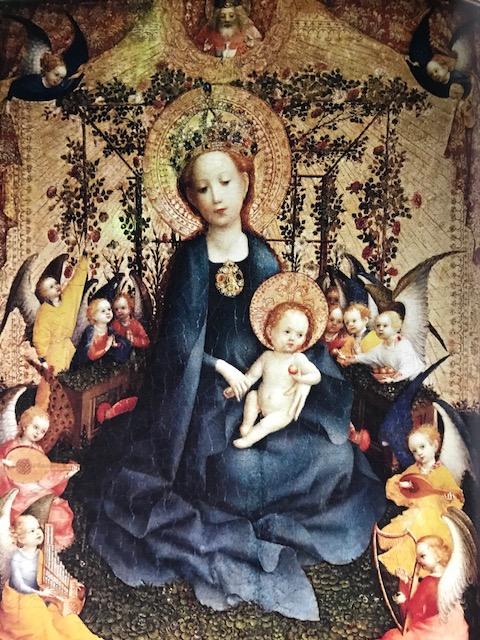
God placed Adam and Eve in a garden, Christian tradition says. (Genesis 2, 8-28) Rising from the dead, Jesus proclaimed eternal life in a garden. (John 20,11-18) For early and medieval Christians, Mary appeared as a garden enclosed, flowers, plants and trees surrounded her, “our life, our sweetness and our hope.” The Mary Garden, which became a favorite inspiration for medieval and renaissance artists, brought the promise of life to the “poor banished children of Eve.”
Does the Mary Garden have a role today in a world facing climate change and environmental degradation? Professor Florenda thinks it does. Besides the mysteries of faith, it teaches reverence for creation, for the soil, for plants that feed us and bring healing, for flowers that nourish our sense of beauty.
Certainly science and technology have a large part to play in the current environmental movement, but Professor Florenda notes the number of young people, from various religious tradition drawn to her Mary Garden at St. John’s, where the mysteries of seed and soil unfold, where pharmacy students study medicinal herbs and seasonal vegetables feed the poor.
The day of reflection on Mary Gardens ended at the grotto honoring Mary in the garden of Immaculate Conception Monastery in Jamaica. There, Professor Florenda spoke about the meaning of the grotto, its structure and the plants and trees surrounding it.
“There is a language in each flower,
that opens to the eye,
A voiceless but a magic power.
A prayer in earth’s blossoms lie.” Anonymous
To listen to the audio of today’s homily please select file below:
Some years ago I went to Rome to visit churches. One was the Church of Saint John Lateran.
Churches have stories, which is especially true of St. John Lateran. It’s the first of the great Christian churches built by the Emperor Constantine after coming to power early in the 4th century. He gave Christians freedom to practice their religion throughout the Roman empire. He also built them churches and St. John Lateran was the first of the many he built. At its entrance is an inscription, “The mother of churches”; it’s been there for 1500 years.
The church, holding 10,000 people, was dedicated around 320 AD. Rome’s Christians must have been thrilled as they entered it.. Many were persecuted or has seen relatives, friends or other believers jailed or put to death during the reign of Diocletian, before Constantine.
Now, a new emperor honored them by building a church, a great Christian church, that everyone in Rome could see. He built it on property belonging to enemies of his, the Laterani family, which is why it’s called St. John Lateran. It’s situated on the southeastern edge of the city, away from the Roman Forum, because Constantine didn’t want to antagonize followers of the traditional religions. Still, the Lateran church was a sign that Christianity had arrived.
Before this, throughout the Roman empire, Christians had no churches but met in ordinary homes or small buildings. In Rome itself there were about 25 homes where they met and worshipped.
That in itself made people wonder about them. Why didn’t Christians participate in public rites and religious sacrifices conducted for the good of the empire, as good Romans did? What kind of religion was this anyway, people said? They’re godless, atheists. The 2nd century pagan writer Celsus saw them plotting rebellion, these “ people who cut themselves off and isolate themselves from others.” (Origen, Contra Celsum,8,2)
So, the building of the church of St. John Lateran was a signal of changing times. After centuries meeting apart in homes and small community settings, Christians now gathered as one great family.
That’s what churches do; they bring people together as one body, one family, one people. That’s how Paul described the church in his Letter to the Romans: “As in one body we have many members, and all the members do not have the same function, so we, though many, are one body in Christ, and individually members one of another.” (Romans12, 4-5)
An important part of the church of Saint John Lateran is its baptistery, a large building connected to the church itself, worn and patched, as you would expect from a building over 1500 years old. You can still see bricks from Constantine’s time. This is where for centuries Romans have been baptized. Conveniently, it’s built over a Roman bath, for a good supply of water for baptism. The church is called St. John Lateran because St. John the Baptist is one of its patrons, along with St. John the Evangelist. A beautiful Latin inscription is over the big baptismal basin and fount.
Those bound for heaven are born here,
born from holy seed by the Spirit moving on these waters.
Sinners enter this sacred stream and receive new life.
No differences among those born here,
they’re one, sharing one Spirit and one faith.
The Spirit gives children to our Mother, the Church, in these waters.
So be washed from your own sins and those of your ancestors.
Christ’s wounds are a life-giving fountain washing the whole world.
The kingdom of heaven is coming, eternal life is coming.
Don’t be afraid to come and be born a Christian.
One last thing about St. John Lateran, which many people don’t know. It’s the pope’s church. From the time of Constantine till the 15th century, the popes as leaders of the Church of Rome resided next to this church. Then, they moved to the Vatican, where they live today.
Celebrating the dedication of a church, as we are doing today, reminds us how important church buildings are for teaching us our faith. God speaks to us in our churches, God comes to us in our churches.
“Do you not know that you are the temple of God,
and that the Spirit of God dwells in you?” St. Paul says.
A spiritual writer beautifully described a listening heart at prayer. “Here I am, Lord. I hear your knocking at my door, as each person or event comes across my life”. How may we grow into this listening person.
A listening heart, first of all, is a heart that is open; namely, open to the heart of God, open to the heart of another person, open to the heart of our world. As someone put it: “When you listen, check your worries at the door”.
Secondly, when we deeply listen, we are also touched by the other. We weep with those who weep, we rejoice with those who rejoice. We are listening not just to their words but also to their feelings.
Finally, a listener responds to the other. Listening is not passive but active. Sometime ago there was a middle age gentleman, who was single and had his own business. He was invited by friends on a pilgrimage. The first evening there was the rosary. During the service, a thought came to him which he never had before: “Be a Priest”. When he returned home, the thought remained with him. He sought the counsel of a priest. The priest encouraged the gentleman. In time he sold his business, his home and entered the seminary. Today he is a Passionist Priest. He had a listening heart. He was open to the word, he was touched by that word, and he responded fully to the word.
The art of listening can have many faces. For example it can be a way of ministry. How often a person might say to us: ‘Thank you for listening’.
Listening can also be a way of being ministered to. We are blessed to have a confidant or friend who is there for us.
Finally, listening is a way of prayer. How often we might see an elderly couple sitting quietly with each other. A beautiful image of the soul with God.
Speaking of prayer, we end the way we began. “Here I am, Lord. I hear your knocking at my door, as each person or event comes across my life”.


 The Victor's Place