Category Archives: Passionists

The Churches the Apostles Left Behind

Fr. Don Senior, in his  biography of Fr. Raymond Brown the American scripture scholar, says that one of Brown’s best books was “The Churches the Apostles Left Behind.” Scholars like Brown and Senior say the apostles left churches behind, not one monolithic church that was everywhere the same. The Gospel of Mark, for example, is different from the Gospel of John and it comes from a church different from the church represented in John. There was not one orderly church, but squabbling, disorderly churches, yet churches just the same.

The New Testament churches were developing churches, the scholars say. They describe them as being on a trajectory. They’re not set in stone or isolation or perfect; they’re interacting with each other and their time. And by the power of the Spirit they’re developing slowly into the church that Jesus wants to bring about.

These insights have great consequences for ecumenism, for one thing. The churches the apostles left behind help us understand Christian churches today and the challenge to keep on a trajectory towards Christian unity.

That’s true also of the particular church we may belong to. I’m thinking of something one of the people who comes to our 11 o’clock Mass here at the monastery told me recently. She enjoys the different priests who celebrate that Mass here, she said. “You’re all so different. In fact, I don’t know why you don’t kill each other.”

Certainly one of the reasons why we don’t kill each other is the presence and patience of Jesus himself. For all his complaint about his own generation, Jesus never gave up on it, but gave himself to it day by day, as he does for us. Our prayer and liturgy together keeps us on the path that leads to what God wants us to be.
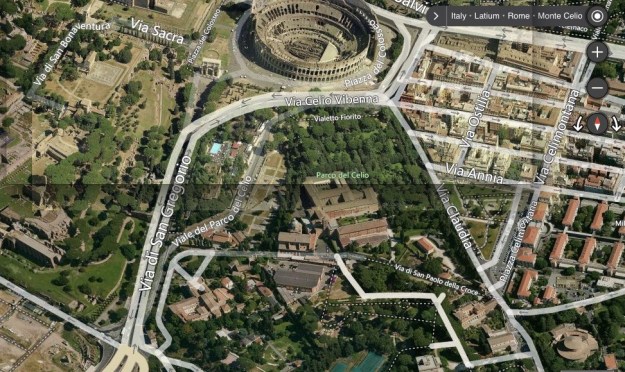
Visiting Gregory the Great; September 3

Church of St. Gregory the Great, lower left, off Via di San Gregorio (google maps)

Morning Prayer: A Genesis Prayer

img_0325

We may think morning prayer is a few mumbled words or the Sign of the Cross quickly made, but morning prayer is meant to be an important part of our experience as we wake from darkness and sleep.

“Let there be light and there was light; and God said it was good.” (Genesis 1, 3-4) Light was the first thing God made. True Light, which enlightens everyone, came into our world, John’s gospel says. ( John 1, 9)

I sit on the porch for a few minutes in the early morning and watch the sun come through the tall trees lining our garden to the east. In winter it takes awhile. In summer, the sparrows and the doves and sometimes a pair of cardinals gather at the bird feeder to begin the day. Before I do a thing, the world gradually is bathed in light and comes awake.

Before I do a thing.

Morning prayer is a Genesis Prayer, an assurance we shouldn’t miss. Light comes to our world today, True Light, as it was from the beginning. Darkness is a sign of the world that’s chaotic. The psalms and hymns of morning prayer say light comes, and we pray our eyes be open to see.

The images in morning prayer are important. In the beginning God created a garden, a symbol of the world ordered and in harmony, beautiful and fruitful. God is the great Gardener, a king enthroned over creation, and all is God’s garden, the morning psalms say.

“Shout to the Lord all the earth, ring out your joy…Let the sea and all within it thunder praise, the world and all its peoples. Let the rivers clap their hands, and the hills ring out their joy. Rejoice at the presence of the Lord, for he comes to rule the earth.” (Psalm 98, Wednesday Morning 111)

The world, however chaotic it seems, is cared for by the One who made it.

Sometimes God is a Shepherd, a Great Shepherd bestriding the world: “Here comes with power the Lord God…Like a shepherd he feeds his flock, in his arms he gathers his lambs, carrying them in his bosom and leading the ewes with care.” (Isaiah 40, Thursday Morning 111)

Sometimes we’re asked to see the world as a city, God’s holy city. “On the holy mountain is his city, cherished by the Lord…a holy city.” (Psalm 87 Thursday Morning III) We’re asked to see our world as holy, yet still to be built.

“Sing a new song to the Lord; sing to the Lord, all the earth; sing to the Lord and bless his name.” we’re told as we begin the day. (Psalm 96. Monday Morning, 111)

“Serve the Lord with gladness, come into his presence singing for joy.”

Silent Clay

The daily Mass readings for Eastertime, from the Acts of the Apostles and the Gospel of John, are so different in tone. The Acts of the Apostles is a fast-moving account of a developing church spreading rapidly through the world through people like Paul of Tarsus and his companions. Blazing new trails and visiting new places,  they’d be frequent flyers today, always on the go.

The supper-room discourse of Jesus from the Gospel of John, on the other hand,  seem to move slowly, repeating, lingering over the words of Jesus to his disciples. Listen, be quiet, sit still, they say. Don’t go anywhere at all.

St. Paul of the Cross, the founder of the Passionists, was inspired by St. Paul, the Apostle, to preach and to teach. Many of his letters end telling readers he has to go, he’s off to preach somewhere. He was a “frequent flyer.”

But the Gospel of John also inspired him; it was the basis for his teaching on prayer. Keep in God’s presence, in pure faith, he often said. Enter that inner room and remain there. Don’t go anywhere.

“It’s not important for you to feel the Divine Presence, but very important to continue in pure faith, without comfort, loving God who satisfies our longings. Remain like a child resting on the bosom of God in faithful silence and holy love. Remain there in the higher part of your soul paying no attention to the noise of the enemy outside. Stay in that room with your Divine Spouse…Be what Saint John Chrysostom says to be: silent clay offered to the potter. Give yourself to your Maker. What a beautiful saying! What the clay gives to the potter, give to your Creator. The clay is silent; the potter does with it what he wills. If he breaks it or throws away, it is silent and content, because it knows it’s in the king’s royal gallery.”  (Letter 1515)


What Does the Risen Christ Look LIke?

Many of us  learned our faith from catechisms and sermons and pictures on the windows and walls of our churches. Xavier Leon-Dufour begins his classic work (Resurrection and the Message of Easter, New York, 1971) remembering trying to reconcile images he saw on the church windows of his youth with the gospel accounts he studied later. In art Jesus often appears as a revived corpse, his body and clothing brighter than before..

The church window above, based on Matthew’s Gospel, changes the way the gospel tells the resurrection story. Similar images appear often, especially in the Easter season.  Jesus risen from the dead appears like Lazarus raised from the tomb. But resurrection is different from resuscitation.

“After the sabbath, as the first day of the week was dawning, Mary Magdalene and the other Mary came to see the tomb. And behold, there was a great earthquake; for an angel of the Lord descended from heaven, approached, rolled back the stone, and sat upon it. His appearance was like lightning and his clothing was white as snow. The guards were shaken with fear of him and became like dead men.” Mt 28,1-5

According to Matthew, an angel descends from heaven, rolls back the stone and strikes fear in the guards at the tomb. Our stained glass window depicts Jesus Christ stepping from the tomb striking fear into the guards. The angel becomes an onlooker wearing green, the color of hope. Jesus looks rather like he did before he died and he would be recognized immediately.

The gospels, however, indicate he was changed. Mary Magdalene and the others have difficulty recognizing him– he’s changed. The disciples on the way to Emmaus recognize him after he quotes the scriptures and, finally,  breaks bread with them. The disciples at the lakeshore in Galilee are not sure who is he, until they eat with him.

The Risen Lord has entered another realm of existence. He is risen.  He remains with us mysteriously.  He does not blind us with  light, as he did Paul the Apostle. He does not appear in bodily form, as he was before his death. He  comes to us risen, risen indeed. Now, we meet him in the scriptures and the “breaking of the bread.” Also, just as mysteriously, we see him in the least. “When did we see you?”  is the question raised at judgment.

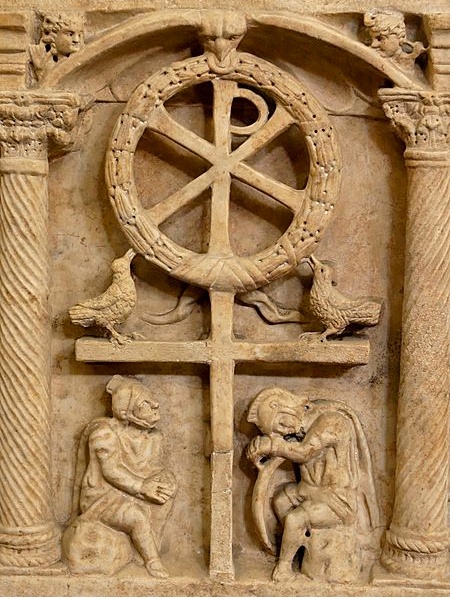
Early Christian art as seen in the 4th century portrayal from catacombs below, recognizing the mystery of the Resurrection, used symbolism to represent the Risen Christ. Jesus entered a new existence in his resurrection. It’s hard for artists and for us to depict that existence.

I mentioned Xavier Leon-Dufour earlier. Here’s what he said about the Risen Jesus:

“To speak of the resurrection of Jesus is to affirm that death has been conquered in one man at least: and to say that he lives forever is boldly to locate oneself at the end of time. It is a challenge for the unbeliever to revise his idea of life: for if one man is alive forever after his death, why not should the same be so for all men at the end of time? Why should there not be after death an existence called heaven?”  In that existence “life is changed, not ended.”

Resurrection

Weekday Readings: Third Week of Easter


Monday Acts 6,8-15; John 6,22-29
Tuesday Acts 7,58-8,1; John 6,30=35
Wednesday Acts 8,1-8; John 6,35-40
Thursday Acts 8,26-40; John 6,44-51
Friday Acts 9,1-20; John 6,52-59
Saturday Acts 9,31-42; John 6,60-69

The Mass readings this week continue from the Acts of the Apostles with the story of the Greek-speaking deacon Stephen. His fiery preaching against temple worship and “stiff-necked” Jewish opposition to Jesus results in his death and a persecution that drives Hellenist Christians out of Jerusalem. (Monday and Tuesday) But Stephen’s death, like the death of Jesus, brings new life. The church grows. “The death of Christians is the seed of Christianity.” (Tertullian )

Philip the Deacon, one of those displaced, preaches to the Samaritans north of Jerusalem. Then, led by the Spirit, he converts the Ethiopian eunuch returning home after his pilgrimage to Jerusalem. (Wednesday and Thursday} Following Philip’s activity, Paul, the persecutor, is converted by Jesus himself. (Friday)

Before Paul’s ministry begins, Peter leaves Jerusalem to bless the new Christian communities near the coast; at Joppa he’s told by God to meet the Roman centurion in Caesarea Maritima. The mission to the gentile world begins with that meeting. (Saturday)

Stephen, Philip, Peter and Paul serve God’s mysterious plan. It’s not human planning. The Holy Spirit is at work.

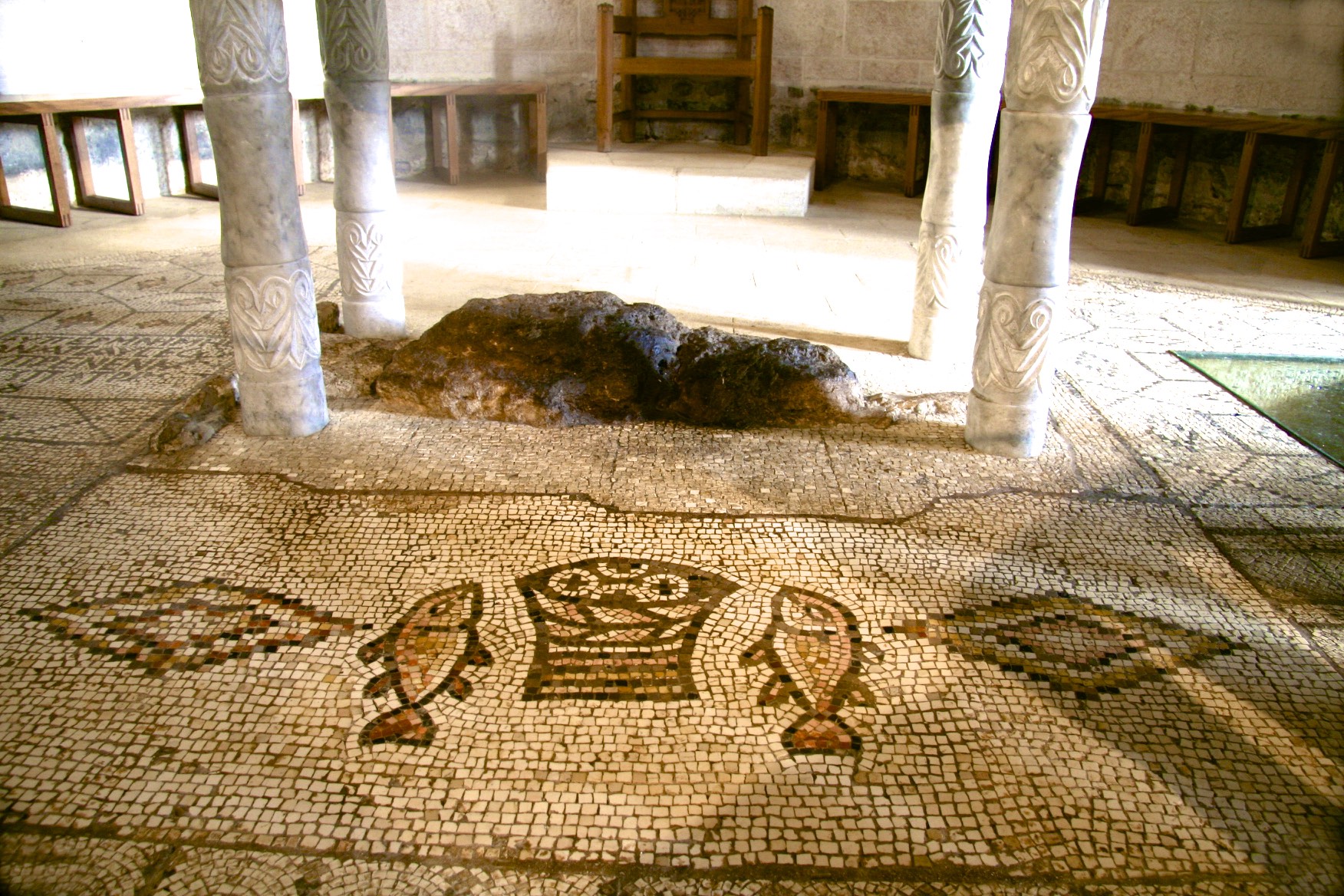
The gospel readings this week are from St.John’s gospel– segments of Jesus’ long discourse on the Bread of Life to the crowd at Capernaum after the miracle of the loaves. (John 6) In the Eucharist we meet the Risen Christ.  He not only feeds us personally, but a growing church is fed.

The Journey to Jerusalem

Jesus begins to set out for Jerusalem in today’s reading at Mass from the 10th chapter of Mark’s gospel. Matthew offers a similar account in the 19th and 20th chapters of his gospel.

Jesus doesn’t go to Jerusalem alone, he invites others to go with him. It’s a journey to resurrection and life and more than a couple of days, but as they hear Jesus describe the way to Jerusalem, people react like people do,

You can’t miss human weakness in the journey stories of Mark’s and Matthew’s gospel, beginning with the Pharisees. I suppose they represent human doubt and questioning that’s always there. The disciples rebuked the women bringing their children forJesus’ blessing, and Jesus rebukes them. Be like children to make the journey, Jesus tells them.

The rich young man wants to hold on to what he has, so he goes away sad. Peter says proudly he’ s given up everything to follow Jesus, but we know how inconstant he is. The story of the brothers, James and John, is obviously a story of human ambition.

1 Hundred Guilder Print
Rembrandt Hundred Guilder Print

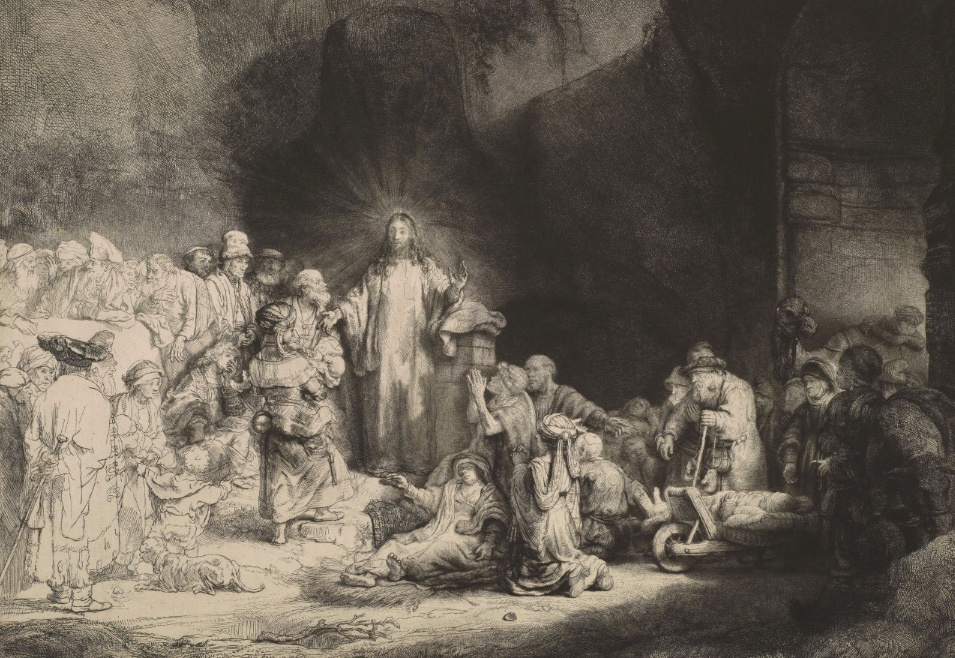
Matthew offers Mark’s stories in chapter 19 and 20 of his gospel. The artist Rembrandt drew a remarkable picture of the 19th and 20th chapter of Matthew called the Hundred Guilder Print.

Jesus stands at the center of Rembrandt’s work, bathed in light, his hands outstretched to the crowds before him.

Peter stands at Jesus right, close by. Other disciples, probably James and John, are next to him. Women and their children, whom the disciples told to go away, are next to them. The rich young man is also there in the crowd. Is he reconsidering?

Some of the enemies of Jesus who plotted against him and argued with him are also there, talking among themselves, but they’re still in the picture. Rembrandt even pictures the camel, back by the city gates.

Jesus sheds his light on them all. His arms are open to them all. Rembrandt has it right. Grace is more powerful than human weakness. It’s everywhere.

6th Sunday c: How Do We Get to Heaven?

For this week’s homily please play the video file below.

Fixing Our Eyes on Jesus


We’ve been reading the Letter to the Hebrews at Mass for two weeks now. It’s a good example of how time-conditioned our scriptures are. Those who listened to the letter long ago knew more about the temple in Jerusalem and its round of worship than we do today.  They were more familiar with the story of the exodus and they knew “the great cloud of witnesses” better than we do.. We’re far removed from their times.

We’re people of our age, wired to the absorbing images of our time. Hard as we try, the language of the bible can be hard to appreciate.

Still, one image from those times stands fresh and strong.. It’s the image of Jesus on the Cross.  We must “keep our eyes fixed on Jesus, the leader and perfecter of our faith,” the Letter to the Hebrews says. “For the sake of the joy that lay before him, Jesus endured the cross, despising the shame, and has taken his seat at the right of the throne of God. Consider how he endured such opposition from sinners, in order that you may not grow weary and lose heart.”

The passion of Jesus  speaks to every time and place. It’s a book anyone can read, a sign to get the attention of every age, for it makes  a startling claim. The Son of God, through whom all things were made, endured the shame of dying on a cross.  Jesus, wise and powerful, fell into the hands of his enemies. And it was all because of a wondrous love.

Fixing our eyes on him, our faith in God grows, the Letter to the Hebrews says. If we keep this mystery before us we won’t tire or lose heart. Fixing our eyes on Jesus means fixing our eyes on the eternal God.

So utterly simple. Beyond past images and time.


Document on Human Fraternity for World Peace and Living Together


Screen Shot 2019-02-06 at 8.49.53 AM

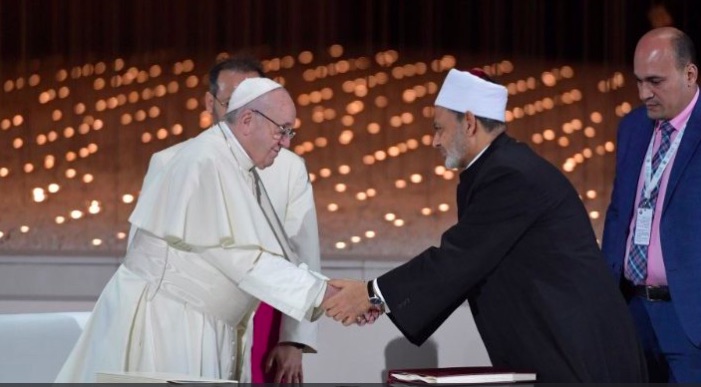
Pope Francis and the Grand Imama of Al-Azhar, Ahmad el-Tayeb,

“Something is happening.” That’s the way the great reading for our Holy Saturday liturgy, taken from an ancient homily, begins. We don’t see clearly yet, but something is happening.

And that’s the way I felt yesterday watching on YouTube a Mass at Abu Dhabi in the United Arab Emirates where more than one hundred thousand Christian migrant workers in the Middle East celebrated their faith with Pope Francis. Christianity is alive in the Middle East.

In the “Document on Human Fraternity for World Peace and Living Together” signed on Monday afternoon in Abu Dhabi by Pope Francis and the Grand Imama of Al-Azhar, Ahmad el-Tayeb, a path for the two religions and the world itself opened. Something is happening.

The document from leaders of these two great religious traditions, Christian and Muslim, is worth reflecting on.

It begins:
“In the name of God who has created all human beings equal in rights, duties and dignity, and who has called them to live together as brothers and sisters, to fill the earth and make known the values of goodness, love and peace,”

The document speaks for innocent human life, the poor, the destitute and the marginalized, the victims of destruction, calamities and war. It invokes the name of freedom, fraternity, peace and justice, the name of all people everywhere:

“In the name of God and of everything stated thus far; Al-Azhar al-Sharif and the Muslims of the East and West, together with the Catholic Church and the Catholics of the East and West, declare the adoption of a culture of dialogue as the path; mutual cooperation as the code of conduct; reciprocal understanding as the method and standard.”

“We, who believe in God and in the final meeting with Him and His judgment, on the basis of our religious and moral responsibility, and through this Document, call upon ourselves, upon the leaders of the world as well as the architects of international policy and world economy, to work strenuously to spread the culture of tolerance and of living together in peace; to intervene at the earliest opportunity to stop the shedding of innocent blood and bring an end to wars, conflicts, environmental decay and the moral and cultural decline that the world is presently experiencing.”

One commentator Tuesday said a meeting like this takes time for its meaning to be felt. “Something is happening.”