Category Archives: Passionists

Presentation in the Temple, February 2nd


DSC00129

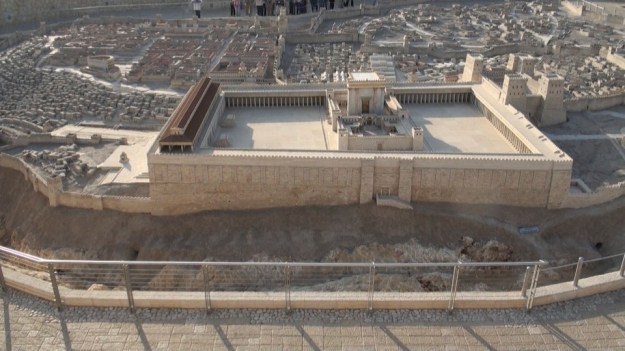
Temple of Jerusalem, 1st century, Israel Museum

The Presentation of Jesus in the temple, forty days after his birth, is a Christmas feast, even though our Christmas decorations are put away. It’s part of Luke’s Infancy Narrative.

The temple of Jerusalem– a reproduction is pictured above– plays a big part in Luke’s Infancy Narrative,  even more important than the stable to which the shepherds came.  The angel announced John’s birth to Zachary in the temple, and there Jesus is presented after his birth. Later, he will come to the temple as a young boy and  impresses its teachers, as he listens to them and asks them questions.

Luke doesn’t dwell on the rituals or appearance of the temple– he may not know much about them–but the temple for him is where God is present, and so it’s the place where Jesus would be recognized. Forty days after his birth, two elderly Jews, Simeon and Anna, recognize him. They’re  faithful believers who  represent the generations waiting for the Messiah.

Old Simeon takes the child in his arms:

“Now, Master, you may let your servant go
in peace, according to your word,
for my eyes have seen your salvation,
which you prepared in the sight of all the peoples:
a light for revelation to the Gentiles,
and glory for your people Israel.”  (Luke  2,22-40)

Afterwards in his gospel Luke describes the rejection of Jesus by his neighbors in the synagogue at Nazareth– neighbors who saw him so frequently but don’t recognize him. Here in the temple two faithful Jews, Simeon and Anna, waiting for years, receive him. The long wai in the temple has not dulled their eyes. In fact, it has made them sharper. They see salvation in this little child, ” a light of revelation to the gentiles, and the glory of  your people Israel.”

Presentation

So true, isn’t it, waiting can dull our eyes? Year by year can diminish what we expect and hope for. Day after day, faith can get tired. Prayers can become rote, sacraments can become routine. A holy place can become just another place.

It wasn’t so for these two elderly Jews. Their steady presence in the temple made them sharper, quicker to recognize the light that came to that place. We bless candles today, to burn in our church this year, and we pray that our church may never be dark but a place where we see the light of Christ and recognize his will for us and for our world.

“Outwardly Jesus was fulfilling the law, but in reality he was coming to meet his believing people. Prompted by the Holy Spirit Simeon and Anna came to the temple. Enlightened by the same Spirit, they recognized the Lord, so let us also gathered by the Holy Spirit, enter the house of the Lord and encounter Christ and recognize him in the breaking of the bread until he comes again, revealed in glory.”  (Feast of the Presentation)



3rd Sunday c: Go to Church

For this week’s homily please watch the video below.

The Epiphany Feast Isn’t Over!

Kings Point, New York

Like the Christmas feast, we can pass over the Feast of the Epiphany too easily. It can become a quaint story of no significance.

I spoke about the meaning of the Epiphany on Sunday at the Maritime Academy in Kings Point, New York, where young men and women are being trained for service on the ships that sail our seas and waterways. This feast should mean something to them.

The only gospel that records this story is the Gospel of Matthew, so why is it there?

Matthew’s gospel was written for Jewish Christians in Galilee and Syria some time after the temple in Jerusalem was destroyed by the Romans in the year 70. We can’t imagine how shocked they were by the complete destruction of the temple and the city itself. These were places where God’s promises would be fulfilled, they thought. The Messiah would appear there. This was where Jesus would come again. All nations would stream to Jerusalem, prophets like Isaiah foretold. Now they were gone.

Matthew’s gospel reminds his hearers–and us too–that Jesus must be known by all nations before he comes again. “Go and make disciples of all nations,” Jesus says in his final words in Matthew’s gospel, “baptizing them in the name of the Father and of the Son and of the Holy Spirit, teaching them to observe all that I have commanded you. And behold, I am with you always, until the end of the age.” (Matthew 28, 18-20)

Matthew’s story of the Magi is a reminder that even as Jesus is born, messengers, strangers, wise men from afar, want to know and acknowledge him as their king and God.

Jesus Christ came, our gospel says, not for only one people or nation, but for all. Though his ministry was first to the Jews, Jesus wishes to make the world one. God doesn’t wish to save a few. He wants to save all– all the world.

The Magi came, our story says, from the east. Could that be from Iran or Yemen; two places we hardly view positively today in our country? More and more, as we look at the world only through the lens of politics and economics; we fear the stranger, we reject the immigrant, we create enemies, we reject people not like us. We’re becoming tribal instead of global. We’re falling into individualism. As the old song said, we’re looking for “perfect peace, where joys never cease, and let the rest of the world go by.”

But we can’t let the rest of the world go by and we won’t be safe behind walls. We’re living in a big world that God wants to be one. That’s what the story of the magi tells us. We’re all commissioned on this Feast of the Epiphany, which is followed next Sunday by the Feast of the Baptism of Jesus, to go out into the whole world, “ baptizing them in the name of the Father, and of the Son, and of the Holy Spirit,” teaching them to observe all that Jesus commands. And he will be with us, even to the end of time.

I told the young men and women at Kings Point on Sunday that they’re commissioned as people of the sea. The oceans and waterways are highways uniting this world of ours. They shouldn’t be looked at only through the eyes of economics or politics. They’re meant to connect peoples, they’re bridges that make us one.

As I left the chapel, I met some people who are “furloughed” by the current government shut-down. We don’t have to look far to see how dangerous it is to see the world only through the eyes of politics and economics. We need a brighter star.

A Prayer for Thanksgiving Day

We Gather Together

Goodness and kindness
join us as we stand around
the dinner table.

Three generations of two families
join hands to give you thanks –
for this special day,
for your gifts of food,
for your many blessings.

We pray for loved ones who are absent
due to time and distance,
or who have gone before us to be with you.

We pray for those who are alone,
without family or friends on this special day,
on many days, or perhaps every day.
And we pray for those who will serve them
with good food, kindness, love and friendship
on this Thanksgiving Day.

We pray for peace, the peace only you can give.
We thank you and we love you.
Amen.

Gloria Ziemienski
November 22, 2018


Does God Get Your Vote?


Elections are going on today in the USA and  so how should people of faith engage in politics? The Book of Samuel tells us about politics in ancient Israel. “Appoint a king over us, as other nations have, to judge us,” the elders of Israel say to Samuel at Ramah. “We too must be like all the nations, with a king to rule us, lead us in warfare, and fight our battles.”

The Prophet Samuel is a reluctant king maker, however. He’s wary about kings and recognizes the dark side of political power.

“He will take your best fields, vineyards, and olive groves, and give them to his servants. He will tithe your crops and grape harvests to give to his officials and his servants. He will take your male and female slaves, as well as your best oxen and donkeys, and use them to do his work. He will also tithe your flocks. As for you, you will become his slaves.”

I suppose the advice we could take from this is: Don’t let people who govern have too much power. In a democratic society like ours that means being a well-informed and engaged citizen.  Know what’s going on and vote. It’s our duty as well as our right. As we go to cast a ballot–and how many will?– what about the common good? The good God wants?

There’s another piece of advice we can also hear in the Book of Samuel.  God complains to the prophet that the peoples’ demand for a king rejects God’s kingship. Some today might agree that politics is just for us humans; God has nothing to do with it.

But is God beyond the messy political world and has nothing to do with it?   Is it all about public opinion and counting heads? Or do we have to ask for God’s help with the way our world is run? The worse thing we can do is leave God out of it.

O God, come to our assistance. O Lord, make haste to help us.

To Pray is to Hope

Prayer is more than looking for something, like a cure for sickness or getting a job., In prayer we search  for something we do not even understand. It’s a hope we have for something beyond anything we know, St.Augustine writes to Proba, a woman asking him about prayer.

“There is one thing I ask of the Lord. This I seek: to dwell in the house of the Lord for years to come. To gaze on the loveliness of the Lord…” The psalms express that hope..

We have an “instructed ignorance,” the saint says, and the Spirit of God helps us in our weakness.

“The Spirit pleads for the saints because he moves the saints to plead… to plead with sighs too deep for words by inspiring in them a desire for the great and as yet unknown reality that we look forward to with patience. How can words express what we desire when it remains unknown? If we were entirely ignorant of it we would not desire it; again, we would not desire it or seek it with sighs, if we were able to see it.”

A Church with a Mission

241SsGiovanniPaolo

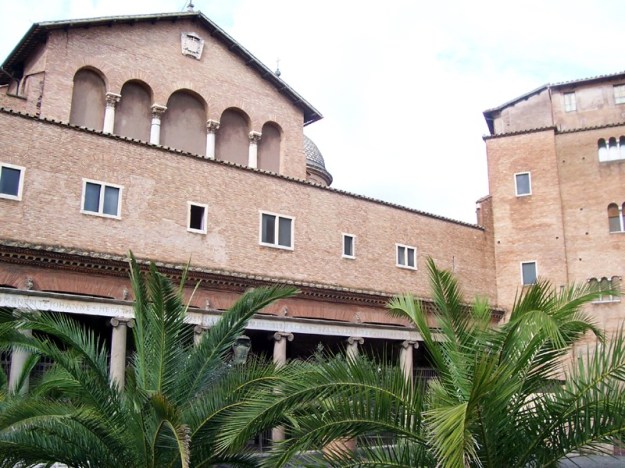
Ss. Giovanni e Paolo 

A few days ago we celebrated the feast of St. Jerome, the great 4th century scripture scholar and controversialist. I’ll be staying through October in a place well known to him in Rome– the Caelian Hill and the church of Saints John and Paul.

In Jerome’s day Rome’s rich and powerful lived on the Caelian Hill, across from the Palatine Hill and the Roman forum. Jerome had prominent friends among them. Pammachius, the ex- Roman senator who built Saints John and Paul, the noblewoman Paula and her daughter Eutochium, who later joined Jerome in his venture in Bethlehem to study the scriptures, her other daughter Blaesilla and others.

Interest in the scriptures ran high among well-off Caelian Christians then, but they also were keen for gossip and religious controversies. Jerome loved the scriptures, but he also loved the fight. His relationship with Paula and her family was part of the gossip that  probably figured among the reasons he left Rome for the Holy Land. Following him there, Paula created a monastic community in Bethlehem and she and her daughter undoubtedly played  a bigger part in Jerome’s scriptural achievements than they’re credited for.

Jerome’s a saint, but I appreciate why so many artists picture him doing penance for his sins. He needed God’s mercy.

FullSizeRender

Excavations, Saints John and Paul

Underneath Pammachius’ Church of Saints John and Paul are remains of Roman apartments going back to the 2nd-4th centuries, probably the best preserved of their kind in the city and a favorite for tourists.

Years ago, when I studied here, one of the rooms in the excavations was pointed out as part of a house church with Christian inscriptions , now archeologists are not so sure.. That doesn’t mean Christians didn’t meet or worship in these buildings, only they didn’t create a special liturgical space for meeting or worship.  Christian evidence, however, says a “house church” was here early on.

Why then did Pammachius in the fourth century build the imposing basilica of Saints John and Paul here on the edge of the Coelian Hill facing the Palatine Hill and the Roman forum ? Many retired soldiers settled on the Caelian Hill then. Did he wish to win them to Christianity through the example of two soldier saints, John and Paul, who were honored in this church? Their remains are still found under the church’s main altar today.

Is there another reason? According to Richard Krautheimer, an expert on Rome’s early Christian churches, the emperor Constantine built St. John Lateran, St. Peter, St. Paul, St. Lawrence, the first Christian churches, on the edge of the city most likely in deference to the sensibilities of the followers of Rome’s traditional religions. He didn’t want any Christian church in the “show areas” of the city, near the Roman forum or the Palatine hill.

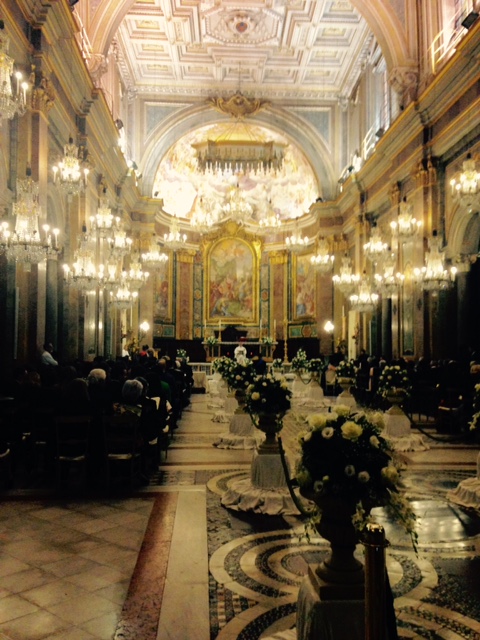
Saints John and Paul, Interior


By Pammachius’ time Christianity was more assertive. Was Pammachius’ church a statement to the city that Christianity had arrived and wished to speak its wisdom here at the heart of traditional Roman religion, near the Palatine Hill and the Roman forum? Jerome’s new translations and commentaries, along with the works of St. Augustine and others, gave them something to say.

So was this a church with a mission? A lesson for the church of today? Speak to the world of your time.

DSC01053

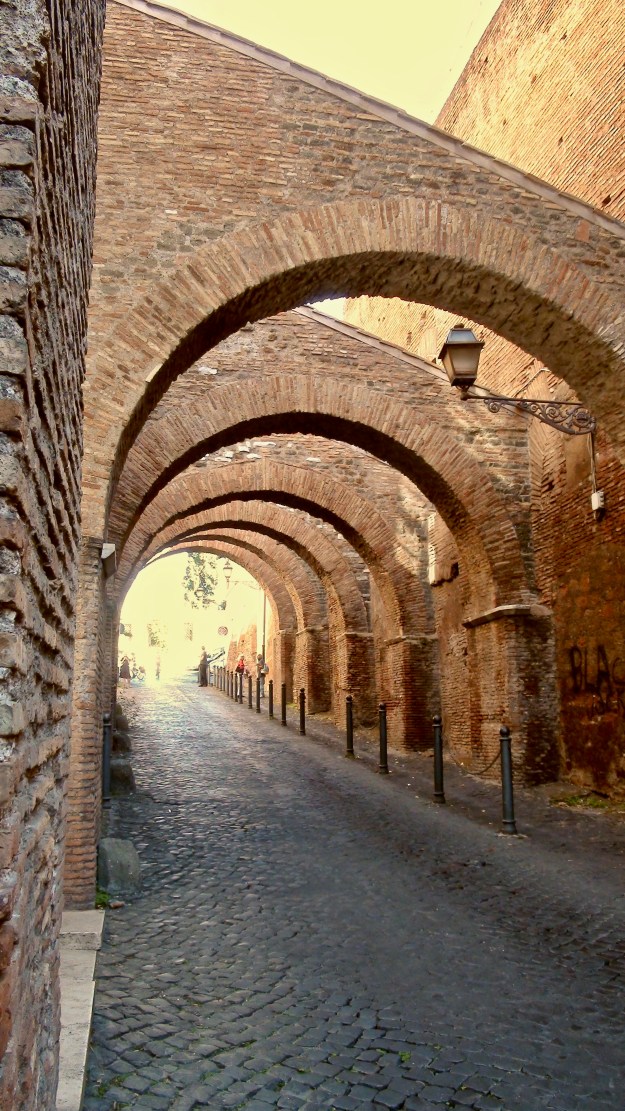
Clivo di Scauri

“Wait for One Another”

In today’s reading at Mass from 1 Corinthians ( 11, 17-26.33) we have the earliest written account of the institution of the Last Supper in the New Testament:
“For I received from the Lord what I also handed on to you,
that the Lord Jesus, on the night he was handed over,
took bread and, after he had given thanks,
broke it and said, “This is my Body that is for you.
Do this in remembrance of me.”
In the same way also the cup, after supper, saying,
“This cup is the new covenant in my Blood.
Do this, as often as you drink it, in remembrance of me.
For as often as you eat this bread and drink the cup,
you proclaim the death of the Lord until he comes.”

The simple account stresses that Jesus, taking bread and wine, gave himself, Body and Blood, “for you.” He gave himself for all. When we do this “in remembrance of me” we are called to be like him, to give ourselves for all.

Paul warns the Corinthians that by what he hears of their divisions and factions they’re failing to do what the Lord commands. Instead of imitating what Jesus d, they’re driving others away in their celebrations and thus bringing judgment on themselves.

Therefore, my brothers and sisters,
when you come together to eat, wait for one another.

A beautiful phrase Paul uses, “wait for one another.” A phrase that comes from the family meal in Paul’s time, when someone might miss the meal if the family did not wait for them. “We have to wait for them.”

So we wait for the grace Jesus offers at the Eucharist, to see all at the table of the Lord, loved by God who loves all.

Hurricane Florence is Coming

We not preparing for the disasters brought by climate change, an article in USAToday by Rick Hampson says. “Will repeated exposures to vivid scenes of natural disaster–Western wildfires, a global heat wave, Hawaiian volcano eruptions, the 2017’s hurricane’s anniversary and a suddenly active 2018 season” prepare us to do something? “Experience counsels skepticism. So does human nature.”

“Experts say people aren’t really motivated by disaster until it come to, or through, their door.” Hampson writes.

We forget that “America, the Beautiful” is vulnerable to climate change as other parts of the world are, and our political system doesn’t help us face the change either. The earth doesn’t get to vote.

“Democracies are creatures of the present, because the public focuses on the here and now, not some future hypothetical problem… Our political system makes us vulnerable to distant crises, because we don’t try to anticipate or diffuse them.” (Robert J. Samuelson)

In a previous blog Pope Francis asks us to hear in the changing climate cries of “Our  Sister, the earth” groaning from the abandonment and mistreatment received at our hands. Is Hurricane Florence a cry of creation?

“Save us, Lord, from becoming simply ‘creatures of the present.’ looking after ourselves. Let us hear our earth and sky and sea when they cry out from our abuse and lack of care. We ourselves are dust from the earth, we breathe her air and are refreshed by her waters. May we hear the cries of our Sister, the earth,  and care for her.”


Speak, Lord, Your Servants are Listening

In times like this we should listen to the voice of the mystics in our church. They speak in troubled times.

Among the mystics I count the writers of scripture, Luke and Paul, who speak in our readings at Mass these days and see things from a higher perspective than we do. Be careful of human wisdom, Paul says today to the Corinthians enmeshed in the politics and personalities of their church:

“So let no one boast about human beings, for everything belongs to you,
Paul or Apollos or Cephas,
or the world or life or death,
or the present or the future:
all belong to you, and you to Christ, and Christ to God.”

Luke’s gospel today (Luke 5, 1-11) describes the fishermen on the lake, Cephas among them, who have come from fishing all night and caught nothing. The One from Nazareth, no fisherman at all, tells them to cast their nets for a catch.

Wisely, they defer to him and their human wisdom is replaced by the power of God.

I think too of Bridget of Sweden and Catherine of Siena, mystics of their day, whose vivid perception of the powerful presence of God in their meditations and prayers reminded the leaders and people of their church to listen to their Lord.

Prayer and listening to God’s word are not small gestures today. We’re like the Corinthians and the fishermen by the lake. We need to listen to the Lord who speaks to us. We get so caught up in the wisdom of the day.