Category Archives: Religion

The Feast of Peter and Paul

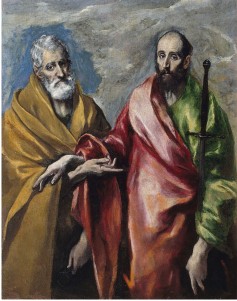
The church of Rome considers Peter and Paul, who came to the city and preached and died  there during the persecution by Nero in the early 60s, her founders. Their burial places are marked by great churches, St. Peter at the Vatican and St. Paul Outside the Walls.

They could not be more unlike: Paul, the educated Pharisee from Tarsus was a latecomer  to Christianity but like a runner raced from place to place in the Roman world to plant the faith. In the end, he believed God would give him “a crown of righteousness”  for his efforts.

Peter,  the fisherman from Galilee, was named by Jesus  the Rock on whom he would build his church. Denying Jesus three times, he was called by Jesus  three times  to shepherd the flock. Warily, he went to baptize a Roman soldier, Cornelius, in Caesaria; then he went to the gentile cities of Antioch and Rome to tell of the One he had seen with his own eyes.

The church today prays for Paul’s zealous faith to bring the gospel to the world and for Peter’s deep love for Jesus Christ which he proved by his preaching and death.

Commenting on Jesus’  threefold call to Peter. St. Augustine says it conquered the apostle’s “self-assurance.”

“Quite rightly, too, did the Lord after his resurrection entrust his sheep to Peter to be fed. Not that he alone  was fit to feed the Lord’s sheep, but when Christ speaks to one, he calls us to be one. And he first speaks to Peter, because Peter is the first among the apostles.

“Do not be sad, Peter. Answer once, answer again, answer a third time. Let confession conquer three times with love, because your self-assurance was conquered three times by fear. What you had bound three times must be loosed three times. Loose through love what you had bound through fear. And for all that, the Lord once, and again, and a third time, entrusted his sheep to Peter.”

“Today we celebrate the  the passion of two apostles. These two  were as one; although they suffered on different days, they were as one. Peter went first, Paul followed. We are celebrating a feast day consecrated for us by the blood of the apostles. Let us love their faith, their lives, their labors, their sufferings, their confession of faith, their preaching.”

“May your church in all things

follow the teaching of those

through whom she has received

the beginning of right religion.”
Saint Irenaeus

Tagbha carol roth

“We are all called to be holy. ‘Each in his or her own way,’” Pope Francis says in his exhortation “ Gaudete et exultate”.  We’re all different; saints are different too.

Today, the church remembers St. Irenaeus,  yesterday we remembered St. Cyril of Alexandria. Two different people, two different saints.. Cyril was a forceful, confrontative bishop of Alexandria; Irenaeus, as his name suggests, was a fair man and a peacemaker.

I learned about Irenaeus many years ago in a course on Gnosticism in Rome under Fr. Antonio Orbe, SJ, an expert on the subject. Gnosticism threatened Christianity in the 2nd century; afterwards most of its writings were destroyed. A large cache of its writings buried in the sands of Egypt had been recently unearthed and Father Orbe was just back after studying them. Until then, the Gnostic teachings  were known mostly through the writings of St. Irenaeus, whom we honor today.,

Fr. Orbe observed that as he compared the gnostic writings to Irenaeus’ reports of them he was struck how accurately and fairly Irenaeus described them,, not distorting anything they said or omitting their ideas. He was fair and respectful.  Irenaeus was fair minded and respectful to friend and foe alike. He was a peace-maker. Cyril of Alexandria was different. He would have left those writings buried in the sands of Egypt.

Irenaeus is not a bad example for today when hot words and smear attacks, distortions and lies dominate so much communication.  Peace makers like him don’t destroy, they heal and unite. That’s why they’re called blessed. He was named the 37th Doctor of the Church by Pope Francis in 2022, who said he was a “Doctor of Church Unity.”

Irenaeus also had a deep respect for creation. Some scholars today insist that the ancient gnostics were broadminded, creative people–rather like themselves–  more progressive than the plodding, conservative people of the “great church”– a term Irenaeus used..

In fact, the gnostics made the world smaller than it is, because they made much of the world evil, only some of it meant anything at all. Forget about the rest of it.

All creation is God’s, Irenaeus wrote. “With God, there is nothing without purpose, nothing without its meaning or reason.” All creation is charged with the glory of God.

Irenaeus saw the Eucharist as a sign of this. Bread and wine represent all creation. God comes to us through these earthly signs. We go to God through them.

“God keeps calling us to what is primary by what is secondary, that is, through things of time to things of eternity, through things of the flesh to things of the spirit, through earthly things to heavenly things.”

We should not demean creation, Ireneaus taught. That’s also the message of Pope Francis in “Laudato si.”

He Loved Us: Dilexit Nos

When I typed in “Sacred Heart” with “Pope Francis” on the Vatican website yesterday, I got 1826 results. In his 13 years as pope, Francis referenced the Sacred Heart of Jesus that many times in his public statements. . He did it in talks to religious communities dedicated to the Sacred Heart who came to Rome for a general chapter, to representatives of hospitals, universities and places associated with this devotion. There is even a reference to the Sacred Heart in a talk the pope gave on artificial intelligence.

His Encyclical Dilexit Nos, written last October,  is a long work that surely reflects years of thought on this mystery.  Francis believed a  world increasingly heartless needed to be reminded of God’s love.

It’s a work well worth reading. I took away a number of things from Dilexit Nos on the symbolism of the heart. For one thing, Pope Francis cautions  against being fixed on one artistic representation of this mystery. The meaning of the Sacred Heart can be expressed in many ways, not just the symbolic heart or the image of Christ showing us his heart that usually recalls this mystery.

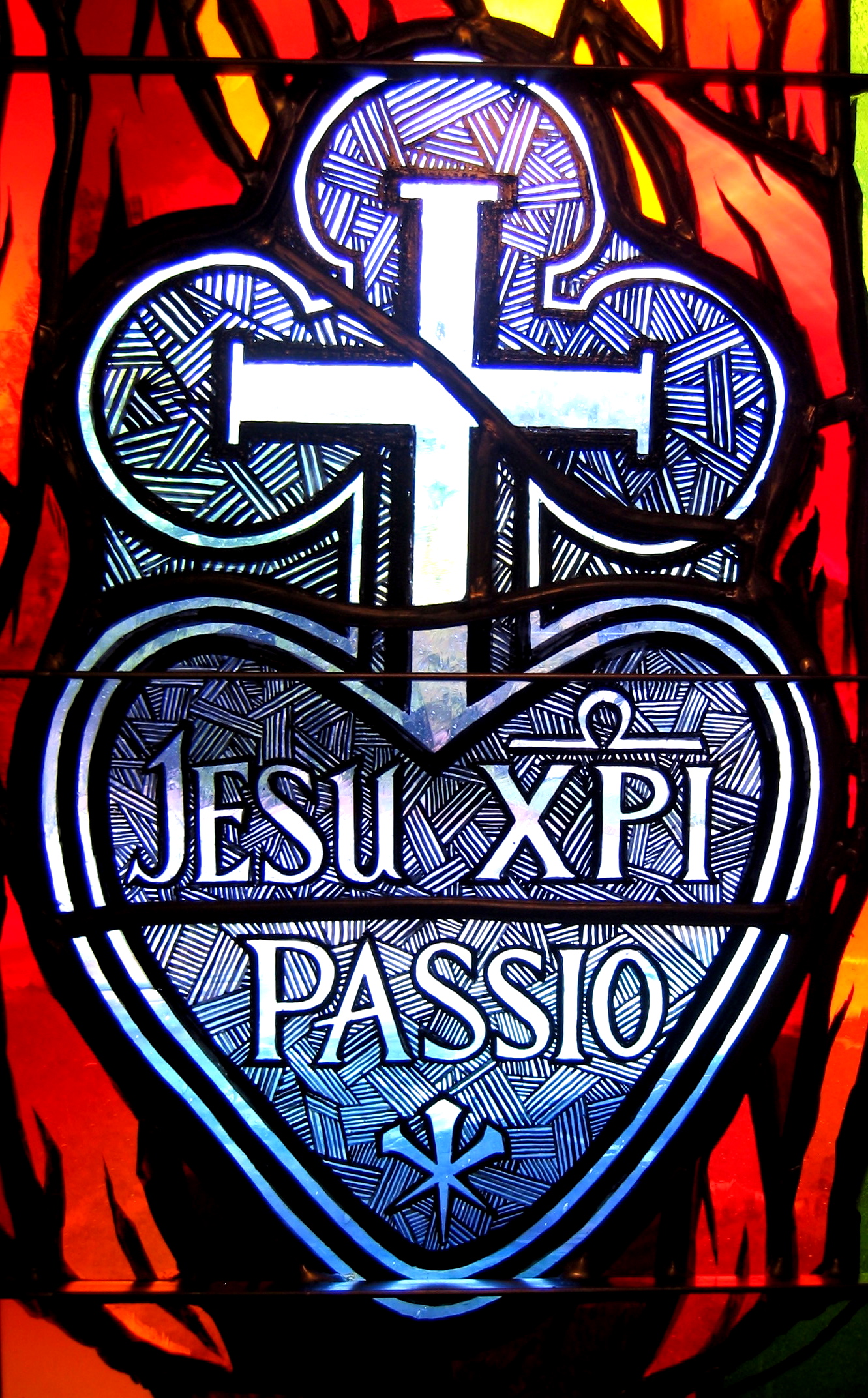
The gospel at Mass today of the Shepherd searching for the lost sheep is an image of the love of God for us. The sign my community the Passionists wears is a symbol of God’s infinite love. The pope is his letter sees a sign of that love in a mother who takes her little child into her arms after the child has done wrong as an example. No matter what her child has done, the mother still loves.  The love of God takes many forms; the heart symbolizes them all.

I also like the pope’s observation that devotions change over time. The devotion of First Friday Mass and Communion originally was a response to Jansenism that saw humanity unworthy to approach Jesus present in the Eucharist. 

Today, as so many ignore the Eucharist, the pope sees the devotion calling us to remember this Sacrament of God’’s Love.

The Sacred Heart: A Heart Says it All

IMG_0291

Faith says great things in simple ways. Sometimes a few words say it all, like the few words of the Creed. Sometimes signs like bread and wine point far beyond themselves to an infinitely generous God.

How is it possible to sum up the love of Jesus Christ for us? Today’s Feast of the Sacred Heart expresses divine love, which cannot be measured, through the human heart. Pope Francis offered an important recent reflection on the Sacred Heart in his Encyclical Letter, Dilexit nos,

The Feast of the Sacred Heart is always celebrated on Friday, the day Jesus showed the depth of his love, the day he faced rejection and gave himself for us. On that day a soldier pierced his heart as he hung on the cross, and blood and water poured out. “Immediately blood and water poured out.”

See these signs with eyes of faith, John’s gospel says. They reveal God’s love for us and for our world. His pierced heart says it all. The heart can never be separate from the Person whose heart it is: Jesus Christ. He can never be separate from the Father and the Holy Spirit, so his heart represents the love of the Trinity for the world.

Consider

Consider who hangs on the cross for you, his death gives life to the dead, his passing heaven and earth mourn,  even the hard stones split. Consider how great he is, who he is. He slept on the cross that the church be formed from his side and scripture might be fulfilled:

“They shall look on him who they have pierced,  One of the soldiers pierced his side with a spear, blood and water flowed out paying the price of our salvation. He gave his blood that the sacraments might give grace, living water, eternal life.

Bride of Christ, arise and like the dove, like the sparrow finding a home, drink from the wells of your Savior. He is the spring flowing in the midst of Paradise. from him four rivers flow to every heart, watering the whole world and making it fruitful.

Run with longing, cry out from your inmost heart: Beauty of God most high, Shining everlasting light, Life that gives life to all life, Light that illumines every light, Water eternal and unseen, clear and sweet, flowing from a spring hidden from all, A spring whose depths can’t be plumbed, whose height can’t be measured, whose shores can’t be charted, whose purity can’t be muddied. From him flows the river that makes glad the city of God. 

So with songs of thanksgiving, we sing hymns of praise. With you is the fountain of life and in your light we shall see light.  Adapted from St. Bonaventure.

Almighty God and Father,  we glory in the Sacred Heart of Jesus, your beloved Son,  as we call to mind the great things his love has done for us.Fill us with the grace that flows in abundance  from the Heart of Jesus, the source of heaven’s gifts. Who lives and reigns with you in the unity of the Holy Spirit,  one God, for ever and ever.Amen.

St. Cyril of Alexandria (d.444)

To be a saint doesn’t mean you’re perfect, Pope Francis says in his exhortation “Gaudete et exsultate“, on holiness in today’s world. That’s good to remember when we consider St.Cyril of Alexandria, the 4th century bishop of Alexandria and doctor of the church, whose feast is today, June 26th.

If you read his online biography in Wikipedia–where many today look for information about saints – you’ll find that he was deeply involved in the messy partisan politics of his time, when Christians, Jews and pagans fought and schemed to control over Alexandria, the city then probably the most important city in the Roman empire. Some called him a “proud Pharaoh;” “ a monster” out to destroy the church, an impulsive, scheming bishop in a riotous city. The Wikipedia biography mainly sees him that way.

He was a saint, other biographies say. Why a saint? Well, Cyril was absorbed in understanding and defending the Incarnation of the Word of God. How did the Word of God come among us? Who was Jesus Christ? Pursuing that mystery defined Cyril during life. It was at the heart of things for him, and the voluminous collection of sermons, letters, commentaries and controversial essays he left bears out that interest.

He thought and wrote extensively about this mystery. The way he came to express it was used at the Council of Ephesus (431) and became the way we also express it in our prayers. Mary was the Mother of God. The One born of her was not simply another human being. Her Son was true God, who would be truly human and eventually die on the Cross. God “so loved the world” that he came among us as Mary’s Son.

What we see as “the totality” of Cyril’s life, his “life’s jouney”, the “overall meaning of his person”, to use the pope’s words, is not his involvement in the violent politics of his day. Yes, that was there. But his abiding quest was to know Jesus Christ.

“‘The Word was made flesh’ [John 1:14], can mean nothing else but that he became flesh and blood like ours; he made our body his own and came forth man from a woman, not casting off his existence as God, or his generation of God the Father, but in taking to himself flesh remaining what he was. 

“This is the correct faith proclaimed everywhere. The holy teachers taught this and so they called the holy Virgin, the Mother of God, not as if the nature of the Word or his divinity began from the holy Virgin, but because that holy body with a rational soul, to which the Word, personally united, was born of her according to the flesh.”

— St. Cyril of Alexandria, First Letter to Nestorius

“When poisonous pride swells up in you, turn to the Eucharist; and that Bread, which is your God humbling and disguising himself, will teach you humility. When the fever of selfish greed rages in you, feed on this Bread; and you will learn generosity. When you feel the itch of intemperance, nourish yourself with the Flesh and Blood of Christ, who practiced heroic self-control during His earthly life, and you will become temperate. When you are lazy and sluggish about spiritual things, strengthen yourself with this heavenly Food; and you will grow fervent. Lastly, when you feel scorched by the fever of impurity, go to the banquet of the Angels; and the spotless Flesh of Christ will make you pure and chaste.”

Are Saints Really Saints?

Saints are example of the “whole mystery of Christ and God’s power on earth.” They’re examples of faith in their time, and they help us envision faith for our time. They assure us that “holiness is not bound by time and place.” 

Yes, saints are men and women of their own time and place, with all the limitations that brings. We can’t understand them unless we appreciate the world and times they lived in.

Some today might strongly object to some we honored recently as saints: John Fischer and Thomas More (June 22) lived in the fierce world of the Reformation and English power politics,  Cyril of Alexandria (June 27) was bishop of Alexandria in Egypt when the city engulfed in factional rivalries, and he was in there fighting with the rest of them, Junipero Serra (July 1) was part of the Spanish colonization of the New World. His statue was recently toppled in San Francisco as a subjugator of the native peoples. 

So, are these people really saints?

Saints, according to the The Second Vatican Council, are examples of the “whole mystery of Christ” and God’s power on earth. Their feasts “proclaim and renew the paschal mystery of Christ.” (Paul VI) The saints in our calendar recently are examples.

Pope Francis in his Apostolic Exhortation “Gaudete et exultate” describes ordinary holiness in our world, beginning with “the saints next door”.  “Their lives may not always have been perfect, yet even amid their faults and failings they kept moving forward and proved pleasing to the Lord. Amid their faults and failings they persevere.”

Canonized saints have faults and failings too, the pope says. “Not everything a saint says is completely faithful to the Gospel; not everything he or she does is authentic or perfect. What we need to contemplate is the totality of their life, their entire journey of growth in holiness, the reflection of Jesus Christ that emerges when we grasp their overall meaning as a person.” (22) We can’t judge them entirely from the perspective of our own times or an idealized time.

Later in his letter, Francis cautions about the dangers of modern day Pelagianism:  “When some say ‘ all things can be accomplished with God’s grace’, deep down they tend to give the idea that all things are possible by the human will, as if it were something pure, perfect, all-powerful, to which grace is added. They fail to realize that not everyone can do everything, and that in this life human weaknesses are not healed completely and once for all by grace. ” (49)

No one, not even a saint, is perfect, the pope says. In an imperfect society there are no perfect people. We all await the mercy of God. That’s good to remember when we consider Saints Thomas More and John Fischer, Cyril of Alexandria, and Junipero Serra and so many others.

They were holy, but not perfect. They lived in an imperfect society and shared in their society’s imperfections– as we do today. Yet, they were seen by many as their lives ended, not as unscrupulous political figures or colonial oppressors, but as people reflecting Jesus Christ and recipients of his mercy.

“Let the Trees of the Forest Exult”

These days in northeast USA are dry and very hot,, so I look especially at the trees. Peter Wolhleben in”The Hidden Life Of Trees,(, Vancouver,Ca 2016} writes that he began his career as a forester working for a German commercial firm harvesting lumber. Then he switched over to managing a natural forest in Germany. His whole approach to trees changed. 

He began seeing trees, not from a human perspective — dollars and cents or how they fit around your homes or on your street—but from their place in the forest before we humans decided what they’re good for.

He finds that trees communicate with one another, among other things. They have a language all their own.They struggle and strategize and unite to form a glorious whole. Trees are parents helping their kids and kids helping their parents; well trees help the sick. Trees respond to the universe of air, water, and soil. They respond to a drought.

We humans can learn from them. Just go out your back door and see, Wolhleben says. So I’m watching the trees these hot days. The new trees we planted,, the red oak and the American elm. The evergreens around our Mary Garden. The big oaks that have watched over us for years. They’re holding on these dry, hot days. So should we.

That’s what Jesus does in today’s gospel. He brings. before us the example of trees:

By their fruits you will know them.
Do people pick grapes from thornbushes, or figs from thistles?
Just so, every good tree bears good fruit,
and a rotten tree bears bad fruit.
A good tree cannot bear bad fruit,
nor can a rotten tree bear good fruit.
Every tree that does not bear good fruit will be cut down
and thrown into the fire.
So by their fruits you will know them.”

The Birth of John the Baptist

June 24, three months after the angel announces to Mary that Elizabeth is six months pregnant (March 25) John the Baptist is born.

From his birth John the Baptist was destined by God, not to follow Zachariah his father as a priest in the temple, but to go into the desert to welcome the Messiah, Jesus Christ. John is the last of the Jewish prophets, the first to recognize Jesus. His birth and death are celebrated in our church calendar.

It may have changed, but there’s an interesting Sunday walk in Rome I’d recommend.  Go out the city gate at the Porta di San Sebastiano and walk south along one of the oldest roads in the world, the Via Appia, to the catacombs and church of San Sebastiano. Outside the city gates, you’re in what the ancient Romans called the “limes,” the limits, the world beyond the city, a different world altogether.

To the ancient Romans the “limes” was the end of civilized, reasonable life. No place to live, they thought. Get where you’re going as soon as you can. “Speed limit” comes from the word. Go beyond the limit and you can lose your life.

Few people today are usually on that road, deserted fields all around. The only sound  you can hear is the sound of your own breathing and your footsteps.

The last line of St. Luke’s gospel for today’s feast says of John:

“The child grew and become strong in spirit, and he was in the desert until the day of his manifestation to Israel.”

How did John become strong in a desert? Centuries before, God told Abraham to go into a land he would show him. He led Jews from Egypt into the desert, and with no map or provisions, to a world unknown. They were in the hands of God, their strength.

Most of us stay within our limits; we don’t go to live in physical deserts. Yet, try as we may, we face them anyway in things we didn’t expect, like sickness or death or separation or divorce or the loss of a job or lost friends or lost places we know and love. The desert’s never far from any of us.

The Via Appia brings you to the catacombs, the great underground tunnels where early Christians buried their dead. They buried them there, I think,  not to hide them, but because this place was an image of a new unknown world.  The “limes,”  marked the end of this life and foreshadowed a new life. The dead no longer belonged in the city; they were going to  a new city.

Life holds its doubts, fears, uncertainty. But we don’t face limits alone. In the “limes” God alone has you in his hands. God gives you strength and brings you where you’re meant to be. God is there.  God is there.

Readings for the Feast:

Like other ancient church feasts, the Nativity of John the Baptist, June 24, is tied to cosmology. Three months after the angel announces to Mary that Elizabeth is six months pregnant (March 25) John the Baptist is born.John’s birth coincides with the summer solstice. He begins to decrease to make way for the one who will increase. Jesus will be born December 25. The Feast of the Nativity of John the Baptist is celebrated by all the ancient Christian churches. The Orthodox Church celebrates it June 24.

Birth of John the Baptist. Orthodox Church of America.

Readings here.

.

Genesis: 11-50

We might call our first readings at Mass this week the Jewish part of the Book of Genesis. (Gen 11–50) The origins of the world and the beginnings of the human race are described in first 10 chapters of Genesis. Chapter 11 begins with the call of Abram and recounts the beginnings of the Jewish people.

For Jews living in exile, when the Jewish scriptures were finally assembled, Abraham was someone to look to as they made their way in uncertain times, when the road ahead was unclear.

The road ahead doesn’t seem clear for us either, does it?

The Commentary from the New American Bible describes these chapters from Genesis as a book exiles can learn from:

Genesis 1150. One Jewish tradition suggests that God, having been rebuffed in the attempt to forge a relationship with the nations, decided to concentrate on one nation in the hope that it would eventually bring in all the nations. The migration of Abraham’s family (11:2631) is part of the general movement of the human race to take possession of their lands (see 10:3211:9). Abraham, however, must come into possession of his land in a manner different from the nations, for he will not immediately possess it nor will he have descendants in the manner of the nations, for he is old and his wife is childless (12:19). Abraham and Sarah have to live with their God in trust and obedience until at last Isaac is born to them and they manage to buy a sliver of the land (the burial cave at Machpelah, chap. 23). Abraham’s humanity and faith offer a wonderful example to the exilic generation.”

I like Jesssica Power’s poem on the great patriarch:

“I love Abraham, that old weather-beaten
unwavering nomad; when God called to him
no tender hand wedged time into his stay.
His faith erupted him into a way
far-off and strange. How many miles are there
from Ur to Haran? Where does Canaan lie,
or slow mysterious Egypt sit and wait?
How could he think his ancient thigh would bear
nations, or how consent that Isaac die,
with never an outcry nor an anguished prayer?

I think, alas, how I manipulate

dates and decisions, pull apart the dark

dally with doubts here and with counsel there,

take out old maps and stare.

Was there a call after all, my fears remark.

I cry out: Abraham, old nomad you,

are you my father? Come to me in pity.

Mine is a far and lonely journey, too.

12th Week of the Year: Readings and Feasts

This week’s first reading from Genesis begin with chapter 12 and the time of the patriarchs: Abraham, Isaac, Jacob and Joseph. They represent “a forward step in the divine plan to bring about recognition of the divine blessing promised to the world, if only humanity would obey and honor God.”   (BG 66. Catholic Study Bible)   

The Old Testament stories can be puzzling, sometimes unjust by our standards. Think about the sacrifice of Isaac and Sarah’s cruel treatment of Hagar. It’s hard for us to see this period as “a forward step” and realize that “the overall purpose of Genesis 12-50 is to carry forward God’s promise “despite all obstacles.” (BG 70)

Psalm 33, read on Monday, insists God’s promise is to make Israel that step forward and a blessing for all the nations: “Blessed the nation whose God is the LORD, the people he has chosen for his own inheritance. From heaven the LORD looks down; he sees all mankind.”

Our gospel readings from the Sermon on the Mount end this week. Jesus goes down to the plain, the real world, where he meets a leper and then a paralyzed man. (Saturday). His “real world” was like the world of Abraham and the Jewish prophets. He brought it a step forward to the Kingdom of Heaven God promised.

Still, it’s hard to see his times as a “step forward”, isn’t it? But, can we see our times now as a “step forward”? Yet they are.

We’re celebrating this week the Birth of John the Baptist (Tuesday) and feast of Sacred Heart. (Friday)