Category Archives: Religion

The Feast of Corpus Christi

The miracle of the loaves and fish that Jesus worked for a crowd of people by Sea of Galilee is one of his most important miracles. All four gospels report it. Mark reports it twice.

Jesus takes five loaves and two fish and feeds more than five thousand people, according to Luke’s Gospel.  They not only have enough, they have more than enough.

Why does Jesus work this miracle? The reason the gospel gives is that the crowd he’s talking to is hungry. They’re far from where they could buy food for themselves and they’re hungry.

So, the first reason Jesus works this miracle is not to prove he has divine power, but because people are hungry. They need to live, and to live you need to eat. 

But their hunger– which is also our hunger– is for more than food and drink.  We want a place to live, we want a life where we can flourish as human beings. Their hunger, like ours, is for more than eating and drinking.

Luke’s gospel today begins by saying that Jesus was speaking to the crowds about the kingdom of God and he healed those who needed to be cured. He gives meaning to their search for meaning and he restores life to them.

 He renews the promises of God, beginning with the good things of creation, signified by the bread and the fish. Bread from the land; fish from the sea. Bread stands for everything, all the blessings this life can bring. The fish stands for the blessings the waters bring. 

Yesterday Pope Leo addressed representatives of over 80 nations and spoke to them of the blessings the world is hungering for today. He spoke of their responsibility to listen and to defend the vulnerable and the marginalized.” This means working to overcome the unacceptable disproportion between the immense wealth concentrated in the hands of a few and the world’s poor,” he.said.

“Those who live in extreme conditions cry out to make their voices heard, and often find no ears willing to hear their plea…This imbalance generates situations of persistent injustice, which readily lead to violence and, sooner or later, to the tragedy of war.” 

Today Leo spoke of the hunger for peace. “Today more than ever, humanity cries out and pleads for peace,” he said. The cry for peace “demands responsibility and reason and must not be drowned out by the roar of weapons or by rhetorical words that incite conflict.”

Pope Leo urged every member of the international community to take up their moral responsibility to “stop the tragedy of war before it becomes an irreparable abyss.”When human dignity is at stake, he said, no conflict is distant. “War does not solve problems,”the Pope note. “On the contrary, it amplifies them and causes deep wounds in the history of peoples—wounds that take generations to heal… No military victory can ever compensate for a mother’s pain, a child’s fear, or a stolen future.”

The Pope expressed his hope for the din of arms to fall silent.“Let diplomacy silence the weapons!” he said. “Let nations shape their future with works of peace, not through violence and bloody conflicts!”

We pray today to Jesus Christ, who recognized the hunger of the crowd. May he recognize our hunger for justice and peace. He is present in our world, as the presence in the Eucharist assures us. He can reach places we cannot. He can speak to those we cannot. He can move hearts and minds beyond us.

We hunger for peace. Grant us peace, Lord.

Matthew 6: 19-23. The Treasures We Bring to Heaven.

In Matthew’s gospel today, Jesus speaks of treasures in heaven. Usually the treasures we think of are gold, silver, works of art, gems, degrees from school, signs of achievement. They’re the “treasures of earth” Jesus speaks of in the gospel. Thieves can steal them away; they can be eaten by moths and forgotten. They don’t last. (Matthew 6,19-23)

Other treasures are for heaven. St. Paul sees some of them in his trials for the gospel that we read today in his 2nd Letter to the Corinthians. God won’t forget his sufferings: the beatings, imprisonments, brushes with death, the long journeys over seas, rivers, and wildernesses where robbers waited. Paul lists dangers he faced, both from enemies and his own people. God wont forget any of them, down to his sleepless nights and bouts with the cold.

He ends his list with what might be the biggest treasure of them all; “the daily pressure upon me of my anxiety for all the churches. Who is weak, and I am not weak? Who is led to sin, and I am not indignant?” He’s tried to be responsible everyday with the people around him, whether they’re the weak or the trying. That’s the lasting treasure God holds in heaven. (2 Corinthians 11,18 ff)

We might not be able to match Paul’s of missionary travails, but let’s keep Paul’s last important achievement in mind. If we do what we have to do each day as well as we can, if we are faithful to our daily duty, if we bear our daily cross, if we bear with the weak and the difficult, won’t that be our treasure?

God counts it so.

Before he was executed St. Thomas More. wrote to his daughter Meg:

 “ I trust only in God’s merciful goodness. His grace has strengthened me till now and made me content to lose goods, land and life as well, rather than swear against my conscience.  I will not mistrust him, Meg, though I shall feel myself weakening and being overcome with fear. I shall remember how St. Peter at a blast of wind began to sink because of his lack of faith, and I shall do as he did: call upon Christ and pray for his help. And then I trust he shall place his holy hand me and in the stormy seas hold me up from drowning. “

Matthew 6: 7-15. Our Father

“This is how you are to pray: Our Father…….”

Gerhard Lohfink in his recent book “The Our Father” notes that ancient Near Eastern prayers always carefully address the god one wished to approach. An Akkadian prayer, for example, begins: “God of heaven and earth, firstborn of Anu, Dispenser of kingship, Chief Executive of the Assembly of the gods, Father of gods and men, Granter of agriculture, Lord of the air”.

“One senses that the forms of address had to be precise; otherwise the god would not listen. It’s not a simple matter to speak to him without making a mistake. Correct language and competence in praying are required. Above all, one must know the deity’s proper name.

Nothing of the kind in the Our Father! ‘Abba’ that’s the only address. It’s familial.”

The creed and other Christian prayers keep that address as first. “I believe in God, the Father Almighty, creator of heaven and earth.” The Creator is our Father. The creed tells us what we as God’s children have received from our Father and what we are promised. 

“We would not dare claim such a name in prayer, unless God himself had given us permission to pray this. And so, we should remember that when we call God our Father, we must live as his children.” (St. Cyprian)

It’s not in family or friends, some government agency or business that we find our the ultimate security we look for, but in God who gives us more than we ask for.

Matthew 6: 1-18: Praying in Secret

Where do we pray?

Jesus taught that we should pray “in secret.” Some may say that means pray in congenial places like the setting above. But St. Cyprian suggests that space may be wherever you find yourself. God is everywhere.

“The eyes of the Lord are everywhere.” So God is ready everywhere to engage us. Praying in secret testifies to the “everywhereness” of God. We can’t limit prayer to one place or time or some favored words..

What about the prayers we pray? Have they just become memorized words? “God hears our heart, not our words,” Cyprian says. God heard Anna who prayed for a child and the publican who prayed for forgiveness. They were not praying words, they prayed from the heart.

Prayer begins, not with yourself, the way the self-absorbed Pharisee prayed in the parable Jesus taught. Prayer begins with God. You are in the presence of God, everywhere. Be like the publican who knew he was a creature of the earth, waiting to the raised up. 

“Rejoice in the Lord” our psalm at Mass says. You are God’s children who call out “Abba.” And God hears us.

When we pray, we never pray only for ourselves. Here’s St. Cyprian: “Above all, the Teacher of peace and Master of unity did not want prayer to be made singly and privately, so that whoever prayed would pray for himself alone. We do not say My Father, who art in heaven or Give me this day my daily bread; nor does each one ask that only his own debt should be forgiven him; nor does he request for himself alone that he may not be led into temptation but delivered from evil. Our prayer is public and common, and when we pray, we pray not for one person but for the whole people, since we, the whole people, are one.”

Song at Daybreak

senic2


Does ordinary time, the days after Pentecost, mean that every day is the same? They’re not. Graces, challenges,  joys and sorrows,  hints of things, “our daily bread” are all there. We have to notice them. The Carmelite nun, Jessica Powers, ends a poem calling the day  “my beautiful unknown.” We just need eyes to see and ears to hear

SONG AT DAYBREAK

This morning on the way

that yawns with light across the eastern sky

and lifts its bright arms high –

It may bring hours disconsolate or gay,

I do not know, but this much I can say:

It will be unlike any other day.


God lives in his surprise and variation.

No leaf is matched, no star is shaped to star.

No soul is like my soul in all creation

though I may search afar.

There is something -anquish or elation-

that is peculiar to this day alone.

I rise from sleep and say: Hail to the morning!

Come down to me, my beautiful unknown.


Jessica Powers

Matthew 5:38-42. Turning the Other Cheek

You have heard that it was said, ‘An eye for an eye and a tooth for a tooth.’But I say to you, offer no resistance to one who is evil. When someone strikes you on [your] right cheek, turn the other one to him as well. If anyone wants to go to law with you over your tunic, hand him your cloak as well. Should anyone press you into service for one mile,* go with him for two miles. Give to the one who asks of you, and do not turn your back on one who wants to borrow.

Retaliation is often built into our legal systems and the way we think. “You do this, and you’ll get that.”  “An eye for an eye and a tooth for a tooth.” 

Jesus asks for something more than getting back at someone. God is merciful. He turns the other cheek, he walks more than a mile with us, he opens the door when beggars like us knock. 

Jesus offered an example of this when he suffered and died at the hands of others. “Father, forgive them, for they know not what they do.” 

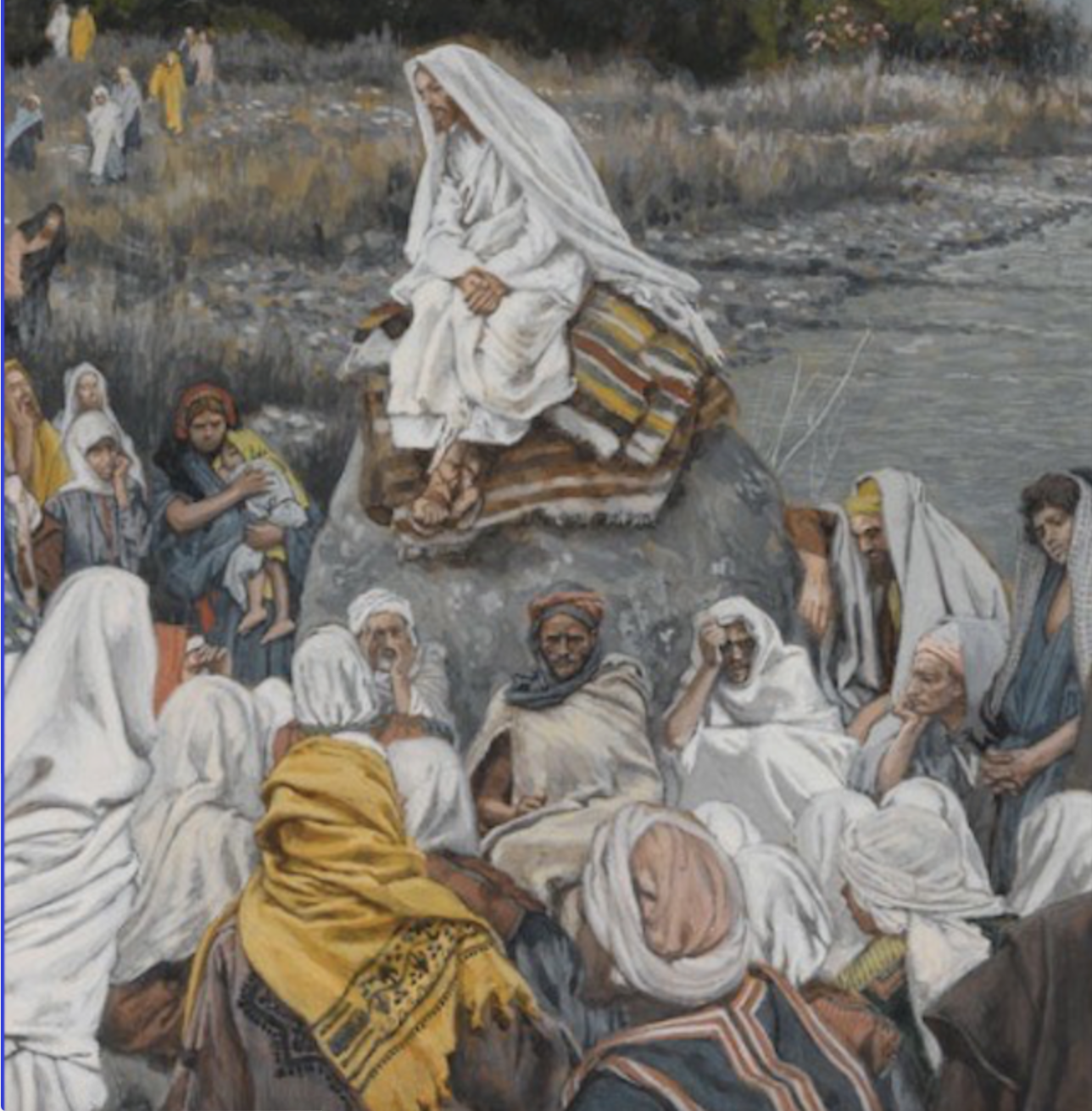
I have Tissot’s picture of Jesus teaching on most of the blogs these days. Those listening to him are not a picked group; everybody’s represented there. Some are still coming to hear him. Jesus does not wait for the perfect moment or the perfect audience. He teaches, continually. The Sower scatters seeds, even on uncertain ground.

11th Week: Readings and Feasts

We continue this week reading from the Sermon on the Mount, a summary of the teaching of Jesus found in chapters 5-7 in Matthew’s Gospel. After promising beatitudes (Mt. 5:1-16),  Jesus calls for addressing anger, lust, vengeance and our tendency to lie more deeply than we may like,  We must go beyond the scribes and pharisees in keeping God’s law, Matthew says. (Mt. 5:21-27) The Sermon on the Mount was considered the basic catechism of the Church from earliest times. It’s still teaches what we believe and hope for.

Jesus warns against giving alms to be seen and teaches prayer in chapter 6. The great prayer, the Our Father, is found in the Matthew 6: 7-15, read this Thursday. We will be quoting from S.t Cyprian, one of the greatest commentators on the teaching of Jesus on prayer.

We’re reading from the Sermon on the Mount until Friday of the 12 Week of the Year. On that day, Jesus comes down from the mountain. He enters a world that’s “troubled and abandoned.” There, people are “like sheep without a shepherd.” Even though a number of feasts interrupt the continuous reading from the Sermon on the Mount, it’s important to reflect on this important part of Matthew’s gospel.

The Nativity of John the Baptist is celebrated this Saturday.  

St. Anthony of Padua

There’ s surprising range of pictures of St. Anthony of Padua. In some he  blissfully holds the Christ Child in his arms, which is how someone saw him one day towards the end of his life. At times he’s pictured holding a book in his hand. Some pictures and statues portray him holding the Child and the book together and giving a loaf of bread to  a poor man.

Pictures and statues say a lot about him.

Anthony was born in Portugal in 1195 and died near Padua, Italy in 1291, acclaimed for his preaching and virtues.  Canonized shortly after his death, he’s invoked as a miracle-worker, especially good at finding something lost. But Anthony’s more than a miracle-worker.

His world was the complex, changing world of the 13th century when Europe’s economy was expanding, military crusades against the Muslim powers were in full swing in Spain, Sicily and the Holy Land, and new religious movements like the Franciscans were bringing reform and new vigor to the western church.

Anthony entered the Augustinian community in his birthplace, Lisbon, and studied at the renowned theological center of Coimbra. Just decades before, Portugal had been freed from the control of the Moors, but then, unfortunately, the victors started fighting among themselves for power and spoils from the crusades.

Anthony rejected the violence and avarice he saw in feuding leaders of church and state; he was a crusader of another kind.  When the bodies of some Franciscan missionaries martyred in Morocco in 1219 while preaching the gospel were brought back to Portugal, Anthony decided to join the new community.  He became a Franciscan and went to Morocco, hoping to preach the faith to the Muslims there, but illness caused him to leave, first for Sicily, then to Italy, where he became a Franciscan missionary and teacher.

Only a few years before, in 1206 in Assisi, young Francis Bernadone stripped himself of his trendy, stylish clothes and put on the dress of a poor man, to follow the poor Man of Nazareth, Jesus Christ. Thousands followed him and the movement he began quickly spread through the Christian world. Like others, Anthony was attracted to this movement, eager to bring the gospel “to the ends of the earth.”

The Franciscan movement began with a dedication to absolute poverty and a simple life, but as church leaders requested them to preach the gospel throughout the world its members needed books, education, training and places of formation. Anthony emerged as a model Franciscan preacher and teacher.

Through northern Italy, then through France, Anthony’s vivid, down-to-earth preaching stirred people’s hearts and minds and showed other preachers how to preach.  At the time, the Franciscan movement was not the only movement attracting the people of Europe. Through northern Italy and especially in France, Albigensian teachers were preaching a message of simplicity and release from the burdens of life to believers dissatisfied with the church. They denied that Jesus was divine, they questioned the gospels and painted the world as an evil place.

“Wise as a serpent and simple as a dove” Anthony disputed their message in his preaching. Gifted with an extraordinary memory for the scriptures and an ability to illustrate his talks with homey examples simple people understood, he spoke “with a well-trained tongue.” Thousands came to hear him. The world was not  evil, Anthony taught, Jesus, the Word of God was made flesh and dwelt among us.

Artists capture Anthony’s spirit in their portraits of him. As a preacher and teacher, he carries of book, most likely a psalter holding the Jewish psalms. St. Augustine, whom Anthony studied as a youth, always carried this one book of the bible with him, as a summary of the scriptures.

Some say this book is also clue to Anthony’s gift for finding lost things. He probably kept his notes for teaching and preaching in it. If he lost it–some say one of his students stole it– he lost something valuable to him. He found it, so he knows what it means when someone loses something too. “Good St. Anthony, come around, something’s lost and can’t be found.”

The Christ Child Anthony holds in his arms was more than a momentary vision he had.  Anthony was deeply attracted, as St. Francis was, to the mystery of the Incarnation. The Word became flesh. God became a little child, who grew in wisdom and age and grace in the simple world of Nazareth. He died on a cross, accepting it as his Father’s will. Then, he rose from the dead.

Human life and the world itself has been blessed by this mystery. Because of it,  life can never be small or inconsequential. Even suffering and death have been changed. “The goodness and kindness of God has appeared.” We hold it in our hands.

I suppose this is why a picture of St. Anthony is down in our laundry where we wash sheets and towels and clothes. He speaks to this world.

I’m sure Anthony, a man of words, worried about being captivated by words. That’s why he wrote this:

Someone filled with the Holy Spirit speaks in different languages, different ways of witnessing to Christ, such as humility, poverty, patience and obedience. These are the languages that reveal who we are. Actions speak louder than words; let your words teach and your actions speak. When we’re full of words but empty of actions, we’re cursed by the Lord, as once he himself cursed the fig tree when he found no fruit but only leaves. Gregory says: “A law is laid upon the preacher to practice what he preaches.” How useless if you preach about the law yet undermine it by your actions.

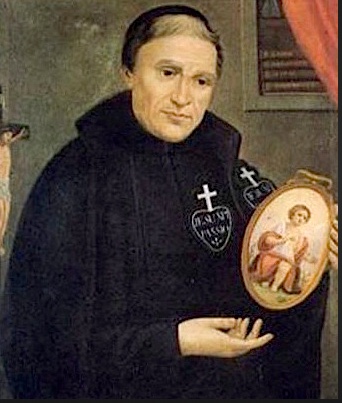
Blessed Lorenzo Salvi, Passionist (1782-1856)

Are Catholic religious communities like the Passionists, down in numbers at least in our part of the world,, on their way out? Numbers don’t always predict the future. More importantly, does the community produce saints and foster holiness? That’s a lesson to learn from Blessed Lorenzo Salvi, a Passionist whose feast is June 12th.

Lorenzo Salvi was born in Rome on October 30, 1782, professed a Passionist in 1802, and ordained a priest in 1805. These dates point to difficult, unpromising times. As Lorenzo entered the Passionists, Napoleon was carrying out his campaign to create a grand new world with France and himself at its center. He saw the Catholic church, particularly the papacy, in his way and he tried to cripple the church and the popes.

Napoleon invaded the Papal States in 1787, then again in 1798 when he declared a Roman Republic and drove Pope Pius Vi into exile where he died in 1799. Napoleon also ordered religious orders like the Passionists suppressed, their religious houses closed and their members sent back to their families or wherever they could find a place for themselves. Most Passionist houses were closed for a year or more at the time.

Not a good time to join the Passionists, you would think. But Lorenzo did.

In 1802 the body of Pius VI was brought back to Rome in 1802, the year Lorenzo made his vows. Many people said then that the papacy had come to an end. The future didn’t look good.

In 1799 the new pope, Pius VII appointed Father Vincent Mary Strambi, a distinguished Passionist preacher and teacher, as bishop of Marcerati, to shore up a tottering diocese in the tottering papal states. Later, Strambi would be declared a saint. Certainly the move benefited the church, but perhaps not so much the Passionists who lost a religious deeply involved in forming their young people, like Lorenzo.

You wonder what the young man felt facing the future at a time like that.

Far from losing hope, Lorenzo’s spirit seemed to soar and his call strengthened during the Napoleonic suppression. The young priest worked to restore the church in Italy and his own congregation. Napoleon’s plans failed.

Lorenzo Salvi was a forceful preacher who had a great devotion to the Child Jesus. “Unless you become like little children, you cannot enter the kingdom of heaven,” Jesus said. Lorenzo had the heart of a child. He believed no one can destroy God’s kingdom.

The Passionists experienced a surprising growth after the Napoleonic suppression. Lorenzo, an inspiring preacher and holy priest, was one of those leading the community into a new era.

Pray for saints like Lorenzo today. Pray that the Passionists have new recruits like him.

Lord, you granted Blessed Lorenzo Maria Salvi an intense and penetrating knowledge of the mystery of your Word made flesh through his devout contemplation of the Child Jesus. Through his intercession grant that we, too, walking in the ways of spiritual childhood, may come to eternal life in your Son. We ask this through our Lord Jesus Christ, your Son, who lives and reigns with you and the Holy Spirit one God, forever and ever.