Category Archives: Religion

Joshua and the Afghan War

At a time we’re preoccupied with the Afghan War how appropriate to hear today in our first reading at Mass from the great Jewish general, Joshua. Ending his career, Joshua gathers the tribes of Israel, not to reminisce about past victories or to plan future battles, but to proclaim for himself and his household, “we will serve the Lord.” (Joshua 24, 1-2,24-27)

Joshua’s days and the days of the Judges that follow were days of war. The Jews had become “a rough people, barbarized by war.” The general now seeks to know God’s will. Good advice to us? What’s God’s will for war today? 

Today at the US Maritime Academy at Kings Point I offered to the young men and women at Mass what our Catechism of the Catholic Faith tells us about war: 

Avoid it:

“The fifth commandment forbids the intentional destruction of human life. Because of the evils and injustices that accompany all war, the Church insistently urges everyone to prayer and to action so that the divine Goodness may free us from the ancient bondage of war. 2307

All citizens and all governments are obliged to work for the avoidance of war. However, as long as the danger of war persists and there is no international authority with the necessary competence and power, governments cannot be denied the right of lawful self-defense, once all peace efforts have failed. 2308

The strict conditions for legitimate defense by military force require rigorous consideration. The gravity of such a decision makes it subject to rigorous conditions of moral legitimacy. At one and the same time: 

  • the damage inflicted by the aggressor on the nation or community of nations must be lasting, grave, and certain; 
  • all other means of putting an end to it must have been shown to be impractical or ineffective; 
  • there must be serious prospects of success;  the use of arms must not produce evils and disorders graver than the evil to be eliminated. the power of modem means of destruction weighs very heavily in evaluating this condition. 2309
  • The Church and human reason both assert the permanent validity of the moral law during armed conflict.The mere fact that war has regrettably broken out does not mean that everything becomes licit between the warring parties. 2312
  • Non-combatants, wounded soldiers, and prisoners must be respected and treated humanely.
  • Actions deliberately contrary to the law of nations and to its universal principles are crimes, as are the orders that command such actions. Blind obedience does not suffice to excuse those who carry them out. Thus the extermination of a people, nation, or ethnic minority must be condemned as a mortal sin. One is morally bound to resist orders that command genocide. 2313
  • Every act of war directed to the indiscriminate destruction of whole cities or vast areas with their inhabitants is a crime against God and man, which merits firm and unequivocal condemnation. A danger of modern warfare is that it provides the opportunity to those who possess modern scientific weapons especially atomic, biological, or chemical weapons – to commit such crimes. 2314
  • The accumulation of arms strikes many as a paradoxically suitable way of deterring potential adversaries from war. They see it as the most effective means of ensuring peace amongnations. This method of deterrence gives rise to strong moral reservations. the arms race does not ensure peace. Far from eliminating the causes of war, it risks aggravating them. Spending enormous sums to produce ever new types of weapons impedes efforts to aid needy populations; it thwarts the development of peoples. Over-armament multiplies reasons for conflict and increases the danger of escalation. 2315
  • The production and the sale of arms affect the common good of nations and of the international community. Hence public authorities have the right and duty to regulate them. 2316

Fox News, CNN, The New York Times, the New York Post, all the media are busy with the politics of it all. Might be better to ask what’s God’s will. 

What’s the Future?

That’s a question we’re all asking these days. It’s all so uncertain. So let’s listen to what faith says. Here’s what the church said at the Second Vatican Council.

“We do not know the time when earth and humanity will reach their completion, nor do we know the way in which the universe will be transformed. The world as we see it, disfigured by sin, is passing away. But we are sure that God is preparing a new dwelling place and a new earth. In this new earth righteousness is to make its home, and happiness will satisfy, and more than satisfy, all the yearnings for peace that arise in human hearts.

On that day, when death is conquered, the sons of God will be raised up in Christ; what was sown as something weak and perishable will be clothed in incorruption. Love and the fruits of love will remain, and the whole of creation, made by God for man, will be set free from the frustration that enslaves it. 

 We are warned indeed that we gain nothing if we win the whole world at the cost of ourselves. Yet our hope in a new earth should not weaken, but rather stimulate our concern for developing this earth, for on it there is growing up the body of a new human family, a body even now able to provide some foreshadowing of the new age. Hence, though earthly progress is to be carefully distinguished from the growth of Christ’s kingdom, yet in so far as it can help towards the better ordering of human society it is of great importance to the kingdom of God.  

The blessings of human dignity, communion and freedom – all the good fruits on earth of our co-operation with nature in the Spirit of the Lord and according to his command – will be found again in the world to come, but purified of all stain, resplendent and transfigured, when Christ hands over to the Father an eternal and everlasting kingdom: “a kingdom of truth and life, a kingdom of holiness and grace, a kingdom of justice, love and peace.” On this earth the kingdom is already present in sign; when the Lord comes it will reach its completion.” (Pastoral Constitution on. the Church in the Modern World)

Responsory

August 16-22: Readings and Feasts

AUGUST 16 Mon Weekday  [Saint Stephen of Hungary) Jgs 2:11-19/Mt 19:16-22 

17 Tue Weekday Jgs 6:11-24a/Mt 19:23-30 

18 Wed Weekday Jgs 9:6-15/Mt 20:1-16 

19 Thu Weekday [Saint John Eudes, Priest] Jgs 11:29-39a/Mt 22:1-14 

20 Fri Saint Bernard,Doctor of the Church  Memorial Ru 1:1, 3-6, 14b-16, 22/Mt 22:34-40 

21 Sat Saint Pius X, Pope Memorial Ru 2:1-3, 8-11; 4:13-17/Mt 23:1-12 

22 SUN TWENTY-FIRST SUNDAY IN ORDINARY TIME

Jos 24:1-2a, 15-17, 18b/Eph 5:21-32 or 5:2a, 25-32/Jn 6:60-69 

Don’t miss the readings from the Book of Judges this week. They’re describing one of Israel’s worst times. I especially like the angel’s words to Gideon:  “Go with the strength you have.”  Words for us.

Interesting mix of saints this week. King Stephen of Hungary, John Eudes, Bernard and Piux X.

Kings, popes, presidents –our political leaders are important figures in society. We may forget they’re called to be saints as well as world figures. Always a danger we look on them as just political figures.

Bernard and John Eudes have left their gifts to us. See later this week.

For Morning and Evening Prayers, see here.

August 9-15: Readings and Feasts

AUGUST 9 Mon Weekday [Saint Teresa Benedicta of the Cross, Virgin and Martyr]

Dt 10:12-22/Mt 17:22-27 

10 Tue Saint Lawrence, Deacon and Martyr Feast

2 Cor 9:6-10/Jn 12:24-26 

11 Wed Saint Clare, Virgin Memorial Dt 34:1-12/Mt 18:15-20 

12 Thu Weekday [Saint Jane Frances de Chantal, Religious]

Jos 3:7-10a, 11, 13-17/Mt 18:21—19:1 

13 Fri Weekday [Saints Pontian, Pope, and Hippolytus, Priest, Martyrs]

Jos 24:1-13/Mt 19:3-12 

14 Sat Saint Maximilian Kolbe, Priest and Martyr Memorial

Jos 24:14-29/Mt 19:13-15 

15 SUN THE ASSUMPTION OF THE BLESSED VIRGIN MARY Solemnity

 Rv 11:19a; 12:1-6a, 10ab/1 Cor 15:20-27/Lk 1:39-56 

Our liturgical calendar this week takes us to distant times and places and a variety of saints.

On Monday to a German concentration camp to remember the heroic death of Edith Stein, Saint Teresa Benedicta of the Cross. On Tuesday we’re in 3rd century Rome for the martyrdom of Lawrence the Deacon; Wednesday in 13th century Assisi with St. Clare; Thursday in 17th century France remembering St. Jane Francis de Chantal, Friday to Rome for Pontian and Hippolytus, 3rd century martyrs, Saturday to a German concentration camp again, remember Maximilian Kolbe. Sunday we’re in 1st century Jerusalem celebrating the assumption of Mary into heaven.

 A wide variety. They’re a school for learning how many ways God can be served.

The liturgy itself is a school, open day by day.

19th Sunday b: More to Come

For this week’s homily please watch the video below.

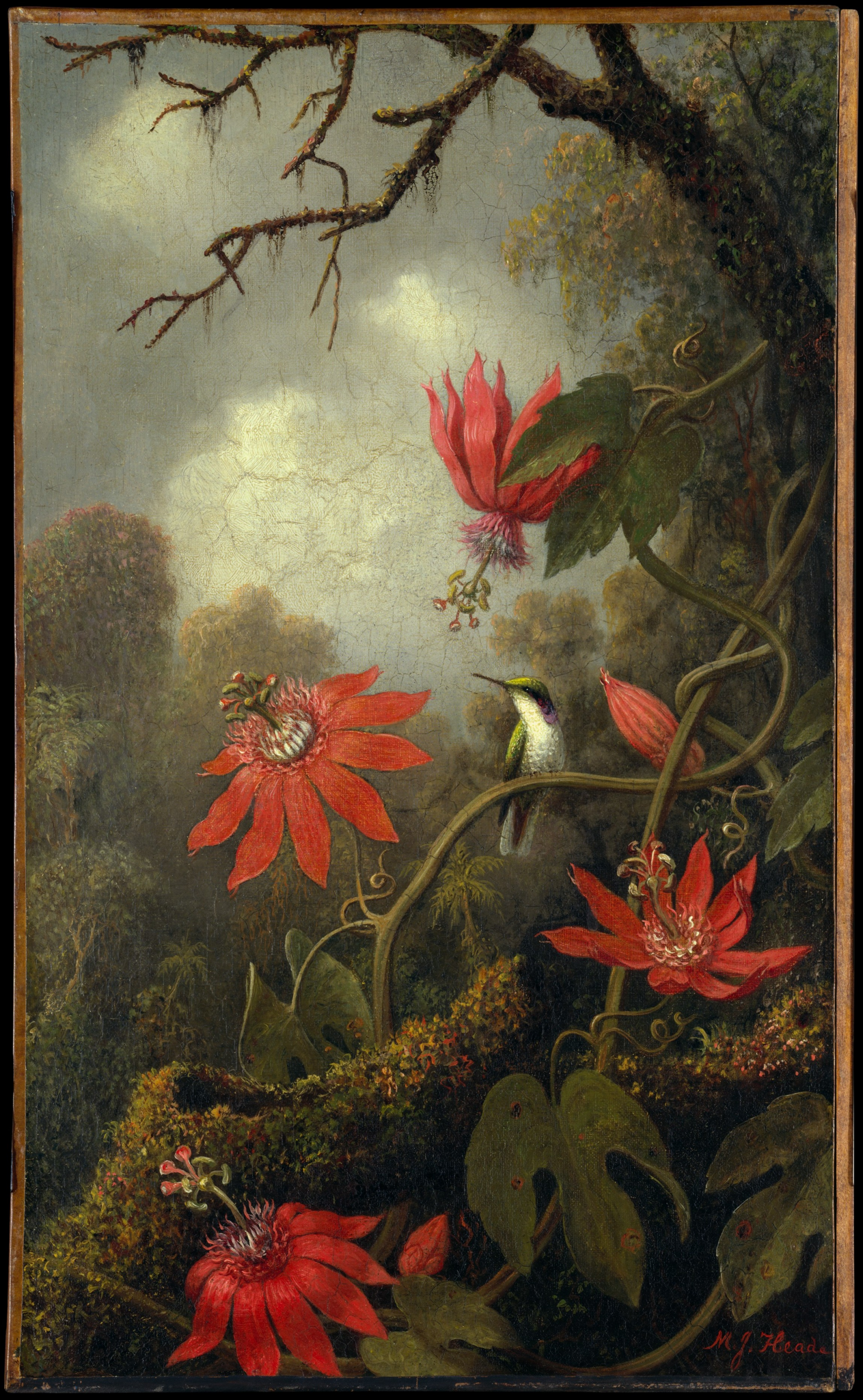
Hummingbird and Passionflowers

by Howard Hain

1509123983639705942327.jpg

Martin Johnson Heade, “Hummingbird and Passionflowers” (ca. 1875-85) (The Met)

The delicate little bird that resides within each of us.

It hops to and fro. It stands startlingly still.

Very often we are the very ones who chase it away.

But it doesn’t fly far.

Just to the closest branch, that’s just beyond our reach.

And it looks back at us, as if to ask, “Why are you afraid?”

The tiny head of a tiny bird, slightly cocked to the side—a question mark floats from its beak.

It longs to return, to live within us, to build a nest, to raise its young.

But it doesn’t rush back.

No, it waits.

It waits for us to ask for it to return.

It’s a patient creature, that tiny bird.

One may be tempted to say it’s not very smart, but that’s not it at all.

It’s simple. It’s holy. It knows who it is. It’s not afraid of the fall.


Howard Hain is a contemplative layman, husband, and father.


Web Link: The Met Museum. Martin Johnson Heade, “Hummingbird and Passionflowers” (ca. 1875-85)

Manna for the Day

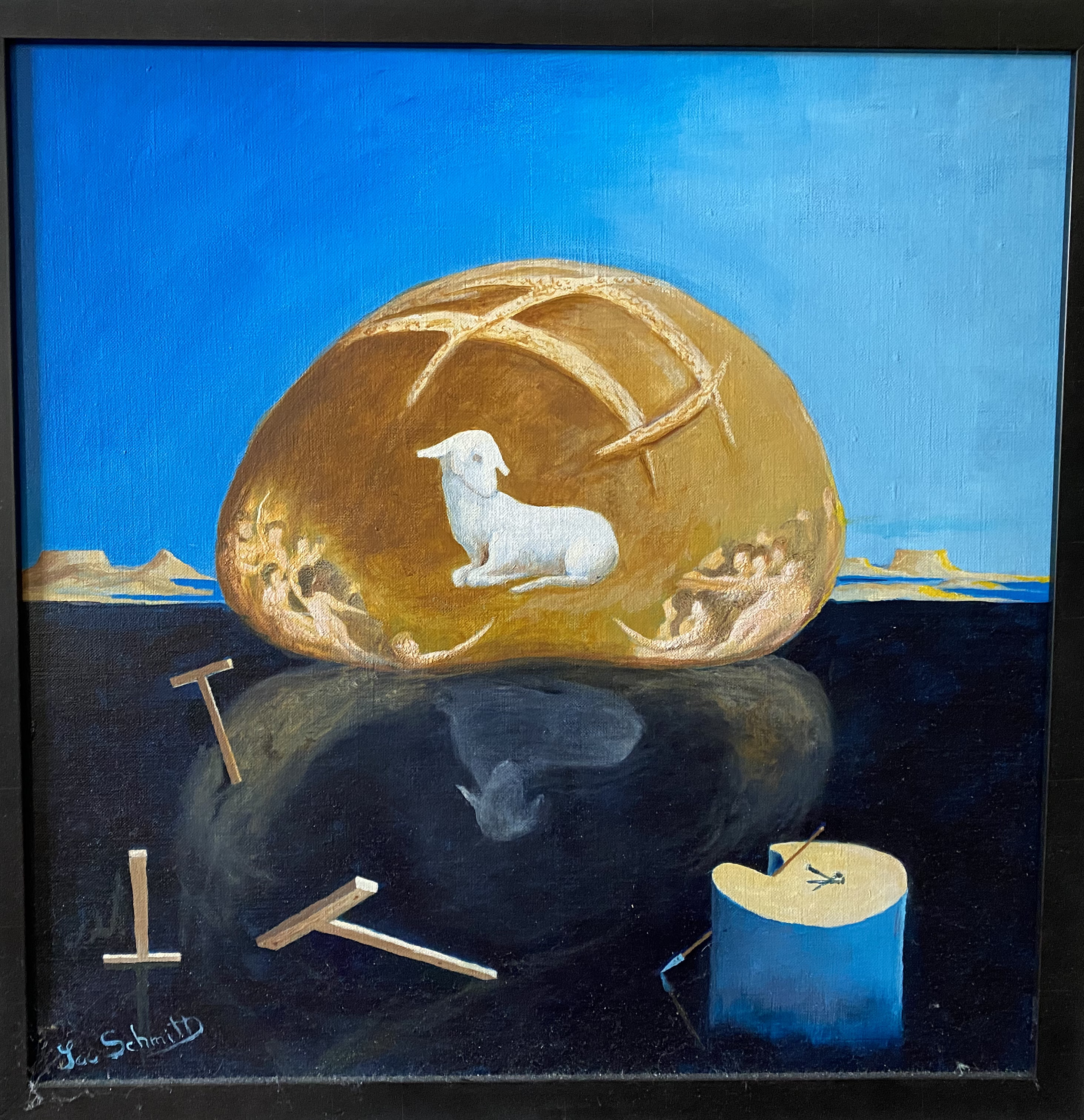
Painting by Lou Schmitt

The American Catholic bishops are writing a letter on the Eucharist. Some say there’s a tinge of politics behind it, but the spokesman for the bishops says it meant to address the decline in devotion to the Eucharist.

Our daily readings offer wisdom for the day, which may help as we consider the mystery of the Eucharist. 

These days the Old Testament readings from the  Book of Numbers have the children of Israel complaining about the manna as they make their way through the desert. It just doesn’t measure up to the cucumbers, melons, leeks, onions, garlic, fish and meat of Egypt. “We see nothing before us but this manna,” they say.

Their desert journey and memories of Egypt blind them to the steady simple presence of God and signs of it. They are looking for more security and a quick arrival to the promised land. Has our journey today, like theirs, the losses we’ve sustained, the dreams denied blinded us to the promise of God’s kingdom and the way it comes?

“The heavens proclaim the glory of God,

and the firmament shows forth the work of his hands.Day unto day takes up the story

and night unto night makes known the message.No speech, no word, no voice is heard

yet their span extends through all the earth,

their words to the utmost bounds of the world.” (Psalm 18)

The Eucharist is daily bread, it tells its story each day…No speech, no word, no voice is heard.”  It’s linked to God’s Kingdom that come quietly, like the seed that inches through the ground. That’s why I prefer its simple celebration in the Mass, with the readings of the day.

AUGUST 2-8: READINGS AND FEASTS

AUGUST 2 Mon Weekday [Saint Eusebius of Vercelli, Bishop; Saint Peter Julian Eymard, Priest]

Nm 11:4b-15/Mt 14:13-21 

3 Tue Weekday Nm 12:1-13/Mt 14:22-36 or Mt 15:1-2, 10-14 

4 Wed Saint John Vianney, Priest Memorial Nm 13:1-2, 25—14:1, 26-29a, 34-35/Mt 15:21-28 

5 Thu Weekday [ Dedication of the Basilica of Saint Mary Major] Nm 20:1-13/Mt 16:13-23

6 Fri The Transfiguration of the Lord Feast Dn 7:9-10, 13-14/2 Pt 1:16-19/Mk 9:2-10 

7 Sat Weekday [Saint Sixtus II, Pope, and Companions, Martyrs; Saint Cajetan, Priest;]

Dt 6:4-13/Mt 17:14-20 

8 SUN NINETEENTH SUNDAY IN ORDINARY TIME

1 Kgs 19:4-8/Eph 4:30—5:2/Jn 6:41-51 

The feasts of saints span the centuries. This week we remember saints of the early church, like St.Sixtus and his companions, martyrs from the 3rd centuries, and saints closer to our time like St. John Vianney and Peter Eymard. Holiness is found everywhere and at all times.

We continue reading from the Torah in our first readings. This week from the Book of Numbers and Deuteronomy. Gospel readings are from St. Matthew.

The dedication of the Basilica of Saint Mary Major is celebrated this Thursday. St. Mary Major is the most important church in Rome dedicated to Mary, the Mother of God. It’s an important church where some of the first feasts of the Christmas celebration were celebrated. Mary plays an important role in the mysteries of Jesus Christ.

MORNING AND EVENING PRAYERS HERE, WEEK 2

18th Sunday b: Our Desert Journey

For this week’s homily please watch the video below.

July 26- August 1: Readings and Feasts

JULY 26 Mon Saints Joachim and Anne, Parents of Mary Memorial

Ex 32:15-24, 30-34/Mt 13:31-35 

27 Tue Weekday Ex 33:7-11; 34:5b-9, 28/Mt 13:36-43

28 Wed Weekday.Ex 34:29-35/Mt 13:44-46 

29 Thu Saint Martha Memorial Ex 40:16-21, 34-38/Jn 11:19-27 or Lk 10:38-42 

30 Fri Weekday [Saint Peter Chrysologus, Bishop and Doctor)] Lv 23:1, 4-11, 15-16, 27, 34b-37/Mt 13:54-58 

31 Sat Saint Ignatius of Loyola, Priest Memorial Lv 25:1, 8-17/Mt 14:1-12 

AUGUST 1 SUN EIGHTEENTH SUNDAY  Ex 16:2-4, 12-15/Eph 4:17, 20-24/Jn 6:24-30

The readings from Exodus and Leviticus we have for a good part of this week are reminders how important the events at Sinai were for the Jewish people and, consequently, for us. God enters into a covenant with his people and they receive a way of life. Still, they turn away to look on false gods. Moses intervenes for his errant people. I like his simple prayer: 

“If I find favor with you, O LORD, do come along in our company.This is indeed a stiff-necked people;  yet pardon our wickedness and sins, and receive us as your own.”

Matthew’s gospel offers readings from Jesus’ lengthy teaching by the sea. His parables summarize what he taught during this public life. Simple and profound. On Saturday we have the account of the martyrdom of John the Baptist which prefigures the death of Jesus. 

Monday we celebrate Joachim and Anne, parents of Mary. Devotion to St. Anne appears in many popular novenas in our churches, asking her intercession. Then, faithful Martha is celebrated July 29th and Ignatius Loyola, founder of the Jesuits is remembered July 31st.