Category Archives: Motivational

6th Sunday c: How Do We Get to Heaven?

For this week’s homily please play the video file below.

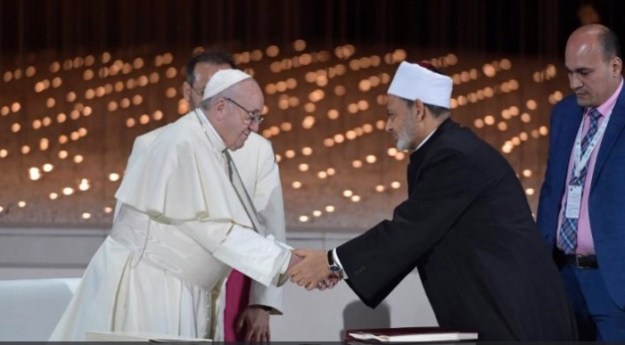
Document on Human Fraternity for World Peace and Living Together


Screen Shot 2019-02-06 at 8.49.53 AM

Pope Francis and the Grand Imama of Al-Azhar, Ahmad el-Tayeb,

“Something is happening.” That’s the way the great reading for our Holy Saturday liturgy, taken from an ancient homily, begins. We don’t see clearly yet, but something is happening.

And that’s the way I felt yesterday watching on YouTube a Mass at Abu Dhabi in the United Arab Emirates where more than one hundred thousand Christian migrant workers in the Middle East celebrated their faith with Pope Francis. Christianity is alive in the Middle East.

In the “Document on Human Fraternity for World Peace and Living Together” signed on Monday afternoon in Abu Dhabi by Pope Francis and the Grand Imama of Al-Azhar, Ahmad el-Tayeb, a path for the two religions and the world itself opened. Something is happening.

The document from leaders of these two great religious traditions, Christian and Muslim, is worth reflecting on.

It begins:
“In the name of God who has created all human beings equal in rights, duties and dignity, and who has called them to live together as brothers and sisters, to fill the earth and make known the values of goodness, love and peace,”

The document speaks for innocent human life, the poor, the destitute and the marginalized, the victims of destruction, calamities and war. It invokes the name of freedom, fraternity, peace and justice, the name of all people everywhere:

“In the name of God and of everything stated thus far; Al-Azhar al-Sharif and the Muslims of the East and West, together with the Catholic Church and the Catholics of the East and West, declare the adoption of a culture of dialogue as the path; mutual cooperation as the code of conduct; reciprocal understanding as the method and standard.”

“We, who believe in God and in the final meeting with Him and His judgment, on the basis of our religious and moral responsibility, and through this Document, call upon ourselves, upon the leaders of the world as well as the architects of international policy and world economy, to work strenuously to spread the culture of tolerance and of living together in peace; to intervene at the earliest opportunity to stop the shedding of innocent blood and bring an end to wars, conflicts, environmental decay and the moral and cultural decline that the world is presently experiencing.”

One commentator Tuesday said a meeting like this takes time for its meaning to be felt. “Something is happening.”

Facing “Unclean Spirits”

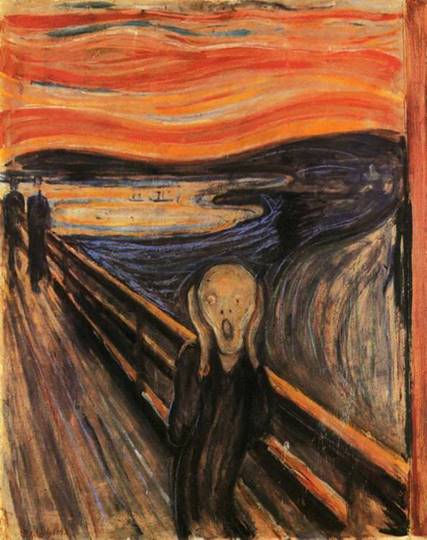
Edvard Munch: The Scream


When Jesus and his disciples cross the sea into pagan territory– an important new step in his ministry– they meet a man in the tombs and Jesus drives the unclean spirit out of him. (Today’s reading: Mark 5, 1-20) 

Throughout  his ministry “whenever unclean sprits saw him they would fall down before him and shout, ‘You are the Son of God.’ (Mark 3,11) Unclean spirits were favorite targets for Jesus in his ministry.

What’s an “unclean spirit”?

In their fine commentary on Mark’s gospel John R. Donahue, SJ, and Daniel Harrington, SJ, say “In this context ‘unclean’ (akatharton) primarily connotes not a moral (even less a sexual) fault), but something opposed to the “holy.” In the command of the Old Testament to be holy (Leviticus 11,44) it implies life, wholeness and completeness,( Leviticus 21, 17-21) whereas uncleanness implies something that should not be, something out of place ( e.g. soil in a farmer’s field is productive, while in a house it’s dirt). The opposite of the realm of the holy is the demonic, hence the spirits there are “unclean”. Physical defects or psychological aberrations can make a person “unclean”in a sense of incomplete, imperfect and out of order.”
(The Gospel of Mark, Sacra Pagina, Liturgical Press 2002 page 80.)

Jesus did not focus on the intellectual establishment or the religious establishment in his ministry. He engaged the chaotic world of the “unclean spirits.” He set up a “field hospital” to use a phrase dear to Pope Francis.

That can be a messy, scary world, as we see in Mark’s gospel. Just think of the poor man in the tombs, chained and hurting himself. Who wants to deal with him? But Jesus gives his disciples “authority” over unclean spirits. His followers have the power to take them on.

Jesus commissioned  his apostles for this ministry. He summons “the twelve and began to send them out two by two and gave them authority over unclean spirits.” (Mark 6, 7) We’re not out of place in our chaotic world today.

3rd Sunday c: Go to Church

For this week’s homily please watch the video below.

The Epiphany Feast Isn’t Over!

Kings Point, New York

Like the Christmas feast, we can pass over the Feast of the Epiphany too easily. It can become a quaint story of no significance.

I spoke about the meaning of the Epiphany on Sunday at the Maritime Academy in Kings Point, New York, where young men and women are being trained for service on the ships that sail our seas and waterways. This feast should mean something to them.

The only gospel that records this story is the Gospel of Matthew, so why is it there?

Matthew’s gospel was written for Jewish Christians in Galilee and Syria some time after the temple in Jerusalem was destroyed by the Romans in the year 70. We can’t imagine how shocked they were by the complete destruction of the temple and the city itself. These were places where God’s promises would be fulfilled, they thought. The Messiah would appear there. This was where Jesus would come again. All nations would stream to Jerusalem, prophets like Isaiah foretold. Now they were gone.

Matthew’s gospel reminds his hearers–and us too–that Jesus must be known by all nations before he comes again. “Go and make disciples of all nations,” Jesus says in his final words in Matthew’s gospel, “baptizing them in the name of the Father and of the Son and of the Holy Spirit, teaching them to observe all that I have commanded you. And behold, I am with you always, until the end of the age.” (Matthew 28, 18-20)

Matthew’s story of the Magi is a reminder that even as Jesus is born, messengers, strangers, wise men from afar, want to know and acknowledge him as their king and God.

Jesus Christ came, our gospel says, not for only one people or nation, but for all. Though his ministry was first to the Jews, Jesus wishes to make the world one. God doesn’t wish to save a few. He wants to save all– all the world.

The Magi came, our story says, from the east. Could that be from Iran or Yemen; two places we hardly view positively today in our country? More and more, as we look at the world only through the lens of politics and economics; we fear the stranger, we reject the immigrant, we create enemies, we reject people not like us. We’re becoming tribal instead of global. We’re falling into individualism. As the old song said, we’re looking for “perfect peace, where joys never cease, and let the rest of the world go by.”

But we can’t let the rest of the world go by and we won’t be safe behind walls. We’re living in a big world that God wants to be one. That’s what the story of the magi tells us. We’re all commissioned on this Feast of the Epiphany, which is followed next Sunday by the Feast of the Baptism of Jesus, to go out into the whole world, “ baptizing them in the name of the Father, and of the Son, and of the Holy Spirit,” teaching them to observe all that Jesus commands. And he will be with us, even to the end of time.

I told the young men and women at Kings Point on Sunday that they’re commissioned as people of the sea. The oceans and waterways are highways uniting this world of ours. They shouldn’t be looked at only through the eyes of economics or politics. They’re meant to connect peoples, they’re bridges that make us one.

As I left the chapel, I met some people who are “furloughed” by the current government shut-down. We don’t have to look far to see how dangerous it is to see the world only through the eyes of politics and economics. We need a brighter star.
Thoughts Upon The Cross: Doxa. Doxa. Doxa.

by Howard Hain

.

And we have seen his glory,

the glory of an only Son coming from the Father,

filled with enduring love.

—John 1:14


.

The power of God.

A tiny leaf caught between two worlds

Suspended by invisible threads

Dancing to the still small voice.

Deeper and deeper

Into the person

The Son of Man

Who is God.

Glory.

And Might.

Power.

And Majesty.

Fully Alive.

Beautifully Human.

Walking Wisdom.

The Lightness of Fullness.

The Heaviness of Simplicity.

Doxa. Doxa. Doxa.

Honor.

Adoration.

And Praise.

Doxa. Doxa. Doxa.

Beyond praise.

The Power of One.

He Is.

We’re not.

He stands.

We fall down.

He dies.

We live.

Doxa to the Father.

Doxa to the Son.

Doxa to the Holy Spirit.

Doxa. Doxa. Doxa.

Between two worlds.

Is a man.

Who says “I AM”.

A tiny leaf suspended.

He is Lord.

He is God.

Invisible threads.

He Is.

And so now are we.

Dancing.

Still.

Small.

Voice.

The Word.

The Depth.

Beyond the signs.

To the Person Himself.

The Person of Jesus.

Deeper.

And deeper.

Into His flesh.

Into His Glory.

Doxa is Thy Name.

Dwelling among us.

Abiding within us.

Still small leaves caught between two worlds.

Suspended by invisible threads.

Dancing to the breath of God.

From deep to deep.

Depth to depth.

It never ends.

Doxa. Doxa. Doxa.

Doxa in the highest.


.

(May 6, 2017)

A Church with a Mission

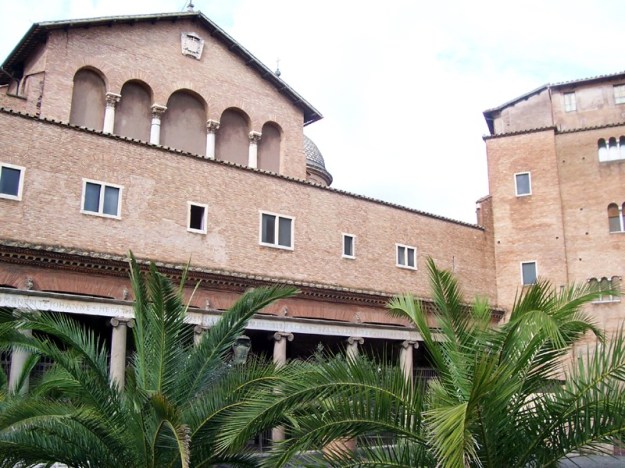
241SsGiovanniPaolo

Ss. Giovanni e Paolo 

A few days ago we celebrated the feast of St. Jerome, the great 4th century scripture scholar and controversialist. I’ll be staying through October in a place well known to him in Rome– the Caelian Hill and the church of Saints John and Paul.

In Jerome’s day Rome’s rich and powerful lived on the Caelian Hill, across from the Palatine Hill and the Roman forum. Jerome had prominent friends among them. Pammachius, the ex- Roman senator who built Saints John and Paul, the noblewoman Paula and her daughter Eutochium, who later joined Jerome in his venture in Bethlehem to study the scriptures, her other daughter Blaesilla and others.

Interest in the scriptures ran high among well-off Caelian Christians then, but they also were keen for gossip and religious controversies. Jerome loved the scriptures, but he also loved the fight. His relationship with Paula and her family was part of the gossip that  probably figured among the reasons he left Rome for the Holy Land. Following him there, Paula created a monastic community in Bethlehem and she and her daughter undoubtedly played  a bigger part in Jerome’s scriptural achievements than they’re credited for.

Jerome’s a saint, but I appreciate why so many artists picture him doing penance for his sins. He needed God’s mercy.

FullSizeRender

Excavations, Saints John and Paul

Underneath Pammachius’ Church of Saints John and Paul are remains of Roman apartments going back to the 2nd-4th centuries, probably the best preserved of their kind in the city and a favorite for tourists.

Years ago, when I studied here, one of the rooms in the excavations was pointed out as part of a house church with Christian inscriptions , now archeologists are not so sure.. That doesn’t mean Christians didn’t meet or worship in these buildings, only they didn’t create a special liturgical space for meeting or worship.  Christian evidence, however, says a “house church” was here early on.

Why then did Pammachius in the fourth century build the imposing basilica of Saints John and Paul here on the edge of the Coelian Hill facing the Palatine Hill and the Roman forum ? Many retired soldiers settled on the Caelian Hill then. Did he wish to win them to Christianity through the example of two soldier saints, John and Paul, who were honored in this church? Their remains are still found under the church’s main altar today.

Is there another reason? According to Richard Krautheimer, an expert on Rome’s early Christian churches, the emperor Constantine built St. John Lateran, St. Peter, St. Paul, St. Lawrence, the first Christian churches, on the edge of the city most likely in deference to the sensibilities of the followers of Rome’s traditional religions. He didn’t want any Christian church in the “show areas” of the city, near the Roman forum or the Palatine hill.

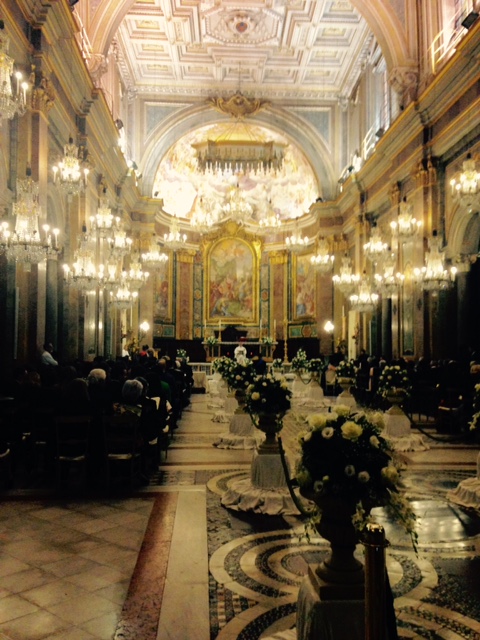
Saints John and Paul, Interior


By Pammachius’ time Christianity was more assertive. Was Pammachius’ church a statement to the city that Christianity had arrived and wished to speak its wisdom here at the heart of traditional Roman religion, near the Palatine Hill and the Roman forum? Jerome’s new translations and commentaries, along with the works of St. Augustine and others, gave them something to say.

So was this a church with a mission? A lesson for the church of today? Speak to the world of your time.

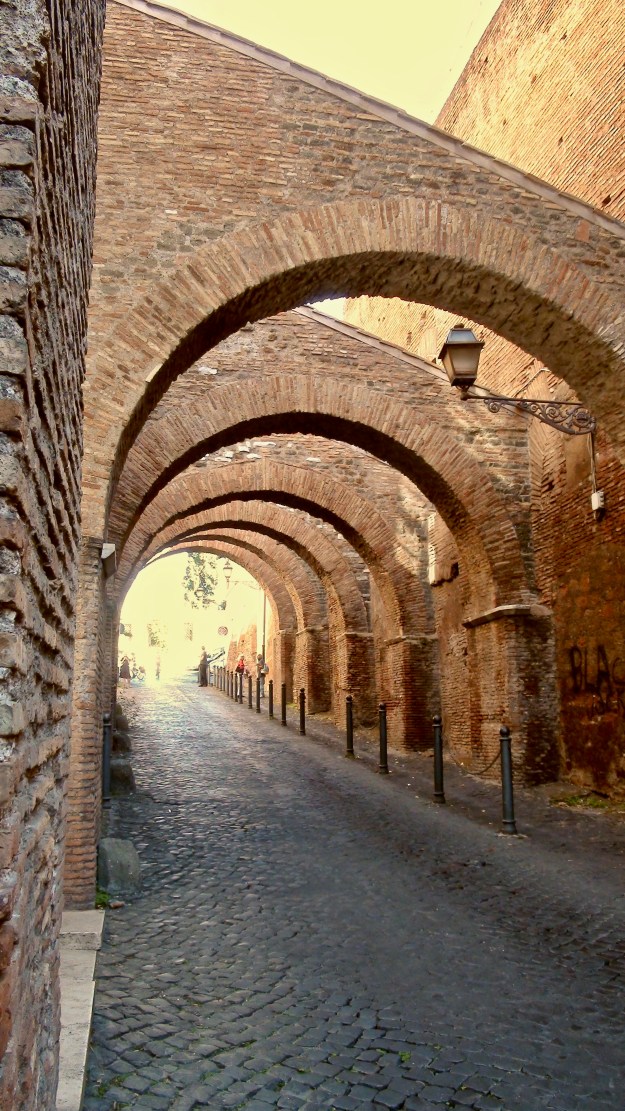
DSC01053

Clivo di Scauri

“Wait for One Another”

In today’s reading at Mass from 1 Corinthians ( 11, 17-26.33) we have the earliest written account of the institution of the Last Supper in the New Testament:
“For I received from the Lord what I also handed on to you,
that the Lord Jesus, on the night he was handed over,
took bread and, after he had given thanks,
broke it and said, “This is my Body that is for you.
Do this in remembrance of me.”
In the same way also the cup, after supper, saying,
“This cup is the new covenant in my Blood.
Do this, as often as you drink it, in remembrance of me.
For as often as you eat this bread and drink the cup,
you proclaim the death of the Lord until he comes.”

The simple account stresses that Jesus, taking bread and wine, gave himself, Body and Blood, “for you.” He gave himself for all. When we do this “in remembrance of me” we are called to be like him, to give ourselves for all.

Paul warns the Corinthians that by what he hears of their divisions and factions they’re failing to do what the Lord commands. Instead of imitating what Jesus d, they’re driving others away in their celebrations and thus bringing judgment on themselves.

Therefore, my brothers and sisters,
when you come together to eat, wait for one another.

A beautiful phrase Paul uses, “wait for one another.” A phrase that comes from the family meal in Paul’s time, when someone might miss the meal if the family did not wait for them. “We have to wait for them.”

So we wait for the grace Jesus offers at the Eucharist, to see all at the table of the Lord, loved by God who loves all.

Hurricane Florence is Coming

We not preparing for the disasters brought by climate change, an article in USAToday by Rick Hampson says. “Will repeated exposures to vivid scenes of natural disaster–Western wildfires, a global heat wave, Hawaiian volcano eruptions, the 2017’s hurricane’s anniversary and a suddenly active 2018 season” prepare us to do something? “Experience counsels skepticism. So does human nature.”

“Experts say people aren’t really motivated by disaster until it come to, or through, their door.” Hampson writes.

We forget that “America, the Beautiful” is vulnerable to climate change as other parts of the world are, and our political system doesn’t help us face the change either. The earth doesn’t get to vote.

“Democracies are creatures of the present, because the public focuses on the here and now, not some future hypothetical problem… Our political system makes us vulnerable to distant crises, because we don’t try to anticipate or diffuse them.” (Robert J. Samuelson)

In a previous blog Pope Francis asks us to hear in the changing climate cries of “Our  Sister, the earth” groaning from the abandonment and mistreatment received at our hands. Is Hurricane Florence a cry of creation?

“Save us, Lord, from becoming simply ‘creatures of the present.’ looking after ourselves. Let us hear our earth and sky and sea when they cry out from our abuse and lack of care. We ourselves are dust from the earth, we breathe her air and are refreshed by her waters. May we hear the cries of our Sister, the earth,  and care for her.”


Praise be to You, My Lord.

DSC00154


“LAUDATO SI’, mi’ Signore” – “Praise be to you, my Lord”. In the words of this beautiful canticle, Saint Francis of Assisi reminds us that our common home is like a sister with whom we share our life and a beautiful mother who opens her arms to embrace us. “Praise be to you, my Lord, through our Sister, Mother Earth, who sustains and governs us, and who produces various fruit with coloured flowers and herbs”.

This sister now cries out to us because of the harm we have inflicted on her by our irresponsible use and abuse of the goods with which God has endowed her. We have come to see ourselves as her lords and masters, entitled to plunder her at will. The violence present in our hearts, wounded by sin, is also reflected in the symptoms of sickness evident in the soil, in the water, in the air and in all forms of life. This is why the earth herself, burdened and laid waste, is among the most abandoned and maltreated of our poor; she “groans in travail” (Rom 8:22). We have forgotten that we ourselves are dust of the earth (cf. Gen 2:7); our very bodies are made up of her elements, we breathe her air and we receive life and refreshment from her waters. Pope Francis, Laudato Si, 1-2