Category Archives: Motivational

2nd Sunday of Advent b: God’s Comfort: I Am With You

For this week’s homily, please play the video below:

The Elusive Prayer

by Orlando Hernandez

The Gospel readings for Tuesday, Wednesday, and Thursday of the 7th Week of Easter present to us the whole of Chapter 17 of the Gospel of John, Jesus’ beautiful prayer at the end of the Last Supper discourses. Cardinal Fulton Sheen, in his book Life of Christ, calls this chapter “Our Lord’s ‘My Father’”. Jesus must have said these words out loud in front of the Apostles, otherwise it could not have been recorded. I imagine Him, His eyes streaming with tears of joy and sorrow, arms open, facing heaven, saying these words like a nightingale in full-throated song.

Cardinal Sheen writes : “In the Our Father which He taught men to pray there were seven petitions. In His ‘My Father’ there were also seven petitions, and they had reference to His Apostles who are the foundation of His Kingdom on earth. First, their continual union with Him; second, their joy as a result of this union; third, their preservation from evil; fourth, their sanctification in the truth which is Himself; fifth, their unity with one another; sixth, that eventually they may be with Him; and seventh, that they may perceive His glory.”

I try to find the parts of Jesus’ prayer that illustrate these points. I almost seem to find them, and then I forget what they were; it’s so strange. This is the chapter of the Bible that I have read the most, and it always eludes me in some mysterious way. There is so much to it. I still cannot wrap my mind around it. It is like some of my deepest, most powerful prayer experiences. My heart is humming afterwards. My eyes might be full of tears, but I cannot find the words to express what I experience, almost as if I have forgotten most of it, like waking from a dream.

The part that remains with me the most is where Jesus, after praying for His Apostles, says, “I pray not only for these, but also for those who will believe in me through their word, so that they may all be one, as You Father are in Me and I in You, that they also may be in us, that the world may believe that You sent me.” (Jn 17: 20-21)

In his book The World’s Religions, Huston Smith comments on how perhaps the greatest psychological force that prompted so many thousands of people throughout the Roman Empire to consider Christianity, was the impressive unity, solidarity, and mutual sacrifice that the followers of The Way exhibited.

When our beloved leader and teacher, Fr. Owen Lally CP was alive, we would conclude our Charismatic prayer meetings by holding hands around the altar with the Monstrance containing the Living Blessed Sacrament, and would sing:
“Father, make us one.
Father, make us one,
that the world may know
That You sent Your Son.
Father make us one.”

I always felt it was the most powerful moment of our prayer meeting, when the presence of God was the most palpable to me. I felt as if our prayer group would never break up. I would realize that Jesus’ prayer in John 17 was being fulfilled right then and there. Years later, we still conclude with this song even in the absence of Fr. Owen, and of the Blessed Sacrament, the effect is still so unifying and holy.

Jesus, High Priest and Teacher, I thank You for this prayer that You say even for me. May it be always a “holy space” where I may be able to go and meet You. May it inspire us all not to lose hope in this “world” that refuses to accept Your words of love and peace. May we, as Your Church, be able to look into each others eyes, smile and say, without fear or embarrassment, “Father make us one.”

Orlando Hernández

3rd Sunday of Easter


6th Sunday A: Commandments about Love

Please watch today’s homily by selecting the video below:

Feast of the Epiphany

For this week’s homily, please play the video below:

Morning Thoughts: Who is Paul of the Cross?

st-paul-castellazzo


..

Who is Paul of the Cross?

He’s a saint, canonized by Pope Pius IX in 1867.

He’s the founder of the Passionists , a religious community of priests, brothers, sisters, and laypeople.

He lived in northern and central Italy during most of the 18th century and was originally called Paul Francesco Danei.

There are books written about him. His letters have been collected and printed in large, thick volumes. And time on the internet will easily identify many short biographical sketches, prayers, and sayings. There is also much available about the Passionists, and their life after the death of Saint Paul of the Cross—their growth, history, struggles, saints, and their current configuration, focus, and works.

There are also the many individual members of the Congregation of the Passion of Jesus Christ, living today and based all around the world, and they each have their own story to tell.

But there is also the man named Paul.

And somehow this kind, gentle, humble, and beautifully-flawed human being seems to get lost in all this.

His weaknesses greatly interest me.

Christ’s courage and strength in and through him inspire me.

If we prayerfully put aside the constitutions, the history, the legacy, and even his incredibly personal and guidance-filled letters (that he never intended anyone other than the recipients to read) we just may find a stripped-down saint whose essence and example we badly need in times such as these.

We just may find what we find in each and every great man and woman of God throughout Christian history—that same occurrence that appears again and again through the lives of our brothers and sisters who have truly renounced all their possessions in order to become true disciples of Christ.

———

In Saint Paul of the Cross we just may find…

…a cold, naked infant in a cradle, desperate for his mother’s breast…

…a frightened and insecure child running to keep pace with the visions of his father…

…a tired, distraught, beaten-down young man offering his life for the benefit of his brothers…

We just may find ourselves.

Or we may find someone that we used to know.

Or we may find someone that we should get to know.

But what really matters is that we find the Word made flesh.

And that is the heart of the matter. The fleshy heart that matters.

For while hearts of stone are hard to wound, they are not really hearts at all. They are the hearts of the walking dead, of those whom Jesus Himself says, “let the dead bury their dead.”

Jesus wants our hearts, our entire hearts. He wants undivided, tenderized hearts. Soft and fleshy hearts.

Yes, that type of heart is easily pierced, but in being wounded they are transformed, in being merciful they begin to bleed, and in forgiving they become His. They become sacred. Our hearts become His Most Sacred Heart.

———

The saints show us Jesus. They show us ourselves. They show us where we come from, where we currently need to stand, and where it is that we should go.

And the answer is always the same: With God.

Born of a virgin. Dying on a cross. Raised from the dead. Ascending into Heaven.

———

I am no expert on Saint Paul of the Cross. But I am his friend, and he has been very good to me. And I hope that you get to know him too.

As far as me telling you more about Paul Danei, you probably fall into one of three categories: you already know the details, you have never even heard of him, or you are about to meet a man with a striking resemblance.

For you see, the best thing I can say about Paul is that he is a lot like Jesus—a man in history but not met through it, a man who wore a robe but not defined by it, a man who submitted himself to the law but didn’t let that stop him from transcending it.

A man who at the end of the day, knows that it is all about love.


.

—Howard Hain

.

Friday Thoughts: Francesca and William

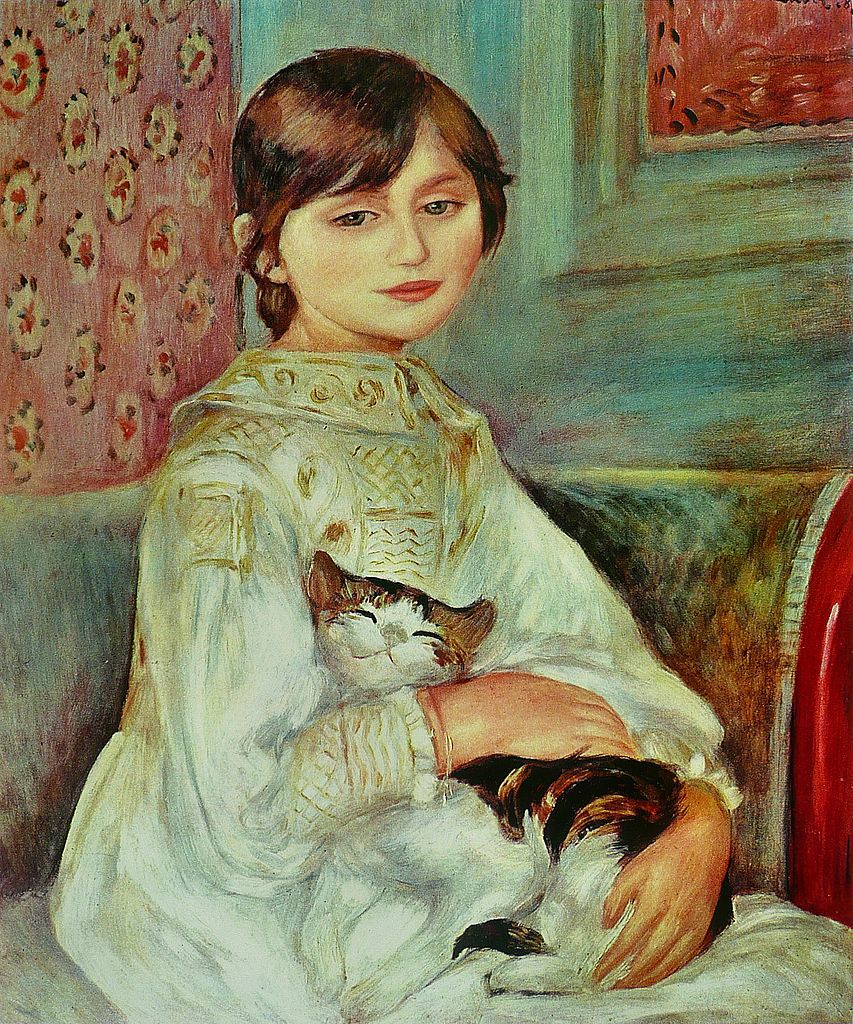
pierre-auguste-renoir-julie-manet-with-cat-1887

Pierre-Auguste Renoir, “Julie Manet with cat”, 1887


Francesca, like most 4-year-olds, is not particularly gentle when it comes to petting a cat. Well, let me put it another way, her gentleness as compared to her zeal when It comes to petting a cat is somewhat lacking. Hence, our cats spend most of their time in the attic of our apartment, hiding from the over-affectionate hand of Francesca.

One morning I was on the couch and Francesca was sitting at the coffee table working on a coloring book. From the door leading to the attic peaked the head of William. Francesca saw him and quickly looked at me, and for some reason this time she attempted to implement what she had been told many times before.

In a barely audible whisper, she looked for affirmation: “Daddy, I shouldn’t move, right?”

“No, Francesca, stay still…”, I whispered back, “…let him come to you. Just leave your hand down by your side.”

And lo and behold, William began to make his way toward us, and began to even approach Francesca’s still fingers. He sniffed. He balked. He approached again. Francesca went to move and stopped. William and Francesca courted each other, one filled with fright, the other excitement, both nearly shaking with emotion.

Francesca broke the tension and attempted to pet his head. William allowed it but could not hold together the nerve to stay put once Francesca’s hand moved past his neck. Off and up the stairs William went.

I realized something. Sometimes, when a person is filled with fear he can not be approached. No matter how kind, soft, sincere our intention, he just can not take the approach, any approach. He needs to make the first move. And we on our part need to simply stay still, patiently waiting for him to come closer, and then maybe, just maybe, we can make a kind gesture. But even if the person runs away at that point we need not take it personal. It is fear that is the cause. Neither the person giving nor the person receiving is to blame.

But unlike cats, who usually show fear just as it is, perhaps with an occasional threatening hiss, humans on the other hand show fear through a different type of tremble. They often preemptively throw insults, curses, mocks, pushes, and even outright physical strikes.

And just as it is hard to ignore the sharp claws of a frightened kitten digging into your arm—even when we fully understand that the kitten truly means no personal harm to us—it is hard to ignore such “attacks” from our fellow man. It is hard to strip them down to what they really are: pathetic attempts at self-preservation. But then again, was not Jesus striped down? And shouldn’t we always keep Christ’s Passion in our hearts? Well, then, as a sign of gratitude, we owe it to Jesus to see His Passion in all our interactions, especially the encounters that cause us pain, be it a superficial abrasion or a wound that pierces the core of our soul.

Let us then employ God’s grace in seeing all harshness, in any form, from any human being toward us, as fear. And by doing so we find ourselves very much in the actual footprints of Christ. For what nailed Him to the Cross was not jealousy nor anger nor even resentment, but fear, fear of the worst kind, fear of the truth. And in the case of Jesus, Truth had a very real face.

But we too are alive. We too have within us the divine presence, a presence that some find dreadfully frightening.

No, we can not like Jesus be sinless, but we can see our persecutors as he did: men to be pitied not punished, men that need mercy not condemnation, men who if we don’t offer forgiveness to are less likely to find it within themselves when they are at the other end of the sword—when it is their turn to be insulted, cursed, mocked, pushed, and even outright physically struck for simply wanting to love.

In the mean time, Francesca continues to color and William sleeps peacefully up in a tight nook of the attic. In the fullness of time, they’ll see eye to eye, as shall you and me.


.

—Howard Hain

.

Morning Thoughts: Saint Francis for 4-year-olds (and you and me)


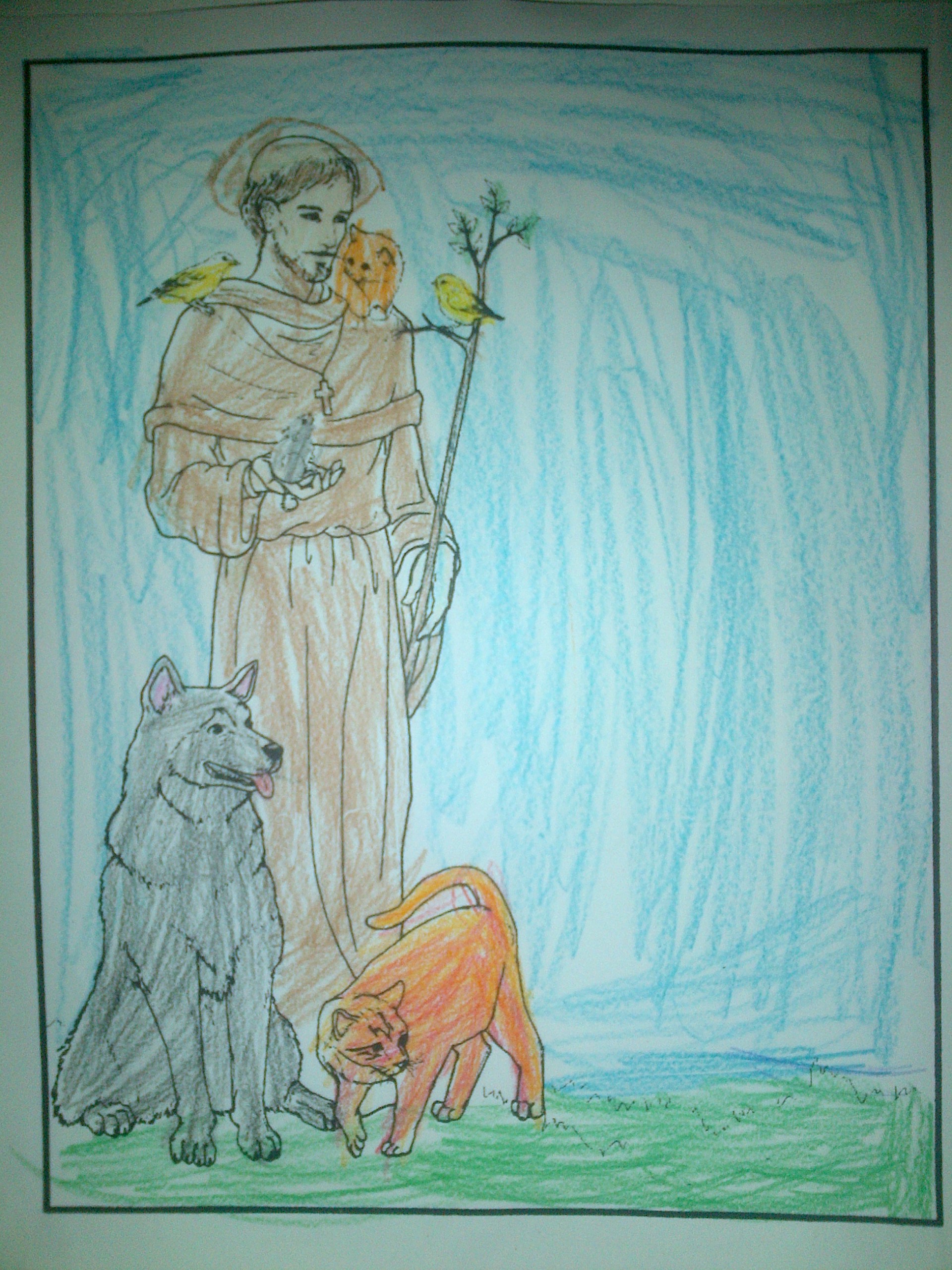
saint-francis-coloring-page

“Saint Francis of Assisi”, coloring book page, colored by a “4-year-old”


(My wife teaches 4-year-olds in a Catholic elementary school. The school’s patron saint is Saint Francis. They call this week “Saint Francis Week” and hold various events throughout the week to celebrate the feast of this great saint (Oct. 4th). My wife and her co-teacher were looking for a short, simple biography that would be appropriate for their 4-year-old students. They didn’t find anything that seemed to be the right fit. So here’s what I jotted down for their pre-K-4 class. The kids really seemed to enjoy it. Maybe you will too. Let us “become like little children”.)


.

Saint Francis, a Knight for God

———

There once was a young man. He lived in a land called Italy. He lived a very long time ago. He lived over 800 hundred years ago!

He lived with his family in a small city named Assisi.

The young man was quite silly. He loved to dream and he loved to sing and he loved to dance. He loved to play with his friends all day long.

The young man’s name was Francis.

His father wanted Francis to be more serious. His father wanted Francis to be just like him. He wanted him to sell expensive fabric to people who were very rich. Fabric is what you use to make pretty things like curtains, tablecloths, and clothes.

Francis’ father wanted him to work in the family shop. But Francis was not very interested in that kind of work. Francis wanted to be a great knight!

And one day Francis went off to do just that.

Francis went off to become a knight. He began to travel to another city where he would fight with a sword and a shield. Francis thought that he would become a great hero.

But on his way Francis got very sick. He had to return to his home. His mother took care of him. And while Francis was getting better he began to dream of different adventures.

He began to spend a lot of time walking around the woods and looking at the flowers and at the trees. He began to watch closely all the animals, especially the birds that flew high up into the sky. Francis began to think a lot about God!

Francis began to dream about heaven. He began to wonder about love. He saw that there was another kind of knight!

Francis decided that he would be a knight for God.

Francis wanted Jesus to be his king and for Mary to be his queen.

Francis no longer wanted to use a sword or a shield. No, Francis wanted to teach all the world how to love. Francis wanted to sing and dance and show everyone how be more like Jesus.

He began to live very simply. He had very few things. His only clothing was an old brown robe. He lived almost like a little animal in the forest. Francis was very free. Francis was filled with joy. He was very happy.

And soon many other young men came to join him. They too wanted to be knights for God. They all lived together. They called each other brother. They shared all they had. They were kind to each other. They loved God together.

And one day, even a young lady wanted to join. She brought other ladies and they started a home of their own. They called each other sister. That young lady’s name was Clare.

A new type of family was beginning to grow. A family who lives very much like Jesus. We call them Franciscans.

We now call that young man, Saint Francis. We now call that young lady, Saint Clare.

Saint Francis and Saint Clare are now in heaven with Jesus and Mary and all the holy angels and saints. They live in perfect peace with God the Father and the Holy Spirit. They see us right now. They pray for us too.

Hey, who knows, maybe one day a few of you boys and girls may become knights and ladies of God, like our patron saints, Saint Francis and Saint Clare!


..

—Howard Hain

.

Visiting Gregory the Great; September 3

Church of St. Gregory the Great, lower left, off Via di San Gregorio (google maps)

The Journey to Jerusalem

Jesus begins to set out for Jerusalem in today’s reading at Mass from the 10th chapter of Mark’s gospel. Matthew offers a similar account in the 19th and 20th chapters of his gospel.

Jesus doesn’t go to Jerusalem alone, he invites others to go with him. It’s a journey to resurrection and life and more than a couple of days, but as they hear Jesus describe the way to Jerusalem, people react like people do,

You can’t miss human weakness in the journey stories of Mark’s and Matthew’s gospel, beginning with the Pharisees. I suppose they represent human doubt and questioning that’s always there. The disciples rebuked the women bringing their children forJesus’ blessing, and Jesus rebukes them. Be like children to make the journey, Jesus tells them.

The rich young man wants to hold on to what he has, so he goes away sad. Peter says proudly he’ s given up everything to follow Jesus, but we know how inconstant he is. The story of the brothers, James and John, is obviously a story of human ambition.

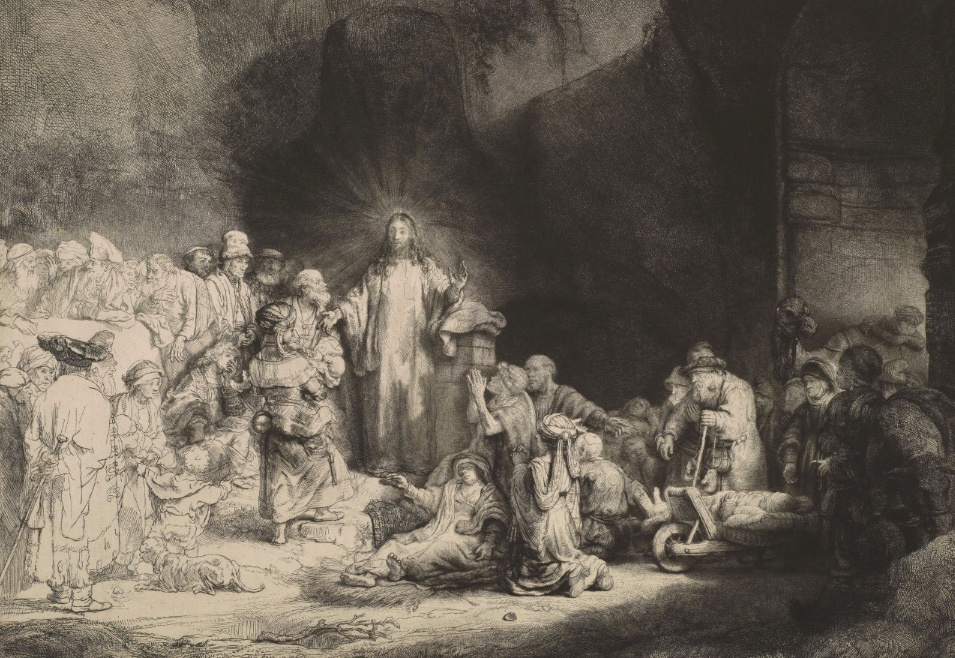
1 Hundred Guilder Print
Rembrandt Hundred Guilder Print

Matthew offers Mark’s stories in chapter 19 and 20 of his gospel. The artist Rembrandt drew a remarkable picture of the 19th and 20th chapter of Matthew called the Hundred Guilder Print.

Jesus stands at the center of Rembrandt’s work, bathed in light, his hands outstretched to the crowds before him.

Peter stands at Jesus right, close by. Other disciples, probably James and John, are next to him. Women and their children, whom the disciples told to go away, are next to them. The rich young man is also there in the crowd. Is he reconsidering?

Some of the enemies of Jesus who plotted against him and argued with him are also there, talking among themselves, but they’re still in the picture. Rembrandt even pictures the camel, back by the city gates.

Jesus sheds his light on them all. His arms are open to them all. Rembrandt has it right. Grace is more powerful than human weakness. It’s everywhere.