Category Archives: Motivational

Morning Thoughts: A Simply Perfect Quilt

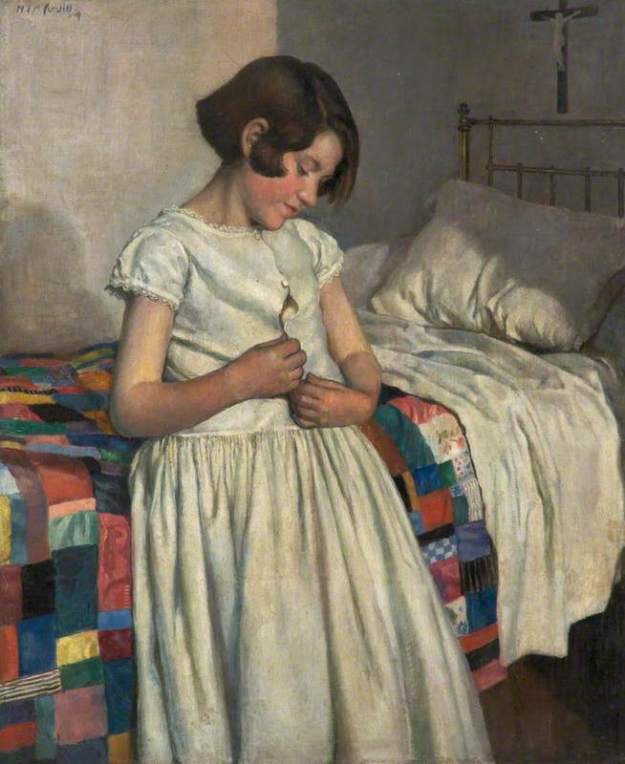
Cundell, Nora Lucy Mowbray, 1889-1948; The Patchwork Quilt

Nora Lucy Mowbray Cundell, “The Patchwork Quilt”, 1919

..

As nurslings, you shall be carried in her arms, and fondled in her lap; as a mother comforts her child, so will I comfort you; in Jerusalem you shall find your comfort.

—Isaiah 66:12-13.


.

I heard someone say the other day that Amish women leave their finished quilts imperfect, and that they do this purposely, so as not to commit blasphemy.

We hear lots of things. And like with most of what we hear, whether this or that is true or not, we quite often just don’t know—at least not in terms of earthly circumstance: what exactly was said, who exactly said it, or the exact context in which it was said. But also quite often, these factors simply don’t matter—at least not in terms of what we most need spiritually at that present moment.

To get caught up within the trivial details of who, what, where, and when is to lose a beautiful opportunity to receive correction, direction, encouragement, and inspiration. It is to miss a moment of grace.

God is always speaking to us. Always instructing. Always telling us what we need to hear. Even if His speech takes the form of a simple smile, or a simple piece of Amish lore. He is always right there with us, each one of us. One God. Three Persons. One clear, consistent, perfectly unified voice, continually encouraging us forward.

To me this is a beautiful case of the left hand knowing exactly what the right hand is doing. It is prophecy in real time. Moment by moment. Step by step. Stich by stich. Incremental inspiration. All toward a beautiful, comforting blanket composed entirely of grace. It is the Holy Spirit at work. It is Holy Spirit teaching.

———

We always get exactly what we need. But we must be willing to wear fleeces white as snow. For everywhere that Mary went, the lamb was sure to go.

Clean hands. Pure heart. Purity of intention.

Meekness. Humility. Docility to the Holy Spirit.

We must submit to Mother Church.

It is Simple. It is Holy. And Holy Simplicity simply results in simple, clear, straightforward answers.

And it gets simpler and simpler:

We simply hear what God says when we pray in the Holy Spirit and “worship in spirit and truth”. (John 4:24)

We simply become living, breathing manifestations of His glory when the Holy Spirit prays for and through us, when “the Spirit Himself intercedes for us with groans too deep for words“. (Romans 8:26)

And the Liturgy simply helps us to allow the Holy Spirit to do so.

———

For the Amish women don’t sew alone. God quilts too. His is simply perfect. Always. And to us it looks a lot like the Liturgy.

O the simple joy of being wrapped up tightly within it!

O the simple wonder of walking deeper into the Body of Christ each new day—into the greatest and most public prayer of the one, true, holy, catholic, and apostolic Church—The Holy Sacrifice of the Mass—with faith and hope and an ever-increasing expectation that we will “nurse“, “be satisfied” and “drink with delight” at the “abundant breasts” of Mother Church. (Isaiah 66:11)

We receive the comforting milk of Sacrament: of reconciliation, of sacrifice, of thanksgiving, of praise, of presence, of joy, of love…

We receive our physical nourishment, our spiritual inspiration, our mercy and forgiveness, our healing and peace, our much needed correction and instruction—and for breakfast and dessert—our daily share in The Cross.

We receive “our daily bread.”

And all are welcome.

The Church invites all, serves all, prays for all…

All of us—me, you, him, her, them, every single one of us—the entire patchwork of humanity—are always welcomed and always encouraged to turn more directly into the light of God’s face. The Face of Truth, of Mercy, of Justice, of Love…

All are always and truly welcome.

Welcome to walk in the clear, crisp, clean air of God’s ceaseless and abundant reality—a reality that never deceives, that never falsely promises imaginary pots of gold lying at the end of fanciful rainbows.

For rainbows are mere optical illusions. And all sin stems from and leads to delusion. Pure faith, on the other hand, rises above all images, whether they are real or those conjured up by Satan in his constant effort to pervert and deceive.

God’s promises are true. His kingdom is no illusion. Heaven is no empty pot of gold.

“…for on those you have rescued from slavery to sin you bestow eternal gladness.” (Collect, 14th Sunday in Ordinary Time, C)

All are welcome to truly come home.

Welcome to walk hand-in-hand with the Lord of the Garden:

“Wash, and be cleansed; remove the foulness of your actions from my sight.

Come, let us speak with one another, says the Lord.”

—Isaiah 1:16,18

———

Perhaps then our Amish lady friends have a good, sharp point. Maybe it is not that important to have things “just right”, exactly the way we will them to be. Maybe it is not about making everything “perfect” according to our own plans, nor about appeasing our every desire and inordinate appetite. Maybe, just maybe, happiness—true joy—resides in just the opposite.

Perhaps what makes a quilt simply “perfect” is that it is made with humble, patient, obedient hands. Grateful hands, quite aware of their own defects. Hands that need not be in constant control, nor constantly caressed.

And perhaps it is just those kinds of hands, the hands of poor humble handmaids, that simply remind us of the true purpose of a simple quilt—to keep us warm—warm enough to get us through—to get us through to the other side—to the other side of a long, dark, cold night.


.

She wrapped him in swaddling clothes and laid him in a manger, because there was no room for them in the inn. Now there were shepherds in that region living in the fields and keeping the night watch over their flock. The angel of the Lord appeared to them and the glory of the Lord shone around them, and they were struck with great fear.

—Luke 2:7-9


.

—Howard Hain
Friday Thoughts: Holding Christ’s Hand

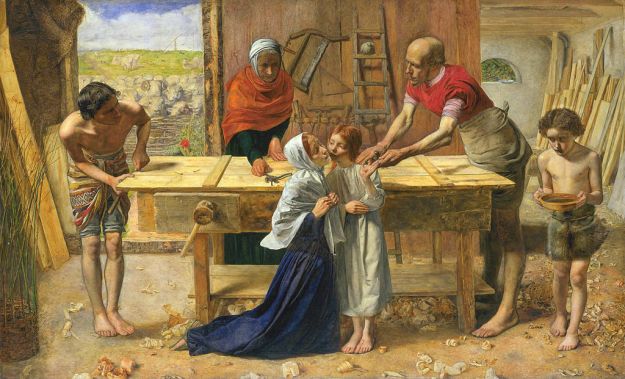
Christ in the House of His Parents by John Everett Millais 1849–50

John Everett Millais, “Christ in the House of His Parents”, 1849-50

.

“I am the way and the truth and the life. No one comes to the Father except through me.

—John 14:6


If we hold Christ’s hand we cannot get lost. For Christ is the way. It is not even possible to go astray.

If we cannot get lost, there can be no doubt. If no doubt, there can be no fear. If no fear—we are in the Kingdom of God. Right here. Right now.

Hold Christ’s Hand. Fear not. You are in the Kingdom of God.


—Howard Hain

.

Friday Thoughts: You Dirty Rat

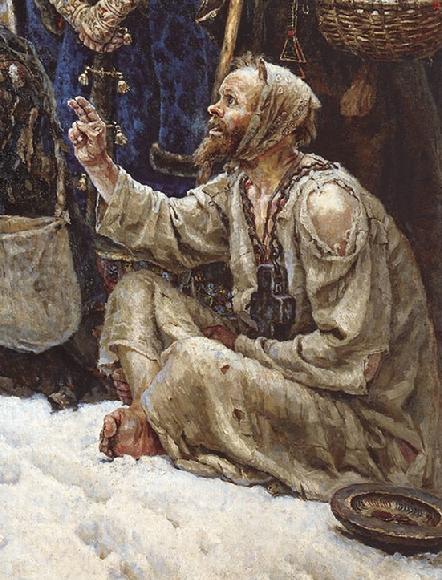
The Boyarina Morozova, Vasilij Surikov, 1887, detail 2

Vasilij Surikov, “The Boyarynya Morozova”, 1887 (detail)

 .
I am starving to death by not preaching. I search the garbage bins and pick out of dumpsters, ever eying with hungry eyes trash thrown by the wayside.

I am so wonderfully fed by Christ!

Yet I thirst a thirst of love. I long for more painful encounters that heal me so. I am a lover of the beach who roams the Sahara. Below the height of the mounting sun, among the singing dunes, I bellow with them the universal hum.

The sand is all about me. An oasis resides within my heart. I am surrounded by mirages of men whom long ago have forgotten to start.

I starve to preach. To sing of our Lord. I starve to fly high with no might of my own. Tapping toes and rocking forth, slightly bending knees, ready to spring forth from well to well.

I love our God. I love Him so. I love Him and Him alone. He tells me to love others as myself. I love Him despite myself. I love Him in others, and others because of Him. I love for I have been brought low. I love for I have learned to soar high. He is my all. My everything. Of Him, and Him alone, do I sing.

I sing of socks, and of sneakers, of old clothes and new sandals, and of wedding rings. I sing of mice, and of men, I sing of the difference that resides only in the length of whiskers. I sing of dogs and of cats, and o yes, of rats—o those ugly creatures that challenge me so.

I ask myself, are they not created by God as well?

Isn’t that dirty filthy stinkin’ rat also beautiful and also real?

Does not God shine the sun and shower the rain on disturbing rats as well?

O, if I could only love rates, then I would truly sing! Mend this heart, this rock of mine, hardened by selfish sight and by wanting what isn’t mine. Yes, boil me down, so I may drown in what the residue of life leaves to those who truly suffer.

I sing to you, O Glorious Rat. Creature of God!

I sing to you that you too shall sing with me. I see that I no longer need to sing alone. Come, accept my embrace. I forgive you. Now perhaps I too may be forgiven.

I see and smell and hear the truth. You the rat, object of everyone’s scorn. You too were once so young, before you crawled into the bin, before you journeyed down the darkened tunnel—you too—little infant rat—were brought forth from the mother’s womb.

Come young, come old! Come from your abandoned buildings, and vacant storage yards, from old ball fields well over grown. Come one, come all!

The pious pied piper now plays a gospel tune. The garbage begins to gather, the desolation takes on an evening glow. The sand all about me recedes from the stormy cloud. It slowly begins to lay low.

The desert creeps up upon a vast body of water.

I pass between walls of a held back sea, my feet tread cross a red clay bottom.

You too, brother rat, are a gift from our mighty God above. You too were loved into existence by the Lord of all.

God of all who share residence upon the earth.

God of all who sigh and sing.

God of all who snort and smile.

God of all who bellow and breathe, both fresh and soiled city air alike.

Come, then, last call, leave your dens, leave your hobbies, leave you daily work behind. Leave you rats, friends of mine, leave the muck and sewers of this world, climb the hills, and charge the mountain, dip yourselves in Carmel air, for even you reflect the glory of Zion from a peak so high.

Come and join the birds who listened so intently, who still this day patiently hear lonely troubadours sing. Yes, join us, for there is always plenty of room, room for even you, object of everyone’s scorn.

Enough for even you, you dirty rat.

A sight for sore eyes to this poor lonely thirsty preacher.

For through you I give our magnificent God mighty humble joy-felt praise.

———

.
—Howard Hain

12 Sunday C: The Everyday Cross


To listen to this week’s homily, please select the audio file below:

Three gospels, Mark, Matthew and Luke, are called the synoptic gospels because they seem to “see” the story of Jesus in the same way. They were written some years apart. Scholars say Mark is the earliest, written around the year 70 AD. Matthew perhaps around the year 80 AD, and Luke between 80 and 90 AD.

All three recall the same story, but each introduces changes and additions of their own to teach the communities they’re writing for. We may hardly notice the differences, but they’re there.

For example, today’s gospel from Luke recalls an important incident that’s found in all three gospels. After ministering and teaching in Galilee for a time, Jesus announces he is going up to Jerusalem to suffer, die and rise again.

In all three gospels, Jesus asks his disciples “Who do people say I am?” Their answers are pretty much the same: ‘John the Baptist’ others ‘Elijah’ still others, ‘One of the ancient prophets has arisen.’”

Jesus then asks his disciples, “Who do you say I am?” All three gospels report Peter’s response: “You are the Messiah.”

Then, Jesus announces he is going up to Jerusalem and he tells his disciples to follow him. The three synoptic gospels agree on the basics of this crucial incident in the story of Jesus.

But notice in Luke’s gospel two interesting variations in Jesus’ call to follow him. “Jesus then said to all, ‘If anyone wishes to come after me, he must deny himself and take up his cross daily and follow me. For whoever wishes to save his life will lose it, but whoever loses his life for my sake will save it. “”

Jesus speaks to “all,” not just to a few disciples, Luke says. He invites all, not just the chosen twelve, or the Jewish people, or Jewish-Christians to follow him. Luke’s gospel insists that Jesus reaches out to everyone. All are invited to follow him and all, not a designated few, have to take of their cross.

Notice, too, the subtle change Luke makes in Jesus’ call to take up our cross. It’s a “daily” cross we are to take up. “If you want to come after me, you must deny yourself and take up your cross daily and follow me.” It’s an everyday cross, not the cross of wood that Jesus bore; it’s not nails in our hands and feet or scourges on our back that we’re asked to bear.

What’s an everyday cross, we may ask? Open your arms wide and what do you see? We’re formed like a cross. That’s what we carry everyday–ourselves. Maybe it’s sickness or disappointment or weariness or worry about something or someone. Maybe it’s putting up with a world that wont change or dreams that wont come true.

The cross we take up is there, everyday, in ourselves and the world we live in, and our patience wears out bearing it.

“Take up your cross daily and follow me,” Jesus says in Luke’s gospel. By adding one word, the evangelist makes clearer what Jesus would say.

Friday Thoughts: Walled Garden

Francis and Clare from the movie Brother Sun, Sister Moon Franco Zeffirelli

Saint Francis and Saint Clare from the movie “Brother Sun, Sister Moon”, (Franco Zeffirelli) (1972)


.
A garden enclosed, my sister, my bride,
a garden enclosed, a fountain sealed!

—Song of Songs 4:12

.


.
From memory it is not easy to recall. I do have a clear image, but if it is accurate that remains to be seen. Here we go.

It was downhill. A sloping path. As I approached the stone church, a few people wandered around out front. There was somewhat of a courtyard, well not a courtyard, more like a little wall hugging into existence a welcoming space. This wall was about bench height, made also of stone, and extended outward from the building. It created what I would normally call an out-front patio space, but in Italian terms, perhaps it would be called a terrazza, or maybe even be considered a piazza, or perhaps most accurately, a piazzetta. Then again, maybe it is just a patio to Italians too.

Well, sitting on this low wall was a friar. And running around the open area was a small brown dog with a shaggy little beige beard.

I entered the church. It was small, almost cave like. A curved ceiling. Dark. Old. There was the cross, a crucifix. Not the actual one that spoke to Saint Francis—no, that one was moved up into the Basilica of Saint Clare located in the central part of the still small but no-longer medieval town of Assisi.

The reproduction spoke to me.

I’m an early companion of Francis.
.


.
I remained in the chapel for a while. I’m not sure if I was praying or not. I’m pretty sure I got on my knees. But from that day’s perspective, prayer was not known to me. So from that perspective, I wasn’t praying. But from today’s perspective, I most certainly was. For I was there. I was in Italy, in Assisi, in the Church of San Damiano. I was there intentionally. I was lost but I was found. I was looking, and I was obeying. Obeying what I didn’t know. I had no idea why, but I wanted to be there. And I felt something. It was heavy, literally. I remember feeling bent over. I remember thinking about all the prayer that must have taken place in that small space over the past thousand years. I remember thinking that all that collective belief must have an effect. It did. It does. It will. I was certain that I felt it. It bowed me down. It bent me over. And I remember liking it.

Faith is common.

I was a pilgrim and didn’t know it.
.


.

I don’t remember much about the convent itself. I do remember walking from room to room, the communal rooms where Saint Clare and her companions, her biological mother and two sisters among them, ate and prayed and cared for their sick. I remember the small warm inner garden, with it’s old well. And the spot marked as the place where Clare liked best to sit. I’ve always loved internal courtyards. The thought of being outdoors and yet enclosed. Architecturally, it best represents the beauty of true solitude. Open. Yet safe. Free. Yet sheltered. Alone. Yet surrounded by those who believe the same.

In that sense, solitude—when it’s truly interior, truly spiritual—is like love: you can never get enough of it, and once you have it, once you truly live within it, you’re never again alone.

Solitude is love. And love is never solitary.
.


.

Therefore the Lord himself shall give you a sign. Behold a virgin shall conceive, and bear a son, and his name shall be called Emmanuel.

—Isaiah 7:14

.

.

—Howard Hain

Morning Thoughts: The Clown of God

norman-rockwell-jester-february-11-1939

Norman Rockwell, “The Jester”, 1939

.

“Alas, poor Yorick! I knew him, Horatio, a fellow of infinite jest, of most excellent fancy.”

—William Shakespeare, Hamlet: Act 5, scene 1

.


.

Early this morning, Francesca and I had a good laugh.

The sun was up, we were not. We were out late a few days ago. On Saturday night we visited a friend’s home and didn’t get to bed until after 11. That’s pretty late for all of three of us, but for Francesca, from her six-year-old perspective, it was “almost the next day!”

So this morning, the Monday of a new week, we found the consequences of that shortened Saturday-night sleep still catching up with us.

Francesca had made her way from her bedroom to the couch I guess around five. I sat up just about half past, the sun fully making its presence known, and as I looked toward the couch I saw Francesca propped against some pillows, cuddled up in the corner, eyes open, but still quite in sleep mode. I walked toward the kitchen to hit the coffee button, and as I passed in front of the couch I broke into an overly-exaggerated stroll. As I disappeared into the kitchen I caught a peek of Francesca’s smile.

When I reentered her line of vision, just a handful of seconds after hitting the “on” button, she was sitting up straight, smiling broadly, and said quite adamantly: “Do it again.”

“Do what again?”, I smiled.

“Walk like that again!”, she immediately answered back, moving her little arms in a fashion somewhat like I hade moved mine.

“What are you talking about?”, I tried to say with a straight face as I walked the same way back across the room.

“Like that!”, she exclaimed, laughing and pointing at my arms.

And we were off and running, or should I say, “walking”. Over and over again, I would say: “What’s wrong with how I’m walking?”, and then she would point out what was “out-of-order” regarding my gait. Each time I would—with as much seriousness as I could muster— “correct” what she pointed out and then try again, this time adding yet another new “discrepancy”. One time I swung my arms wildly, another time I goose stepped, then I raised my knees too high, one round I walked “perfectly” but made funny noises with my mouth as I moved, and this went on and on, or I should say, we went on and on, and each and every time she was laughing more and more, getting more and more exasperated and adamant about what it was that I was not doing right.

“Just walk normal!”, she would laugh, and I would answer, “I am”, again and again. And then it got really funny. I could barely keep a straight face for even a few seconds. She herself began to illustrate how to properly walk, and seeing her trying to walk “normal”, which only resulted in her walking quite “un-normally”, only added to the Buster-Keaton type ridiculousness taking place in our tiny little living room. And all the while Laurie was just a few feet away still in bed, I wont say still asleep, because I have a hard time believing she could continue to snooze through all that ruckus.

But what really brought the house down was when I began to “really try” to walk right, listening intently to all her instructions, and painfully listing each one, and at the same time actually beginning to get confused. I had to think to myself for a second, “How is it that a person actually does just get up and walk?”. It is amazing what happens, what a mess we can make of things, when we try to understand and take control of what comes so naturally to us, of what comes so easily to almost all of mankind by the very nature of who we are, and seemingly without any effort or consciousness. But this little philosophical reflection didn’t stand a chance, Francesca was still on the scene and a child just wont permit, not even for a second, the antics of self-indulgent adult reflection to get in the way of a good time. She was focused on the action at hand, on the flow, from one act to the next, and she now had herself hysterical about the next and final slapstick scene in our not-so-silent film.

For you see, she discovered something in me that’s just priceless in her estimation. She loved the fact that I developed this little movement, quite unintentionally, as I “prepared” to try again to walk properly. I would kind of slightly waddle in place, lining up and squaring my feet, while at the same time slightly rotating my hips and shoulders, trying to position my feet, hips and shoulders just right. I guess I began to resemble a gymnast right before he launches the big run leading toward a long series of tumbles, or better yet, perhaps a diver in the Olympics right before leaping off the high board. Well, either way, this was more than Francesca could handle. She let out a true belly laugh, and then pointing wildly at my shoulders: “Daddy, do it again!”

At this, she jumped off the stool that she was now teetering upon, trying with all her might to mimic me. We both we’re beside ourselves with laughter. It was an absolute blast. It was creative chaos at its best. All heaven broke loose.

I hadn’t even had a sip of coffee yet. My morning prayers were still in a holding pattern. And then the thought came to me. A thought came to this continually under-occupied, perpetually unemployed forty-four-year-old man who just can’t seem to find his way in this world: “I should be a clown.”

I asked Francesca what she thought about my new career path. She loved the idea!

“Yes!!! Do it Daddy, do it!”

I decided to keep my prayers this morning to a few simple Our Fathers.

God was clearly praying for me since the moment I awoke.

The Spirit groans on our behalf, perhaps He laughs for us as well.

Prayer is prayer. This morning, Francesca’s laugh, and mine as well, was the peal of the morning bell—calling all the world to still attention—before the settling in of the business of another new day:

.

The Angel of the Lord declared unto Mary.

And she conceived by the Holy Spirit.

Hail Mary, full of grace…

.

.

—Howard Hain


10th Sunday C: Raising the Dead

To listed to today’s homily please select the  audio file below:

All this week and most of the following week our readings at Mass are about the Prophet Elijah from the Book of Kings. Jesus, remember, is often compared to Elijah. “Who do people say I am?” he asks his disciples. “Some say you are Elijah,” they answer. On the Mount of Transfiguration Moses and Elijah appear with Jesus in glory. Elijah is a prophet who helps us know Jesus.

He’s a mysterious prophet, first of all. We know little about his origins. The scriptures call him, “Elijah, the Tishbite.” Like Jesus, his origins are mysterious.

Elijah is also a lonely prophet. By “lonely” I don’t mean he chooses to avoid people or prefers a solitary life. Elijah is lonely because he got into trouble with the powerful establishment of his day and is continually on the run, hiding out in caves and wadis. His loneliness comes because he fearlessly challenges the wicked king Ahab and his notorious wife Jezebel, who have absolute control over Israel. He himself has no political party, no cadre of followers to back him up. Yes, people like what he’s doing, but when danger comes, they abandon him, like the disciples who abandoned Jesus when danger came to him.

Like Jesus, Elijah speaks the truth and defends the truth, but speaking the truth and defending the truth can also make you unpopular. It can be a lonely, thankless path.

Our reading today from the Book of Kings is from the first part of Elijah’s mission. On God’s authority the prophet announces to King Ahab a drought is coming to the land of Israel. Because Ahab and his people are unfaithful to God no rain will fall, no crops will be harvested, no money will come in from trade. Of course, the king and his queen are furious and want Elijah’s head.

On a pilgrimage to the Holy Land some years ago, I remember standing on Mount Carmel in northern Israel, which is Elijah’s traditional home, looking out to the east and to the south. Our guide pointed east toward the Jordan valley, where Elijah went to hide from Ahab and Jezebel near a mountain stream, the Wadi Cerith. The king knew every water hole, every hiding place and he sent his soldiers out to hunt down the prophet. No one would be foolish enough to shelter or give food to an enemy of the king. But God kept Elijah safe and alive. A poor widow with an only son took him in.

That’s where we find Elijah in today’s reading. He’s in hiding with a poor widow and her only son. The only people who will take him in. But suddenly, the widow’s son dies. This poor woman trusted in God, taking Elijah in, and now her only son is taken from her. She has no one else, nothing else in this world.

You can hear in our reading the poor woman’s anger and regret as she lashes out at the prophet she’s taken in. Is this the way God rewards her good deed? “Why have you done this to me, O man of God?” Elijah too bitterly complains to God: “O LORD, my God, will you afflict even the widow with whom I am staying by killing her son?” He’s fed up with it all.

Then, he calls on the God of life to bring back this boy. He places his body on the dead body of the son, and God raises the boy to life and Elijah gives him to his mother. “Your son is alive.”

The story of Elijah is an old story, but it’s filled with interesting insights into our world and the way God works in it. Elijah himself is a powerful prophet; he raises the widow’s son to life. But really, he’s powerless most of the time, just a poor man on the run, not knowing where to go or what to do next. The world he’s challenging doesn’t seem to change. No matter what he says, Ahab and his wife Jezebel seem to keep running things. The society is corrupt and people are too afraid to do anything about it.

But God keeps the prophet going. In the worst of times, God tells Elijah to be faithful. Even when he is ready to give up, God calls him again, to speak the truth, even to raise the dead.

I mentioned earlier that Jesus reminded people of his time of Elijah. “Some say you are Elijah,” they said. Today’s gospel story would give them reason to compare the two. Jesus raises a widow’s son as they are carrying him from the town of Naim for burial. But it might also be true that people see their own times like the times of Ahab and Jezebel. They were living in a tough, unjust world they couldn’t see being changed. To do that, you would need someone who could raise the dead.

Friday Thoughts: Running with the Lord

cezanne bather-with-outstreched-arms 1878

Paul Cezanne, “Bather With Outstretched Arms”, 1878

.

“…into your hands I commend my spirit”

and when he had said this he breathed his last.

—Luke 23:46

.


.

Years ago when I was living in San Francisco, a group of us used to go hiking out in Marin County, just across the giant red expanse of the Golden Gate Bridge. We went often. A group of both men and women, mostly single, mostly without a care in the world. I think every one of us was under thirty, or thereabouts.

My favorite part was running down. Don’t get me wrong, the hike upward was terrific too, that’s when we discussed ideas and dreams and laughed almost all the while, breaking up into smaller groups of two or three or maybe even four, and then drifting back together—like a herd of elk, for they too have not a care in the world—only to once again drift apart, this time usually paired up with a different companion or combination thereof. None of it was planned or had any real intention of course, it just happened: laughter, ideas, silence, stops, gazes outward, waiting, speeding up, sipping water, laughter, drifting apart….it was divine.

 Like the elk, it all seemed to be instinct.

But something special happened when we reached the top. After we reached the top. After we caught our breath, removed our backpacks, and viewed the scape. After we had eaten a little snack or a small sandwich, something light, usually along with an apple or granola bar, maybe even a small handful of assorted nuts and a few of those purple chips that all San Franciscans seem to love. It was time to descend.

My friends used to laugh and say that it was because I’m an Indian. They would go on and on about my “Cherokee” blood, and the fact that the first three letters of my first name spelled “how” only served as additional fodder. But there was some truth in it. Not only because I actually do have some American Indian blood, but more so because at that time I was very much a native. Primitive. Raw. Free.

That’s why I would run down.

I loved it. I would run as fast as I could go. Cutting back and forth, hopping over logs, propelling myself around turns by pivoting hard on the corner tree. I loved it. I loved the way I felt. I loved that my weight added to the speed, that what normally would slow me down, would normally make me huff and puff, now drove me forward, propelled me toward from whence I came.

It was wonderful. I was free. I was free. I was free. It was the closest this man ever came to flying.

This morning, almost twenty years later, in urban New Jersey—just across the Hudson River from Manhattan—I went for a jog. They just opened a new circular path around the old reservoir resting slightly higher than its surrounding cities of Weehawken and Union City. It is very pleasant.

I wasn’t sure how far I’d be able to make it. And after a very short distance I thought to myself, “Oh boy, I’m gonna have to stop already.” But I didn’t. I thought about posture. I thought about positioning of hands. I thought about breath. I quickly realized that the Lord has taught me much.

The posture of prayer is important. How we position ourselves is powerful. And breathing is everything.

I made it around three times. I smiled almost all the way. My pace was pretty good. I did alright, not bad for a man I thought just a few minutes before was getting old. I think even the newly-minted goslings admired my gait. And even if they didn’t, it was nice to be in a place to think that maybe they did.

I walked a lap and then began to make my way back toward my home, my one bedroom apartment that I share with my most recent and till-death-do-us-part hiking companions: my beautiful, delicately strong bride of twelve years, and my precious little girl, who at six-and-a-half runs and laughs like the wind.

I was a few streets away, coming down 18th and crossing Summit, when it happened. I never really noticed it before. The next two blocks were a steady, fairly steep decline. I began to run.

I loved it. I ran as fast as I could go. Cutting back and forth, hopping over the cracks in the sidewalks, propelling myself around the turn by pivoting hard on the corner stop sign. I loved it. I loved the way I felt. I loved that my weight added to the speed, that what normally would slow me down, would normally make me huff and puff, now drove me forward, propelled me toward from whence I came.

It was wonderful. I was free. I was free. I was free. It was the closest this man ever came to flying.

For a moment I thought I was on the outskirts of San Francisco.


.

And with that he breathed on them and said, “Receive the Holy Spirit…”

—John 20:22

.

.

—Howard Hain

Friday Thoughts: Playing Around

Bruegel, Children's Games, 1560

Bruegel, “Children’s Games”, (1560)


…and a little child will lead them.

—Isaiah 11:6

———

It’s the simple moments. It’s playing hide-and-seek. It’s pretending that what isn’t is.

Like a game made-up as we go, with only a single rule: It has to make us laugh.

But not the kind of laughter that hurts anyone or anything. No, it has to be true laughter, the kind that comes from and through kindness, through truly wanting to be with one another—so much so that we’ll make up just about any old game, just as long as we wont have to go our separate ways.

“Life” then becomes one big beautiful “excuse” to stay together, and our “actions” take on a tremendously meaningful fashion. They become like soft pieces of colorful clothing gently placed upon our joy-filled affections.

Little children know this through and through. They’re constantly changing and tailoring their “clothes”, adapting and accessorizing as they go, with only one goal in mind: for the “fun” to continue. But the fun they seek is not the kind that you and I normally desire—for little children know what few adults remember. They’re not so easily tricked. They know that fun, true fun, has very little to do with the actual game being played, in and of itself. For little children it’s all about what the game, as a mere instrument, allows them to experience—the freedom to let out love.

That’s why the type of game they play can turn on a dime. It just doesn’t matter.

Rules? Scores? Time-limits?

Who cares about stuff like that?

Are we “laughing”? Are we having “fun”? Are we still “with each other”?

Are we still in love?

These are the only questions that matter to a small child!

And with prayer it is much the same. Saints make up all kinds of “games” in order to “excuse” the time that they want so desperately to spend with God. They play all kinds of little games. They slide beads, they sing little songs, they pretend to be statues while playing hide-and-seek with the Lord, and some—the ones that the world most often calls crazy—even dream up little tales and fanciful stories, imagining along with God what could be if only everyone in the world would join in and play together.

But this is no big secret. All saints in one way or another come to say the same thing: Every technique, every approach, every means of entering into prayer…each and every one…they’re all part of one giant “excuse”, one seemingly never-ending “game”. For at the end of the day, techniques and approaches are at best a mere prelude to divine laughter—that infant-like sound composed of pure joy, that only the Love of God can bring into being.

———

He said to them, “Let the little children come to me, and do not hinder them, for the kingdom of God belongs to such as these. Truly I tell you, anyone who will not receive the kingdom of God like a little child will never enter it.” And he took the children in his arms, placed his hands on them and blessed them.

—Mark 10: 14-16

.

—Howard Hain

.

Friday Thoughts: To All Gathered in Thought and Prayer

by Howard Hain

.

Jesus Christ is Real.

.

He is not made of wood or ink or paint. He is not a distant figure from a distant past. He is here. We gather in His name—He is here. He is as real as each one of us. He is what makes each one of us real.

The message is simple:

He is the Son of God. He is the Way, and the Truth, and the Life. He is Love. He is Forgiveness. He is Humility. He is Boldness and Obedience.

He is Lord. He is God. He is Jesus Christ, crucified and risen.

He is Christ Jesus, and He is Real.

I see Him now in each of you. I say to Him, I say to you: “I love You, my Lord and my God.”

.

Now, let us go and tell others…

.

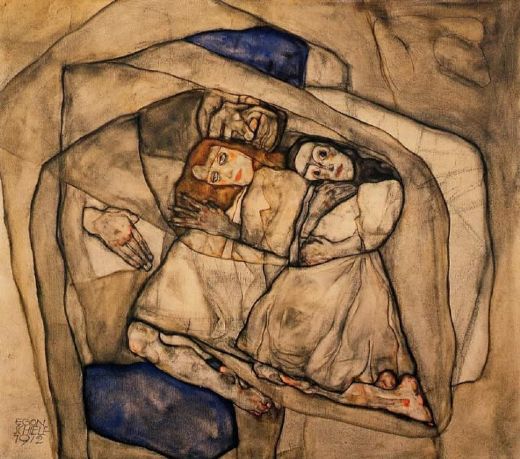
egon-schiele-conversion-78198

Egon Schiele, “Conversion” (1912)

.

And behold, I am with you always, until the end of the age.”

— Matthew 28:20

.