Category Archives: Inspiration

10th Sunday C: Raising the Dead

To listed to today’s homily please select the  audio file below:

All this week and most of the following week our readings at Mass are about the Prophet Elijah from the Book of Kings. Jesus, remember, is often compared to Elijah. “Who do people say I am?” he asks his disciples. “Some say you are Elijah,” they answer. On the Mount of Transfiguration Moses and Elijah appear with Jesus in glory. Elijah is a prophet who helps us know Jesus.

He’s a mysterious prophet, first of all. We know little about his origins. The scriptures call him, “Elijah, the Tishbite.” Like Jesus, his origins are mysterious.

Elijah is also a lonely prophet. By “lonely” I don’t mean he chooses to avoid people or prefers a solitary life. Elijah is lonely because he got into trouble with the powerful establishment of his day and is continually on the run, hiding out in caves and wadis. His loneliness comes because he fearlessly challenges the wicked king Ahab and his notorious wife Jezebel, who have absolute control over Israel. He himself has no political party, no cadre of followers to back him up. Yes, people like what he’s doing, but when danger comes, they abandon him, like the disciples who abandoned Jesus when danger came to him.

Like Jesus, Elijah speaks the truth and defends the truth, but speaking the truth and defending the truth can also make you unpopular. It can be a lonely, thankless path.

Our reading today from the Book of Kings is from the first part of Elijah’s mission. On God’s authority the prophet announces to King Ahab a drought is coming to the land of Israel. Because Ahab and his people are unfaithful to God no rain will fall, no crops will be harvested, no money will come in from trade. Of course, the king and his queen are furious and want Elijah’s head.

On a pilgrimage to the Holy Land some years ago, I remember standing on Mount Carmel in northern Israel, which is Elijah’s traditional home, looking out to the east and to the south. Our guide pointed east toward the Jordan valley, where Elijah went to hide from Ahab and Jezebel near a mountain stream, the Wadi Cerith. The king knew every water hole, every hiding place and he sent his soldiers out to hunt down the prophet. No one would be foolish enough to shelter or give food to an enemy of the king. But God kept Elijah safe and alive. A poor widow with an only son took him in.

That’s where we find Elijah in today’s reading. He’s in hiding with a poor widow and her only son. The only people who will take him in. But suddenly, the widow’s son dies. This poor woman trusted in God, taking Elijah in, and now her only son is taken from her. She has no one else, nothing else in this world.

You can hear in our reading the poor woman’s anger and regret as she lashes out at the prophet she’s taken in. Is this the way God rewards her good deed? “Why have you done this to me, O man of God?” Elijah too bitterly complains to God: “O LORD, my God, will you afflict even the widow with whom I am staying by killing her son?” He’s fed up with it all.

Then, he calls on the God of life to bring back this boy. He places his body on the dead body of the son, and God raises the boy to life and Elijah gives him to his mother. “Your son is alive.”

The story of Elijah is an old story, but it’s filled with interesting insights into our world and the way God works in it. Elijah himself is a powerful prophet; he raises the widow’s son to life. But really, he’s powerless most of the time, just a poor man on the run, not knowing where to go or what to do next. The world he’s challenging doesn’t seem to change. No matter what he says, Ahab and his wife Jezebel seem to keep running things. The society is corrupt and people are too afraid to do anything about it.

But God keeps the prophet going. In the worst of times, God tells Elijah to be faithful. Even when he is ready to give up, God calls him again, to speak the truth, even to raise the dead.

I mentioned earlier that Jesus reminded people of his time of Elijah. “Some say you are Elijah,” they said. Today’s gospel story would give them reason to compare the two. Jesus raises a widow’s son as they are carrying him from the town of Naim for burial. But it might also be true that people see their own times like the times of Ahab and Jezebel. They were living in a tough, unjust world they couldn’t see being changed. To do that, you would need someone who could raise the dead.

Friday Thoughts: Running with the Lord

cezanne bather-with-outstreched-arms 1878

Paul Cezanne, “Bather With Outstretched Arms”, 1878

.

“…into your hands I commend my spirit”

and when he had said this he breathed his last.

—Luke 23:46

.


.

Years ago when I was living in San Francisco, a group of us used to go hiking out in Marin County, just across the giant red expanse of the Golden Gate Bridge. We went often. A group of both men and women, mostly single, mostly without a care in the world. I think every one of us was under thirty, or thereabouts.

My favorite part was running down. Don’t get me wrong, the hike upward was terrific too, that’s when we discussed ideas and dreams and laughed almost all the while, breaking up into smaller groups of two or three or maybe even four, and then drifting back together—like a herd of elk, for they too have not a care in the world—only to once again drift apart, this time usually paired up with a different companion or combination thereof. None of it was planned or had any real intention of course, it just happened: laughter, ideas, silence, stops, gazes outward, waiting, speeding up, sipping water, laughter, drifting apart….it was divine.

 Like the elk, it all seemed to be instinct.

But something special happened when we reached the top. After we reached the top. After we caught our breath, removed our backpacks, and viewed the scape. After we had eaten a little snack or a small sandwich, something light, usually along with an apple or granola bar, maybe even a small handful of assorted nuts and a few of those purple chips that all San Franciscans seem to love. It was time to descend.

My friends used to laugh and say that it was because I’m an Indian. They would go on and on about my “Cherokee” blood, and the fact that the first three letters of my first name spelled “how” only served as additional fodder. But there was some truth in it. Not only because I actually do have some American Indian blood, but more so because at that time I was very much a native. Primitive. Raw. Free.

That’s why I would run down.

I loved it. I would run as fast as I could go. Cutting back and forth, hopping over logs, propelling myself around turns by pivoting hard on the corner tree. I loved it. I loved the way I felt. I loved that my weight added to the speed, that what normally would slow me down, would normally make me huff and puff, now drove me forward, propelled me toward from whence I came.

It was wonderful. I was free. I was free. I was free. It was the closest this man ever came to flying.

This morning, almost twenty years later, in urban New Jersey—just across the Hudson River from Manhattan—I went for a jog. They just opened a new circular path around the old reservoir resting slightly higher than its surrounding cities of Weehawken and Union City. It is very pleasant.

I wasn’t sure how far I’d be able to make it. And after a very short distance I thought to myself, “Oh boy, I’m gonna have to stop already.” But I didn’t. I thought about posture. I thought about positioning of hands. I thought about breath. I quickly realized that the Lord has taught me much.

The posture of prayer is important. How we position ourselves is powerful. And breathing is everything.

I made it around three times. I smiled almost all the way. My pace was pretty good. I did alright, not bad for a man I thought just a few minutes before was getting old. I think even the newly-minted goslings admired my gait. And even if they didn’t, it was nice to be in a place to think that maybe they did.

I walked a lap and then began to make my way back toward my home, my one bedroom apartment that I share with my most recent and till-death-do-us-part hiking companions: my beautiful, delicately strong bride of twelve years, and my precious little girl, who at six-and-a-half runs and laughs like the wind.

I was a few streets away, coming down 18th and crossing Summit, when it happened. I never really noticed it before. The next two blocks were a steady, fairly steep decline. I began to run.

I loved it. I ran as fast as I could go. Cutting back and forth, hopping over the cracks in the sidewalks, propelling myself around the turn by pivoting hard on the corner stop sign. I loved it. I loved the way I felt. I loved that my weight added to the speed, that what normally would slow me down, would normally make me huff and puff, now drove me forward, propelled me toward from whence I came.

It was wonderful. I was free. I was free. I was free. It was the closest this man ever came to flying.

For a moment I thought I was on the outskirts of San Francisco.


.

And with that he breathed on them and said, “Receive the Holy Spirit…”

—John 20:22

.

.

—Howard Hain

Friday Thoughts: Playing Around

Bruegel, Children's Games, 1560

Bruegel, “Children’s Games”, (1560)


…and a little child will lead them.

—Isaiah 11:6

———

It’s the simple moments. It’s playing hide-and-seek. It’s pretending that what isn’t is.

Like a game made-up as we go, with only a single rule: It has to make us laugh.

But not the kind of laughter that hurts anyone or anything. No, it has to be true laughter, the kind that comes from and through kindness, through truly wanting to be with one another—so much so that we’ll make up just about any old game, just as long as we wont have to go our separate ways.

“Life” then becomes one big beautiful “excuse” to stay together, and our “actions” take on a tremendously meaningful fashion. They become like soft pieces of colorful clothing gently placed upon our joy-filled affections.

Little children know this through and through. They’re constantly changing and tailoring their “clothes”, adapting and accessorizing as they go, with only one goal in mind: for the “fun” to continue. But the fun they seek is not the kind that you and I normally desire—for little children know what few adults remember. They’re not so easily tricked. They know that fun, true fun, has very little to do with the actual game being played, in and of itself. For little children it’s all about what the game, as a mere instrument, allows them to experience—the freedom to let out love.

That’s why the type of game they play can turn on a dime. It just doesn’t matter.

Rules? Scores? Time-limits?

Who cares about stuff like that?

Are we “laughing”? Are we having “fun”? Are we still “with each other”?

Are we still in love?

These are the only questions that matter to a small child!

And with prayer it is much the same. Saints make up all kinds of “games” in order to “excuse” the time that they want so desperately to spend with God. They play all kinds of little games. They slide beads, they sing little songs, they pretend to be statues while playing hide-and-seek with the Lord, and some—the ones that the world most often calls crazy—even dream up little tales and fanciful stories, imagining along with God what could be if only everyone in the world would join in and play together.

But this is no big secret. All saints in one way or another come to say the same thing: Every technique, every approach, every means of entering into prayer…each and every one…they’re all part of one giant “excuse”, one seemingly never-ending “game”. For at the end of the day, techniques and approaches are at best a mere prelude to divine laughter—that infant-like sound composed of pure joy, that only the Love of God can bring into being.

———

He said to them, “Let the little children come to me, and do not hinder them, for the kingdom of God belongs to such as these. Truly I tell you, anyone who will not receive the kingdom of God like a little child will never enter it.” And he took the children in his arms, placed his hands on them and blessed them.

—Mark 10: 14-16

.

—Howard Hain

.

Friday Thoughts: To All Gathered in Thought and Prayer

by Howard Hain

.

Jesus Christ is Real.

.

He is not made of wood or ink or paint. He is not a distant figure from a distant past. He is here. We gather in His name—He is here. He is as real as each one of us. He is what makes each one of us real.

The message is simple:

He is the Son of God. He is the Way, and the Truth, and the Life. He is Love. He is Forgiveness. He is Humility. He is Boldness and Obedience.

He is Lord. He is God. He is Jesus Christ, crucified and risen.

He is Christ Jesus, and He is Real.

I see Him now in each of you. I say to Him, I say to you: “I love You, my Lord and my God.”

.

Now, let us go and tell others…

.

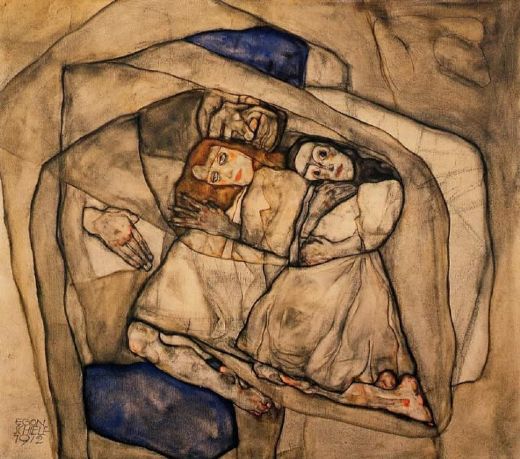
egon-schiele-conversion-78198

Egon Schiele, “Conversion” (1912)

.

And behold, I am with you always, until the end of the age.”

— Matthew 28:20

.

Friday Thoughts: Don’t Look At Me

Caravaggio, Denial of St. Peter, (1610)

Caravaggio, “Denial of St. Peter” (1610)

.

Never look to a man for answers.

Look to Christ who is the answer.

If you insist on looking to a man, then choose one who points to Christ.

For the best teacher is Christ Himself…and His best assistants are those who clearly say: “Don’t look at me.”

.

.

—Howard Hain

.

Friday Thoughts: No Cross Outweighs Christ’s

The more bold we are in God’s name, the greater the mission He assigns—and the greater the resistance from the world.

That resistance is very real, a gravitational force, threatening to crush us, to drive us down beneath the earth—and that resistance takes the form of a cross.

The greater the mission, the heavier the cross.

But fear not, the supernatural force of faith always overcomes. And rest assured in this: No cross outweighs Christ’s, for He took on the weight of the entire world.

Yet, Christ stood, Christ climbed, Christ raised His punctured palms. He overcame the force of death itself and ascended victoriously into Heaven.

So be bold my brothers and sisters in Christ. Accept your mission, pick up your cross and walk, and if you stumble, if you fall…get up. Stand. Stand in faith. And know that you never stand alone.

Know that none of it is an illusion, not the suffering, not the victory.

Know that the struggle is not a figment of your imagination.

No, the weight of your cross is very real…but so is Christ.

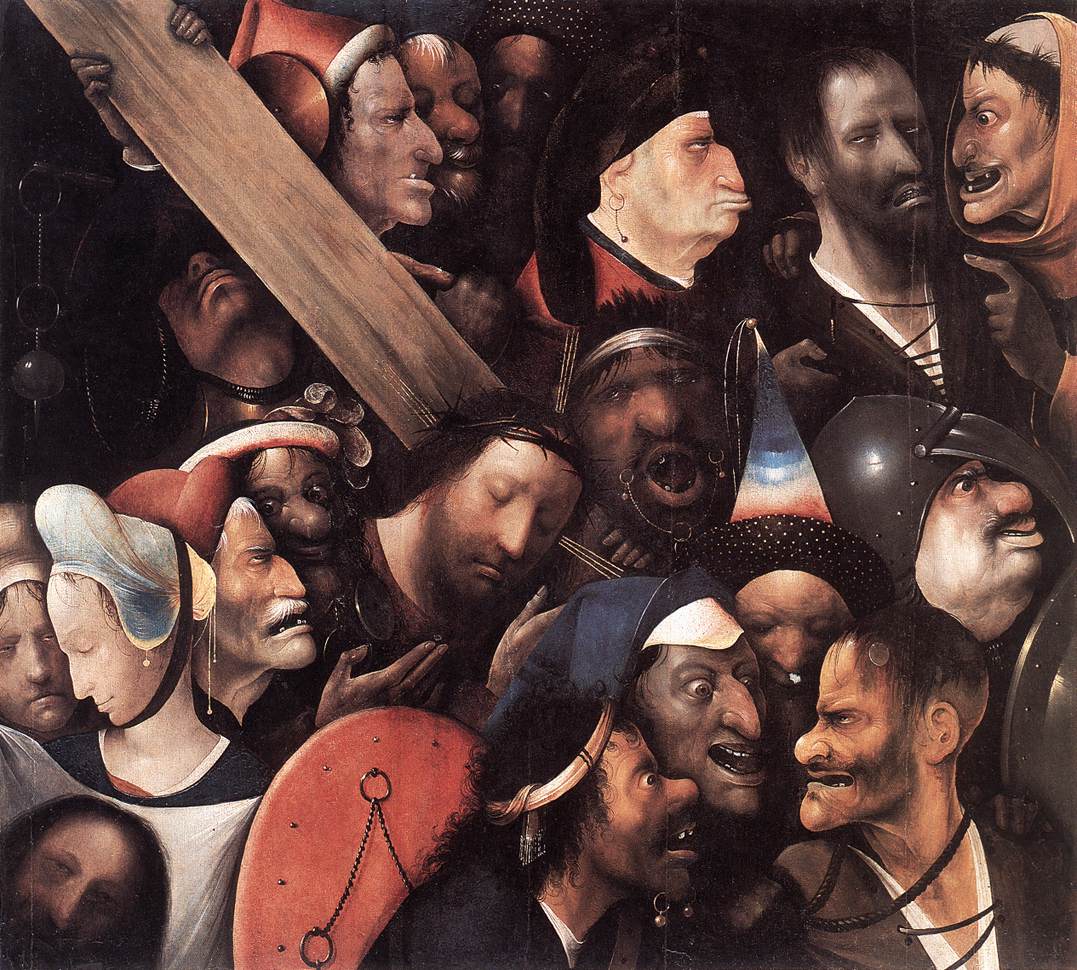
Hieronymus Bosch, Christ Carrying the Cross (1515-16)

Bosch, “Christ Carrying the Cross” (1515-16)

..

—Howard Hain

.

Friday Thoughts: A Cross-Shaped Shadow

But Jesus cried out again in a loud voice, and gave up his spirit. And behold, the veil of the sanctuary was torn in two from top to bottom. The earth quaked, rocks were split, tombs were opened, and the bodies of many saints who had fallen asleep were raised.

—Matthew 27:50-52

.

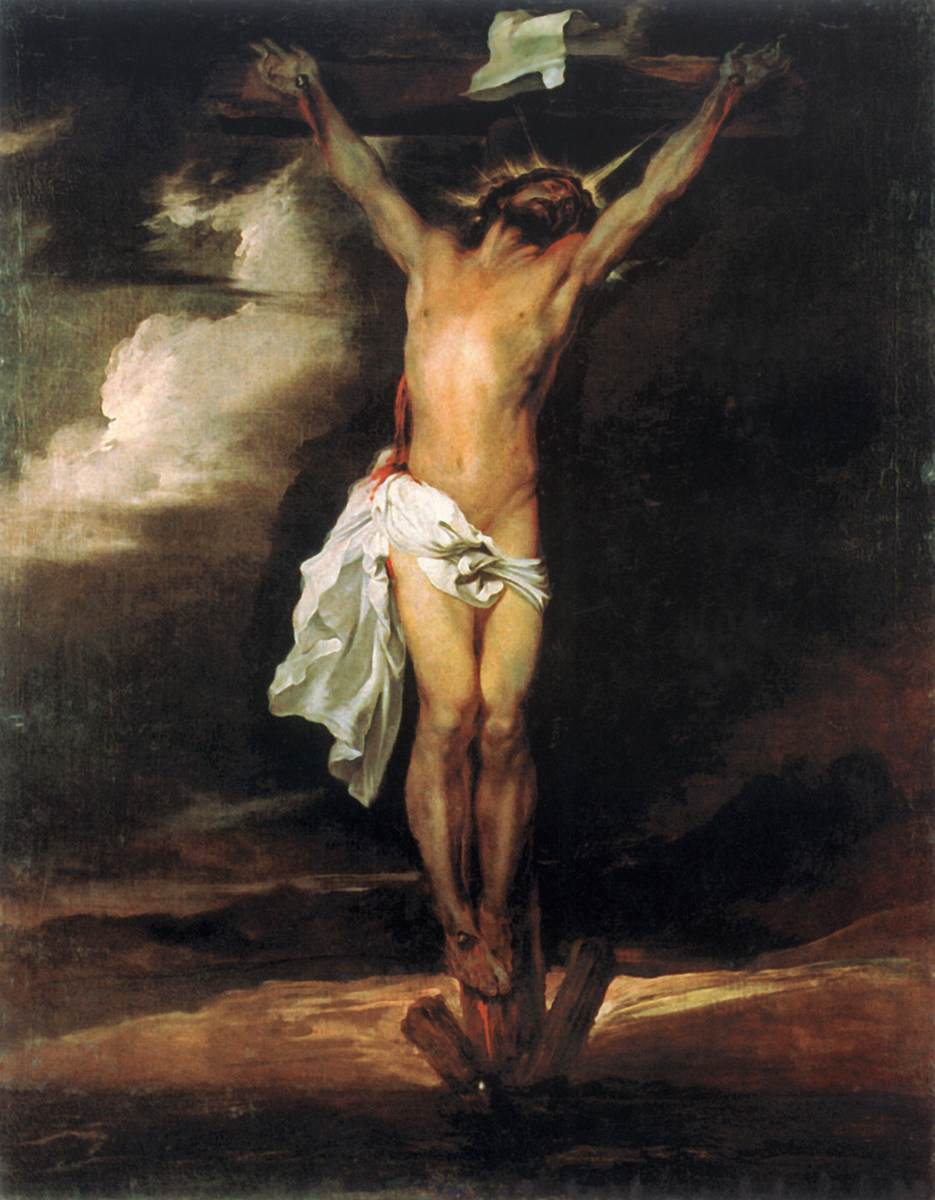
Van Dyck, “Crucifixion” (1622)

.

Get close to the Cross, so close that you stand in its shadow.

It is then that you feel the earth quake and your faith deepen.

It is then that you witness salvation pouring forth from His wounds.

.

.“Clearly this man was the son of God!”

—Mark 15:39


..

—Howard Hain

.