“Amen, I say to you, this poor widow put in more than all the other contributors to the treasury. For they have all contributed from their surplus wealth, but she, from her poverty, has contributed all she had, her whole livelihood.” Today’s gospel image of the generous widow emphasizes the attitude of biblical stewardship that is not based on surplus but on sacrifice. Most of us live this kind of stewardship. We call our offertory collection a “sacrificial offering.” Biblical stewardship goes far beyond the material because something behind that spirit of giving comes from having values, namely the values of sharing, support, and trust. Sharing is not a programmatic gift. It comes from seeing our parents and grandparents sharing a home, their love, shelter, food, and themselves with us so we could grow into generous human beings. Jesus is not advocating financial irresponsibility; he is asking for the freedom to give out of love, not out of calculation.
The early Church put a great emphasis on the care of widows and orphans. It wasn’t a safety net that gave the widow in today’s gospel the strength to give, it was the church that she knew as a family that cared with compassion for those who were in the greatest need.
I remember when I was in Jamaica, West Indies, we had a group from a parish in Pennsylvania visiting. We went to see a woman in a very rural area. She told us that some of her crops from her small plot of vegetables were stolen. We spent an hour with her and as we were leaving, she handed us a bag of beans from her garden. The visiting pastor was speechless and immediately protested knowing her garden was depleted because of a theft. But she smiled, “Father, you cannot come to my home and not receive a gift to take back to your home.” He took the beans and was shocked but said, “I just met the widow from the gospel.” He witnessed the living gospel.
May our eyes be open to those generous hearts who renew our hope in the way God provides and never tires of giving himself to us in his Son whose sacrifice is the ultimate act of generosity.
An Excerpt From Pope Francis, General Audience, Saint Peter’s Square Wednesday, 4 May 2016
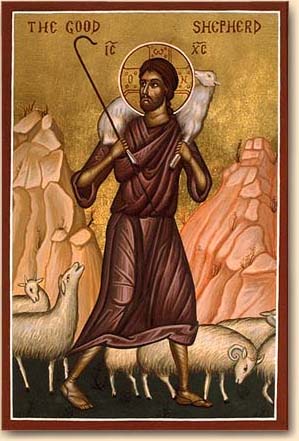
We are all familiar with the image of the Good Shepherd with the little lost lamb on his shoulders. This icon has always been an expression of Jesus’ care for sinners and of the mercy of God who never resigns himself to the loss of anyone. The parable is told by Jesus to make us understand that his closeness to sinners should not scandalize us, but on the contrary it should call us all to serious reflection on how we live our faith. The narrative sees, on the one hand, the sinners who approach Jesus in order to listen to him and, on the other, the suspicious doctors of the law and scribes who move away from him because of his behavior. They move away because Jesus approaches the sinners. These men were proud, arrogant, believed themselves to be just.
The lesson that Jesus wants us to learn is… that not a single one of us can be lost. God’s action is that of one who goes out seeking his lost children and then rejoices and celebrates with everyone at their recovery.
We are all warned: mercy to sinners is the style with which God acts and to this mercy he is absolutely faithful: nothing and no one can distract him from his saving will. God does not share our current throw-away culture… God throws no one away; God loves everyone, looks for everyone: one by one! He doesn’t know what “throwing people away” means, because he is entirely love, entirely mercy.
While he is looking for the lost sheep, he challenges the ninety-nine to participate in the reunification of the flock. Then, not only the lamb on his shoulders, but the whole flock will follow the shepherd to his home to celebrate with “friends and neighbors.”
We should reflect on this parable often, for in the Christian community there is always someone who is missing and if that person is gone, a place is left empty. Sometimes this is daunting and leads us to believe that a loss is inevitable, like an incurable disease.
In Jesus’ vision there are no sheep that are definitively lost, but only sheep that must be found again. We need to understand this well: to God no one is definitively lost. Never! To the last moment, God is searching for us. Think of the good thief; only in the eyes of Jesus no one is definitively lost. For his perspective is entirely dynamic, open, challenging and creative. It urges us to go forth in search of a path to brotherhood. No distance can keep the shepherd away; and no flock can renounce a brother. To find the one who is lost is the joy of the shepherd and of God, but it is also the joy of the flock as a whole! We are all sheep who have been retrieved and brought back by the mercy of the Lord, and we are called to gather the whole flock to the Lord!
Click here to read the full address by Pope Francis.
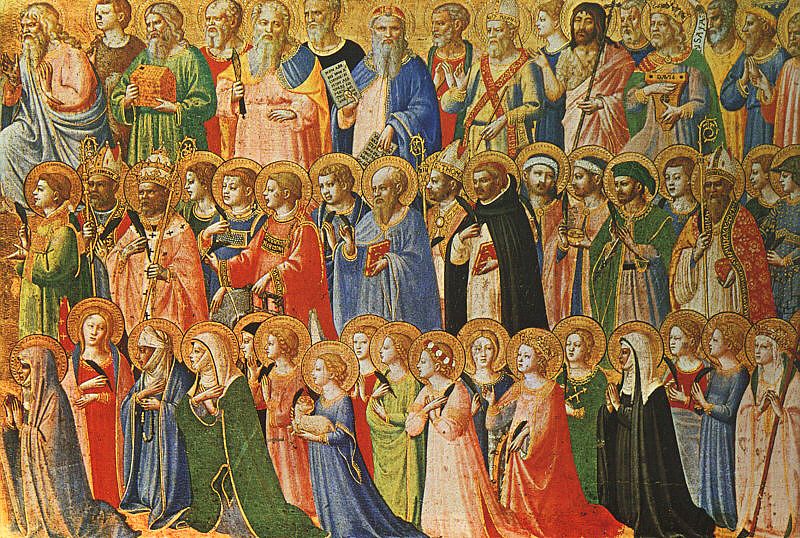
Hubble Ultra Deep FieldFra Angelico, The Forerunners of Christ with Saints and Martyrs
By Gloria M. Chang
From eternity the Lord God designed humanity and the cosmos in his image, envisioning the constellation of saints bursting with Christic Light in the heavens. Formed from the dust of the earth, Adam evolves through the eons to completion in Jesus Christ, his descendant and Lord—the Potter’s masterpiece (Isaiah 64:8).
Kindling the treasure of Christ’s flame in “jars of clay,” we grow day by day into the image of the Blessed Trinity as one Mystical Body (1 Corinthians 15:41). The dazzling kaleidoscope of saints, reflecting the unity and diversity of the Father, Son, and Holy Spirit radiates the infinite rays of divinity. Each saint refined in God’s furnace of Love emerges as an original from the hands of the Divine Artist, for “star differs from star in glory” (1 Corinthians 15:41).
Form me with your hands, Lord, day by day. You are the Potter; I am the clay. From soil you shaped sparkling saints like stars, Blazing your glory from earthen jars.
Just as we have borne the image of the man of dust, we shall also bear the image of the man of heaven.
A monastery is a house of prayer to pursue the “happy” or blessed life. Our Passionist priests and brothers in Jamaica, NY faithfully pray the Liturgy of the Hours every morning and evening, which prepares them to give the bread of the Word and the Eucharist at Mass and to serve in various ministries. Prayer and the Eucharist, the daily bread of apostles, fuel works of mercy.
In a letter to a Roman noblewoman named Proba, St. Augustine offers valuable insights on prayer. The bishop of Hippo, whose rule of life continues to guide monastic communities today, understood the value of “prayer at appointed hours.” Although he was an extremely busy bishop, St. Augustine kindled his desire for God throughout the day by lifting his heart in prayer from sunrise to sunset. Forgetfulness of God in the midst of constant work makes the heart “lukewarm” and “chill” over time.
Thankfully, we can redeem the time. As the earth revolves around the sun, children of God revolve in the orbit of the Blessed Trinity. Space and time, the materials of our journey from birth to eternity, belong to the Father, Creator of all things through his Word and Spirit. Jesus, who frequently spent the night in prayer, models our way home to the Father.
Can one pray during a busy schedule? St. Augustine teaches that “even in these actions” (work responsibilities), we pray by continually longing for God. Many words are unnecessary. The desert monks discovered that short but frequent prayers, “hurled like swift javelins,” keep the heart and mind fixed on the Lord.
“Ask and it will be given to you; seek and you will find; knock and the door will be opened to you” (Matthew 7:7). Persistence in prayer with sighs and tears unite us with the ineffable God, “for he has established all things through his Word and does not seek human words.” As a monastery is a house of prayer, so are all of us “temples” of prayer in the Holy Spirit (Romans 8:26-27).
The Passionists Pray website offers resources for daily prayer, which can be accessed here.
From a letter to Proba by Saint Augustine, bishop
Let us turn our mind to the task of prayer at appointed hours
Let us always desire the happy life from the Lord God and always pray for it. But for this very reason we turn our mind to the task of prayer at appointed hours, since that desire grows lukewarm, so to speak, from our involvement in other concerns and occupations. We remind ourselves through the words of prayer to focus our attention on the object of our desire; otherwise, the desire that began to grow lukewarm may grow chill altogether and may be totally extinguished unless it is repeatedly stirred into flame.
Therefore, when the Apostle says: Let your petitions become known before God, this should not be taken in the sense that they are in fact becoming known to God who certainly knew them even before they were made, but that they are becoming known before men through boasting.
Since this is the case, it is not wrong or useless to pray even for a long time when there is the opportunity. I mean when it does not keep us from performing the other good and necessary actions we are obliged to do. But even in these actions, as I have said, we must always pray with that desire. To pray for a longer time is not the same as to pray by multiplying words, as some people suppose. Lengthy talk is one thing, a prayerful disposition which lasts a long time is another. For it is even written in reference to the Lord himself that he spent the night in prayer and that he prayed at great length. Was he not giving us an example by this? In time, he prays when it is appropriate; and in eternity, he hears our prayers with the Father.
The monks in Egypt are said to offer frequent prayers, but these are very short and hurled like swift javelins. Otherwise their watchful attention, a very necessary quality for anyone at prayer, could be dulled and could disappear through protracted delays. They also clearly demonstrate through this practice that a person must not quickly divert such attention if it lasts, just as one must not allow it to be blunted if it cannot last.
Excessive talking should be kept out of prayer but that does not mean that one should not spend much time in prayer so long as a fervent attitude continues to accompany his prayer. To talk at length in prayer is to perform a necessary action with an excess of words. To spend much time in prayer is to knock with a persistent and holy fervor at the door of the one whom we beseech. This task is generally accomplished more through sighs than words, more through weeping than speech. He places our tears in his sight, and our sighs are not hidden from him, for he has established all things through his Word and does not seek human words.
Reference
The passage from St. Augustine can be found in the Office of Readings for Monday of the 29th Week in Ordinary Time.
You are the light of the world. A city set on a mountain cannot be hidden. Nor do they light a lamp and then put it under a bushel basket; it is set on a lampstand, where it gives light to all in the house.
Matthew 5:14-15
Jesus, the light of the world, purifies hearts and illuminates minds in the truth, restoring lost sons and daughters to the Father. Every child redeemed by the Lamb of God is a Christ-bearer and therefore, a light-bearer, but from where does the light shine?
In a reading by St. Maximus the Confessor, he identifies the lamp of the parable with Jesus Christ and the lampstand as Holy Church. As the Head and the Body are inseparable, the lamp and the lampstand together illumine the “house, which is the world,” filling all people with divine knowledge.
In an age of profound skepticism and disappointment in the institutional Church, St. Maximus’ vision challenges us to lift up our eyes to the mountain of the Lord (Zechariah 8:3), praying to become one with Christ collectively in the communion of saints. For it is by the virtuous lives of the saints that a world parched for mercy and truth is drawn to the Church as its Mother.
In the old covenant, “the word was hidden under the bushel, that is, under the letter of the law,” veiling the eternal light. In the new covenant of grace in the Father, Son, and Holy Spirit, Christified saints become living letters of the law inscribed not on tablets of stone but on hearts of flesh, vivified by the Spirit (2 Corinthians 3:3).
Bereft of the lamp, the lampstand is dark and empty—a tomb of death and despair. Catholics experience the effects of the empty lampstand in the Church on Good Friday to Holy Saturday every year when the Blessed Sacrament is removed from the sanctuary. At dawn on Easter morning, with millions of candles piercing the darkness around the world, the Body of Christ rises with its Head from the empty tomb, joyfully singing “Alleluia! Christ is risen!”
From an inquiry addressed to Thalassius by Saint Maximus the Confessor, abbot
The light that illumines all men
The lamp set upon the lampstand is Jesus Christ, the true light from the Father, the light that enlightens every man who comes into the world. In taking our own flesh he has become, and is rightly called, a lamp, for he is the connatural wisdom and word of the Father. He is proclaimed in the Church of God in accordance with orthodox faith, and he is lifted up and resplendent among the nations through the lives of those who live virtuously in observance of the commandments. So he gives light to all in the house (that is, in this world), just as he himself, God the Word, says: No one lights a lamp and puts it under a bushel, but on a stand, and it gives light to all in the house. Clearly he is calling himself the lamp, he who was by nature God, and became flesh according to God’s saving purpose.
I think the great David understood this when he spoke of the Lord as a lamp, saying: Your word is a lamp to my feet and a light to my path. For God delivers us from the darkness of ignorance and sin, and hence he is greeted as a lamp in Scripture.
Lamp-like indeed, he alone dispelled the gloom of ignorance and the darkness of evil and became the way of salvation for all men. Through virtue and knowledge, he leads to the Father those who are resolved to walk by him, who is the way of righteousness, in obedience to the divine commandments. He has designated holy Church the lampstand, over which the word of God sheds light through preaching, and illumines with the rays of truth whoever is in this house which is the world, and fills the minds of all men with divine knowledge.
This word is most unwilling to be kept under a bushel; it wills to be set in a high place, upon the sublime beauty of the Church. For while the word was hidden under the bushel, that is, under the letter of the law, it deprived all men of eternal light. For then it could not give spiritual contemplation to men striving to strip themselves of a sensuality that is illusory, capable only of deceit, and able to perceive only decadent bodies like their own. But the word wills to be set upon a lampstand, the Church, where rational worship is offered in the spirit, that it may enlighten all men. For the letter, when it is not spiritually understood, bears a carnal sense only, which restricts its expression and does not allow the real force of what is written to reach the hearer’s mind.
Let us, then, not light the lamp by contemplation and action, only to put it under a bushel—that lamp, I mean, which is the enlightening word of knowledge—lest we be condemned for restricting by the letter the incomprehensible power of wisdom. Rather let us place it upon the lampstand of holy Church, on the heights of true contemplation, where it may kindle for all men the light of divine teaching.
Reference
The passage from St. Maximus the Confessor can be found in the Office of Readings for Wednesday of the 28th Week in Ordinary Time.
Statue of St. Paul of the Cross at the Passionist Monastery in Jamaica, NY
“Let everything in creation draw you to God. Refresh your mind with some innocent recreation and needful rest, if it were only to saunter through the garden or the fields, listening to the sermon preached by the flowers, the trees, the meadows, the sun, the sky, and the whole universe. You will find that they exhort you to love and praise God; that they excite you to extol the greatness of the Sovereign Architect who has given them their being.”
As the Synod on Synodality proceeds in Rome, we can all participate as the listening Church, the Bride of Christ, sitting at Jesus’ feet like Mary of Bethany (Luke 10:38). Enveloped in his peace, we can attune our hearts and minds to the Spirit of truth sent to us from the Father by the Son (John 15:26).
In a world of distracting noise, the Lord invites us to listen to his voice in Sacred Scripture, the Holy Mass, the Liturgy of the Hours, and personal prayer. Heard in the silence of the Spirit, the ancient words resonating from centuries past speak to the present generation with striking relevance. May the Lord grant us “ears to hear” his voice amid the din of the latest buzz (Matthew 11:14).
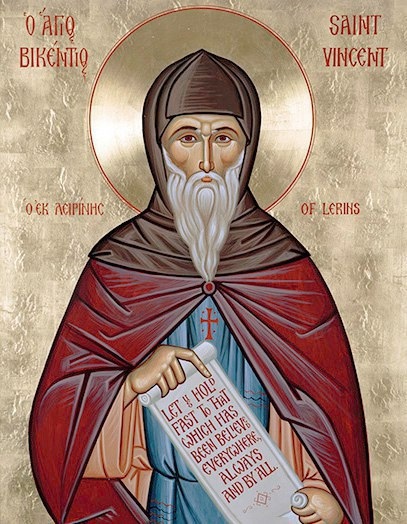
In a recent passage from the Office of Readings (October 11, 2024), St. Vincent of Lerins, a fifth-century French monk, seemed to jump out of the pages to address the Synod in Rome during its second week. In his vision, the organism of the Church grows and matures like a child to an adult, but preserves her essential form. Human skeletal structure, facial features, limbs, and organs develop with maturity but do not evolve into another species. The Body of Christ, the Church, in its heavenward journey also grows in the Holy Spirit into the perfect image of the Incarnate Son of God and not a distortion (2 Corinthians 3:18). May the Blessed Virgin Mary, Mother of the Church, guide her sons and daughters in the Spirit to her Son, who is the Way, the Truth, and the Life.
From the first instruction by Saint Vincent of Lerins, priest
The development of doctrine
Is there to be no development of religion in the Church of Christ? Certainly, there is to be development and on the largest scale.
Who can be so grudging to men, so full of hate for God, as to try to prevent it? But it must truly be development of the faith, not alteration of the faith. Development means that each thing expands to be itself, while alteration means that a thing is changed from one thing into another.
The understanding, knowledge and wisdom of one and all, of individuals as well as of the whole Church, ought then to make great and vigorous progress with the passing of the ages and the centuries, but only along its own line of development, that is, with the same doctrine, the same meaning and the same import.
The religion of souls should follow the law of development of bodies. Though bodies develop and unfold their component parts with the passing of the years, they always remain what they were. There is a great difference between the flower of childhood and the maturity of age, but those who become old are the very same people who were once young. Though the condition and appearance of one and the same individual may change, it is one and the same nature, one and the same person.
The tiny members of unweaned children and the grown members of young men are still the same members. Men have the same number of limbs as children. Whatever develops at a later age was already present in seminal form; there is nothing new in old age that was not already latent in childhood.
There is no doubt, then, that the legitimate and correct rule of development, the established and wonderful order of growth, is this: in older people the fullness of years always brings to completion those members and forms that the wisdom of the Creator fashioned beforehand in their earlier years.
If, however, the human form were to turn into some shape that did not belong to its own nature, or even if something were added to the sum of its members or subtracted from it, the whole body would necessarily perish or become grotesque or at least be enfeebled. In the same way, the doctrine of the Christian religion should properly follow these laws of development, that is, by becoming firmer over the years, more ample in the course of time, more exalted as it advances in age.
In ancient times our ancestors sowed the good seed in the harvest field of the Church. It would be very wrong and unfitting if we, their descendants, were to reap, not the genuine wheat of truth but the intrusive growth of error.
On the contrary, what is right and fitting is this: there should be no inconsistency between first and last, but we should reap true doctrine from the growth of true teaching, so that when, in the course of time, those first sowings yield an increase it may flourish and be tended in our day also.
Reference
The passage from St. Vincent of Lerins can be found in the Office of Readings for Friday of the 27th Week in Ordinary Time.
“What is theology?” asked Professor Andrea Florendo to a group of young Catholic Scholars in the Passionist Monastery Chapel.
“The study of God,” responded a sophomore brightly in the front row.
“Yes, and where does theology begin?” Professor Florendo continued. Looking at each of the young faces, she exclaimed, “In a garden!” Following the creation account in Genesis, the story of God and humankind unfolds in the Garden of Eden. Flowers, trees, rocks, soil, animals, sun, moon, sky, water, humans—the whole natural world—declare the glory of God. Prayer and liturgy burst forth among flowering plants and birdsong in God’s garden of paradise.
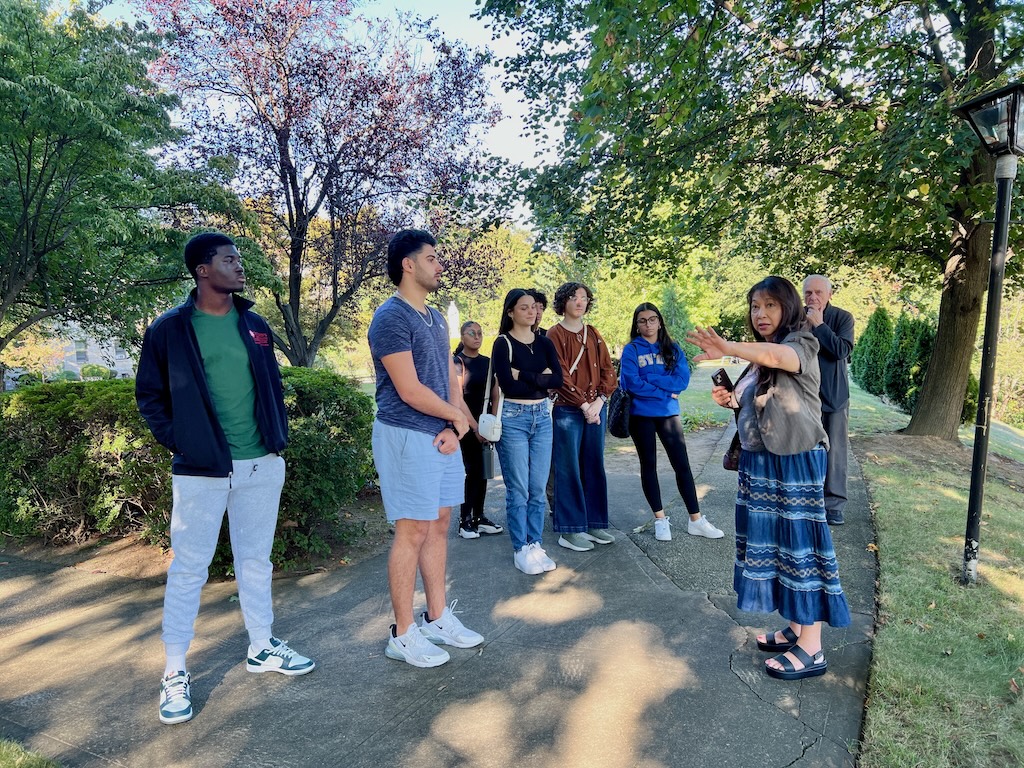
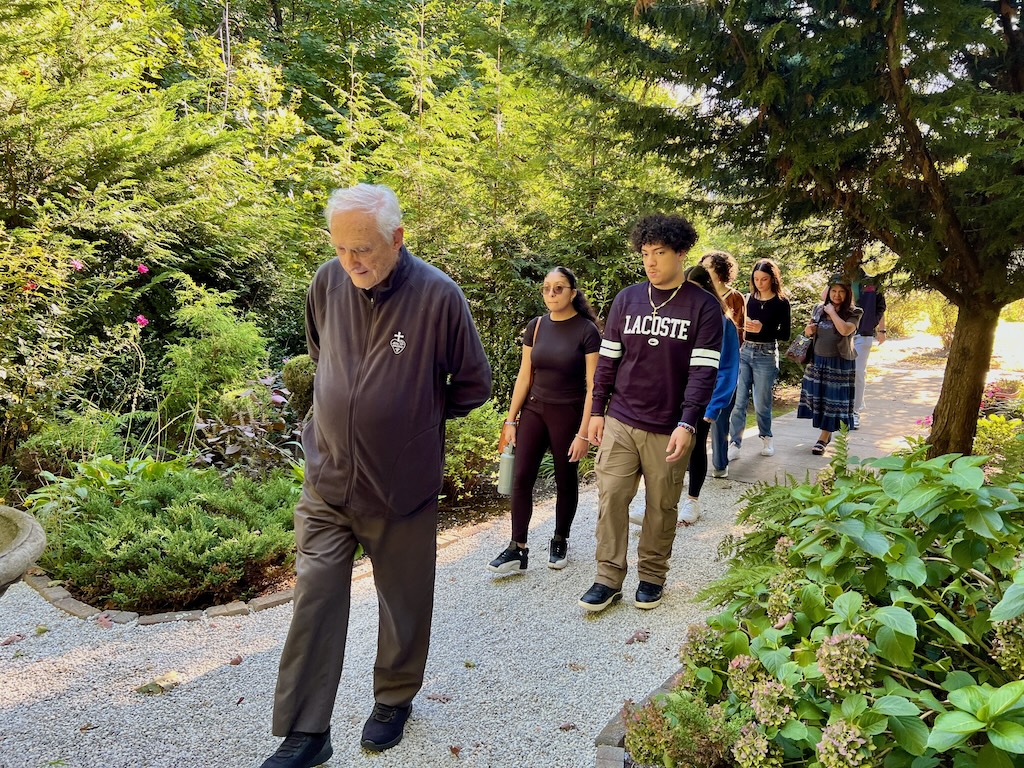
On Sunday, October 6, 2024, seven Catholic Scholars from St. John’s University visited the Mary Garden at the Passionist Monastery in Jamaica, NY. Fr. Victor Hoagland, C.P., Professor Andrea Florendo, and Gloria Chang, founders of the Mary Garden Guild at the Passionist Monastery, welcomed the students warmly.
Fr. Victor, who has traveled extensively throughout the world on pilgrimages and missions, shared the global Passionist charism with the Catholic Scholars, who are preparing for a life of faith-inspired leadership. The Passionists, who received their mission from St. Paul of the Cross to keep alive in the world the love of Jesus Crucified as seen in His Sacred Passion, have expanded their charism to include the care of creation as taught by Pope Francis in his encyclical Laudato Si. Inspired also by Fr. Thomas Berry, C.P. (1914-2009), a pioneer in ecology, the Passionists have redesigned their retreat center in Jamaica, NY, in his name.
Andrea Florendo, a retired theology professor at St. John’s University and designer of the Mary Garden, gave a tour, pointing out the significance of the enclosed garden as a symbol of Mary’s virginal womb, the fountain as Christ’s “fountain of living waters,” and the cross path as the four rivers in the Garden of Eden.
Our visit in the Mary Garden ended in praise and thanksgiving to God with prayers from Scripture and a reading from the Book of Genesis. May the Lord bless our Catholic Scholars abundantly with faith and grace as they continue their studies and formation at St. John’s University.
How great is your name, O Lord our God, through all the earth!
The Rosary of the Virgin Mary, which gradually took form in the second millennium under the guidance of the Spirit of God, is a prayer loved by countless Saints and encouraged by the Magisterium. Simple yet profound, it still remains, at the dawn of this third millennium, a prayer of great significance, destined to bring forth a harvest of holiness. It blends easily into the spiritual journey of the Christian life, which, after two thousand years, has lost none of the freshness of its beginnings and feels drawn by the Spirit of God to “set out into the deep” (duc in altum!) in order once more to proclaim, and even cry out, before the world that Jesus Christ is Lord and Saviour, “the way, and the truth and the life” (Jn 14:6), “the goal of human history and the point on which the desires of history and civilization turn.”
The Rosary, though clearly Marian in character, is at heart a Christocentric prayer. In the sobriety of its elements, it has all the depth of the Gospel message in its entirety, of which it can be said to be a compendium. It is an echo of the prayer of Mary, her perennial Magnificat for the work of the redemptive Incarnation which began in her virginal womb. With the Rosary, the Christian people sits at the school of Mary and is led to contemplate the beauty on the face of Christ and to experience the depths of his love. Through the Rosary the faithful receive abundant grace, as though from the very hands of the Mother of the Redeemer.”
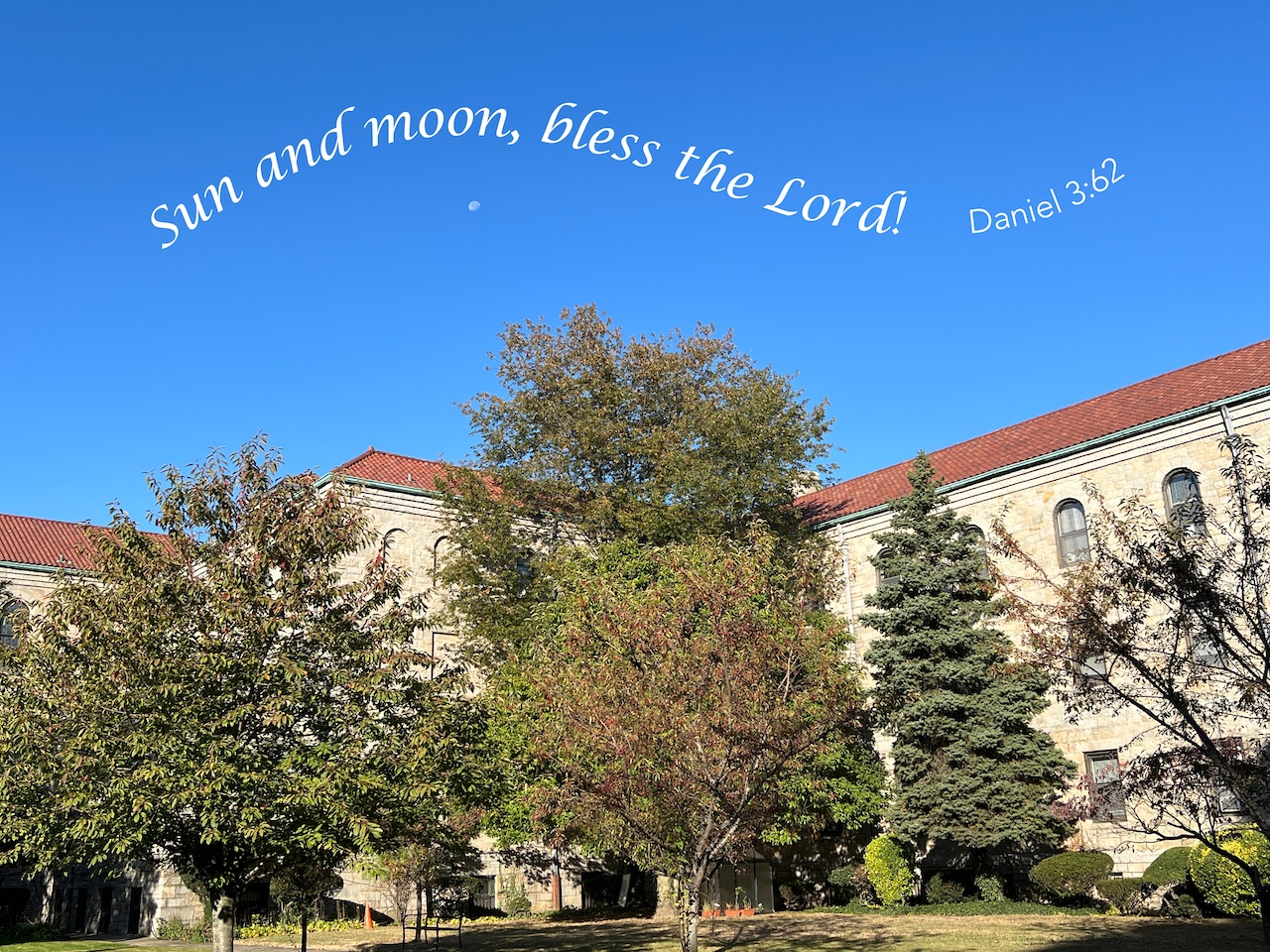
The words of the Preacher, the son of David, king in Jerusalem. Vanity of vanities, says the Preacher, vanity of vanities! All is vanity. What does man gain by all the toil at which he toils under the sun? A generation goes, and a generation comes, but the earth remains forever. The sun rises, and the sun goes down, and hastens to the place where it rises. The wind blows to the south and goes around to the north; around and around goes the wind, and on its circuits the wind returns. All streams run to the sea, but the sea is not full; to the place where the streams flow, there they flow again. All things are full of weariness; a man cannot utter it; the eye is not satisfied with seeing, nor the ear filled with hearing. What has been is what will be, and what has been done is what will be done, and there is nothing new under the sun. Is there a thing of which it is said, “See, this is new”? It has been already in the ages before us. There is no remembrance of former things, nor will there be any remembrance of later things yet to be among those who come after.
Ecclesiastes 1:1-8 (ESV)
What is the Meaning of Life?
Qoheleth, the “Preacher,” writing in the name of Solomon, the son of David, wrestles with the absolute in the book of Ecclesiastes. The Hebrew word Qoheleth (from qahal, a root that means “assembly” or “congregation”) is Ekklesiastes in Greek, which names the book. Early traditions attribute the book’s authorship to Solomon, but philological evidence dates the book to no earlier than the mid-fifth century B.C., a half-millennium after Solomon’s reign. Thus, Qoheleth, a Hebrew sage, critiques the world through the eyes of King Solomon, the wisest, wealthiest, and most powerful man in the world. He investigates the patterns of nature and human striving, hoping to discover an ultimate purpose behind it all.
World of Vapor
Qoheleth begins by lamenting that all is “vanity” (in Hebrew hebel, “vapor, breath”), which he pronounces five times in a single utterance (1:2). Finding no ultimate profit in the drudgery of human toil, he rhetorically asks, “What does man gain by all the toil at which he toils under the sun?”
Ephemeral phenomena and superficial impressions shift and slide incessantly “under the sun,” where nothing is constant. The rising and setting of the sun, and the circuitous currents of wind go “round and round” ceaselessly in a futile loop. The sea, too, like human ambition and appetite, never finds fulfillment despite continuous filling: “All streams run to the sea, but the sea is not full” (1:7). Jaded by familiarity, Qoheleth deplores the predictable motions of the earth.
“All things are full of weariness,” he despairs, “a man cannot utter it.” “The eye is not satisfied with seeing, nor the ear filled with hearing” (1:8). Ever restless, human desire insatiably consumes the panorama of sight and sound—representative of all sensory and intellectual stimuli. All impressions eventually evaporate like steam (hebel).
Nothing New Under the Sun
What has been is what will be, and what has been done is what will be done, and there is nothing new under the sun. Is there a thing of which it is said, “See, this is new”? It has been already in the ages before us.
Ecclesiastes 1:9-10 (ESV)
Ecclesiastes affirms the truism that “history repeats itself.” As civilizations rise and fall, human nature remains the same. War and peace, joy and sorrow, strength and weakness, freedom and slavery, profit and loss—the same old human affairs cycle round and round, generation after generation, world without end. A keen observer of human nature and historical recurrence, Qoheleth bleakly concludes, “There is nothing new under the sun.”
Puff of the Past
There is no remembrance of former things, nor will there be any remembrance of later things yet to be among those who come after.
Ecclesiastes 1:11 (ESV)
As the sands of time fade away, so does human “remembrance of former things.” Stars and galaxies, fossils, and artifacts provide clues to the mystery of the 13.8 billion-year-old universe and human evolution. Yet billions of ancestors lie buried in the ground, forgotten by their descendants. Apart from cave paintings, oral traditions, scrolls, books, annals, chronicles, and even modern audiovisual media, which capture only fragments from limited perspectives, the past vanishes like vapor “under the sun.” Can fragmentary memories preserve an unbroken, unified recollection of the past? Can mortals achieve immortality in the minds of posterity?
The Value of Struggle
Ecclesiastes challenges the assembly of wisdom seekers to find ultimate purpose and profit “under the sun.” Like Job, Qoheleth embraces disputation and wrestling with elemental questions. Sometimes described as “unorthodox,” these books goad the pious to “struggle with God,” the meaning of Israel’s name (Genesis 32:28). Questions do not threaten religion but expand its horizons.
Without being an atheist, Qoheleth journeys to the edge of human striving to discover its peaks and valleys apart from God. His experiment confirms Paul’s observation that, on account of Adam’s departure from God’s will, “the creation was subjected to futility” (Romans 8:20; Genesis 3:17). The Greek word for futility,mataiotés (“vanity,” “emptiness”), translates the Hebrew word hebel (“vapor,” “breath”) in the Septuagint. Ecclesiastes allows every seeker of meaning to feel the emptiness of a life and vision that never rises above the sun.
I have seen all things that are done under the sun, and behold, all is vanity and a chase after wind.
Ecclesiastes 1:14 (NABRE)
All is vanity, a chase after wind. Series and cycles—these I examined. Under the sun, seasons whirl like vapor. What do humans gain by all their labor?










 The Victor's Place