Author Archives: Gloria M. Chang

Unknown's avatar

About Gloria M. Chang

Gloria M. Chang is a multimedia content creator who launched Shalom Snail as a contemplative space for silence, prayer, and gratitude for our divinely designed cosmos.

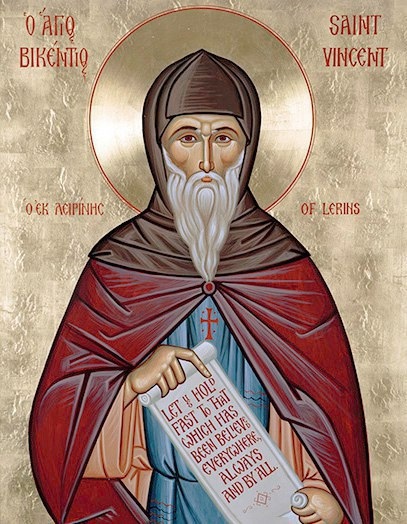
St. Vincent of Lerins Speaks to the Modern Church

By Gloria M. Chang

As the Synod on Synodality proceeds in Rome, we can all participate as the listening Church, the Bride of Christ, sitting at Jesus’ feet like Mary of Bethany (Luke 10:38). Enveloped in his peace, we can attune our hearts and minds to the Spirit of truth sent to us from the Father by the Son (John 15:26). 

In a world of distracting noise, the Lord invites us to listen to his voice in Sacred Scripture, the Holy Mass, the Liturgy of the Hours, and personal prayer. Heard in the silence of the Spirit, the ancient words resonating from centuries past speak to the present generation with striking relevance. May the Lord grant us “ears to hear” his voice amid the din of the latest buzz (Matthew 11:14).

In a recent passage from the Office of Readings (October 11, 2024), St. Vincent of Lerins, a fifth-century French monk, seemed to jump out of the pages to address the Synod in Rome during its second week. In his vision, the organism of the Church grows and matures like a child to an adult, but preserves her essential form. Human skeletal structure, facial features, limbs, and organs develop with maturity but do not evolve into another species. The Body of Christ, the Church, in its heavenward journey also grows in the Holy Spirit into the perfect image of the Incarnate Son of God and not a distortion (2 Corinthians 3:18). May the Blessed Virgin Mary, Mother of the Church, guide her sons and daughters in the Spirit to her Son, who is the Way, the Truth, and the Life.

From the first instruction by Saint Vincent of Lerins, priest

The development of doctrine

Is there to be no development of religion in the Church of Christ? Certainly, there is to be development and on the largest scale.

Who can be so grudging to men, so full of hate for God, as to try to prevent it? But it must truly be development of the faith, not alteration of the faith. Development means that each thing expands to be itself, while alteration means that a thing is changed from one thing into another.

The understanding, knowledge and wisdom of one and all, of individuals as well as of the whole Church, ought then to make great and vigorous progress with the passing of the ages and the centuries, but only along its own line of development, that is, with the same doctrine, the same meaning and the same import.

The religion of souls should follow the law of development of bodies. Though bodies develop and unfold their component parts with the passing of the years, they always remain what they were. There is a great difference between the flower of childhood and the maturity of age, but those who become old are the very same people who were once young. Though the condition and appearance of one and the same individual may change, it is one and the same nature, one and the same person.

The tiny members of unweaned children and the grown members of young men are still the same members. Men have the same number of limbs as children. Whatever develops at a later age was already present in seminal form; there is nothing new in old age that was not already latent in childhood.

There is no doubt, then, that the legitimate and correct rule of development, the established and wonderful order of growth, is this: in older people the fullness of years always brings to completion those members and forms that the wisdom of the Creator fashioned beforehand in their earlier years.

If, however, the human form were to turn into some shape that did not belong to its own nature, or even if something were added to the sum of its members or subtracted from it, the whole body would necessarily perish or become grotesque or at least be enfeebled. In the same way, the doctrine of the Christian religion should properly follow these laws of development, that is, by becoming firmer over the years, more ample in the course of time, more exalted as it advances in age.

In ancient times our ancestors sowed the good seed in the harvest field of the Church. It would be very wrong and unfitting if we, their descendants, were to reap, not the genuine wheat of truth but the intrusive growth of error.

On the contrary, what is right and fitting is this: there should be no inconsistency between first and last, but we should reap true doctrine from the growth of true teaching, so that when, in the course of time, those first sowings yield an increase it may flourish and be tended in our day also.


Reference

The passage from St. Vincent of Lerins can be found in the Office of Readings for Friday of the 27th Week in Ordinary Time.
Catholic Scholars Visit the Mary Garden

Photos: Gloria M. Chang

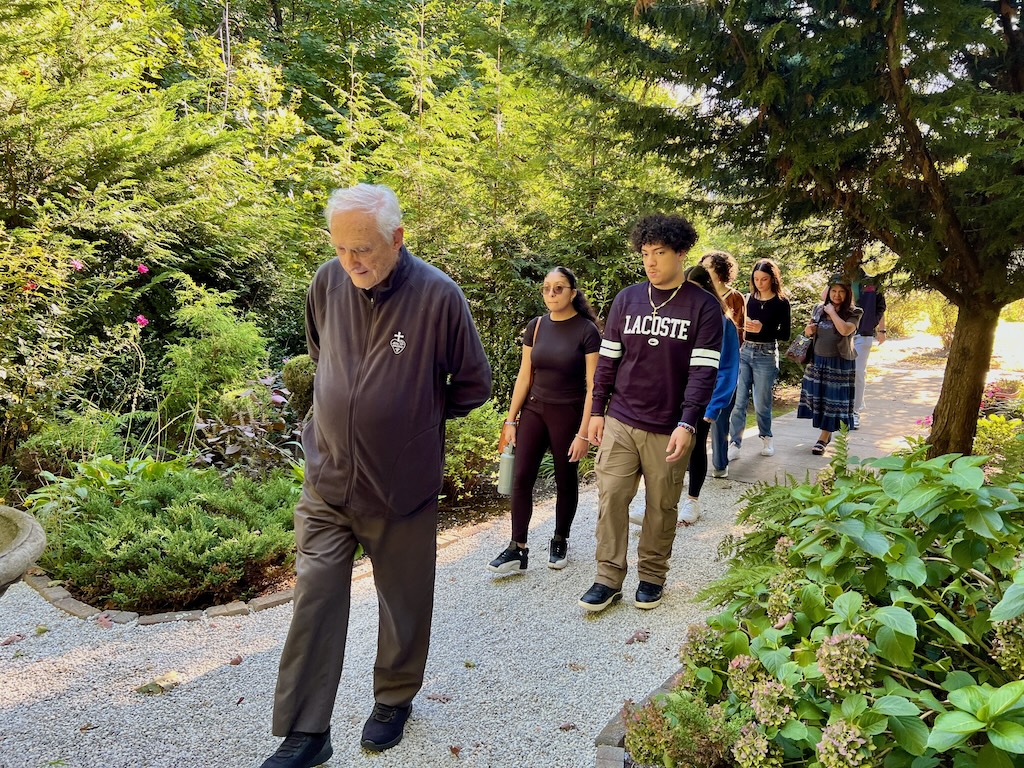
“What is theology?” asked Professor Andrea Florendo to a group of young Catholic Scholars in the Passionist Monastery Chapel.

“The study of God,” responded a sophomore brightly in the front row. 

“Yes, and where does theology begin?” Professor Florendo continued. Looking at each of the young faces, she exclaimed, “In a garden!” Following the creation account in Genesis, the story of God and humankind unfolds in the Garden of Eden. Flowers, trees, rocks, soil, animals, sun, moon, sky, water, humans—the whole natural world—declare the glory of God. Prayer and liturgy burst forth among flowering plants and birdsong in God’s garden of paradise. 

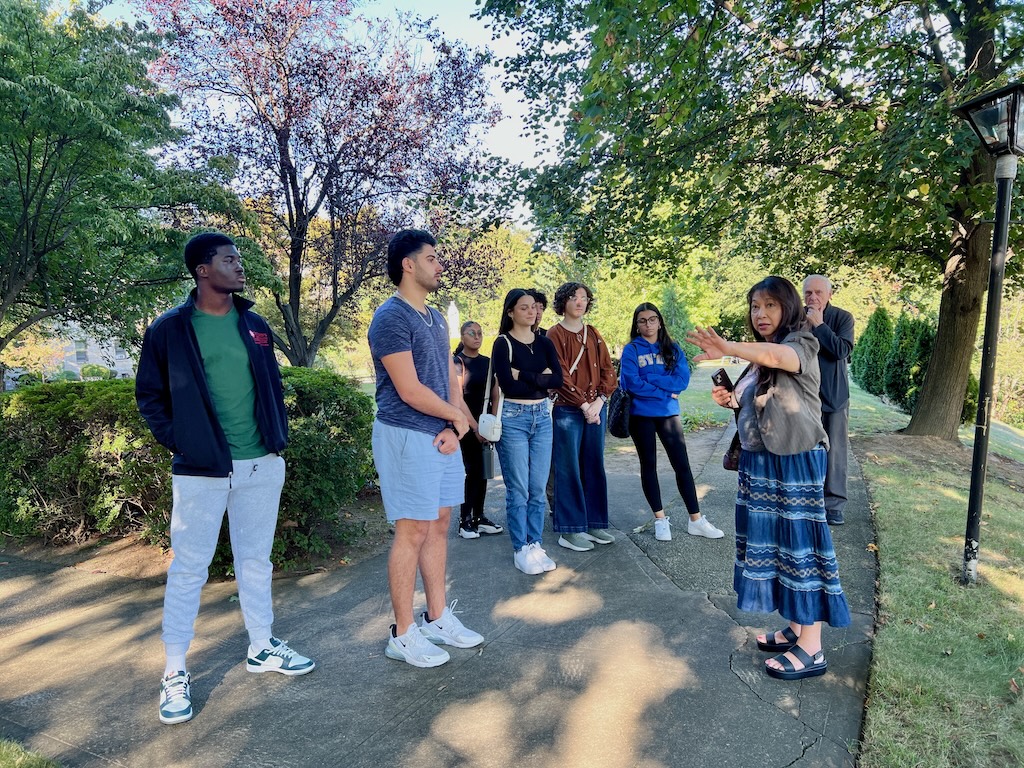
On Sunday, October 6, 2024, seven Catholic Scholars from St. John’s University visited the Mary Garden at the Passionist Monastery in Jamaica, NY. Fr. Victor Hoagland, C.P., Professor Andrea Florendo, and Gloria Chang, founders of the Mary Garden Guild at the Passionist Monastery, welcomed the students warmly. 

Fr. Victor, who has traveled extensively throughout the world on pilgrimages and missions, shared the global Passionist charism with the Catholic Scholars, who are preparing for a life of faith-inspired leadership. The Passionists, who received their mission from St. Paul of the Cross to keep alive in the world the love of Jesus Crucified as seen in His Sacred Passion, have expanded their charism to include the care of creation as taught by Pope Francis in his encyclical Laudato Si. Inspired also by Fr. Thomas Berry, C.P. (1914-2009), a pioneer in ecology, the Passionists have redesigned their retreat center in Jamaica, NY, in his name. 

Andrea Florendo, a retired theology professor at St. John’s University and designer of the Mary Garden, gave a tour, pointing out the significance of the enclosed garden as a symbol of Mary’s virginal womb, the fountain as Christ’s “fountain of living waters,” and the cross path as the four rivers in the Garden of Eden. 


Photo: Gloria M. Chang

Our visit in the Mary Garden ended in praise and thanksgiving to God with prayers from Scripture and a reading from the Book of Genesis. May the Lord bless our Catholic Scholars abundantly with faith and grace as they continue their studies and formation at St. John’s University.

How great is your name, O Lord our God,
through all the earth!

Psalm 8:1

Contemplating the Face of Christ With Mary

“Contemplating the Face of Christ With Mary”
Our Lady of the Rosary
A reflection on Rosarium Virginis Mariae, Apostolic Letter of St. Pope John Paul II
©️2024 Gloria M. Chang

The Rosary: A Christocentric Prayer

The Rosary of the Virgin Mary, which gradually took form in the second millennium under the guidance of the Spirit of God, is a prayer loved by countless Saints and encouraged by the Magisterium. Simple yet profound, it still remains, at the dawn of this third millennium, a prayer of great significance, destined to bring forth a harvest of holiness. It blends easily into the spiritual journey of the Christian life, which, after two thousand years, has lost none of the freshness of its beginnings and feels drawn by the Spirit of God to “set out into the deep” (duc in altum!) in order once more to proclaim, and even cry out, before the world that Jesus Christ is Lord and Saviour, “the way, and the truth and the life” (Jn 14:6), “the goal of human history and the point on which the desires of history and civilization turn.”

The Rosary, though clearly Marian in character, is at heart a Christocentric prayer. In the sobriety of its elements, it has all the depth of the Gospel message in its entirety, of which it can be said to be a compendium. It is an echo of the prayer of Mary, her perennial Magnificat for the work of the redemptive Incarnation which began in her virginal womb. With the Rosary, the Christian people sits at the school of Mary and is led to contemplate the beauty on the face of Christ and to experience the depths of his love. Through the Rosary the faithful receive abundant grace, as though from the very hands of the Mother of the Redeemer.”

Apostolic Letter, Rosarium Virginis Mariae of St. Pope John Paul II, 1

Our Lady of the Rosary with Saints, 18th century (Brooklyn Museum)

Saints who pray the Holy Rosary
Adore the face of Christ with Mary.


This content by Gloria M. Chang was originally published online at Shalom Snail: Journey to Wholeness

World of Vapor

“World of Vapor”
A reflection on Ecclesiastes 1:1-11
©️2024 Gloria M. Chang

The words of the Preacher, the son of David, king in Jerusalem.
Vanity of vanities, says the Preacher,
vanity of vanities! All is vanity.

What does man gain by all the toil
at which he toils under the sun?

A generation goes, and a generation comes,
but the earth remains forever.

The sun rises, and the sun goes down,
and hastens to the place where it rises.

The wind blows to the south
and goes around to the north;
around and around goes the wind,
and on its circuits the wind returns.

All streams run to the sea,
but the sea is not full;
to the place where the streams flow,
there they flow again.

All things are full of weariness;
a man cannot utter it;
the eye is not satisfied with seeing,
nor the ear filled with hearing.

What has been is what will be,
and what has been done is what will be done,
and there is nothing new under the sun.

Is there a thing of which it is said,
“See, this is new”?
It has been already
in the ages before us.

There is no remembrance of former things,
nor will there be any remembrance
of later things yet to be
among those who come after.

Ecclesiastes 1:1-8 (ESV)

What is the Meaning of Life?

Qoheleth, the “Preacher,” writing in the name of Solomon, the son of David, wrestles with the absolute in the book of Ecclesiastes. The Hebrew word Qoheleth (from qahal, a root that means “assembly” or “congregation”) is Ekklesiastes in Greek, which names the book. Early traditions attribute the book’s authorship to Solomon, but philological evidence dates the book to no earlier than the mid-fifth century B.C., a half-millennium after Solomon’s reign. Thus, Qoheleth, a Hebrew sage, critiques the world through the eyes of King Solomon, the wisest, wealthiest, and most powerful man in the world. He investigates the patterns of nature and human striving, hoping to discover an ultimate purpose behind it all.  

World of Vapor

Qoheleth begins by lamenting that all is “vanity” (in Hebrew hebel, “vapor, breath”), which he pronounces five times in a single utterance (1:2). Finding no ultimate profit in the drudgery of human toil, he rhetorically asks, “What does man gain by all the toil at which he toils under the sun?”

Ephemeral phenomena and superficial impressions shift and slide incessantly “under the sun,” where nothing is constant. The rising and setting of the sun, and the circuitous currents of wind go “round and round” ceaselessly in a futile loop. The sea, too, like human ambition and appetite, never finds fulfillment despite continuous filling: “All streams run to the sea, but the sea is not full” (1:7). Jaded by familiarity, Qoheleth deplores the predictable motions of the earth.

“All things are full of weariness,” he despairs, “a man cannot utter it.” “The eye is not satisfied with seeing, nor the ear filled with hearing” (1:8). Ever restless, human desire insatiably consumes the panorama of sight and sound—representative of all sensory and intellectual stimuli. All impressions eventually evaporate like steam (hebel).

Nothing New Under the Sun

What has been is what will be,
and what has been done is what will be done,
and there is nothing new under the sun.

Is there a thing of which it is said,
“See, this is new”?
It has been already
in the ages before us.

Ecclesiastes 1:9-10 (ESV)

Ecclesiastes affirms the truism that “history repeats itself.” As civilizations rise and fall, human nature remains the same. War and peace, joy and sorrow, strength and weakness, freedom and slavery, profit and loss—the same old human affairs cycle round and round, generation after generation, world without end. A keen observer of human nature and historical recurrence, Qoheleth bleakly concludes, “There is nothing new under the sun.”

Puff of the Past

There is no remembrance of former things,
nor will there be any remembrance
of later things yet to be
among those who come after.

Ecclesiastes 1:11 (ESV)

As the sands of time fade away, so does human “remembrance of former things.” Stars and galaxies, fossils, and artifacts provide clues to the mystery of the 13.8 billion-year-old universe and human evolution. Yet billions of ancestors lie buried in the ground, forgotten by their descendants. Apart from cave paintings, oral traditions, scrolls, books, annals, chronicles, and even modern audiovisual media, which capture only fragments from limited perspectives, the past vanishes like vapor “under the sun.” Can fragmentary memories preserve an unbroken, unified recollection of the past? Can mortals achieve immortality in the minds of posterity? 

The Value of Struggle

Ecclesiastes challenges the assembly of wisdom seekers to find ultimate purpose and profit “under the sun.” Like Job, Qoheleth embraces disputation and wrestling with elemental questions. Sometimes described as “unorthodox,” these books goad the pious to “struggle with God,” the meaning of Israel’s name (Genesis 32:28). Questions do not threaten religion but expand its horizons. 

Without being an atheist, Qoheleth journeys to the edge of human striving to discover its peaks and valleys apart from God. His experiment confirms Paul’s observation that, on account of Adam’s departure from God’s will, “the creation was subjected to futility” (Romans 8:20; Genesis 3:17). The Greek word for futility, mataiotés (“vanity,” “emptiness”), translates the Hebrew word hebel (“vapor,” “breath”) in the Septuagint. Ecclesiastes allows every seeker of meaning to feel the emptiness of a life and vision that never rises above the sun. 

I have seen all things that are done under the sun, and behold, all is vanity and a chase after wind.

Ecclesiastes 1:14 (NABRE)

All is vanity, a chase after wind.
Series and cycles—these I examined.
Under the sun, seasons whirl like vapor.
What do humans gain by all their labor?


This content by Gloria M. Chang was originally published online at Shalom Snail: Journey to Wholeness.

God’s Word, the Tree of Life

“God’s Word, the Tree of Life”
A reflection on Proverbs 30:5-9 and Luke 9:1-6
Wednesday of the Twenty-Fifth Week in Ordinary Time (Year II)
©️2024 Gloria M. Chang

Putting God First

Every word of God is tested;
he is a shield to those who take refuge in him.
Add nothing to his words,
lest he reprove you, and you will be exposed as a deceiver.

Two things I ask of you,
deny them not to me before I die:
Put falsehood and lying far from me,
give me neither poverty nor riches;
provide me only with the food I need;
Lest, being full, I deny you,
saying, “Who is the LORD?”
Or, being in want, I steal,
and profane the name of my God.

Proverbs 30:5-9

“Every word of God is pure (tested, refined),” like fruit from a tree of life. “He is a shield to those who take refuge in him.” Comparing divine wisdom to a tree of life (Proverbs 3:18), the Book of Proverbs guides us toward healing our broken relationship with God that occurred in the Garden of Eden. God created us for abundant life, which we reap by hearing and heeding his word. 

Ordering life around God, the sage asks for a truthful heart and for “neither poverty nor riches.” Luxury may tempt him to deny the Lord, while penury may incite him to steal and dishonor the name of God. Our heavenly Father, who knows what we need, will give us our “daily bread.” When making choices, the sage seeks the honor and glory of God above all.

Neither poverty nor riches, seek I,
But to honor God and him glorify.

God Provides


Jesus summoned the Twelve and gave them power and authority over all demons and to cure diseases, and he sent them to proclaim the kingdom of God and to heal the sick. He said to them, “Take nothing for the journey, neither walking stick, nor sack, nor food, nor money, and let no one take a second tunic. Whatever house you enter, stay there and leave from there. And as for those who do not welcome you, when you leave that town, shake the dust from your feet in testimony against them.” Then they set out and went from village to village proclaiming the good news and curing diseases everywhere.

Luke 9:1-6

Jesus sends his twelve apostles to proclaim the kingdom of God, the fulfillment of his word. The word of the Lord (dabar YHWH), which led the Israelites from Sinai to Jerusalem, has become flesh with divine authority to heal and cast out demons. Jesus, whose Father provides for his children, enjoins the Twelve to “take nothing for the journey.” 

The apostle, like the sage of the Book of Proverbs, lives on and through the Word of God, who is a “shield” and refining fire. Christ, the Word of God and Tree of Life, feeds us with himself in the sanctifying Eucharist.

Your word, O Lord, is a lamp for my feet.

Psalm 119:105 (Responsory)

God’s Word protects and purifies
Apostles who evangelize.


This content by Gloria M. Chang was originally published online at Shalom Snail: Journey to Wholeness

The Kingly Child and Flower

“The Kingly Child and Flower”
Mark 9:30-37, Matthew 6:28-29, Luke 12:27 in a couplet
Sunday of the Twenty-Fifth Week in Ordinary Time (Year B)
©️2021 Gloria M. Chang

They left from there and began a journey through Galilee, but he did not wish anyone to know about it. He was teaching his disciples and telling them, “The Son of Man is to be handed over to men and they will kill him, and three days after his death he will rise.” But they did not understand the saying, and they were afraid to question him.

They came to Capernaum and, once inside the house, he began to ask them, “What were you arguing about on the way?” But they remained silent. They had been discussing among themselves on the way who was the greatest. Then he sat down, called the Twelve, and said to them, “If anyone wishes to be first, he shall be the last of all and the servant of all.” Taking a child he placed it in their midst, and putting his arms around it he said to them, “Whoever receives one child such as this in my name, receives me; and whoever receives me, receives not me but the One who sent me.”

Mark 9:30-37

Who is the Greatest?

Walking through Galilee, Jesus’ thoughts and that of his disciples diametrically clashed. A brooding Judas heard his master’s prediction of his betrayal and death. Did the omen disquiet the lone treasurer? Each man heard Jesus uniquely and darkly. The matter of his rising after three days sounded meaningless and opaque. 

Filtering out ideas that conflicted with their image of an earthly Messianic kingdom, the Twelve heatedly argued about their relative positions of power. When questioned by Jesus, no one dared answer. Their squabble, in his presence, vanished as vain and arrogant chatter.

Sitting down to teach in the rabbinic manner, Jesus settled their debate: the greatest of all will be the least of all, like a little child. “If anyone wishes to be first, he shall be the last of all and the servant of all.” Jesus’ whole life from his birth in a manger, wrapped in swaddling clothes, to his burial in a tomb, wrapped in grave clothes, bespoke a complete stripping of earthly pride and power. 

Jesus felt more at home among the lilies of the field than in the palaces of kings. Like the lowly child, the colorful, fragile flowers in the wild express the splendor of God, the true King of Israel. 

Learn from the way the wild flowers grow. They do not work or spin. But I tell you that not even Solomon in all his splendor was clothed like one of them.

Matthew 6:28-29; cf. Luke 12:27

As the Cross loomed, the Twelve vied for power.
Jesus bent down to the child and flower.


This content by Gloria M. Chang was originally published online at Shalom Snail: Journey to Wholeness

Pray for us to God, O Queen of Heaven!

Photo art by Fr. Victor Hoagland, C.P. and Gloria M. Chang

The Regina Caeli is a 12th century antiphon in honor of the Blessed Virgin Mary that is prayed during the Easter season in place of the Angelus. A legend records that during a pestilence in Rome, while the Regina Caeli was being prayed in procession with her image, angels were heard singing along and an end was put to the plague. Let us pray to our Queen with the angels to bring healing to our world.

A Message From Shalom Snail

Dear Readers,

Thank you for following Shalom Snail, which made its debut at The Victor’s Place in May 2020. With Fr. Victor’s blessing, Shalom Snail: Journey to Wholeness, was launched on October 7, 2021. Due to technical challenges, the site underwent a change of hosting in July 2022. With stable WordPress hosting now, all Shalom Snail posts will be permanently accessible on its home site. A link to Shalom Snail can be found on the sidebar of The Victor’s Place. Our blog posts have always been complementary as we follow the daily Scripture readings and saints, so may they continue to be a blessing to you.

Shalom,
Gloria M. Chang

First Snow in Our Mary Garden

Divinity is Infinity!