Tag Archives: solitude

Morning Thoughts: The Sound of Life


.

Then the LORD God formed a man from the dust of the ground and breathed into his nostrils the breath of life, and the man became a living being.

—Genesis 2:7


.

What is it this moment holds? Not last night, not later today. This moment. What does it hold?

Friendship.

Hello my friend. Good morning.

It is cold. Outside. In here though, it’s quite comfortable.

Just you and me.

Just me and you.

Shall we talk or just sit a while?

Ha, that reminds me of being in the chapel, early in the morning.

No one speaking but such a beautiful sound.

An old man, a holy priest, breathing quite loud.

But it wasn’t just air passing to and fro.

It was the sound of “spirit and truth.

———

Community is the beautiful sound of other people breathing.

———

May God truly bless your day. May we both appreciate what He has given. And may we forgive each other our petty crimes. For you, my friend, in many ways, here and now, in earthen clay, are all I got. For without you—my neighbor, my brother, my wife, my boss, my employee, my business partner, my competitor, my foe—I won’t glimpse the face of Christ. And that I so badly need to do. He is after all, all we truly got. My face and yours will dry up and wrinkle, His remains the same. His love never gets old. May we hear each other breathe, with compassion and mercy, knowing that so much we take in causes mold. But it’s also in that very sound—the mysterious sound of breath—that can seemingly annoy us to death—that we witness daily the Word become flesh, again and again, to and fro, the entire universe, expand and contract.

We hear the One who sits on the throne.

We hear Him reconciling the world to Himself.


.

Jesus said to them again, “Peace be with you. As the Father has sent me, so I send you.” And when he had said this, he breathed on them and said to them, “Receive the Holy Spirit…

—John 20:21-22


.

—Howard Hain

.

Friday Thoughts: A Happy Statement

.

What state are we meant to be?

To be happy. No matter the circumstances. No matter the facts. No matter the evidence you see.

But shouldn’t we try to change unfavorable circumstances? Help beautify ugly facts? And want to witness genuine good being done?

Yes. Good desires, are all three. And, still, happy is the state you should be.

But are there not times we cry, we grieve, we fight? Times for righteous anger? Times, if you will, to flip the tables of hypocrisy?

Yes. Seasons such as these, yes, they do come and go. Happy is the state you should be.

But surely then, being happy too is also a phase, one that must come and go?

That I hope not. For happy is hope. And hope is always. Always happy. Knowing that somehow, someway, it’s all gonna be ok. That’s the state of hope. And happy is such a state. A state that is meant to be. A state to move into. And to stay. Not just for visits. A permanent lease. A place within. A home. From within which all seasons are observed. A duck blind. From which all God’s creation is closely, and quietly, and calmly glorified.

A place of patience. And of great expectation.

A place of simplicity. And of bare bones.

A place of abundance. And of hearty bread and good wine.

A place set apart.

A place setting for two, or perhaps for three or four…

A place for more. And a place of much less.

Surely, then, you speak of a different type of “happy”—a different type of “happy” than that known to the world? You simply speak of a place I do not know!

I speak. And what I speak comes to be. I speak Joy. I speak Peace. I speak Love. I speak Mercy. I speak Grace. I speak Kingdom. I speak now. Put out your arm. Look at your hand. Is that distance far? Shorten it still by placing your palm upon your heart. Now say, “Thy kingdom come.” I say it’s that close. I say the kingdom is at hand. I say it resides within. I say it is not of this world.

You are not of this world.

You are of ME.

And I AM.

And I say happy.

Live in the place I meant for you to be.

Perpetually.

A place for all seasons, of all times, beyond all phases.

Now go!

Happy is a state meant to be.


.

—Howard Hain

.

Morning Thoughts: The Prayer of Milk and Honey


.

Then the LORD brought us out of Egypt with a strong hand and outstretched arm, with terrifying power, with signs and wonders, and brought us to this place, and gave us this land, a land flowing with milk and honey.

—Deuteronomy 26:8-9


.

Last fall we went apple picking. We were a small party, composed of immediate family. It was a beautiful crisp day, just the kind you would order for such an excursion.

On our rounds we passed an old wood wagon, behind it and off a bit in the distance lay the remains of an abandoned stone farmhouse—roofless, hollowed out, its fireplaces and chimneys still the main draw. But is was a tiny hand-painted sign on the wagon right before me that most caught my attention:

“Honey is the only food that includes all the substances necessary to sustain life, including enzymes, vitamins, minerals, and water.”

I don’t know if it’s true or not, and I’m not going to spend much time investigating. I like the thought. That’s what matters. So I’m going to keep it, well not keep it, but steward it. Yes, ‘steward’ is a much better word:

Thus should one regard us: as servants of Christ and stewards of the mysteries of God.

(1 Corinthians 4:1)

So often an internet search can do quite the opposite. It can make us into investigators, examiners, maybe even mean-spirited inquisitors. It can turn us into lots of things, other than stewards.

Such an investigative approach also often opens the door to outright skepticism. It may even lead us into intellectual scrupulosity. And all scrupulosity, no matter its form or make up, steals joy. And that we just cannot allow.

On the other hand, we also have to be responsible. We can’t just “believe everything we hear and read”, right?

So what is one to do with such a pickle?

Well, a good steward should look to his master for advice, after all it’s his property we are called to steward on his behalf:

Now it is of course required of stewards that they be found trustworthy.

(1 Corinthians 4:2)

So there we have it. We must be stewards of God’s mysteries, and as stewards we must be found trustworthy.

Sounds straight forward enough. Tough to do though.

Perhaps this can help.

Let’s go step by step, at our Savior’s command:

———

First, let us become more aware of the very mystery that is put into our care:

Our Father, who art in heaven…

Let us next adore what we do not understand:

hallowed be thy name;

Let us then accept the great gift of responsibility, handed over to each one of us daily:

thy kingdom come,

thy will be done

on earth as it is in heaven.

What happens next seems logical enough, we have to ask for help:

Give us this day our daily bread,

And with that, we address the inevitable—for even if we possess only a morsel of humility—we all know that disobedience on our part is bound to occur:

and forgive us our trespasses,

as we forgive those who trespass against us;

Now, having about all we need to proceed, it’s a very good idea to remind ourselves of an eternal reality: That the master is ultimately in control and oversees us closely—rooting us on to accomplish what he wills for us to achieve, all in his very name:

and lead us not into temptation,

But just in case we fail to avoid the snares and traps hidden in plain and disordered sight—especially from falling into the false belief that the “possessions” placed into our care are actually our own—we plead with great desperation, like Saint Peter and all true disciples who think they’ve become lost, that we don’t completely sink into the waters of darkness when our faith begins to falter:

but deliver us from evil.

And together we say:

Yes. I accept. I believe. I agree.

So be it.

(or in other words:)

AMEN.

.

Now, if I can only find some raw milk for breakfast…


.

Look down, then, from heaven, your holy abode, and bless your people Israel and the fields you have given us, as you promised on oath to our ancestors, a land flowing with milk and honey.

—Deuteronomy 26:15


.

—Howard Hain

.
Sunday Vespers: A Chip off the Old Block

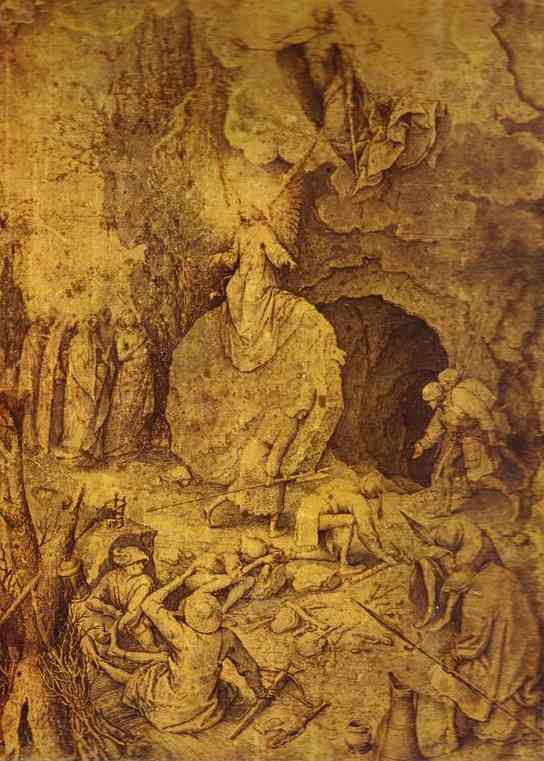
pieter-bruegel-the-resurrection-of-christ-ca-1562


You are my rock

Upon the rock You built Your Church

At Your death the rock was split in two

They laid You lifeless in the rocky tomb

And rolled the rock to seal the light of day

I am Your rock

Upon me You build Your Church

At Your death I split in two

You lay lifeless in my lifeless tomb

My rocky heart seals the light of day

In secret to Father we do pray

Our stillness knows that He is God

No longer statues we arise

And throw aside what we once wore

Total darkness and yet we see

Clearly only one way to go

Your promise lights the way

To restore what You foretold

Same as in the beginning

God and in His image

His creation

His masterpiece

His Son and His brother

The One known as The Word and the one called man

We both enter the garden

As the rock is rolled away


.

—Howard Hain

.

* Pieter Bruegel the Elder, “The Resurrection of Christ”, ca. 1562

.

Friday Thoughts: Heroic Virtue, The Holy Face of Jesus


.

He had no majestic bearing to catch our eye,

no beauty to draw us to him.

.

—Isaiah 53:2


.

There is a great hero alive this very moment.

He’s running into a burning building to rescue a small child.

He’s chasing down a thief who nabbed a pocketbook from a helpless old lady.

He’s performing CPR on a middle-aged man in the midst of a heart attack.

He’s keeping diligent watch over the safety of a nation.

But there is no “burning building”, no “thief”, no “heart attack.” And the “nation” he watches over is his own home.

Oh, but there is crisis, there are certainly trials.

There are countless situations and scenarios that require heroic virtue.

For the child he rescues lives in a foreclosing home, the helpless old lady he aides is robbed by dementia, the middle-aged man he resuscitates is his own brother who desperately needs a sober ride home.

And “he”, our hero, is not just one man. He is several, and numerous, and he wears all kinds of different clothes.

And like that ultimate superhero, the one our childhood comic books ceaselessly proclaim, he spends most of his other waking hours in a job that appears rather mundane.

His “telephone booth”—where he quickly straps on his boots, belt, and cape—is often a tiny bathroom—into which he quietly enters and calmly closes the door, only to clasp his face and let out a silent cry. He sometimes even falls to his knees, begging God for strength. But he only has a minute.

He cant help but look in the mirror as he regains his composure and dries his face, preparing to head back into the arena. What he sees looks old and unfamiliar. That’s not the face of adolescent dreams.

And the door is opened and out walks our hero to save the scene.


.

Yet it was our pain that he bore,

our sufferings he endured.

We thought of him as stricken,

struck down by God and afflicted…

.

—Isaiah 53:4-5


.

—Howard Hain

.

Friday Thoughts: Hide-n-Seek, Lost-n-Found, all within the Liturgy

.

A big fat book.

I’ll have to hollow it out.

I don’t see any other way to fit inside.

Of course I’ll have to leave the covers, the binding, and the outer edges of every inner page.

But what to do with the scraps?

Even the dogs are fed these.

Yes, I’ll eat them.

I’ll digest what’s been hallowed.

Then I’ll climb inside.

The cut-outs will be back in position.

Yes, all still right there, entirely inside, all in its proper place.

The complete volume.

The entire collected work.

The only difference is now I’m part of the story.

An essential part.

Without the pages in my belly the whole thing is essentially empty.

———

Here I am, tucked away, a perfect fit, fetal position within the bind of an ever-revolving nook.

The covers tightly closed, the pages all accounted for, the sanctity of the space preserved.

Now I can rest assured…

Not a bit of attention on little ole me.

———

But what if someone opens the cover?

Oh my, what if he turns the title page?

The jig is up!

I’m spotted for sure…seen as I am.

A stowaway. Hidden from the crowd. Holding out for the end of the storm. Eyes closed even within the dark pages of night.

But what’s he doing now?

He can’t possibly…

No, no…get away…this is my spot…there’s not enough space for two…

What do you mean there’s plenty of room?

What do you mean there are already a million others inside?

Where?

How?

Who?

I don’t see anybody but myself.


.

—Howard Hain

.

Morning Thoughts: New Year, New Love


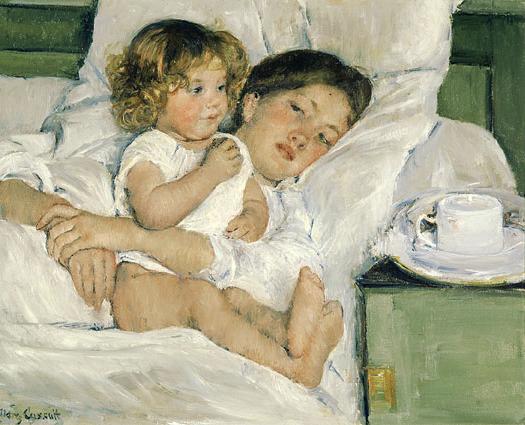
mary-cassatt-breakfast-in-bed-1897

Mary Cassatt, “Breakfast in Bed”, 1897

.

Lord, a new year is upon us.

Help us.

Help us to be grateful.

Gracious and grateful.

Gracious, grateful, and giving.

You give and you take away.

Nothing but Your love is truly ours.

For love You give and love You never take away.

Love only love.

Love just love.

What is it, Lord? What is Your love?

A million answers.

Each of us could probably come up with a thousand.

It’s times such as these that You are not silent, although You don’t seem to say a word.

You answer. You have and will always continue to do so.

You gave Your Only Begotten Son.

A tiny babe. A beautiful child. A strong young man. A fearless leader. A lamb to be slaughtered.

You gave the Tree of Life.

You threw it into the River.

You made all that is bitter sweet.

You gave the Sign of the Cross.

You wrote Your name upon our foreheads.

You gave us a mother, and common brothers and sisters, and holy angels and saints, all of whom we are free to call friends.

Yes, You gave us love.

But what is it, Lord?

We know love exits and we know it does not come from ourselves.

Even for those who say You don’t exist.

To them we could point at the ocean, or the sky—the sun, the moon, and the stars—or even a simple common everyday tree—a single leaf of grass.

“Who made them?”, we can ask.

“Who but God alone?”

Who but You, Lord God, Who willed not to be alone?

You willed love.

You willed Yourself.

Proof of Your existence is You don’t need it.

For nothing will prove You, for nothing can disprove You.

For the love You send is not only born, crucified, and risen, it also ascends.

Above all knowledge.

Into Heaven.

Pure and simple.

Knowledge.

Knowledge that You love us.

You truly love us.

Little old us.

That is what You love.

The object of Your love.

The product of Your love.

We are Your love.

Thank You, Lord.


.

—Howard Hain

.

Morning Thoughts: Wise as Doves

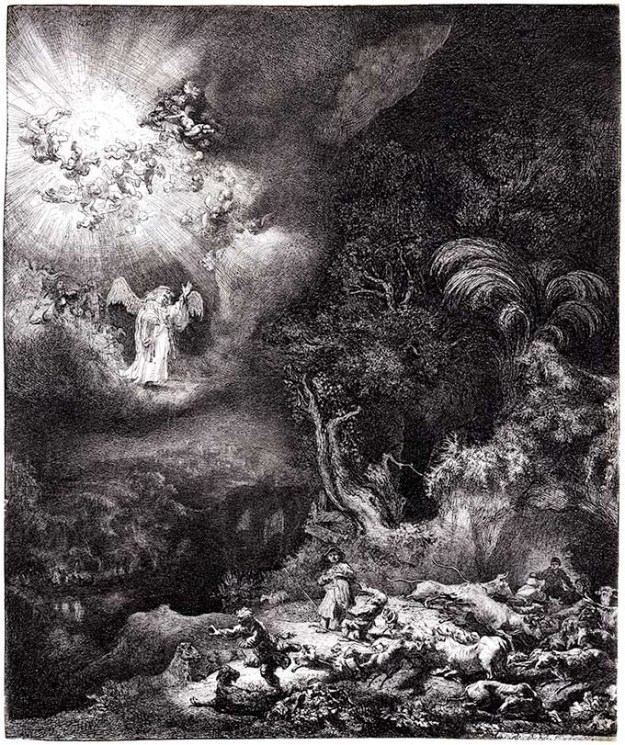
rembrandt-angel-appearing-to-the-shepherds-1634

Rembrandt, “The Angel Appearing to the Shepherds”, 1634

 .

Now there were shepherds in that region living in the fields and keeping the night watch over their flock. The angel of the Lord appeared to them and the glory of the Lord shone around them, and they were struck with great fear.

—Luke 2:8-9


.

Perhaps the scariest thing to those of us who cling tightly to the things of the world is to accept the job that the Lord assigns us.

Oh, how so many of us are so quick to long for greater adventure!

Yet, when it comes to those humble, little shepherds to whom the angel of the Lord appeared, we are perhaps even quicker to long to be one of them—sitting quietly upon a gentle hillside, effortlessly tending to a passive flock, while the always-full moon provides a soft, ever-so-appropriate illumination from above.

But we are liars. For there’s nothing less romantic in each one of our daily lives, or more mundane. We simply have to be honest, or at least consistent. It all depends on how we look at it. If we see the shepherds in such a delicate light then we also need to see ourselves in the same. For before the angel appears, the shepherds were hardly posing for picturesque landscapes. Perhaps it is for this very reason—their realness, their authenticity, their holy simplicity—that the Lord chose them to be present when He revealed His glory.

It is exciting. We have a wonderful choice, then. Either our “boring” lives make us just the kind of people to whom God prefers to reveal Himself, or our lives are a lot more “exciting” than we ever imagined. Either way, what is vital to making such a decision is true sincerity and genuine gratitude. We need to thank God for who He has made us, for where He has placed us, and for what type of task He has assigned us.

A faithful, humble heart dreams and believes and sees great things among the most ordinary circumstances. Just look at the young virgin and the upright carpenter to whom the shepherds “went in haste” to find in a stable, adoring a child born within the company of the “lowest” of men.

If we spend our time dreaming of being someone else, living somewhere else, and doing something else, we miss the opportunity of being exactly who God intends us to be—and when that happens—we are always in the wrong place, at the wrong time, and most tragically, doing that which matters very little.

For to be the first on the scene, the first to “lay hold”, the first to adore the New Born King, is as good as it gets—even for those whose “normal existence” isn’t standing around all alone—day after day in the scorching sun or biting cold, while picking fleas from matted-down fleece or scaring off hungry wolves.


.

The angel said to them, “Do not be afraid; for behold, I proclaim to you good news of great joy that will be for all the people…”

So they went in haste and found Mary and Joseph, and the infant lying in the manger. When they saw this, they made known the message that had been told them about this child. All who heard it were amazed by what had been told them by the shepherds.

Then the shepherds returned, glorifying and praising God for all they had heard and seen, just as it had been told to them.

—Luke, Chapter 2:10,16-18,20


.

—Howard Hain

.

Friday Thoughts: Just Up At Dawn


utagawa-hiroshige-titmouse-and-camellias-right-sparrow-and-wild-roses-center-and-black-naped-oriole-and-cherry-blossoms-left-ca-1833

Utagawa Hiroshige, “Titmouse and Camellias (right), Sparrow and Wild Roses (center), and Black-naped Oriole and Cherry Blossoms (left)”, ca. 1833


Lord, You are good.

Truly Good.

You are a great promise.

You are as good as Your Word.

You set free and You restore.

You truly make all things new.

I have seen great deeds.

Only Your hand can accomplish.

Within spaces.

So big and so small.

I have seen you in the sky and in the bird.

I have heard You cry and felt You shake.

I feel Your smile.

This very moment.

Good morning, Father.

You are so very good.

You are God.

And You alone.

Thank You for teaching me.

For showing me how to be free.

By asking only one thing.

Each and every moment.

What is Your will?

I need know nothing more.

I need not see, nor hear, nor feel, nor sense anything else.

I need not understand, nor remember, nor plan.

I need not desire nor will more than Your will itself.

I am.

Here.

To know.

To love.

To serve.

You.

And You alone.

That is Your will.

Your will is You.

One and the same.

Father, Son, Holy Spirit.

Holy Mother Church.

Holy Angels.

Holy Saints.

Cloud of Witnesses.

Help me, Lord God.

Maker of Heaven and Earth.

To love You more and more each day.

In all Your creation.

Every bit of Your handiwork.

All for Your sake.

Simple. Clear. Honest. Pure.

A sparrow just up at dawn.

Tweet…tweet…tweet…

I hear Your will knocking at my door.


.

—Howard Hain

.

http://www.metmuseum.org/art/collection/search/56918

.

Friday Thoughts: Heaven Touching Earth

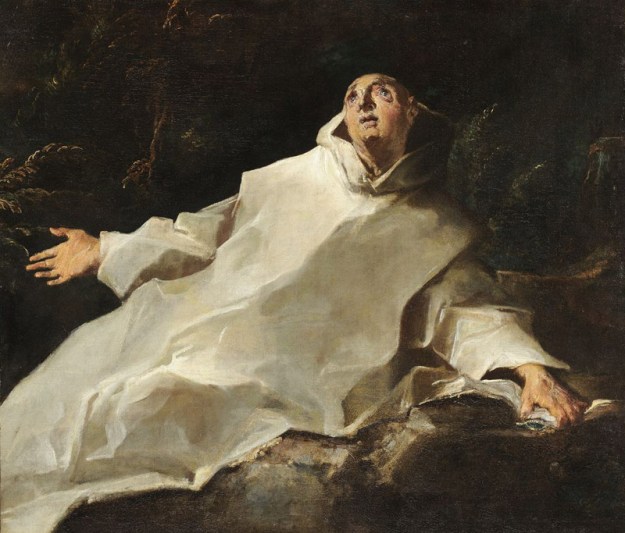
louis-cretey-the-vision-of-saint-bruno-late-17th-century

.

The sound of heaven touching earth is silence.

For silence is the absence of interruption.

And in heaven there is continual praise. A constant, perpetual, ceaseless, indescribable continuation of everything good. There is no interruption of absolute goodness. No interruption of peace or prayer, no interruption of joy or love.

In heaven, then, the eternal roar may perhaps be so inadequately described as an incomprehensible silence—a silence that blissfully deafens.

Deafens us to any pain or fear.

Deafens us to even the thought, the idea, or the conception that there could be any pain or fear.

So then when heaven touches earth, does not that same awesome eternal silence also reign here too, as it does in heaven?

Silence reigns.


.

—Howard Hain

.

(image: Louis Cretey, “The Vision of Saint Bruno”, late 17th century)