Tag Archives: poetry

Bozza Imperfetta (imperfect sketch)

by Howard Hain


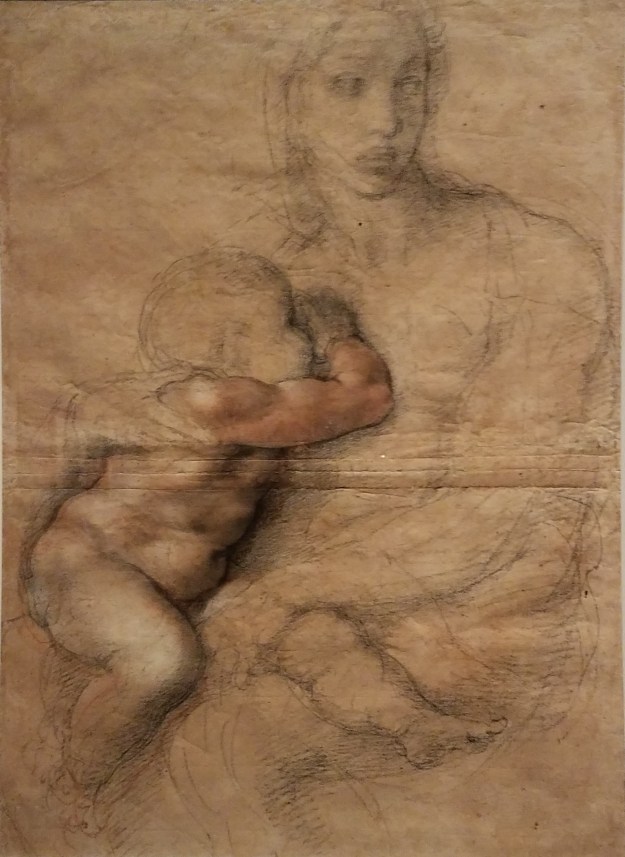
20171121_104929

Michelangelo Buonarroti (Italian, Caprese 1475–1564 Rome). “Unfinished cartoon for a Madonna and Child.” 1525–30. Drawing, black and red chalk, white gouache, brush and brown wash. Casa Buonarroti, Florence


I know almost nothing.

What I do know leads me up the ladder of not understanding.

To my perch upon the Cross.

Within the heart of my child Jesus.


20171121_110016

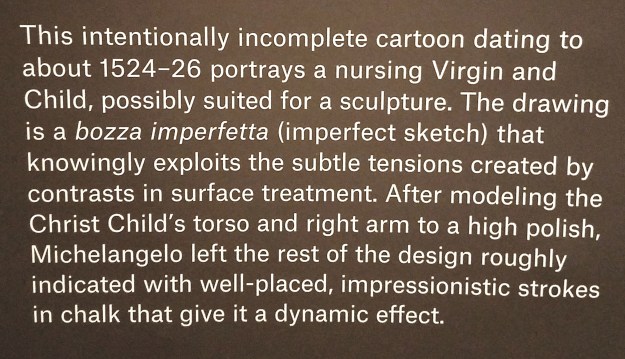
Museum Wall Card for Work Above, from: Michelangelo: Divine Draftsman and Designer, on view at The Met Fifth Avenue from November 13, 2017 through February 12, 2018.

Arriving in Hope

by Howard Hain


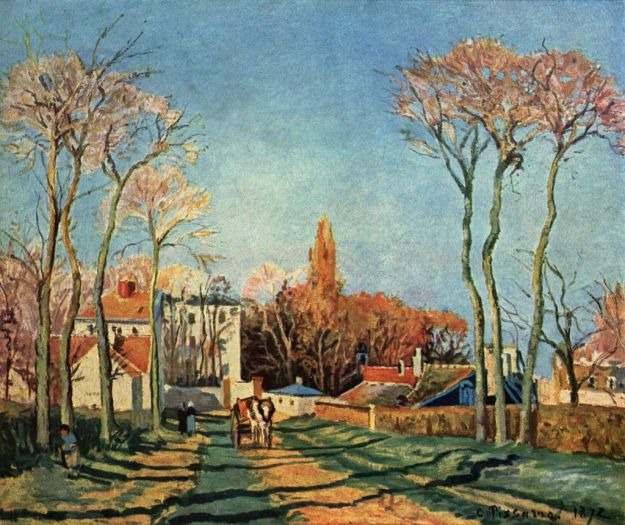
camille-pissarro-entree-du-village-de-voisins-1872.jpg

Camille Pissarro, “Entrée du village de Voisins”, 1872 (Musée d’Orsay)


Waiting and waiting, for exactly what I’m not sure.

The sun to rise.

The day to end.

The water to boil.

Mass to begin.

The cock to crow.

Christ to return.

———

A new day is here.

———

Father, thank You.

Jesus, I love You.

Holy Spirit, have Your way.


Howard Hain is a contemplative layman, husband, and father. He blogs at http://www.howardhain.com

Follow Howard on Twitter @HowardDHain

twitter.com/HowardDHain

If you enjoyed this post, please consider “liking” it, adding a comment, becoming an email subscriber, or passing it along via the social-media links below. Your support is greatly appreciated. Step by step. All for God’s glory.

Young Mother Sewing

by Howard Hain

DP139632

Mary Cassatte, “Young Mother Sewing” 1900, (The Met)


A living faith works. It is always active, especially when we are docile to the Spirit.

When we walk by faith we see, we hear, we speak what God intends, especially when we are blind to the cares and anxieties of the world.

Small children are wonderfully active, superbly passive, and at times they seem completely blind, fantastically blind. They are alive. They see. They hear. They speak. They watch. They feel.

Mother Church calls all of us home, even when she is silent. She is always at work. She watches us even when her eyes are busy with the business of the day.

She sews. We just need to obey. To trust. To allow ourselves the freedom to lay across her lap.

In the short description upon the little museum card hanging beneath the painting shown above, God has planted great instruction. The work is by American impressionist Mary Cassatt.

According to the card, about the year 1890 “Cassatt redirected her art toward women caring for children and children alone—themes that reflected her affection for her nieces and nephews and the prevailing cultural interest in child rearing.” And then, after informing us that for this particular painting Cassatt “enlisted two unrelated models to enact the roles of mother and child”, the card completes its little catechesis by blessing us with a precious little anecdote and quote:

Louisine Havemeyer, who purchased it in 1901, remarked on its truthfulness: “Look at that little child that has just thrown herself against her mother’s knee, regardless of the result and oblivious to the fact that she could disturb ‘her mamma.’ And she is quite right, she does not disturb her mother. Mamma simply draws back a bit and continues to sew.”

God are we blessed. So blessed to have such a mother. All of us. Maybe give her a call today. Better yet, perhaps even stop by. She’d love that. She’d love to see your face. You’re always on her mind and in her heart. She lives in the closest church you can find, any building that truly houses her Son.

If she seems a little occupied with the “cooking and cleaning”, with all “the business of life”, don’t let that stop you or cut your visit short. No, throw yourself against your “mother’s knee regardless of the result and oblivious to the fact” that you could disturb your “mamma.”

It most certainly does not.

“Mamma simply draws back a bit and continues to sew.”


Howard Hain is a contemplative layman, husband, and father. He blogs at http://www.howardhain.com

Follow Howard on Twitter @HowardDHain

www.twitter.com/HowardDHain

If you enjoyed this post, please consider “liking” it, adding a comment, becoming an email subscriber, or passing it along via the social-media links below. Your support is greatly appreciated. Step by step. All for God’s glory.


Web Link: The Met Museum. Mary Cassatt, “Young Mother Sewing”, 1900


Morning Thoughts: Remembrance of Things Past

by Howard Hain

.

“…forgetting the past and pushing on to what is ahead…”

—Philippians 3:13


.

What is the past? A remembrance of things past. Of what has been. Of what is not now. Of what is no longer today.

What is re-membering? A putting back together of what once was. Of what was once whole. Complete. United. Unified. A re-attachment of “bodily” members currently detached. A body made whole, brought back into health. It is healing. It is “being” fulfilled.

What is to forget? The act of properly re-membering. Beyond elimination. Beyond denial. It is re-valuation. It is re-deeming. Of value. A re-establishment of worth. An instance of humanity made universality worthy once more.

What is worthy? What has value? The future lived presently. Proper hope brought into active being. Knowing ‘now’ is a perpetual tomorrow, lived fully today.

It is tomorrow’s air breathed as we currently speak.

A human being living in heaven.

A human being “knowing” heaven was once, is now, and will be forever.

Worthy is a person “forgetting the past and pushing on to what is ahead…”


Praise be Incarnate Wisdom. Now and forever.

.


.

.

Friday Thoughts: The Height Of Stars

by Howard Hain

.

My constant companion.

My acting partner, my motivational coach.

Sometimes I forget you’re there.

Such lack of gratitude, such empty graciousness.

But you remind me, lest I forget.

There you are once again.

Right beside me.

Center stage.

All the world to see.

Hard to imagine you any other way.

My constant companion.

My antagonist. My adversary.

Middle of the night, just you and me.

Another standoff. Another scene.

Good or bad, there’s always drama.

One day we’ll part ways I suppose.

But for today, this hour, you continue to goad.

Pestering and probing.

A reaction, any, is what you want.

Like a needle in my hay stack

Pricking my limbs.

Especially my heart.

Weakness.

That’s who you are.

You play your role.

Upstaging the stronger, more noble parts of man.

Clever, cunning, looking for the upper hand.

Curtain up or curtain down.

You’re a character for sure.

Smile or frown.

Jester or clown.

Your disguise is basically the same.

Some sort of wise man, a plot all your own.

But you, Sir Weakness, you are important.

Like tragedy.

Like divine comedy.

You give good measure.

You give the chorus something to say.

And despite your best intentions.

You help establish strength.

You remind people the height of stars.

Without you, my dear Weakness, no hero could ever be.


.

.

Thoughts Upon The Cross: Bold Humility

by Howard Hain

.

We should always strive to be fully united with The Body of Christ, in both thought and prayer. To think prayerfully, and to prayerfully think.

Let us then prayerfully embrace this particular moment:

Lord God, Father Almighty, let us use the talents, the gifts, and the abilities—that come from You, that will return to You, but that You have lent us for the time being—with maximum effectiveness, maximum efficiency, and bold humility—all for Your glory.

In the name of Jesus—in the person of Christ—as the Messiah Himself would offer.

Amen.

———

Now, let us think, prayerfully.

What is “bold humility”?

Let’s explore an answer, slow and steady.

First, like all manifestations of God’s glory, “bold humility” is a matter of transcendence.

Second, transcendence is not merely a type of balance. Balance is something else entirely. It is something less than divine. Balance is a man-made religious concept. It is practical human philosophy at work in the world, depending on and functioning within human limitation. Unlike transcendence, balance does not stem from the theological posture of divine providence, and more so, it does not rely on the acknowledged power and faithful acceptance of divine grace.

For example, with regard to the matter at hand, “bold humility” is not merely the balancing of boldness and humility—it is not a matter of being equally bold and equally humble—as if on a scale of 1-10, a score of 5 for boldness and a score 5 for humility is achieved simultaneously—adding up to 10 and at the same time keeping the “seesaw” of virtue straight and parallel to the earth lying below.

No, “bold humility”, like all Christian (and therefore preternatural) virtue is not a matter of equally limiting each natural characteristic in order to fit them all within the confines of human potential and logical limitations.

In plain language then, “bold humility” is not simply a healthy combination of two virtues, namely “boldness” and “humility”.

And most directly to the point: Christ didn’t balance. He transcended.

Then what does transcendence mean in this supernatural sense?

Well, let us rule out a few more false understandings before positing a possible positive understanding.

It will prove helpful to also establish this negation: To transcend is not merely to eliminate. Nor is it merely to deny. By transcending one does not destroy the categories it transcends. So in this particular case we can say that “bold humility” does not “eliminate” or “deny” the category of “boldness” or the category of “humility”.

Now let us begin to state positively what Jesus accomplished—for Jesus most certainly transcended.

To transcend is to rise above and beyond. It is to journey through. It is to transform.

Transcendence fulfills the “categories” it leaves below—it completely and utterly fulfills each and every virtue that man could ever conceive—and not only at the same time or simultaneously, but eternally and to a maximum degree. Transcendence is perpetual fulfillment of all “goodness” to an infinite “degree”.

Transcendence is then what we might call: Active Shalom.

It is living, breathing “Fullness”. It is “True Peace”. It is “Oneness” and the “Unity of God”—alive and constantly in motion. For to transcend is also to enter and live within the Internal Consistency of The Eternal Creator Himself.

Transcendence is the ultimate simplicity of “I AM.

It is Ipse Christus—Christ Himself—God made man, the Word made flesh, the magnificence of God brought into visible light.

And it is human redemption at work.

For the person of Jesus is just that: He is the glory of God woven into and through the very fabric of humanity—taking humanity above and beyond itself—transforming it on earth and simultaneously bringing it back with Him to the Father in heaven—as a new, glorified, and righteous form.

Jesus both lifts humanity into heaven and manifests fully God’s glory on earth.

Bold Humility” is Jesus Himself.

He alone fulfills completely both “boldness” and “humility” without ceasing.

And by doing so He straddles two worlds—making them one. But yet He is much more than a bridge, much more than a mere mystical ladder. Jesus, if you will, is Jacob’s Ladder but built of human flesh—upon Whom not only holy angels ascend and descend between heaven and earth—but through Whom the very helix of humanity is redeemed and glorified.

———

But enough words.

For they can never capture.

Jesus is profoundly free.

The best we can hope for is a glimpse—a fleeting image of the living, breathing manifestation of “Bold Humility” in ultimate action.

It takes silence.

It involves leaving the senses and faculties behind.

It requires “spirit and truth”:

We must stare at The Cross.

We must experience—firsthand—The Crucified Christ.


..

Let us then pray once more:

Lord God, Father Almighty, let us use the talents, the gifts, and the abilities—that come from You, that will return to You, but that You have lent us for the time being—with maximum effectiveness, maximum efficiency, and bold humility—all for Your glory.

In the name of Jesus—in the person of Christ—as the Messiah Himself would offer.

Amen.


.

.
A Lump of Clay


A Lump of Clay


I feel like a lump of clay

lying shapeless on a board

waiting for the sculptor

to shape me into what

he sees in his mind’s eye


The sculptor is perfect

but the clay is not-

it can be stubborn

resistant, uncooperative,

free-willed


It does not always mold

into the sculptor’s vision

but prefers to take shapes

that his hands have not

intended

and so, many times

it has to be scooped up

and shaped into the lump

it once was


With infinite patience

and love

the sculptor starts again

and shapes over and over again


until the clay realizes

it is gradually, willingly,

becoming the sculptor’s vision


Gloria Ziemienski

September 29, 2012

The Silent Self

The silent self


Silence is

sitting still

standing still

lying still

consciously

gratefully

breathing

inspiring-

being inspired with life

and love

from him from whom these

gifts do come-

the Lord of life and love-

the living Lord Jesus.

And in the stillness

knowing

and joyfully acknowledging

that in Jesus alone

the silence of life and love is found.

Then to humbly rest

sit

stand

lie

to bow the knee

in all that satisfying silence-

and be fulfilled.

Harry Alfred WIGGETT, The silent self, in: Nigel Watts, Most this Amazing Day, Fount , 1998

Tell Us

We have had names for you:

The Thunderer, the Almighty

Hunter, Lord of the snowflake

and the sabre-toothed tiger.

One name we have held back

unable to reconcile it

with the mosquito, the tidal wave,

the black hole into which

time will fall. You have answered

us with the image of yourself

on a hewn tree, suffering

injustice, pardoning it;

pointing as though in either

direction; horrifying us

with the possibility of dislocation.

Ah, love, with your arms out

wide, tell us how much more

they must still be stretched

to embrace a universe drawing

away from us at the speed of light.

R.S.THOMAS, from: The SPCK Book of Christian Prayer, London, 1995