Tag Archives: Peter

Jesus in Caphernaum

img_0065

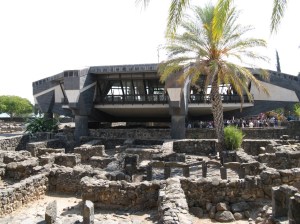
  Near the shore of the Sea of Galilee, in Israel, one can visit the excavations of the ancient town of Capernaum. There the Franciscans have built a lovely hexagonal church over the restored ruins of a circular stone house, with the opening for its front door clearly visible. We pilgrims believe in our hearts of faith that this is the house mentioned in today’s Gospel.

      ” On leaving the synagogue Jesus entered the house of Simon and Andrew with James and John. Simon’s mother-in-law lay sick with a fever. They immediately told Him about her. He approached, grasped her hand, and helped her up. Then the fever left and she waited on them.

     ” When it was evening, after sunset, they brought to Him all who were ill or possessed by demons. The whole town was gathered at the door.” (Mk 1; 29-33).

     We believe that right at that door Jesus healed dozens, if not hundreds, of people (including the paralytic, who was lowered with ropes through the ceiling). He might also have preached the Good News of the Kingdom in front of that humble threshold.

     I cannot help but imagine my Lord residing in my own private room within my heart. I know that there, through the Eucharist or prayer, planned or unexpectedly, He continuously “grasps my hand and helps me up”. He stands at the door of my heart and encourages me to serve, to invite all those around me, in my family and community, who might need some of the hope and healing that He compels me to share. This is what I live for.

     And He asks for more: ” Let us go on to the nearby villages that I may preach there also. For this purpose have I come.” (Mk 1; 38). With His holy companionship I am asked to reach out to those beyond the locust of my comfort zone: to the stranger, the different, the unpleasant one,the hopeless one, the one whose political ideas or interests are so different from mine.

     May He give me the strength and faith, and courage, to try and “grasp” the hand that might reject mine. He has given me so much undeserved grace and love. He has given me the eyes to “see Him”. For what “purpose” has He come to me, if not so that I may be an instrument of His peace and love?   

                                      Orlando Hernandez

Acts of the Apostle: The Crippled Man


By the old temple gate
lay a poor crippled man,
forced to beg
for the daily needs of life.
He was lame from his birth
with no hope to be healed
until Peter and John came to pray.

Those two friends of the Lord
saw the man lying there
and were filled with compassion and love.
They had no money to share,
so Peter reached out his hand
and gave him the best that they had.

“I have no silver, no gold,
but I give you what I have –
in the Name of Jesus, stand up and walk!
Take this gift of new life
and proclaim to all the world
that the Name of the Lord has set you free!”

By the old temple gate
stands a man strong and free,
singing praise to the Name of the Lord!

Gloria Ziemienski
April 1997

The man crippled from birth who is cured by Peter and John as they enter the temple precincts after Pentecost is an important figure in our readings for the last four days of Easter Week. Crippled from birth, over 40 years old, he’s carried to the gate of the temple each day to beg for alms.  Everyone knows him, he’s a regular. 

After he’s cured he goes into the temple to hear Peter’s message to the crowd about Jesus of Nazareth. As he stands there, relishing his cure, he’s a sign God’s power is a work. Can we see him becoming a believer? The temple leaders, on the other hand, find him an annoying presence whom they try to silence. 

How can he be explained away?

The man was surely at Peter’s side when he spoke to the people in the temple area. Just as miracles accompanied the teaching of Jesus, so now they will accompany the teaching church. We have to expect signs like this, that raise up the poor, to be part of the church’s witness, especially in an unbelieving age.

What other signs can we see in Peter’s words to the crowd as he witnesses to the Resurrection? He points to the tomb of Jesus, in contrast to David’s tomb. It’s empty. We have to keep the holy places associated with Jesus as part of our witness.  He points to the scriptures. We have to keep reflecting on them to enrich our witness. His message is overwhelming a message of forgiveness. Mercy and forgiveness should be our witness too. 

Words are not the only way we witness the Resurrection of Jesus.

Readings here.

Morning and Evening Prayer.  Sunday, Week 1 http://www.praydaybyday.org

Children’s prayers here.

Human versus Divine Thinking

DSC00804“Who do you say that I am?” Jesus asks his disciples on the way to Caesarea Philippi. “You are the Christ,” Peter says in reply, going beyond what the crowds were saying then of Jesus.

But then as Jesus speaks of suffering greatly, being rejected, killed and rising after three days, Peter rejects his prediction. In reply Jesus says to him “Get behind me Satan. You are thinking not as God does, but as humans do. ” (Mark 8,27-33)

The Gospel of Mark, more than the others, presents us with the human Peter, thinking as humans do. He appears in the story of the Passion of Jesus failing miserably as he denies Jesus three times and deserts him in his last hours. If Peter is the voice behind Mark’s gospel, he certainly hasn’t made himself a hero nor does he excuse his failures. Many times he seems to say as he says elsewhere in the gospel; “I’m a sinful man.”

Yet, he was called upon by Jesus to lead and teach.

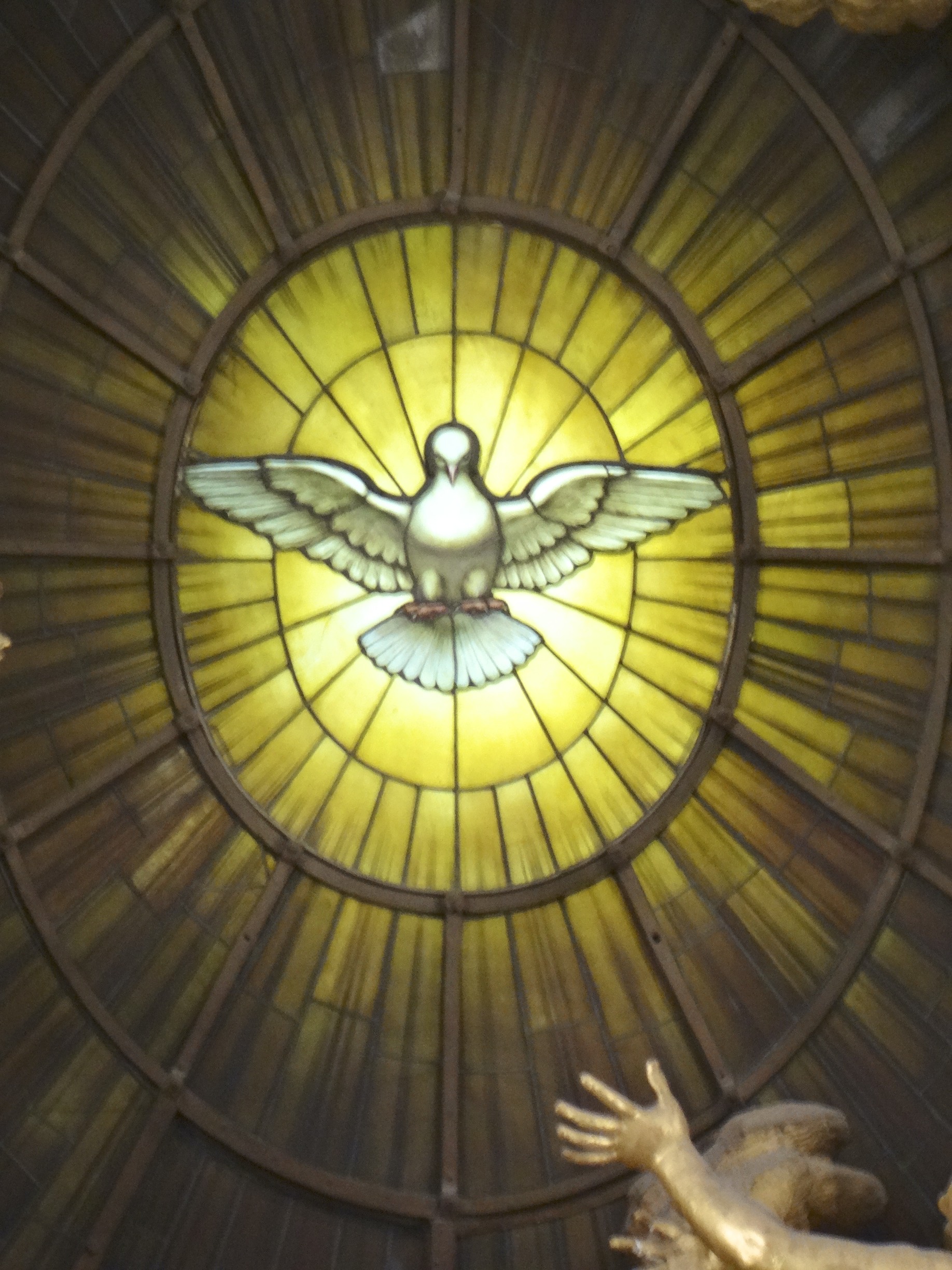
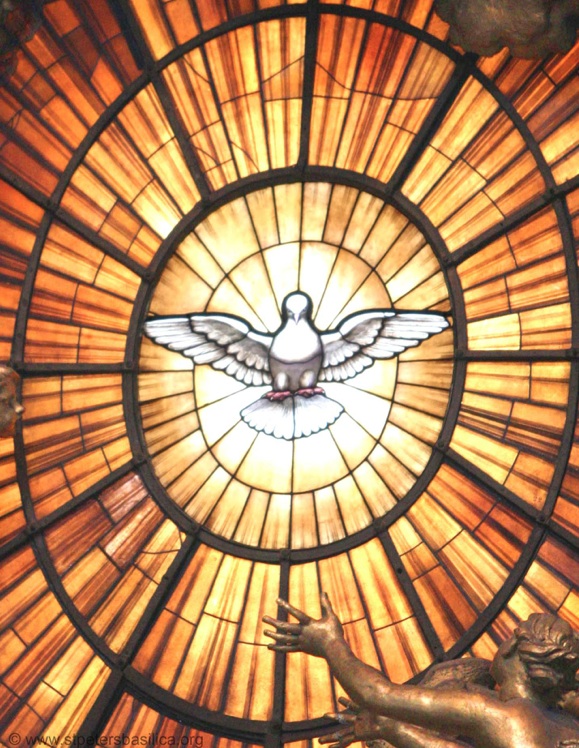
In a few days (February 22nd) we’re going to celebrate the Feast of the Chair of St. Peter. The chair is in the Vatican Basilica beneath the window of the Holy Spirit which sheds its bright light upon it. It’s a teacher’s chair, not a throne, and from Mark’s gospel we get a picture of the one who, with the Spirit’s help, leads and teaches the church.

A human hand reaches from the darkness to the divine.

August is Here

At the start of each month I email members of the Confraternity of the Passion and anyone else who asks a calendar indicating the scripture readings for the Mass and the feast days of the saints we remember that month.

The reason I do is that following the church calendar is an important way to grow in faith.It puts us in touch with the scriptures in our daily lectionary and the wonderful world of the saints.

Reading the daily scriptures together with fellow believers throughout the world develops a common mind, as it were. Fortunately, not just Catholics use the daily lectionary, some Protestant churches use it now too; so more Christians read the same scriptures together through the year.

Praying together can bring us together, we hope. Praying the scriptures together, which the Catholic church encouraged at the Second Vatican Council, is a step towards Christian unity. Blessed Dominic Barberi, Passionist whose feast is August 26th was especially dedicated to the work of Christian unity.

This month at Mass we continue reading from Matthew’s gospel. With chapter 14, Jesus begins to establish his church, built on Peter, a rock, but a frail man who with the other disciples must follow Jesus to the cross.

The following chapters from Matthew offer an instruction about the nature of the church. Its members must care for each other and forgive those who have offended them. At the same time they’re obliged to correct their fellow Christians, even to the point of separation from the community. (Matthew 18)

During the first few weeks of August we’ll continue reading from the books of Exodus, Leviticus, Deuteronomy and Numbers about the Jewish exodus from Egypt led by Moses. Then we’ll read about their occupation of Canaan under Joshua and the Judges.

It’s a brutal occupation. Our lectionary softens our exposure to it by limiting what we read about it, but even so, why the violence? Why so many exterminated in the name of God? The scriptures raise questions and cause objections as well as give answers and raise our hopes.

Here’s where good commentaries and wise answers help; otherwise, we lapse into biblical fundamentalism. I’m reading the commentaries from the New American Bible, which recognize we can’t read these books as literal history. There’s a human hand at work in them.

God reveals himself progressively to the human family, which is intent on its own welfare and quick to destroy rather than build. God works in mud. Here’s a quote I like:

“Progressive revelation throughout Israel’s history produced far more lofty ideals, as when the prophets see all the nations embracing faith in Yahweh, being joined to Israel, and living in peace with one another (Is 2:2419:232545:2225Zec 8:2223), and the New Testament teaches us to love even our enemies (Mt 5:4345).” (New American Bible, Commentary)

There’s another way to look at the violence and exterminations found in the Book of Joshua:

“The theological message of the book is unmistakable. God has been faithful to the promise of the land. If Israel relies totally on the Lord for victory; if Israel is united as a people; if the law of herem is kept and no one grows rich from victory in war—then and only then will Israel possess the land.”

We’re a long way from possessing the land. “Your kingdom come.”


Martha, Martha

29d6ce6c782d7314a69950e1a560b871

We read St. Luke’s account of Jesus’ visit to Bethany for the Feast of St. Martha. It’s part of Jesus’ journey from Galilee to Jerusalem (Luke 10,38-42), a journey Luke describes,  not by miles, but by the people Jesus meets.

Jesus is a prophet speaking God’s word as he goes. Some reject him outright on his way to Jerusalem.  Jesus enters the house of Martha and Mary as a prophet speaking God’s word. Unfortunately Martha, busy about many things, misses his word and Jesus rebukes her. Mary hears his word and is praised. Good as she is, Martha’s carrying too many of the “cares of this life” when Jesus visits.

That’s what Luke wants us to learn from this gospel- the cares of this life can get in the way of hearing God’s word. But we all know there’s more to Martha than what Luke tells us here. Other New Testament sources praise this good woman.  John’s gospel, for example, says that  Jesus was a long time friend of Lazarus and his sisters in Bethany.

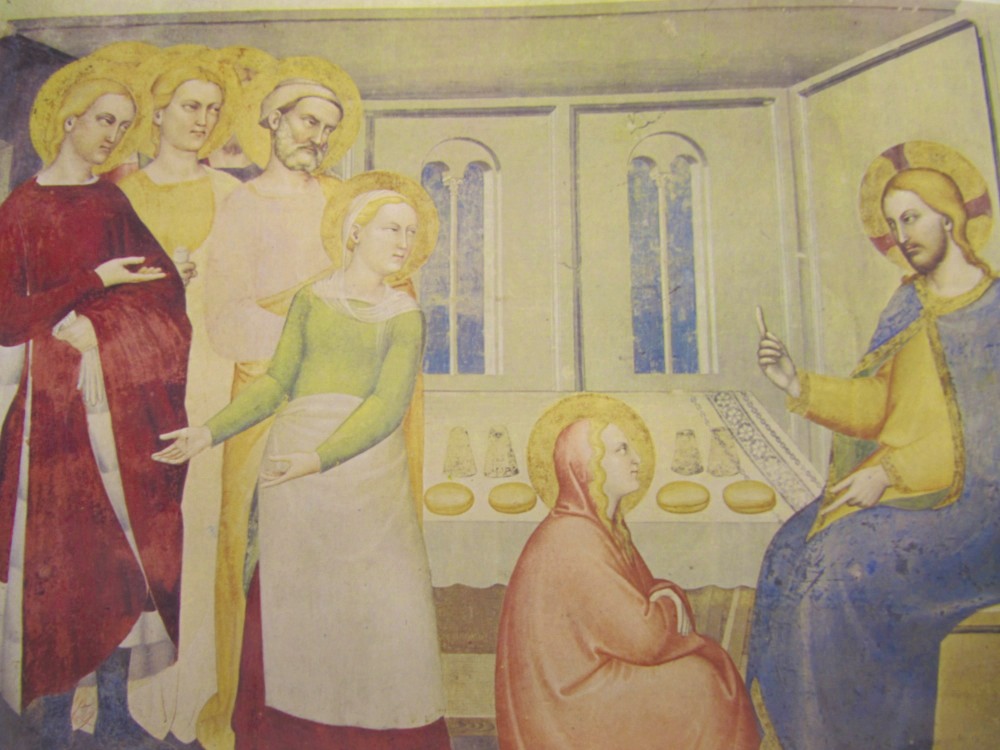
I keep two other sources in mind when I read Luke’s story.  One is a painting (above) by the 13th century Tuscan artist, Giovanni di Milano, showing Jesus with Martha and Mary at Bethany.

The artist imagines a supper at Bethany. The table’s set for four people– that would be Jesus, Lazarus, Mary and Martha. But look at the others coming in the door. Obviously, they’re Jesus’ disciples, led by Peter. One disciple gestures towards Peter, as if saying, “He told us to come.”

Poor Martha in her apron holds up her hands in frustration, “What are we going to do?”
There will be no miracle. The miracle is Martha’s hospitality. Thanks to her,  more than four are going to be fed. We need artists like di Milano to flesh out what the gospels say.

The other source I like is St. Augustine who obviously has a soft spot for Martha and the work she does. Both Martha and Mary had the same holy desire, Augustine says: “ They stayed close to our Lord and both served him harmoniously when he was among them.”

Martha served him as the “Word made flesh,” who was hungry and thirsty, tired and in need of human care and support. She longs to share what Mary enjoys, his presence, his wisdom and his gifts. And she will find her desires fulfilled.

“You, Martha, if I may say so, will find your service blessed and your work rewarded with peace. Now you are much occupied in nourishing the body, admittedly a holy one. But when you come to the heavenly homeland you will find no traveller to welcome, no one hungry to feed or thirsty to give drink, no one to visit or quarreling to reconcile, no one dead to bury.”

“No, there will be none of these tasks there. What you will find there is what Mary chose. There we shall not feed others, we ourselves shall be fed. What Mary chose in this life will be realized there in full. She was gathering only fragments from that rich banquet, the Word of God. Do you wish to know what we will have there? The Lord himself tells us when he says of his servants, Amen, I say to you, he will make them recline and passing he will serve them.”

Want to see Bethany, home of Martha, Mary and Lazarus. Take a look here.

It’s the Lord!

sinful man
John 21, 1-18

I think I know where this gospel took place– Tabgha, a quiet, wooded area on the Lake of Galilee just south of the ancient town of Capernaum. Easy walking distance from the town that was the center of Jesus’ ministry.

The name Tabgha comes from the seven springs of water flowing into the lake there. When I visited some years ago, flocks of birds were singing in the trees and drinking from the streams of water.

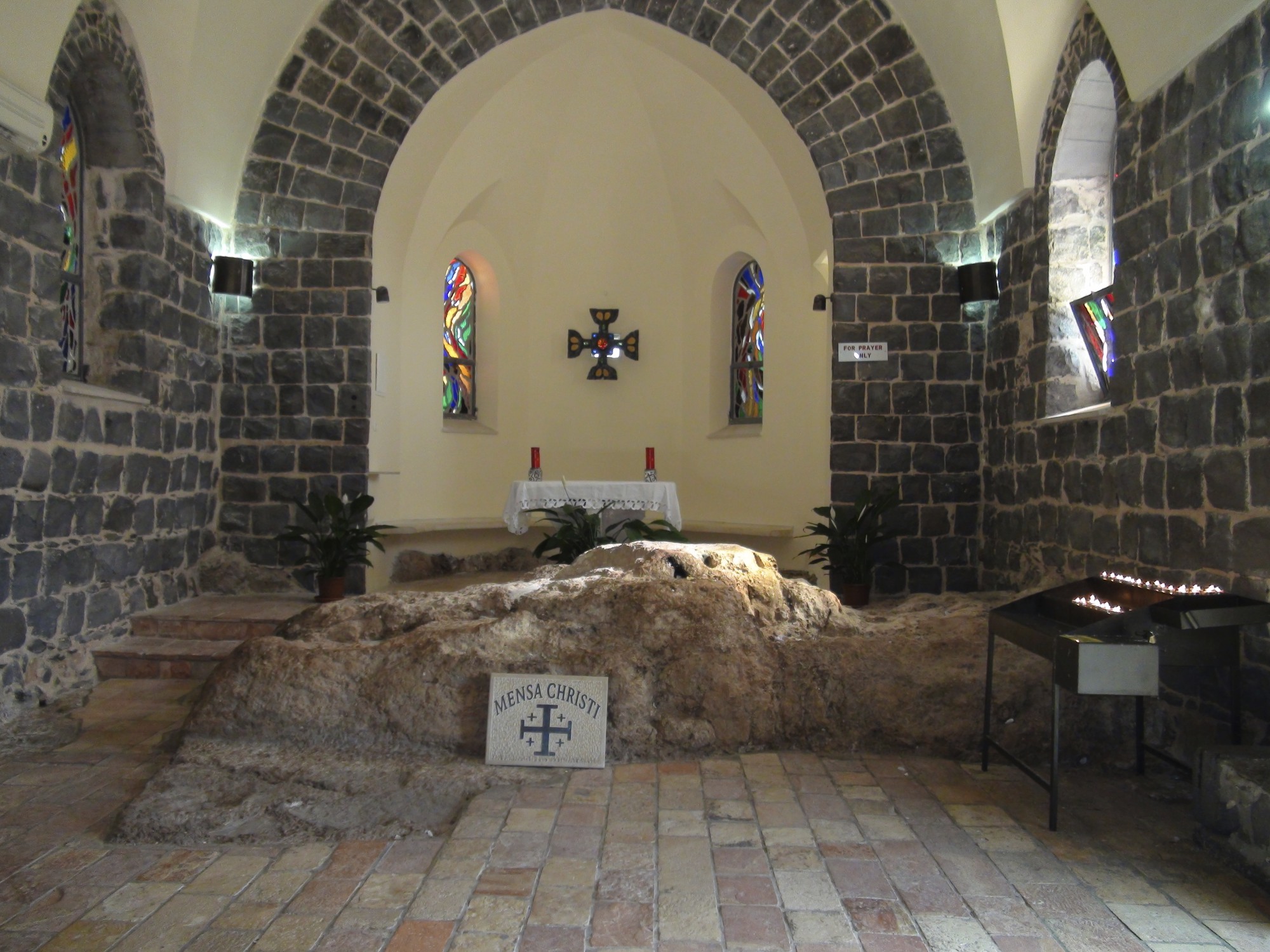
For centuries fishermen must have pulled for fresh water from the springs, and perhaps fry some fish over a fire on the beach. It’s a likely place where Jesus would come to pray. Tradition– two centuries-old churches are on the site–says he met his disciples here after his resurrection.

DSC00042

John’s gospel says that Peter and other disciples of Jesus came to Galilee after the Lord’s death and resurrection and went fishing. Through the night they caught nothing, but at dawn they heard a call from the shore to cast their nets out again.
“… Jesus was standing on the shore; but the disciples did not realize that it was Jesus.”

They caught of large catch of 153 fish. Jesus then called from the shore to come eat some fish at a fire he had started and he gave them bread and some fish to eat and revealed himself to them.

Peter has a leading role in this story. He jumped into the water to get to the shore. Then after they have eaten, Jesus takes him aside and three times asks the disciple who denied him three times, “Do you love me?” A beautiful statue  (above) marks that moment.

Three times the apostle who cursed and swore in the courtyard of the High Priest that he did not even know Jesus answers “Yes, I do. I love you.” And Jesus tells him “Feed my lambs. Feed my sheep.”

A great example of forgiveness . No scolding words or recriminations. No “I told you so.” No warning, “You do that again and …” No demotion, no putting on parole. Rather, Jesus gives Peter new responsibility. “Feed my lambs” as I do. A beautiful picture of God’s mercy.

Instead of punishing him, God calls Peter to new things. The mercy of God always calls us to something new, some new life.

Tabgha, along the Lake of Galilee where Jesus met his disciples, is a wonderful place to visit. I wonder if Jesus prayed here during his days in Capernaum and called his disciples to rest awhile. Here he communed with God his Father; here he prayed and forgave. His memory lingers at this lovely place besides the Sea of Galilee.

Prayer and forgiveness go together Jesus taught. “Forgive us our trespasses as we forgive those who trespass against us.” Today’s gospel tells us to pray and forgive. Maybe  someone  has hurt us, maybe there’s some situation we’re facing now. A job we don’t like, a home situation we’re angry about, something in society that upsets us.

Pray and forgive.

Revelation

    In this Wednesday’s Gospel ( MT 16: 13-18 ) Jesus asks His disciples:

            ” ‘ Who do people say that the Son of Man is?’ They replied, ‘ Some say John the Baptist, others Elijah, still others Jeremiah or one of the prophets.’ He said to them, ‘But who do you say that I am?’ Then Simon Peter said in reply,’ You are the Christ, the Son of the Living God. ‘  Jesus said to him in reply,’Blessed are you, Simon son of Jonah. For flesh and blood has not revealed this to you, but my heavenly Father. And so I say to you, you are Peter, and upon this rock I will build my church, and the gates of the netherworld shall not prevail against it.'”

    Over the last week I have allowed myself to be angered and distressed by the news on TV. Out of so many things, what I found most disturbing was the underreported story that the Congress is quietly crafting nearly 100 “riders” that take away or degrade all types of environmental laws, from energy conservation, to the Endangered Species Act, to the protection of the oceans, rivers , lakes, groundwater, and air. There seems to be no way to stop these new laws from being enacted.

    I feel helpless. I even feel embarrassed to ask my Lord Jesus, in prayer, “Why?” . In the darkness I feel Him asking me, ” Who do you say that I am? Am I just a nice priest or prophet to be remembered and venerated? Do you believe that I am the Son of the Living God? Don’t you trust that I am the Savior of the world? Do you have faith that I AM in charge? Don’t you know how much I love my creation?”

    His soothing presence reminds me that only by loving can I begin to do anything about these problems. So I surrender myself, in hope and confidence, to His Will. Like Peter, I confess His kingship. I will be His instrument. He will show me the way.

    And I am not alone. I am part of a great community of love, His Church, where I meet so many good people who want to do good for this world. We also have Peter’s successor, Pope Francis. He is a compassionate man, a rock of righteousness, a strong voice in our world, strong enough to reach the ears of the powerful. His message advocates for the poor, the oppressed, the dispossessed, and also reminds us of our urgent need to protect God’s Creation.

    So, Beloved Heavenly Father, never mind my thoughts and the thoughts of men. You have given me confidence in You, and I thank You for Your Revelation: Christ lives, and loves, and cares for us . We are not floundering alone in a wild, threatening sea. We are standing on firm rock.

Orlando Hernández

Friday Thoughts: “Prophesy!”

saint-peter-being-freed-from-prison-gerard-van-honthorst-1616-18

Gerard van Honthorst, “Saint Peter Being Freed from Prison”, 1616-18


.

“What further need have we of witnesses? You have heard the blasphemy. What do you think?”

They all condemned him as deserving to die.

Some began to spit on him.

They blindfolded him and struck him and said to him, “Prophesy!”

And the guards greeted him with blows.

While Peter was below in the courtyard…

—Mark 14:63-66


.

I don’t want to hear myself.

I want to hear from You.

My thoughts, my concerns, my feelings, bore me terribly.

I think You are silent but I know it isn’t true.

The moon is so very full this night and so are You.

The coffee I sip is bitter.

Your Word hangs on every tree.

If only Lord we could see.

Drama. Tragedy. Puppet show. Divine Comedy.

Me, me, me, look at me!

But it is You raised up high.

For all to see.

Forgive us, Father, for we still haven’t a clue.


.

The inscription of the charge against him read, “The King of the Jews.”

With him they crucified two revolutionaries, one on his right and one on his left.

Those passing by reviled him, shaking their heads and saying, “Aha! You who would destroy the temple and rebuild it in three days, save yourself by coming down from the cross.”

Likewise the chief priests, with the scribes, mocked him among themselves and said, “He saved others; he cannot save himself. Let the Messiah, the King of Israel, come down now from the cross that we may see and believe.”

Those who were crucified with him also kept abusing him.

—Mark 15:26-32


.

—Howard Hain

.

A Church that Heals?

peter healing

Readings

Peter and the other disciples confidently walk among the needy, bringing them life and healing in the name of the Risen Jesus. “Thus they even carried the sick out into the streets and laid them on cots and mats so that when Peter came by, at least his shadow might fall on one or another of them.” (Acts 5, 15) Healing is a sign of the resurrection.

Our readings from The Acts of the Apostles for the next few days are about the cure of a crippled man in the temple. (Acts 3, 1-4, 37)  Peter and John meet the man begging at the temple gate. “In the name of Jesus Christ the Nazorean, get up and walk,” Peter says, and the man got up and “went into the temple with them, walking and jumping and praising God.”

Jesus began his ministry in Galilee with dramatic healings like that. Peter’s mother in law was among the first he healed on the momentous day he came to Capernaum. (Mark 1, 29-32) Wonder and excitement quickly spread, people flocked to him, but soon opponents began to question and finally try to stop the Nazorean.

His followers continue his healing mission after his resurrection.  “In the name of Jesus Christ the Nazorean” Peter and the rest move others to believe and join them by signs of healing; they also face the reaction Jesus faced when he healed. They face opposition.

An important witness of God’s presence in the early church, is healing still important in our age which trusts so much in modern medicine and the latest drugs and treatments?  Pope Francis recently called the church a “field hospital.”A reminder that the church must never abandon it’s mission to be a healing church, witnessing to the resurrection of  Jesus, praying for and caring for and sustaining those in need.

The Acts of the Apostles is a template for looking at our church today as well as the church of the past.


5th Sunday C Deep Waters


To listen to the audio for today’s homily, select the audio file below:

I usually go out fishing a couple of times a year at the Jersey Shore with a friend of mine who has a boat equipped with radar that tracks fish. I notice, though, he also has some old maps he has marked where the fish usually are; he also looks around to check where the party boats are. They’re the fishermen who are out there day after day and night after night. They make their living off the sea and so if they aren’t catching anything, nobody is.

In our gospel, Peter and his friends are professional fishermen, night and day, everyday fishermen. If they don’t know the waters, nobody does. One recent archeological investigation on the Sea of Galilee, at Magdala on its northwestern shore, close to Capernaum where Peter docked his boats, seems to confirm that at the time of Jesus, the fishing industry in Galilee was quite sophisticated. They had elaborate methods for storing and preserving fish in order to bring them to market at the right time. They had developed a dark blue netting for night fishing. They were good at it.

And so, when Peter tells Jesus, “We have worked hard all night and caught nothing,” he’s a professional talking. Experience is behind him; reason and human skill are behind him. “But at your word I will lower the nets.” Because he accepts the word of Jesus he gets a reward bigger than he could ever expect– a catch so great that their boats were in danger of sinking.

Later on in Mark’s gospel, Jesus asks Peter: “Who do people say I am?” “You are the Messiah,” Peter answers. But when Jesus goes on to say he will be arrested and put to death and rise again, Peter doesn’t want to hear it. That’s not reasonable. “Don’t think about that,” he says. And Jesus calls him Satan. “You’re not thinking like God, you’re thinking like human beings do.”

As he did on the Sea of Galilee, Jesus asks Peter to go beyond human thinking. When God speaks and reveals things we have to go beyond our reasonableness and calculations.

Peter is not the only one who has to go beyond human thinking. We’re also asked to do that too, if we want to be people of faith. In our 2nd reading today the Apostle Paul asks us to believe.

“Brothers and sisters,

I handed on to you as of first importance what I also received:

that Christ died for our sins

in accordance with the Scriptures;

that he was buried;

that he was raised on the third day

in accordance with the Scriptures;

that he appeared to Cephas, then to the Twelve.

Last of all, as to one abnormally born,

he appeared to me, and

so we preach and so you believed.”

Paul wants his hearers to believe in God, the creator of this world. This world did not just happen. Jesus Christ is God’s Son, born of Mary, suffered under Pontius Pilate, died and rose again.

We’re called to follow him, to be with him, to be his companions, his friends, to listen to his words, to hope in his promises, to love others as he has loved us.

“Put out into the deep water and lower your nets for a catch,” That’s what we do when we come to Mass. This is the deep water where we lower our nets to catch those graces God wishes to give us. Surprising graces, more than we imagine, greater than we could expect. This is the sea where believers are blessed.