Tag Archives: peace

Saint Francis for 4-year-olds (and you and me)

by Howard Hain


Saint Francis Coloring Book Page.jpg

“Saint Francis of Assisi”, coloring book page, colored by a “4-year-old”


.(My wife teaches 4-year-olds in a Catholic elementary school. The school’s patron saint is Saint Francis. They call this week “Saint Francis Week” and hold various events throughout the week to celebrate the feast of this great saint (Oct. 4th). My wife and her co-teacher were looking for a short, simple biography that would be appropriate for their 4-year-old students. They didn’t find anything that seemed to be the right fit. So here’s what I jotted down for their pre-K-4 class. The kids really seemed to enjoy it. Maybe you will too. Let us “become like little children”.)

.

Saint Francis, a Knight for God

———

There once was a young man. He lived in a land called Italy. He lived a very long time ago. He lived over 800 hundred years ago!

He lived with his family in a small city named Assisi.

The young man was quite silly. He loved to dream and he loved to sing and he loved to dance. He loved to play with his friends all day long.

The young man’s name was Francis.

His father wanted Francis to be more serious. His father wanted Francis to be just like him. He wanted him to sell expensive fabric to people who were very rich. Fabric is what you use to make pretty things like curtains, tablecloths, and clothes.

Francis’ father wanted him to work in the family shop. But Francis was not very interested in that kind of work. Francis wanted to be a great knight!

And one day Francis went off to do just that.

Francis went off to become a knight. He began to travel to another city where he would fight with a sword and a shield. Francis thought that he would become a great hero.

But on his way Francis got very sick. He had to return to his home. His mother took care of him. And while Francis was getting better he began to dream of different adventures.

He began to spend a lot of time walking around the woods and looking at the flowers and at the trees. He began to watch closely all the animals, especially the birds that flew high up into the sky. Francis began to think a lot about God!

Francis began to dream about heaven. He began to wonder about love. He saw that there was another kind of knight!

Francis decided that he would be a knight for God.

Francis wanted Jesus to be his king and for Mary to be his queen.

Francis no longer wanted to use a sword or a shield. No, Francis wanted to teach all the world how to love. Francis wanted to sing and dance and show everyone how be more like Jesus.

He began to live very simply. He had very few things. His only clothing was an old brown robe. He lived almost like a little animal in the forest. Francis was very free. Francis was filled with joy. He was very happy.

And soon many other young men came to join him. They too wanted to be knights for God. They all lived together. They called each other brother. They shared all they had. They were kind to each other. They loved God together.

And one day, even a young lady wanted to join. She brought other ladies and they started a home of their own. They called each other sister. That young lady’s name was Clare.

A new type of family was beginning to grow. A family who lives very much like Jesus. We call them Franciscans.

We now call that young man, Saint Francis. We now call that young lady, Saint Clare.

Saint Francis and Saint Clare are now in heaven with Jesus and Mary and all the holy angels and saints. They live in perfect peace with God the Father and the Holy Spirit.

They see us right now. They pray for us too.

Hey, who knows, maybe one day a few of you boys and girls may become knights and ladies of God, like our patron saints, Saint Francis and Saint Clare!


.

Howard Hain is a contemplative layman, husband, and father. He blogs at http://www.howardhain.com

Follow Howard on Twitter @HowardDHain   http://www.twitter.com/HowardDHain

If you enjoyed this post, please consider “liking” it, adding a comment, or passing it along via the social-media links below. Your support is greatly appreciated. Step by step. All for God’s glory.
Stench of the Cross

by Howard Hain


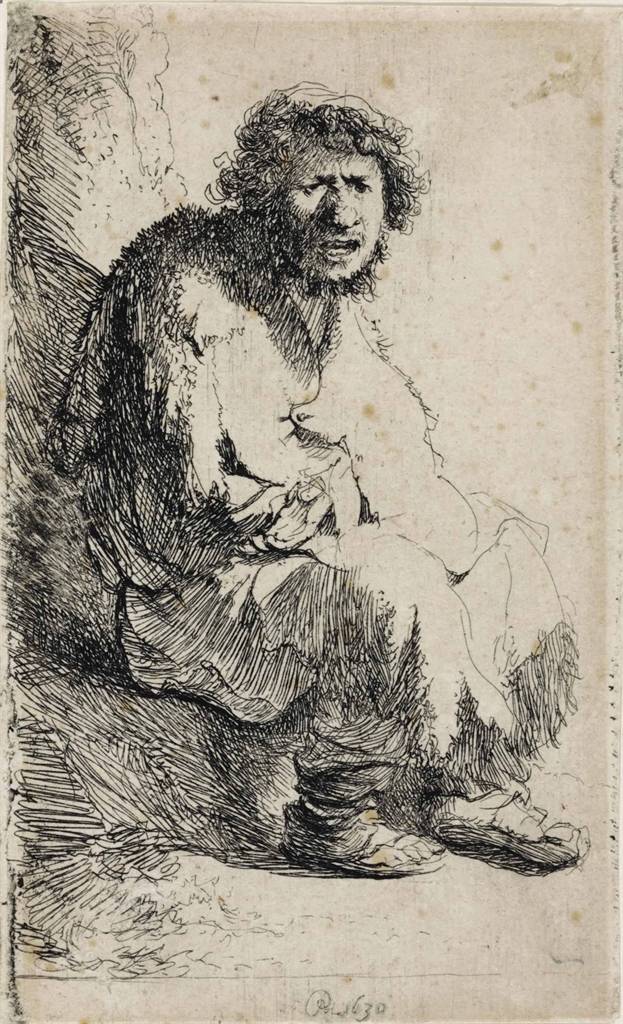
Rembrandt Begger Seated on a Bank (1630)

Rembrandt, “Beggar Seated on a Bank”, (1630)


.

For we are to God the sweet aroma of Christ among those who are being saved and those who are perishing…

—2 Corinthians 2:15


.

We see so many images of Christ Crucified. Museums and churches are full of them. And they should be. It is the greatest paradox ever told.

And to go along with the abundance of visual representations, there are of course also many artworks in written form depicting the Passion of Jesus Christ. Shelf after shelf can be filled with books containing the seemingly endless repertoire of poems, plays, and musical compositions based on the subject.

But none can capture the stench of death.

Smell moves us like no other sense.

It is so powerful. So quick. So nauseating.

Think of that the next time you’re riding the subway on your way to a museum. Think of that when a homeless man enters your subway car. Think of that when you’re tempted to switch trains at the next stop due to the stench.

Breathe deep instead.

Think of the stench. Think of that poor man—that poor sorrowful man dying right in front of you. The stench of rotting flesh. The stench of death.

No artwork that you’re on your way to see will bring Jesus and His Cross more to life.

Take a deep breath, and pray. You’re on holy ground.

Pray for yourself. Pray for the man. Pray for all those on board. Pray for the entire world.

Pray that that particular stench, that stench of death, right then and there, brings life.

That it brings life to hardened hearts.

That it brings life to senses numbed to the utter poverty of human suffering—suffering that manifests itself in oh so many ways.

That it brings life to what the world says can’t and shouldn’t be redeemed.

And give that gentleman a few bucks.

———

The Metropolitan Museum of Art recommends an entrance fee of twenty-five dollars. Do you know how much consolation that poor suffering Christ riding right next to you would receive if you gave him that much?

Do you know how cheap a price that is to pay to be able to get so close to a living breathing masterpiece of sacrificial life?

Dig in deep. Dig into your pockets. Dig deep into the reserves of your heart.

You will be amazed how such a prayer, such an act of compassion, such a “living faith”, will transform the stench of death into the aroma of life.

Breathe deep. Pick up your cross. Die daily.

Get over yourself.

What a breath of fresh air!

Now that’s truly an entrance fee.

And it’s worth every drop.


.

Then Mary took about a pint of pure nard, an expensive perfume; she poured it on Jesus’ feet and wiped his feet with her hair. And the house was filled with the fragrance of the perfume.

—John 12:3


.

.

Howard Hain is a contemplative layman, husband, and father. He blogs at http://www.howardhain.com

Follow Howard on Twitter @HowardDHain   http://www.twitter.com/HowardDHain

If you enjoyed this post, please consider “liking” it, adding a comment, or passing it along via the social-media links below. Your support is greatly appreciated. Step by step. All for God’s glory.

.

Friday Thoughts: Pure Faith

by Howard Hain

.

“God won’t let His power flow through someone who demands clarity.”

.


20170929_064112

“The Crucified One” (H. Hain, 2006)


.

Faith. Pure Faith.


Howard Hain is a contemplative layman, husband, and father. He blogs at http://www.howardhain.com

Follow Howard on Twitter @HowardDHain   http://www.twitter.com/HowardDHain

If you enjoyed this post, please consider “liking” it, adding a comment, or passing it along via the social-media links below. Your support is greatly appreciated. Step by step. All for God’s glory.

Morning Thoughts: A Delicate Nose

by Howard Hain

.

In near darkness silhouettes take hold.

So delicate. Features so fragile.

How can such a perfect little nose exist in such a world?

A world of flying soccer balls.

My hardened features cringe at the thought.

Her delicate little nose and a direct encounter.

A soccer ball, an elbow, another child’s brow…my God, how could such beauty absorb any such kind of blow?

And yet it has, seven years and counting.

Time and again the playground gives what it’s got.

Close encounters and direct hits, this night that little nose as delicate as ever.

The chaos, the screams, the various forms of laughter…they too for the time being stand silent.

Before such a sight.

A simply beautiful child sleeps.

A father smiles.

Such beauty is surely painful.

Innocence is everything.

My Lord and my God.

Thank You.

A beautiful child sleeps.

A father wipes away a tear.


.

.

Morning Thoughts: God’s Wealth

by Howard Hain

.

Then they handed him the Roman coin.

He said to them, “Whose image is this and whose inscription?”

They replied, “Caesar’s.”

At that he said to them, “Then repay to Caesar what belongs to Caesar and to God what belongs to God.”

—Matthew 22:19-21

.


.

What has value? What has true, lasting value?

And how do we distinguish between arbitrary and absolute value?

Good questions. Meaningful questions. Questions with great relevance since the first moment of man, and questions still very much relevant today—maybe more so than ever before—as cultures become increasingly pluralistic, governments increasingly complex, and economies, natural resources, and “manpower” increasingly intertwined and qualitatively and quantitatively obscure.

And perhaps nothing better expresses this uncertainty than the incredibly difficult task of evaluating the meaning of money—something that for so long has been so generally accepted—but now a question our present day begs us to ask anew.

What then is the role of currency within our ever-increasing global complexity?

Does “currency” still mean what it meant in its most basic form: A medium of exchange, generally accepted, and possessing integrity with regard to accurately representing the goods, services, and/or resources involved in an exchange?

Complex times, complex questions. I’m sure polished academics, investors, and politicians have complex answers—if they’d even recognize such a naive question in the first place.

Though I have a hunch that if we ask the common man and woman—those who are the actual “human resources” bundled together, broken apart, and tossed back and forth like various sizes of sacks of potatoes—we’d hear a common concern.

I bet the consensus is a growing sense of separation between the real connection between “currency” and the actual “items” being evaluated and exchanged—that the “general acceptance” sees a serious disconnect—no matter how simple or straightforward the words or expressions used to describe it.

Maybe we should follow their common lead. For it just may be our common sense that best suggests the level road. Let’s then move forward by asking a simple and straightforward question: What is made by man and what is made by God?

Such a question quickly restores a humble perspective—one in which the questioner is once again seen as part of the question—viewing God as the Uncreated Creator of all creation, and viewing man as part of it, not the cause of it.

Such a question also reminds us of a comforting reality, one that helps build up our view of humanity, not devalue it: For in God’s eyes, man always has a certain, absolute value, as do animals, plants, and all the earth’s resources: air, soil, water, minerals, metals…every nook and cranny. For God made it all. And what God makes He values. And what God values He values absolutely.

On the other hand, the price we place on them—the fluctuations in “perceptive” worth—is most certainly arbitrary value—completely man-made. In fact, without man there can be no arbitrary value: No man, no human perception, therefore no arbitrary value.

It is worth noting that there seems to be nothing inherently wrong with arbitrary value. But we also know through real experience that freewill and temptation continuously battle it out. We’ve all seen firsthand how arbitrary value can be used quite negatively. It can be manipulated. It can be unjust. It can be a weapon man uses against his fellow-man.

Absolute value is not the same. It never undergoes corruption or discriminates. It never hurts life or creation.

But why do we ask these questions? Why should we wonder about such issues?

Because without big questions—the panoramic views—we ironically lose sight of the intricacies and peaceful beauty of day-to-day reality. In other words, we need philosophers. We need those who ask questions from mountain-peak perspective in order to properly value even the smallest creature within the deepest valley.

It’s about divine perspective. About wisdom: Knowing there’s One Source of all creation, and that all creation—no matter how seemingly infinite and minute its manifestation—is always a reflection of the totality and unity of the One Source.

For the enterprise of philosophy—literally the “love of wisdom”—is not narrow or shallow. It is neither micro nor macro. It is never “either-or”.

Philosophy is not a specific knowledge of a specific something. It is not a specific science encompassing a specific field or a specific mastery of a specific craft or trade. Philosophy is not even a specific art expressing itself through a specific medium.

Philosophy is a relationship. A specific relationship. A love-propelled relationship with wisdom itself. And wisdom is not merely a word existing solely of sound waves and vibrations, nor is wisdom merely a concept existing solely in man’s mind. No, wisdom is beyond words, beyond concepts, beyond ideas. Wisdom is the Ultimate Idea, the Only Concept, and the Unspeakable Word.

Wisdom is. Always. Purely. Absolutely. No starts or stops. No lines, no boundaries. It possesses no arbitrary or man-made qualities.

Wisdom is God Himself.

The philosopher is therefore a lover of God. A lover of the Incarnate Word. Of Incarnate Wisdom. The philosopher is a lover of Jesus Christ—in all His manifestations—in all His creation.

This is why we ask such questions.

True lovers never lose sight of the Beloved. We therefore must never lose sight of true worth and the source of all that has worth. We must correctly identify reality and all that is rightly extracted from it. Leaving behind the rest. For all experience runs through the philosopher’s fingers as if sifting for precious metals—knowing that even what is priceless is not yet our possession.

The philosopher is also a child of faith. And therefore a descendant of the patriarch Abraham, our father in faith, who was promised descendants as numerous as the sand on the seashore. We must therefore be willing to lift up and cherish every “worthless” grain. A task we can hardly achieve. But God who created us shows us how.

The answer is quite absurd—making little logical sense—but it is certain and perfect nonetheless. We must recall Christ’s suffering. And we must partake. It is the only way. For by His Cross and Resurrection, Christ sets us free. Free to use freewill properly. Free to distinguish God’s worth from that which disordered man imposed.

And how does that translate into a more pragmatic approach, into a “practical philosophy” that helps “order our days“?

Hope tells us we must stay grounded. Our toes in the dirt. The nitty-gritty of day-to-day life filling our sensitive nose. Our arms stretched wide, unafraid of having our wind unexpectedly knocked out. And all the while, our chins slightly tilted up and away. Our eyes fixed on the Light of Creation—the One Source that burns away all artificial value.


..

Morning Thoughts: Other People

by Howard Hain

.

Other people. That’s when things get complicated.

Being patient, forgiving, meek, honest, prudent, wise…when it comes to our own wellbeing is hard enough…but when it comes to dealing with the world’s offenses against those we love—especially those put into our care—things can really get out of hand.

For living a life of integrity and peace, of “turning the other cheek”, seems somewhat possible when it’s my cheek, but to ask me to act the same when it comes to witnessing an injustice against my mother, my wife, or my daughter, then it’s a whole other ballgame.

The lamb becomes a lion. I want justice. Now. A roaring lion. Game on. And it is no longer about defense. No, a full-frontal offensive attack is launched. Crush the opponent. Leave no opportunity for the “hyena” to not fully understand: “Not on my watch, you vile creature—you don’t stand a chance—and now you’ll pay tenfold.”

This is all figure of speech, of course. But internally, this hypothetical dialogue is somewhat close.

But then there comes the question of action itself.

What do we actually do?

What should we actually do?

Each situation of course has its own set of circumstances.

But Truth and Wisdom apply to every situation and circumstance.

And that hits upon what is perhaps the biggest affront the world inflicts upon those placed in our care: The lie that Truth, Morality, Virtue, Justice, and Goodness are relevant to time and place, to culture and historical period.

Truth is Truth. Moral Virtue is Moral Virtue. Justice is Justice. And offenses against Eternal Truths are offenses against Eternal Truths, whether you live in Poland, the United States, Russia, China, Saudi Arabia, or Zimbabwe.

And yes, I am fully aware that the above statement makes the assumption that there are Eternal Truths. There are. Period. God’s Love and His demand for Human Dignity are real. God’s reality insists upon it.

Perhaps then this is the best first step in truly defending our families: To know the Truth. To stand in the Truth. To anchor ourselves in and to the Truth.

Day by day. Hour by hour. One Eucharistic encounter at a time.

Here then is such a nugget* that might help us navigate the turbulent waters of this new day:

“The rash man has no integrity; but the just man, because of his faith, shall live.”

—Habakkuk 2:4


.

* nug·get
/ˈnəɡət/
noun
a small lump of gold or other precious metal found ready-formed in the earth.

.


Friday Thoughts: A Common Question

by Howard Hain

.

Does it make any sense to ask “why” but not want to know why?

It depends on how we see an answer. For there is one answer that applies to each and every question, that fully satisfies each and every query—one certainty that fully answers all wonderings.

All other answers—true although they may be—are subordinate to this one primary and exhaustive answer.

And this one answer has many expressions, but only one meaning. It has several names, but only one significance. It has billions of manifestations, but only one divine presence.

The answer is “I AM”…

The answer is “Truth”…

The answer is “Pure Existence”…

And on and on….

But let us express it one additional way: “The Perfect Will of God”.

If we believe this—if we believe in God we must believe this—then we have no questions to ask. Unless of course we ask for a different reason—a reason other than wanting an answer. And what may that reason be?

To experience God.

To “know” He is real.

To feel He cares.

———

For does an infant question his mother’s love?

Does he wonder if she will offer her breast?

Does he ask any questions at all?

No. He cries.

He prays with utter faith to a power beyond his capacity to wonder why.

For the newborn “knows” why.

The infant “knows” he is loved.

Yet he cries.

———

And we do too. We cry “why” to a God who knows our every need and has preordained our every righteous desire.

We pray like infants—like newborn children—when we ask our all-knowing and all-caring God a question we instinctively “know” is already forever answered.

We pray when we cry out loud in the direction of Him whom we believe exists—no matter the form of the cry.

For prayer is active believing. Asking is simply a common language.

Either way, the translation is the same.

———

“Why Lord?” (I believe in You)

“Why God?” (I trust in You)

“Why, Lord, why? (I love You)

———

And God always answers.

He always nurses.

More faith…more hope…more love.


.

.

Morning Thoughts: Beyond

by Howard Hain


F. Hain Untitled ~2014

F. Hain, “Untitled”, ~2014


Beyond “Yes”

Beyond “Amen”

Beyond “I love You”

You are beyond

Beyond prayer

Beyond is my prayer

It looks a lot like sitting still

Like not thinking

Not remembering

Not planning

Not wanting

It looks a lot like pure existence

A lot like being free

Infinitely free


You, Lord, are the Lord of Freedom, if only we’d accept Your declaration—if only we’d love the person we most imprison with jealousy and petty dislikes.

Free us Lord from ourselves, from our most secret possession, from our deeply hidden pride.

Grant us, Lord of Infinite Freedom, the grace to fly upward, and inward, all toward You.

.


.


Friday Thoughts: Can’t Be Afraid

by Howard Hain


No matter what it is. All good options are on the table. All goodness is on the table. For God sets a banquet before us, a great breakfast. Liberty first. We must be free. Drink deep of letting go of the past, repentance is not an aftertaste. Repentance sets the table. A table held in place by belief. Upon which God’s goodness gives life. It is always about life. More of it. More letting go, less picking up the scraps. Of course, if scraps are all we have, by all means let us be grateful. But I have a sneaky suspicion there’s a whole lot more—if only we’d tell “fear” to take a hike—and then take our proper place at the table.

So much goodness is in store.


Friday Thoughts: The Laugh’s On Us

by Howard Hain

.

No matter what I’m going through I feel the urge to laugh when I speak to a brother in Christ—and now I know why—true fellowship reminds us that God laughs at our trifling fears.


Rembrandt Self Portrait

Rembrandt, “Self-Portrait”, (1668)