Tag Archives: peace

D-day June 6th, 1945: “Arma virumque cano”

Normandy Beach, June 6, 1945

“I sing of arms and a man” , words the Latin poet Virgil used to describe Aeneas, a founder of Rome. His fate was to take up arms and after much struggle found a great city. The words could also describe our generation. For most of the last hundred years, we have taken up the arms of war to achieve our various purposes.

Tomorrow is the 75th anniversary of one of the great battles of all time–the sea born invasion of Normandy by175,000 Allied troops, which led to the liberation of Western Europe from Nazi Germany’s control. The Second World War, which began in 1939 and ended in 1945 was followed by the Korean War (1950-51}, the War in Vietnam (1965-73) and the War in Iraq (2003-present). Other wars besides these have raged world wide.

Will the day come to lay down our arms? Not soon, it seems, and the arms in our hands become still deadlier. We don’t live in a peaceful world. 

War over the years, with all its consequences, affects us in many ways. I’m wondering about the way it affects our theological imagination. Has it weakened our sense of hope in life and in God? Have the long years of war brought doubt about human life flourishing here on earth? Is personal flourishing now the only way to go? So let’s survive the best we can on our own, in a house or country surrounded by walls.

We take up arms to control land and resources. Has chronic war also affected the way we see our planet?  Should we abandon our fragile and unsteady earth, and make heaven our goal? Or maybe survive the best we can on our own, here and now, without a thought of it?

The Feast of the Ascension points to heaven and tells us that’s our goal. But what about the world God created? Doesn’t it yearn for something new and needs our care? The Feast of the Ascension is linked to Pentecost and the promise of the Spirit who teaches us all things. 

Come, Holy Spirit, fill the hearts of the faithful and renew the face of the earth.
Friday Thoughts: Pure Extra Virgin

by Howard Hain

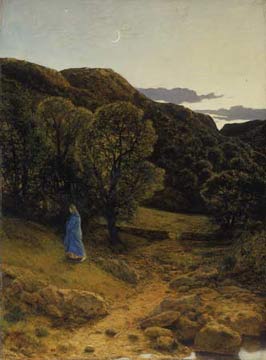
william-dyce-the-garden-of-gethsemane-1860

William Dyce, “The Garden of Gethsemane”, 1860*


To your eyes a thousand years are like yesterday, come and gone, no more than a watch in the night.

—Psalm 90:4


.One good olive.

There are so many factors.

The altitude. The light. The soil. The temperature. The rainfall. The wind. The dew point and humidity. The age of the tree.

Then there are those factors that we can control: pruning, watering, fertilizing, fanning, netting, and wrapping chilly trees with burlap or fleece.

And of course there are those other factors, those that fall somewhere in-between, between our control and our complete lack thereof: most of these relate to the sneaky work of numerous little thieves—animals, birds, insects, and perhaps even fellow farmers or other hungry travelers who just happen to pass by.

But when all is said and done—when all the factors are poured into the olive equation, mixed-up well, and left to unify or settle out—the fruit that’s produced by the world’s most nostalgic, symbolic, and romantic of trees means very little (at least in digestive terms) if it’s simply left to shrivel up and fall to the ground.

———

Picking an olive is perhaps the highest part of the art.

———

When to do so? And toward what end?

If too early, great potential is squandered.

If too late, great taste is lost.

If indecisive, we might as well let nature enjoy it for the time being—for one way or another—God’s process will eventually return it to the earth.

———

And yet, we’re still not done, for even if the olive is picked at just the right time, from just the right tree—the one that has grown in all the right circumstances—when it comes to the culmination of olive production, all is moot if the precious fruit of the womb is never squeezed.

For no matter how good the olive, without applied pressure, there’s nothing left to be labeled “pure extra virgin”.


.But when the fullness of time had come, God sent his Son, born of a women…

—Galatians 4:4


* Gethsemane is the name of a garden on the Mount of Olives in Jerusalem. It appears in the Greek of the Gospel of Matthew and the Gospel of Mark as Γεθσημανή (Gethsēmanē). The name is derived from the Aramaic ܓܕܣܡܢ (Gaḏ-Šmānê), meaning “oil press”.


(Dec/23/2016)


Thoughts Upon The Cross: Doxa. Doxa. Doxa.

by Howard Hain

.

And we have seen his glory,

the glory of an only Son coming from the Father,

filled with enduring love.

—John 1:14


.

The power of God.

A tiny leaf caught between two worlds

Suspended by invisible threads

Dancing to the still small voice.

Deeper and deeper

Into the person

The Son of Man

Who is God.

Glory.

And Might.

Power.

And Majesty.

Fully Alive.

Beautifully Human.

Walking Wisdom.

The Lightness of Fullness.

The Heaviness of Simplicity.

Doxa. Doxa. Doxa.

Honor.

Adoration.

And Praise.

Doxa. Doxa. Doxa.

Beyond praise.

The Power of One.

He Is.

We’re not.

He stands.

We fall down.

He dies.

We live.

Doxa to the Father.

Doxa to the Son.

Doxa to the Holy Spirit.

Doxa. Doxa. Doxa.

Between two worlds.

Is a man.

Who says “I AM”.

A tiny leaf suspended.

He is Lord.

He is God.

Invisible threads.

He Is.

And so now are we.

Dancing.

Still.

Small.

Voice.

The Word.

The Depth.

Beyond the signs.

To the Person Himself.

The Person of Jesus.

Deeper.

And deeper.

Into His flesh.

Into His Glory.

Doxa is Thy Name.

Dwelling among us.

Abiding within us.

Still small leaves caught between two worlds.

Suspended by invisible threads.

Dancing to the breath of God.

From deep to deep.

Depth to depth.

It never ends.

Doxa. Doxa. Doxa.

Doxa in the highest.


.

(May 6, 2017)

Still Life with Nativity

by Howard Hain


Can’t keep it neat

Bunched-up cloth

Shifting sand

An avalanche of gifts

Those toward the outside move the most

The trough is fixed in place

The world turns, the Cross stands still” *

Manger, manger, what happened to you?

Sprouted roots

Began life as a tree

…..A table

……….A sawhorse

……………A wagon wheel

Dusty bumpy road

Excitement of a coming feast

Not quite yet

To and fro

Which place is home?

Bethlehem, Nazareth, Jerusalem

The land of Cana

A wedding toast

Now a wooden throne

Plenty of wine to go around

The world turns, the Cross stands still” *

Manger, manger, what happened to you?

Sprouted roots

Began life as a tree


* this line is a loose paraphrase of the Carthusian motto: “Stat Crux Dum Volvitur Orbis” (The Cross Stands Firm, While The World Turns)

Wise as Doves

by Howard Hain

rembrandt-angel-appearing-to-the-shepherds-1634

Rembrandt, “The Angel Appearing to the Shepherds”, 1634


Now there were shepherds in that region living in the fields and keeping the night watch over their flock. The angel of the Lord appeared to them and the glory of the Lord shone around them, and they were struck with great fear.

—Luke 2:8-9


Perhaps the scariest thing to those of us who cling tightly to the things of the world is to accept the job that the Lord assigns us.

Oh, how so many of us are so quick to long for greater adventure!

Yet, when it comes to those humble, little shepherds to whom the angel of the Lord appeared, we are perhaps even quicker to long to be one of them—sitting quietly upon a gentle hillside, effortlessly tending to a passive flock, while the always-full moon provides a soft, ever-so-appropriate illumination from above.

But we are liars. For there’s nothing less romantic in each one of our daily lives, or more mundane. We simply have to be honest, or at least consistent. It all depends on how we look at it. If we see the shepherds in such a delicate light then we also need to see ourselves in the same. For before the angel appears, the shepherds were hardly posing for picturesque landscapes. Perhaps it is for this very reason—their realness, their authenticity, their holy simplicity—that the Lord chose them to be present when He revealed His glory.

It is exciting. We have a wonderful choice, then. Either our “boring” lives make us just the kind of people to whom God prefers to reveal Himself, or our lives are a lot more “exciting” than we ever imagined. Either way, what is vital to making such a decision is true sincerity and genuine gratitude. We need to thank God for who He has made us, for where He has placed us, and for what type of task He has assigned us.

A faithful, humble heart dreams and believes and sees great things among the most ordinary circumstances. Just look at the young virgin and the upright carpenter to whom the shepherds “went in haste” to find in a stable, adoring a child born within the company of the “lowest” of men.

If we spend our time dreaming of being someone else, living somewhere else, and doing something else, we miss the opportunity of being exactly who God intends us to be—and when that happens—we are always in the wrong place, at the wrong time, and most tragically, doing that which matters very little.

For to be the first on the scene, the first to “lay hold”, the first to adore the New Born King, is as good as it gets—even for those whose “normal existence” isn’t standing around all alone—day after day in the scorching sun or biting cold, while picking fleas from matted-down fleece or scaring off hungry wolves.


The angel said to them, “Do not be afraid; for behold, I proclaim to you good news of great joy that will be for all the people…”

So they went in haste and found Mary and Joseph, and the infant lying in the manger. When they saw this, they made known the message that had been told them about this child. All who heard it were amazed by what had been told them by the shepherds.

Then the shepherds returned, glorifying and praising God for all they had heard and seen, just as it had been told to them.”

—Luke, Chapter 2:10,16-18,20


Posture of Prayer

by Howard Hain

el_greco_st_dominic_in_prayer-1595

El Greco, “St. Dominic Praying”, c. 1588

Sometimes just showing up is all we can do.

To put ourselves in position to pray and worship—at least physically, even if we just cannot seem to get there spiritually—is an act of prayer and worship in itself. And quite often, it is the best we have to offer.

By confessing our aridity through physical obedience alone, we approach God’s altar with humility, for we come to God in our “nothingness”.

The bowing of head, the placement of knees, and the closing of eyes return us to the dark warmth of the womb. It is no coincidence that the posture of prayer and the fetal position bear great semblance.

It is in the womb that we are closest to God, furthest from the corruption of the world, and possess the least of what our “flesh” considers of value—our “brilliant” ideas, our “magnificent” plans, our “heroic” acts—our self-aggrandizement.

It is in the womb that we find ourselves in complete dependence. We receive all we need without knowing, without speaking, without cost.

In that sense, being in the womb is much the same as being in the world—for in the world we are still completely dependent—it is just that without the obvious reminder of the umbilical cord, we so easily forget our total and complete dependence on God, our Creator, our Sustainer, and our Ultimate End.

Hence we find ourselves “knowing,” “telling,” and “paying a price.” When in reality, the only thing that we can somewhat even come close to taking credit for is being physically present to receive His Word, His Wisdom, and His Will. All of which come free of charge, His Son having already paid the price.

———

“Lord, let me place my knees to the earth. Let me feel the foot of the cross against the caps of my knees. Let me close my eyes and bow my head. Let my brow lay upon your bloodied feet. Let me humbly raise my eyes to gaze upon your battered body. Oh my Lord and my God, let your blood and water rain down upon me.”

Amen.


Howard Hain is a contemplative layman, husband, and father. He blogs at http://www.howardhain.com

Follow Howard on Twitter @HowardDHain

twitter.com/HowardDHain

If you enjoyed this post, please consider “liking” it, adding a comment, becoming an email subscriber, or passing it along via the social-media links below. Your support is greatly appreciated. Step by step. All for God’s glory.

I’m Pro-Art

by Howard Hain

DT1554

Paul Cézanne, “Bathers”, 1874-75, (The Met)

I’m Pro Art

In other words:

I’m Pro Truth

In other words:

I’m Pro Beauty

In other words:

I’m Pro Love

In other words:

I’m Pro Creation

In other words:

I’m Pro Life

(Oops, how’d that happen…funny how logic can lead you to such “un-expecting” places.)

(Words do seem to matter—or at least carry some weight—maybe even 7 pounds 8 ounces worth.)

(Before you panic, give it a little, teeny-weeny, infant-sized bit of thought…)

Conclusion:

ProArt (pro-creates) ProLife

ProLife (pre-conceives) ProArt

ProArt (equ=als) ProLife


Howard Hain is a contemplative layman, husband, and father. He blogs at http://www.howardhain.com

Follow Howard on Twitter @HowardDHain

twitter.com/HowardDHain

If you enjoyed this post, please consider “liking” it, adding a comment, becoming an email subscriber, or passing it along via the social-media links below. Your support is greatly appreciated. Step by step. All for God’s glory.


Web Link: The Metropolitan Museum of Art. Paul Cézanne, “Bathers”, 1874–75

Sure and Steady

by Howard Hain

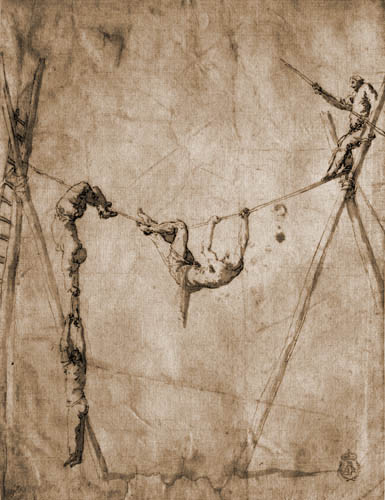
jusepe-josc3a9-de-ribera-tightrope-walkers-1634

Jusepe (Jose) de Ribera, “Tightrope Walkers”, 1634


The brighter the light the more we squint.

The closer we get the less we see.

And if we stare we go blind.

Now what?

You have to trust.

In what?

Not in yourselves.

In total darkness the answer is clear.

All other ways disappear.

Close your eyes.

Shutter your ears.

Forget the past.

Ignore what is below.

Chin slightly elevated.

Now walk.

No need to go too slow.

Sure and steady.

Heart on the goal.

And if we slip?

Don’t worry.

I made the rope.

I hold it tight.

My Son is “the way and the truth and the life”.

In Him you never fall.

In Him you know.

In Him you live.

He walks before you.

You may not see Him but He is there.

Follow close behind.

It is a tight walk.

That’s why I gave Him a pole.

I gave you one too.

And because it can get very dark.

I made them easy to identify.

They are made of thick dead wood.

Your hands know their splinters and knots.

Hold tight.

Say thank You.

Kiss in the dark what you cannot see.

For that old piece of wood.

Will get you across the gorge.

Where on the other side.

It will be planted.

Grafted into the Tree of Life.


Howard Hain is a contemplative layman, husband, and father. He blogs at http://www.howardhain.com

Follow Howard on Twitter @HowardDHain

twitter.com/HowardDHain

If you enjoyed this post, please consider “liking” it, adding a comment, becoming an email subscriber, or passing it along via the social-media links below. Your support is greatly appreciated. Step by step. All for God’s glory.

Clean Enough To Care

by Howard Hain

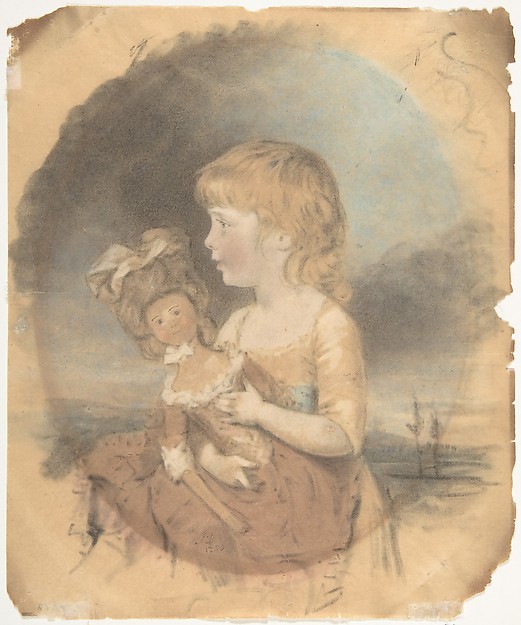
DP801172.jpg

John Downman, “Child Holding a Doll”, 1780 (The Met)


What if someone handed you a child?

A small child.

A tiny child.

An infant.

A few hours…a few minutes old.

What if you were the only one that the child could be handed to?

Only you.

No one else around to help.

Would you receive that child into your arms?

There’s no sterilized room, no sanitary precautions, no sink, not even a bar of soap—just plain old you, a bunch of imperfect circumstances, and a poor tiny child that needs to be embraced.

You know what you would do.

Even if your hands were filthy, completely covered in soot and mud, you know what you would do.

You’d quickly rub your hands against your pants or shirt and wipe away the obvious dirt.

Then you’d hold out your hands.

Wouldn’t you?

Yes. You would.

We all would.

That’s what makes us human.

That’s what makes us children of God.

We’d do what we could with what we have to help an innocent child.

We know that “cleanliness” in such cases really doesn’t matter. For even if the circumstances were “perfect” we’d still have that uneasy feeling. That feeling that we’re not worthy to hold such innocence, to be entrusted with such treasure.

It’s a holy hesitancy that only true humility can bear.

Yet, it’s the necessity to help, the clear need for our assistance—the abundantly clear reality that we’re the only “hands” on deck—that drives us to overcome such holy and righteous fear—a fear that reveals just how poor we really are, much poorer in fact than even the helpless child we are about to embrace.

It is preciously this beautiful fear of God that propels us to love boldly—to boldly reach out beyond ourselves, to boldly become part of God’s mystical body, to become His very arms and hands—to embody Divine Love Itself—that perfect love of the eternal Father for each and every child ever created.

For it is the Father’s love that creates us, and sustains us, and longs to flow through us.

We just sometimes need extreme circumstances—ridiculously obvious situations—in order to tap the needed courage to let it to flow beyond our own borders and into those around us.

You are in such a situation. Right now.

We all are.

This very moment.

No matter where you are or what you’re doing.

Such a situation is at hand.

A child, a new born—cold, hungry, and without a home—desperately needs to be held.

Quick then, wipe your dirty hands, make due with what you’ve got—believe the Word of God, it’s good enough—now hold out your hands.

You’re clean enough to care.


Howard Hain is a contemplative layman, husband, and father. He blogs at http://www.howardhain.com

Follow Howard on Twitter @HowardDHain

twitter.com/HowardDHain

If you enjoyed this post, please consider “liking” it, adding a comment, becoming an email subscriber, or passing it along via the social-media links below. Your support is greatly appreciated. Step by step. All for God’s glory.


Web Link: The Metropolitan Museum of Art. John Downman, “Child Holding a Doll”, 1780

Bozza Imperfetta (imperfect sketch)

by Howard Hain


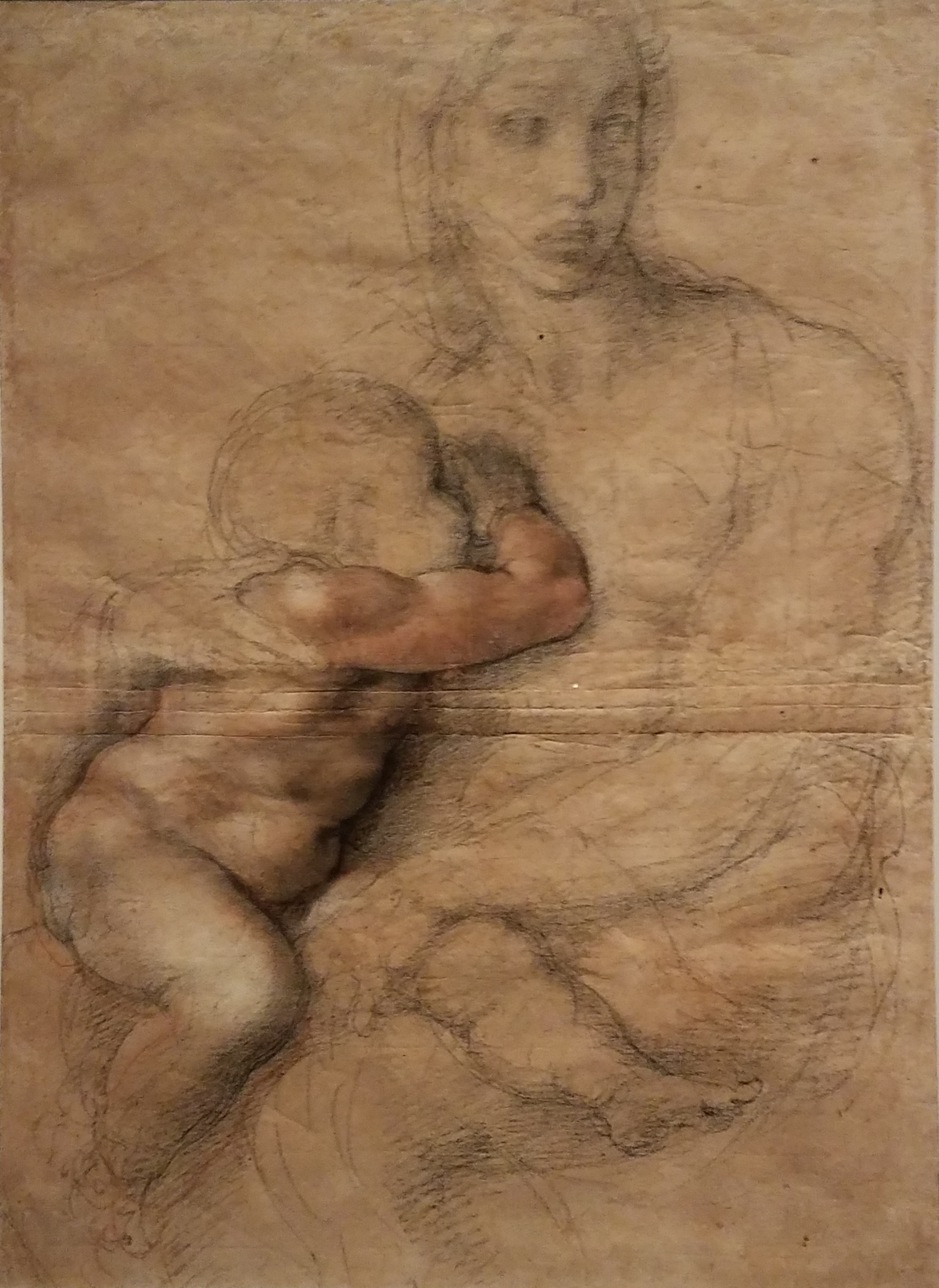
20171121_104929

Michelangelo Buonarroti (Italian, Caprese 1475–1564 Rome). “Unfinished cartoon for a Madonna and Child.” 1525–30. Drawing, black and red chalk, white gouache, brush and brown wash. Casa Buonarroti, Florence


I know almost nothing.

What I do know leads me up the ladder of not understanding.

To my perch upon the Cross.

Within the heart of my child Jesus.


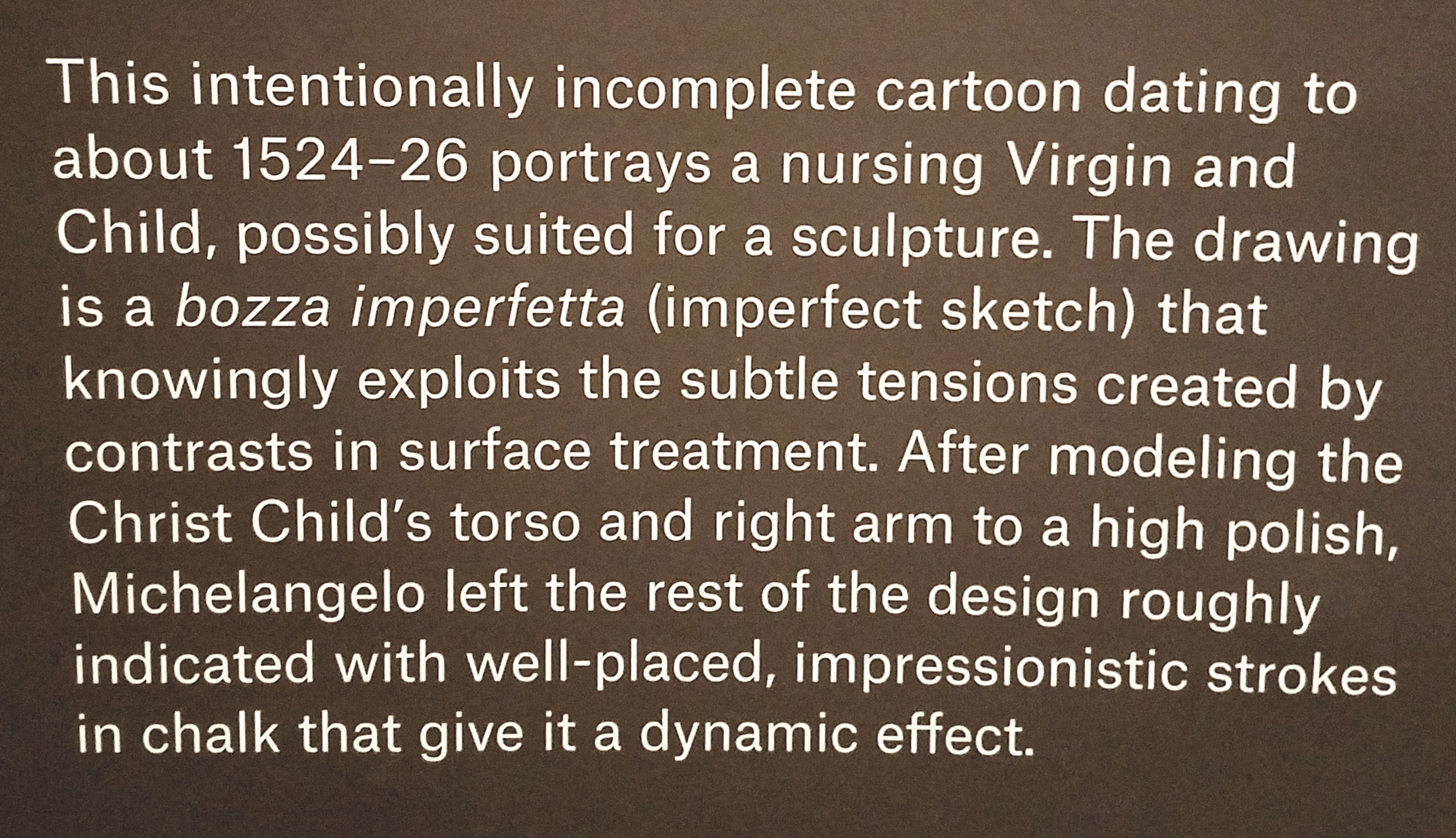
20171121_110016

Museum Wall Card for Work Above, from: Michelangelo: Divine Draftsman and Designer, on view at The Met Fifth Avenue from November 13, 2017 through February 12, 2018.