Tag Archives: Passionists

Mary Gardens

Andrea Oliva Florenda, a professor at St. John’s University in Queens, New York, offered a day of reflection on Mary Gardens, December 1 at Bishop Molloy Retreat Center, Jamaica, New York. Professor Florenda teaches in the department of theology and religious studies at St. John’s, specializing in Marian theology. She’s also the designer and curator of the Marian Garden at the university.

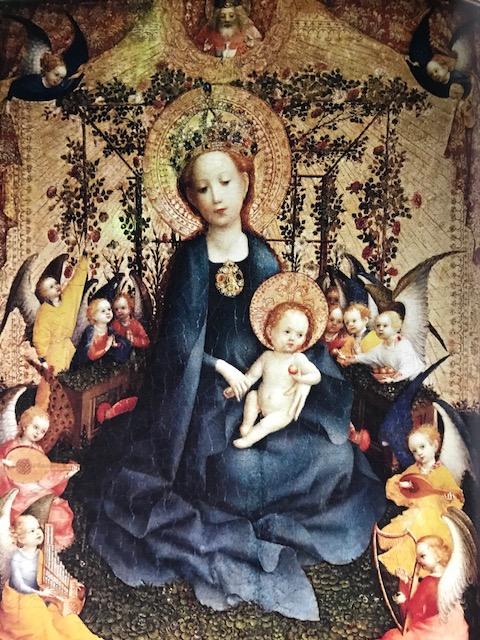
Mary Gardens, dedicated to Mary, the Mother of Jesus, appeared in Europe following the Black Death, a pandemic that caused millions of deaths in that part of the world in the 14th century. The gardens, usually found in monasteries and religious shrines, brought hope to people walking “in the shadow of death.”

God placed Adam and Eve in a garden, Christian tradition says. (Genesis 2, 8-28) Rising from the dead, Jesus proclaimed eternal life in a garden. (John 20,11-18) For early and medieval Christians, Mary appeared as a garden enclosed, flowers, plants and trees surrounded her, “our life, our sweetness and our hope.” The Mary Garden, which became a favorite inspiration for medieval and renaissance artists, brought the promise of life to the “poor banished children of Eve.”

Does the Mary Garden have a role today in a world facing climate change and environmental degradation? Professor Florenda thinks it does. Besides the mysteries of faith, it teaches reverence for creation, for the soil, for plants that feed us and bring healing, for flowers that nourish our sense of beauty.

Certainly science and technology have a large part to play in the current environmental movement, but Professor Florenda notes the number of young people, from various religious tradition drawn to her Mary Garden at St. John’s, where the mysteries of seed and soil unfold, where pharmacy students study medicinal herbs and seasonal vegetables feed the poor.

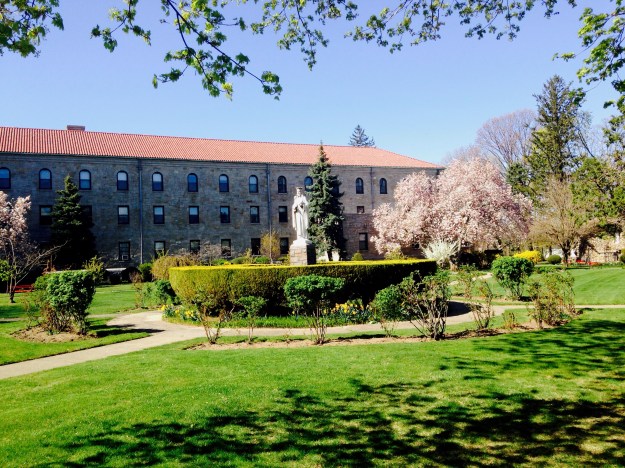
The day of reflection on Mary Gardens ended at the grotto honoring Mary in the garden of Immaculate Conception Monastery in Jamaica. There, Professor Florenda spoke about the meaning of the grotto, its structure and the plants and trees surrounding it.

“There is a language in each flower,
that opens to the eye,
A voiceless but a magic power.
A prayer in earth’s blossoms lie.” Anonymous
1st Sunday of Advent: Wake Up!

For this week’s homily, please play the video file below:

Leaves of Memories

autumn-leaf-jim-delillo
I hold in my hand a faded old leaf,
dry and crisp,
and I remember spring
when it was a tender lime green bud
and grass was greening and soft;
when flowers began to bloom
and birds sang again;
when the air was fresh and warm
and breezes were light and fragrant.

I think of that tiny bud
growing into a bright mature leaf;
of spring turning to summer,
of birds nests filled with eggs,
then babies chirping.
I think of the leaf maturing in summer’s heat
and soft grass growing tough and resistant.

Now the leaves have turned to autumn colors
and soon the trees will be bare,
resting in winter’s arms,
waiting for the tiny green buds of spring.

Gloria Ziemienski

October 17, 2007

The Listening Heart

by Father Theodore Walsh, CP

A spiritual writer beautifully described a listening heart at prayer. “Here I am, Lord. I hear your knocking at my door, as each person or event comes across my life”. How may we grow into this listening person.

A listening heart, first of all, is a heart that is open; namely, open to the heart of God, open to the heart of another person, open to the heart of our world. As someone put it: “When you listen, check your worries at the door”.

Secondly, when we deeply listen, we are also touched by the other. We weep with those who weep, we rejoice with those who rejoice. We are listening not just to their words but also to their feelings.

Finally, a listener responds to the other. Listening is not passive but active. Sometime ago there was a middle age gentleman, who was single and had his own business. He was invited by friends on a pilgrimage. The first evening there was the rosary. During the service, a thought came to him which he never had before: “Be a Priest”. When he returned home, the thought remained with him. He sought the counsel of a priest. The priest encouraged the gentleman. In time he sold his business, his home and entered the seminary. Today he is a Passionist Priest. He had a listening heart. He was open to the word, he was touched by that word, and he responded fully to the word.

The art of listening can have many faces. For example it can be a way of ministry. How often a person might say to us: ‘Thank you for listening’.

Listening can also be a way of being ministered to. We are blessed to have a confidant or friend who is there for us.

Finally, listening is a way of prayer. How often we might see an elderly couple sitting quietly with each other. A beautiful image of the soul with God.

Speaking of prayer, we end the way we began. “Here I am, Lord. I hear your knocking at my door, as each person or event comes across my life”.

Fr. Theodore Walsh, C.P.

About Suffering


“In America, there is education for success but no education for suffering.” Ross Douthat wrote in the New York Times today. There’s no education to bear the suffering we have or deal with the suffering of others.

We’re told we can achieve anything we set our minds to and surmount any hardship that comes our way. We filter out the misery around us, Douhat says, with the filters of political party, race, social status.

Douthat confessed that while reading a book by one of his political adversaries, a book in which the man described his experience of sickness and other hardships, he realized he never saw that dimension in him. He was only someone to argue with.

Tragic moments like the shootings in Las Vegas and the storms in Puerto Rico are temporary reminders of suffering, but we quickly forget and turn to something else.

St. Paul of the Cross saw the Passion of Jesus as a book to learn about life and how to live. It seems the Passionists have a mission today, as a recent letter of Father Joachim Rego reminded us, to offer a remedy to society today with “no education for suffering.”

An Unpeaceable Kingdom

Jesus said to his disciples:
“I have come to set the earth on fire,
and how I wish it were already blazing!
There is a baptism with which I must be baptized,
and how great is my anguish until it is accomplished!
Do you think that I have come to establish peace on the earth?
No, I tell you, but rather division.
From now on a household of five will be divided,
three against two and two against three;
a father will be divided against his son
and a son against his father,
a mother against her daughter
and a daughter against her mother,
a mother-in-law against her daughter-in-law
and a daughter-in-law against her mother-in-law.” Luke 12,49-53

Most of us don’t want to live in the house our Lord describes in today’s gospel, where fathers fight with their sons, sons with their fathers; where mothers fight with their daughters, daughters with their mothers.”

Not a nice house to live in.

Same way with a world on fire. A little fire is all right, but a world on fire? Too much.

We’d rather live in a world Isaiah describes: a holy mountain where the lion and the lamb lie down together and a child can put his hand into a snake hole and not get bit. A peaceable kingdom.

But maybe the situation Jesus describes is a form of the cross he endured. Maybe it’s the cross he asks us to endure today: a world on fire with strife, confusion and misunderstanding. Can the cross take the form of confusion and misunderstanding? It’s hard to live in a world where things are not clear and hard to understand.

Maybe that’s the cross we have to carry today.

Why Read the Old Testament?

Some people complain about the selections from the Old Testament we’re reading at weekday Mass these past few weeks. Too long, they say, they don’t tell us anything. They’d rather hear what Jesus is saying and doing.

Why do we read from the Old Testament? Reading from the Old Testament is a lot like reading from the New York Times or the Daily News, or following David Muir on ABC each evening. You’re not going to hear much about Jesus there either. The media gives us the news of the day as it happens and, especially these days, it’s not encouraging.

Not much encouraging news in our Old Testament reading today from the Book of Numbers either. (Numbers 13-14) Giants are out there blocking the way to the promised land. Israel’s scouts face giants as they reconnoiter the world ahead. There’s no way ahead.

Our media tells us the same: giants are blocking our way– North Korea, the Middle East, storms from climate change, political giants who seem to get in the way of a world of justice and peace. And we don’t have answers what to do.

But the Old Testament tells us more than the media. It’s salvation history. More than the story of the Jews, the Old Testament is the story of the human race and all creation on a journey, from the beginning of time to its end. Human sinfulness, tragedies and delays are there, but the story begins and ends in hope. God is there.

That makes the Old Testament stories so different from the stories the media serves up everyday. God is there from the beginning. That’s the way our selection today from the Book of Numbers begins: “The LORD said to Moses [in the desert of Paran,]‘Send men to reconnoiter the land of Canaan,
which I am giving the children of Israel.’” And God is there as his people experience the consequences of their foolishness and lack of faith.

The columnist David Brooks in the Times yesterday said he has to think less about Donald Trump or he’s going to go crazy. He needs to think more about the deeper shifts taking place in society, he says.

I wonder if thinking about the deeper shifts is enough to stop you from going crazy these days. We need hope from another source. That’s where the Old Testament and the rest of the scriptures comes in. Some prefer calling it the “First Testament.” It testifies that the first thing to keep in mind about time is that God is there, from beginning to the end. God is our Savior.

Martha, Martha

29d6ce6c782d7314a69950e1a560b871

We read St. Luke’s account of Jesus’ visit to Bethany for the Feast of St. Martha. It’s part of Jesus’ journey from Galilee to Jerusalem (Luke 10,38-42), a journey Luke describes,  not by miles, but by the people Jesus meets.

Jesus is a prophet speaking God’s word as he goes. Some reject him outright on his way to Jerusalem.  Jesus enters the house of Martha and Mary as a prophet speaking God’s word. Unfortunately Martha, busy about many things, misses his word and Jesus rebukes her. Mary hears his word and is praised. Good as she is, Martha’s carrying too many of the “cares of this life” when Jesus visits.

That’s what Luke wants us to learn from this gospel- the cares of this life can get in the way of hearing God’s word. But we all know there’s more to Martha than what Luke tells us here. Other New Testament sources praise this good woman.  John’s gospel, for example, says that  Jesus was a long time friend of Lazarus and his sisters in Bethany.

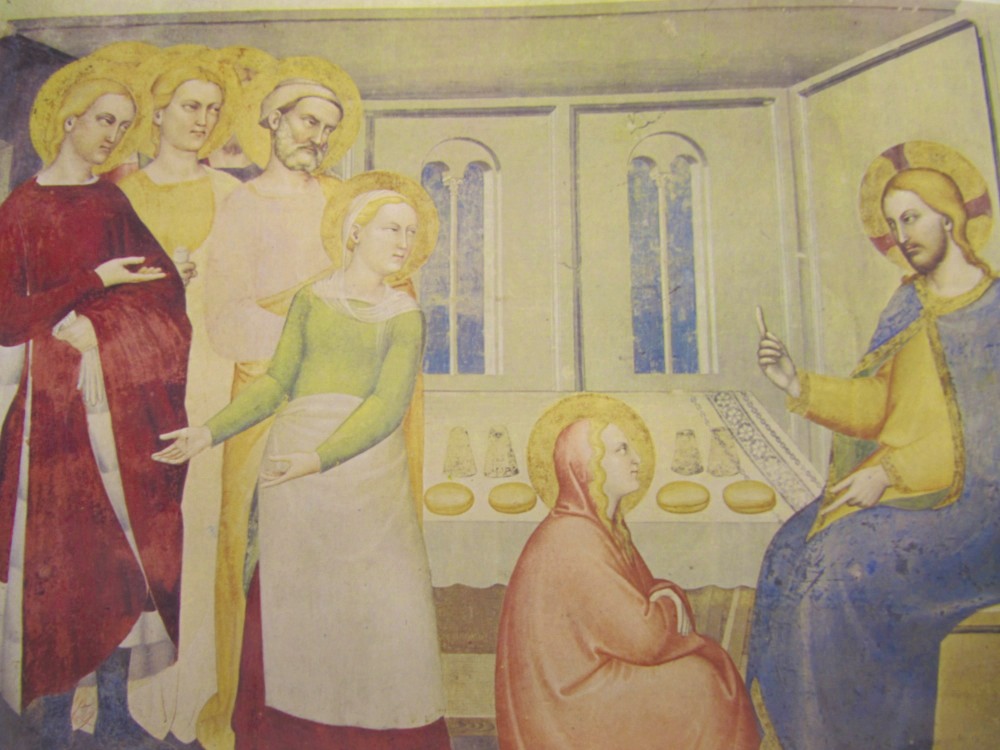
I keep two other sources in mind when I read Luke’s story.  One is a painting (above) by the 13th century Tuscan artist, Giovanni di Milano, showing Jesus with Martha and Mary at Bethany.

The artist imagines a supper at Bethany. The table’s set for four people– that would be Jesus, Lazarus, Mary and Martha. But look at the others coming in the door. Obviously, they’re Jesus’ disciples, led by Peter. One disciple gestures towards Peter, as if saying, “He told us to come.”

Poor Martha in her apron holds up her hands in frustration, “What are we going to do?”
There will be no miracle. The miracle is Martha’s hospitality. Thanks to her,  more than four are going to be fed. We need artists like di Milano to flesh out what the gospels say.

The other source I like is St. Augustine who obviously has a soft spot for Martha and the work she does. Both Martha and Mary had the same holy desire, Augustine says: “ They stayed close to our Lord and both served him harmoniously when he was among them.”

Martha served him as the “Word made flesh,” who was hungry and thirsty, tired and in need of human care and support. She longs to share what Mary enjoys, his presence, his wisdom and his gifts. And she will find her desires fulfilled.

“You, Martha, if I may say so, will find your service blessed and your work rewarded with peace. Now you are much occupied in nourishing the body, admittedly a holy one. But when you come to the heavenly homeland you will find no traveller to welcome, no one hungry to feed or thirsty to give drink, no one to visit or quarreling to reconcile, no one dead to bury.”

“No, there will be none of these tasks there. What you will find there is what Mary chose. There we shall not feed others, we ourselves shall be fed. What Mary chose in this life will be realized there in full. She was gathering only fragments from that rich banquet, the Word of God. Do you wish to know what we will have there? The Lord himself tells us when he says of his servants, Amen, I say to you, he will make them recline and passing he will serve them.”

Want to see Bethany, home of Martha, Mary and Lazarus. Take a look here.

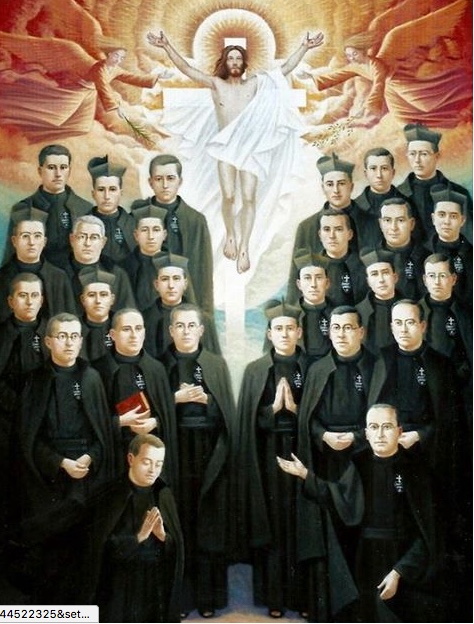
The Martyrs of Daimiel


Wars, especially civil wars, can bring unspeakable violence. The Spanish Civil War in the 1930s is a good example. There were atrocities on both sides. Innocent people were among its victims, and suffered for no reason at all.

The Martyrs of Daimiel, Spanish Passionists from my own community, most of them young students for the priesthood preparing for missionary work in Cuba and Mexico, were killed in 1936. It’s a tragic story, but also a story of God’s grace shining through human evil..

Between July 22nd and October 24th, 1936, twenty-six religious from the Passionist house of studies, Christ of the Light, outside the city of Daimiel, about eighty miles south of Madrid, died at the hands of anti-religious militiamen at the outbreak of the Spanish Civil War. They were: Niceforo Diez Tejerina, 43, provincial superior, who previously served as a missionary in Mexico and Cuba after being ordained in Chicago, Illinois.; Ildefonso García Nozal, 38; Pedro Largo Redondo, 29; Justiniano Cuestra Redondo, 26; Eufrasio de Celis Santos, 21; Maurilio Macho Rodríguez, 21; Jose EstalayoGarcia, 21; Julio Mediavilla Concejero, 21; Fulgencio Calv Sánchez, 19; Honorino Carraced Ramos, 19; Laurino Proáno Cuestra, 20; Epifanio Sierra Conde, 20; Abilio Ramos Ramos, 19; Anacario Benito Nozal, 30; Felipe Ruiz Fraile, 21; Jose Osés Sainz, 21; Felix Ugalde Irurzun, 21; Jose Maria Ruiz Martinez, 20; Zacarias Fernández Crespo, 19; Pablo Maria Lopez Portillo, 54; Benito Solano Ruiz, 38; Tomas Cuartero Gascón, 21; Jose Maria Cuartero Gascón, 18; German Perez Jiménez, 38; Juan Pedro Bengoa Aranguren, 46; Felipe Valcobado Granado, 62.

Most of those killed were young religious studying for ordination and destined for missionary work in Mexico and Cuba. Others were priests who taught them and brothers who served in the community. Father Niceforo, the provincial, was visiting the community at the time. Militiamen entered the Passionist house on the night of July 21st and ordered the thirty-one religious to leave in one hour. Father Niceforo gathered them in the chapel, gave them absolution, opened the tabernacle and said: “We face our Gethsemane. . . all of us are weak and frightened,but Jesus is with us; he is the strength of the weak. In Gethsemane an angel comforted Jesus; now he himself comforts and strengthens us. . .Very soon we will be with him. . .To die for him is really to live. . . Have courage and help me by your example.”
He then distributed the sacramental hosts to them.

The militiamen ordered the group to the cemetery and told them to flee. At the same time, they alerted companions in the surrounding areas to shoot the religious on sight. The Passionists split into five groups. The first group of nine was captured and shot outside the train station of Carabanchel in Madrid on July 22, 1936 at 11pm. The second group of twelve, Father Niceforo among them, was taken at the station at Manzanares and shot by a firing squad. Father Niceforo and four others died immediately. Seven were taken to a hospital where one later died. Six of them recovered, only to be shot to death later on October 23, 1936.

Three other religious, traveling together, were executed at the train station of Urda (Toledo) on July 25th. Two gave their lives at Carrion de Calatrave on September 25th. Only five of the thirty-one religious were spared.

Numerous eye-witnesses testified afterwards to the brave faith and courage shown by the Daimiel Community in their final moments, especially the signs of forgiveness they gave their executioners. They were beatified by Pope John Paul II on October 1, 1989, who said of them: “None of the religious of the community of Daimiel was involved in political matters. Nonetheless, within the climate of the historical period in which they lived, they were arrested because of the tempest of religious persecution, generously shedding their blood, faithful to their religious way of life, and emulating, in the twentieth century, the heroism of the Church’s first martyrs.” (Homily: October 1, 1989) Today their bodies are interred in the Passionist house at Daimiel.

Their feastday is July 24th. They’re remembered still at their shrine in Daimiel, Spain.

13th Sunday A

For today’s homily, please play the video below: