The Easter season ends with the Feast of Pentecost and we’re into ordinary time in the church year. Unlike other feasts, Pentecost has no octave; ordinary time is its octave. Most of the church year is ordinary time; most of life is ordinary too, but the Spirit is there just the same.
“Their message goes out to all the earth.” We read the Acts of the Apostles during the Easter season as Jesus’ apostles, led by Peter and Paul, ventured on their way from Jerusalem to Asia Minor and to Rome, empowered by strong winds and tongues of fire, Yes, the Spirit can bring us to the ends of the earth, but the Spirit is also there in the few steps we take every day, though we’re hardly aware.
We tend to minimize ordinary life. Just ordinary, nothing’s happening, we say. Yet, day by day in ordinary time the Risen Lord offers his peace and shows us his wounds. Every day he breathes the Spirit on us. No day goes by without the Spirit’s quiet blessing.
The Archdiocese of New York has a renewal program called Revive taking place in its parishes this year. The program comprises a reading from scripture, a sermon on the purpose of life, a witness talk, prayers and hymns.
This week, Monday, Tuesday and Wednesday evenings at 7:00 PM, I’m taking part in the Revive program at Immaculate Conception Parish, Irvington on the Hudson, NY. Besides Immaculate Conception, Sacred Heart, Our Lady of Pompeii, St. Matthew, and Our Lady of Perpetual Help Parishes are taking part in Revive. I’m giving the sermon and will be offering some of the prayers.
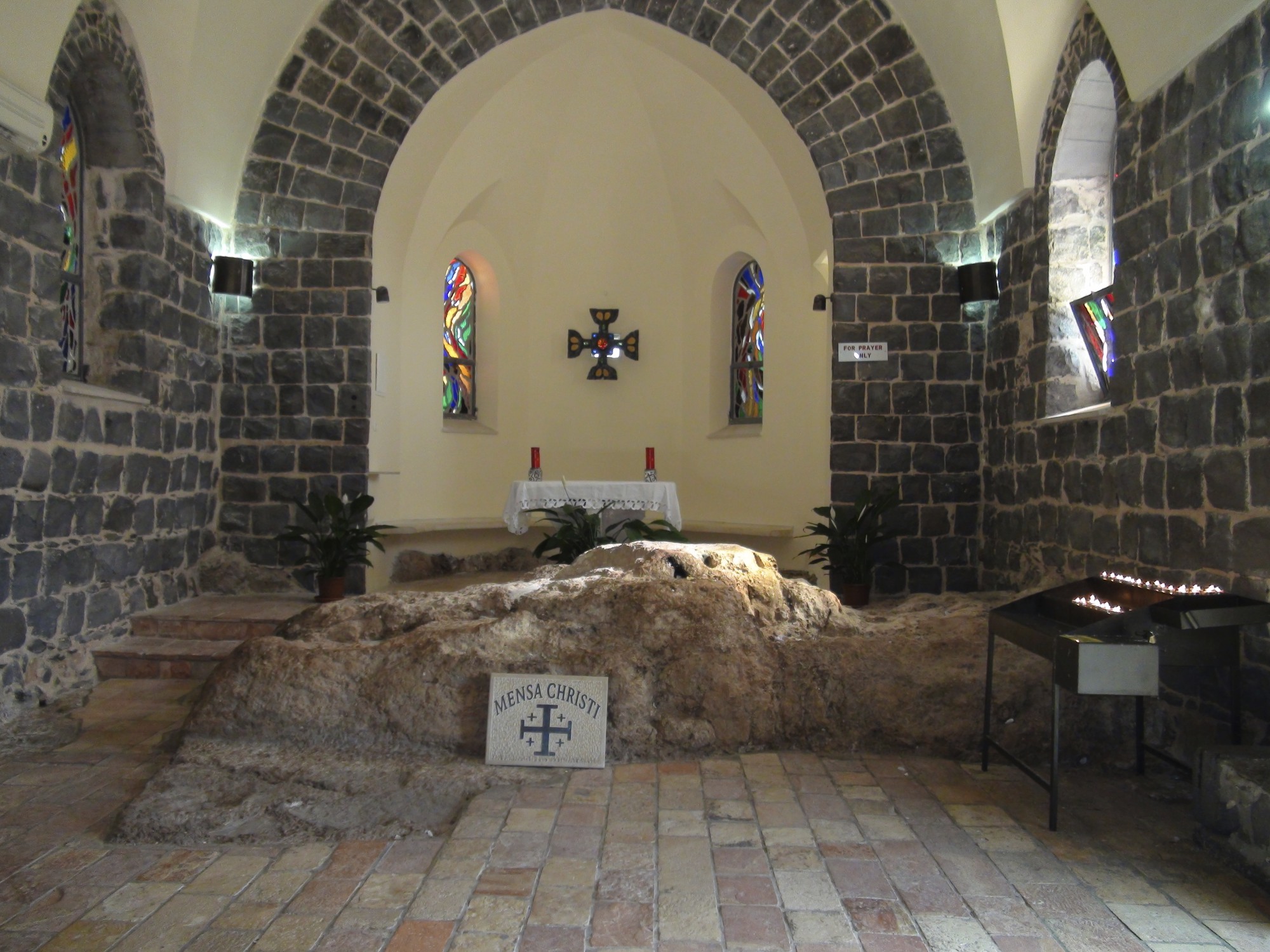
I think I know where this gospel took place– Tabgha, a quiet, wooded area on the Lake of Galilee just south of the ancient town of Capernaum. Easy walking distance from the town that was the center of Jesus’ ministry.
The name Tabgha comes from the seven springs of water flowing into the lake there. When I visited some years ago, flocks of birds were singing in the trees and drinking from the streams of water.
For centuries fishermen must have pulled for fresh water from the springs, and perhaps fry some fish over a fire on the beach. It’s a likely place where Jesus would come to pray. Tradition– two centuries-old churches are on the site–says he met his disciples here after his resurrection.
John’s gospel says that Peter and other disciples of Jesus came to Galilee after the Lord’s death and resurrection and went fishing. Through the night they caught nothing, but at dawn they heard a call from the shore to cast their nets out again.
“… Jesus was standing on the shore; but the disciples did not realize that it was Jesus.”
They caught of large catch of 153 fish. Jesus then called from the shore to come eat some fish at a fire he had started and he gave them bread and some fish to eat and revealed himself to them.
Peter has a leading role in this story. He jumped into the water to get to the shore. Then after they have eaten, Jesus takes him aside and three times asks the disciple who denied him three times, “Do you love me?” A beautiful statue (above) marks that moment.
Three times the apostle who cursed and swore in the courtyard of the High Priest that he did not even know Jesus answers “Yes, I do. I love you.” And Jesus tells him “Feed my lambs. Feed my sheep.”
A great example of forgiveness . No scolding words or recriminations. No “I told you so.” No warning, “You do that again and …” No demotion, no putting on parole. Rather, Jesus gives Peter new responsibility. “Feed my lambs” as I do. A beautiful picture of God’s mercy.
Instead of punishing him, God calls Peter to new things. The mercy of God always calls us to something new, some new life.
Tabgha, along the Lake of Galilee where Jesus met his disciples, is a wonderful place to visit. I wonder if Jesus prayed here during his days in Capernaum and called his disciples to rest awhile. Here he communed with God his Father; here he prayed and forgave. His memory lingers at this lovely place besides the Sea of Galilee.
Prayer and forgiveness go together Jesus taught. “Forgive us our trespasses as we forgive those who trespass against us.” Today’s gospel tells us to pray and forgive. Maybe someone has hurt us, maybe there’s some situation we’re facing now. A job we don’t like, a home situation we’re angry about, something in society that upsets us.
In today’s Gospel we read about Jesus’ return to “His native place,” and the reception He got from His peers when He began to teach them. They found it hard to take Him seriously, asking,
“Is he not the carpenter, the son of Mary, and the brother of James and Joseph and Judas and Simon? And are not his sisters here with us?” And they took offense at him. Jesus said to them, “A prophet is not without honor except in his native place and among his own kin and in his own house.”
Why such a reaction? Why were they not proud of their hometown boy? We’re they jealous of Him? Did they believe that a humble carpenter’s son had no right to teach about the divine? Were they startled because He no longer acted like a “regular guy”, one of them?
When I started testifying about my newfound faith at men’s retreats and at prayer groups, some people would come up to me and thank me for helping them in their search for healing, and for God, while others treated me like I was just some upstart who didn’t know anything! Well, I guess one of the lessons of this Gospel is that you just can’t please everybody, especially if they’re your friends and relatives .
After my conversion, many of them could not believe that I was for real. One of my drinking buddies winked at me and said, ” You gotta be kidding! Common, have fun. You only live once.” Another said, “Hey, don’t turn into a religious fanatic! That’s not the guy I know! What about that temper?”
A nice cousin of mine said, “You’re dedicating your life to God now that you’re retired? That’s a nice hobby. I guess you gotta do something with your free time.”
A very intelligent, cynical, clever friend would use her language skills to prove me wrong, and justify her way of thinking and acting towards others. I was no match for her smart talk. But another fiercely atheist friend synthesized the feelings of all the others:” Don’t come preaching to me! I don’t want to hear anything about God! If you’re my friend, let’s talk about anything but that!”
Like Jesus, I was ” amazed at their lack of faith!” I certainly wasn’t able to perform any “mighty deeds” there, except perhaps keep my composure, shake my head, and smile. I really love these persons. I guess the best I can do is show them this, knowing how much greater than mine is the love that our Lord Jesus has for them.
If they ask me I will tell them about the peace I feel in my heart. Maybe I’ll be able to show them how I have changed, even if a little, perhaps reflect the words of the scholar of mythology, Joseph Campbell: ” Preachers err by trying to talk people into belief, better they reveal the radiance of their own discoveries.”
My spiritual director, Fr John Powers C.P., once wrote, ” I begin the telling of my tale with the assumption that my story is, in some measure, everyone’s story.”
For most people, Christmas is over– the music’s stopped; Santa Claus is gone from the malls. The decorations are down and put away. It’s over.
But in church Christmas isn’t over. We’re still singing carols and continue to celebrate as we think about what it means when we say “our God was made visible.”
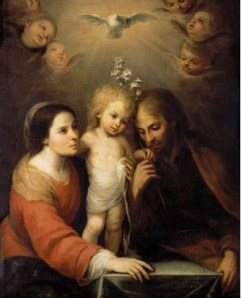
Today’s the feast of the Holy Family. The Word was made flesh, and as the child of Mary and Joseph Jesus was part of a family in the small town of Nazareth in hills of Galilee.
For one thing, families then were extended families or clans, living close together and working side by side. Archeological excavations in Nazareth and Capernaum (pictures below) make that clear. Families worked together in the fields or in business, they ate together and moved together, as they still do in parts of the Middle East and elsewhere today.
It’s safe to say that nuclear families didn’t exist then. A nuclear family– mother, father and children– is a modern form of family life. Mary, Joseph and the Child Jesus were not all by themselves in a small house in Nazareth. Rather, Jesus was raised in an extended family where grandfathers and grandmothers, uncles, aunts and cousins lived together and were involved in bringing him up.
That doesn’t take away the part Mary and Joseph played in his upbringing, of course. They weren’t props, standing by while angels brought him up. Some of the apocryphal gospels – early stories about Jesus which the church rejected – seem to say that. One story describes the Child Jesus forming the figure of a bird from clay, then breathing on it, and instantly it becomes a living bird and flies away. Stories like that presented him exercising miraculous powers as a child.
The church rejected those stories because they gave a false picture of Jesus growing up. He “was subject” to Mary and Joseph, the gospel of Luke says. He grew up in their care as an ordinary child would.
Like mothers and fathers everywhere, they saw to his needs, they held him in their arms, fed him, clothed him, stayed up at night when he was sick. They taught him his first words, guided his first steps, nudged him along this way and that.
They brought him to church–the synagogue, the temple–as we see in today’s gospel from Luke. They instructed him in his tradition. They taught him to pray, interpreted events for him, listened to his questions, encouraged him over and over. They had their misunderstandings, as today’s gospel indicates. In fact, they influenced his life.
Yes, angels were there, but at a distance. Mary and Joseph and that larger family and village around him raised the Child.
Today’s feast of the Holy Family takes in the years of Jesus’ childhood and early adult life called his “Hidden Life.” His years in that nondescript town among those ordinary people were truly hidden, yet were they less important than his Public Life, the few years he taught and did great miracles, suffered and died and rose from the dead? In those hidden years “he humbled himself.” A hidden life is important; it’s what mostly characterizes life in a family.
We need to think about family life today, because it’s in trouble. For one thing, the nuclear family– father, mother, children– is in trouble. I read some disturbing statistics recently. In every state in our country, families where children have two parents have declined significantly in the last 10 years. One of three children live in a home without a father. Almost 5 million children live in a home without a mother. A single mother may have an income of $24,000. Two parents are likely to have an income significantly greater.
What can we do? How can we help? Feasts like the Holy Family focus our attention on important things. They remind us what’s important in God’s eyes. The feast of the Holy Family focuses on the family. It’s important, it says. At the same time, it tells us God’s grace will be ours when we work to make families go and when we support them all we can. God points to family life today. It’s vitally important in our world.


 The Victor's Place