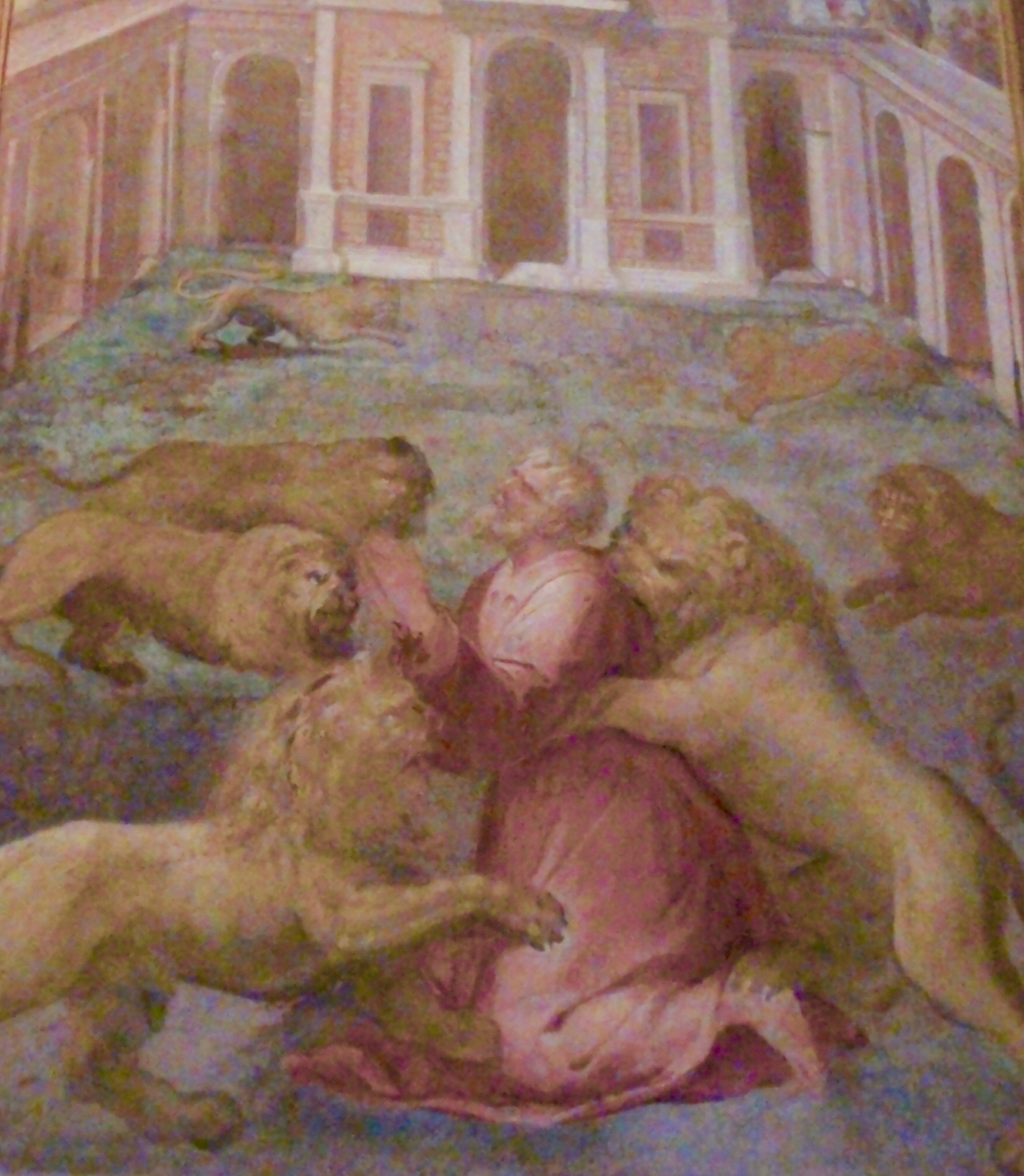
Ignatius, bishop of the large early Christian center of Antioch, was put to death in the third century in the Colosseum in Rome during the reign of Trajan. His death by wild animals is vividly portrayed in the picture (above) in the church of San Stefano Rotondo in Rome. We celebrate his feast October 17th..
On the way to Rome, Ignatius wrote seven letters to important Christian churches. The letters show him as a skillful teacher and writer; he must have been an eloquent preacher.
In his letter to the Christians at Ephesus, however, you sense his days for words are coming to an end. He’s entering the silence of death where words are not important, Ignatius writes– faith and “ being faithful to the end,” are what count:
“It is better to remain silent and to be than to talk and not be. Teaching is good if the teacher also acts. One teacher ‘spoke, and it was done,’ yet what he did in silence was worthy of the Father. He who has the word of Jesus can also listen to his silence…”
What does Ignatius mean? The Word of God silent? True, in his early years at Nazareth, Jesus is silent. Before his baptism in the Jordan by John he’s silent, until the voice of the Father says, “This is my beloved Son, listen to him.”
Then his public ministry began, yet many didn’t hear him at all. Finally, when he’s arrested and taken to the cross to die, the evangelists say Jesus was silent.
Silence is part of facing the mystery of God. Here and now, some things can’t be known or explained. Like terrorism, natural disasters, the suffering of children. Why? God is silent. Again, Ignatius:
“He who has the word of Jesus can truly listen also to his silence.”
Martyrs like Ignatius made early Christians aware of what it meant to follow Jesus. It meant following Jesus into the silence of his death and his promise of resurrection. Some, however, were not so brave. As religious persecutions increased, many Christians abandoned their faith rather than face death. All they could see was this world.
The martyr became a significant figure in Christianity, a faithful follower of Jesus, an example for Christians to see further than this life. That’s why martyrs are so frequent in our calendar.
The martyr was also a powerful advocate for the mercy of God, who could turn our fear of death into hope. In the pictures of above, powerful lions tear into the saint, but his face is not turned to them, but to the One who promises life “I believe in the resurrection of the body and life everlasting. Amen.”


 The Victor's Place